
God Is Not Great: How Religion Poisons Everything
Christopher Hitchens
 English
 ไทย
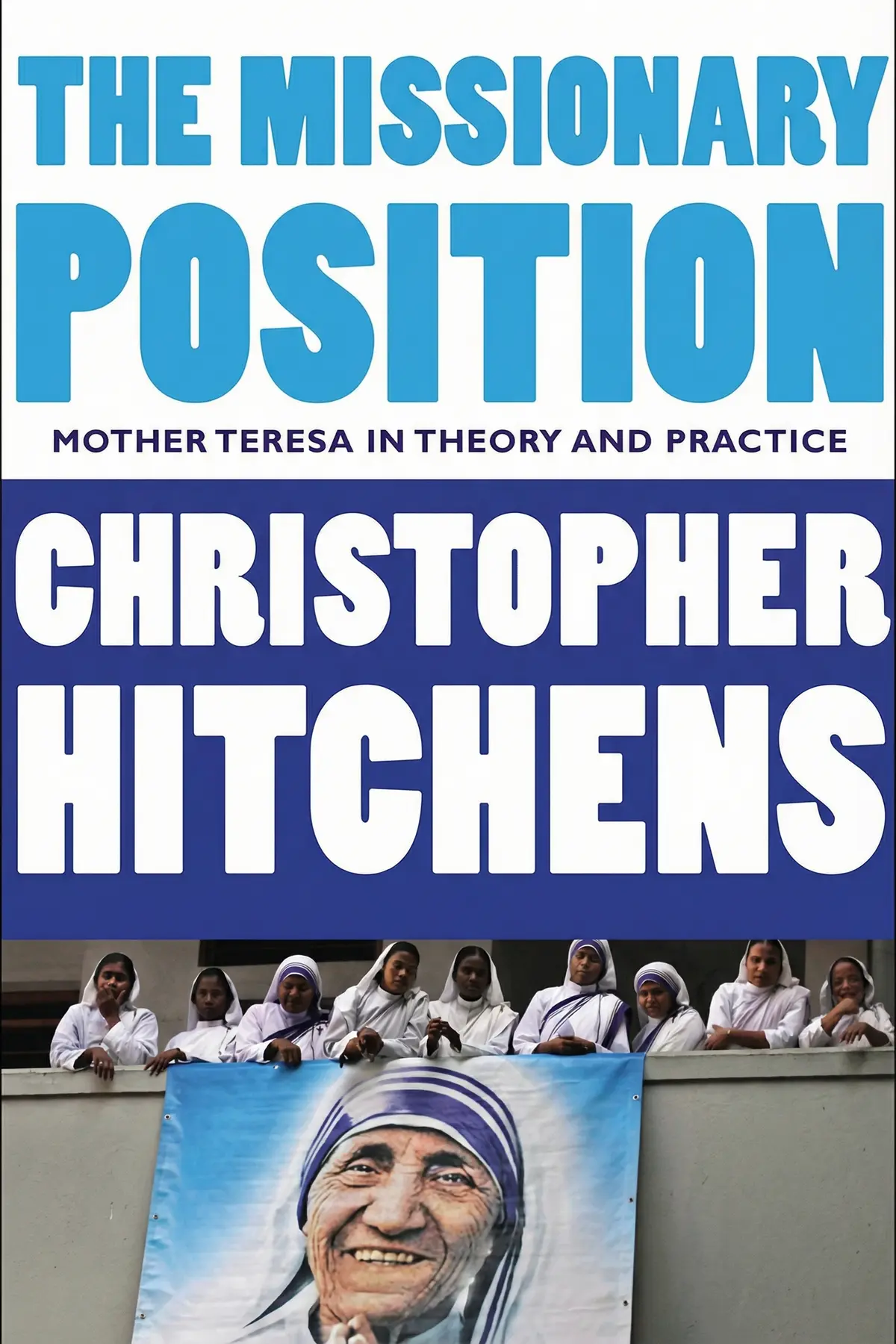
Christopher Hitchens takes apart the legend of Mother Teresa. He traces her fame to a misleading documentary and argues that her homes neglected the sick while her influence lent comfort to dictators and conservative causes.
1 min 06 sec
If you have always treated Mother Teresa’s goodness as settled fact, consider the miracle that made her famous: a glowing light on film that, according to the cameraman, came from a new Kodak stock. In The Missionary Position, the journalist Christopher Hitchens re-examines the woman born Agnes Bojaxhiu and the reputation that eventually made her a saint. His case is blunt. Her fame grew from a misleading picture, her homes for the dying gave poor care while donations piled up, and her moral standing repeatedly lent cover to dictators and conservative campaigns.
The image remains strong: in 2016, nearly two decades after her death, she was declared a saint before 1,500 homeless people gathered from across Italy. Hitchens holds that the holier a reputation, the more closely it should be checked. Following his case builds a habit worth keeping, separating a public image from the record behind it and asking what any charity truly does with its money and its influence.
2 min 20 sec
A television crew filmed a dark room in Calcutta and caught a glow no one could explain. The story that followed made a nun world famous, and the real explanation arrived far too late to matter.
2 min 06 sec
A respected medical editor walked into one of the most celebrated care homes in the world and did not like what he saw. Then there was the question of where the donations went.
2 min 09 sec
In San Francisco, a beautiful house was stripped bare on purpose. In New York, a planned center in the Bronx died before it opened. A nun who served for nearly ten years explains why.
1 min 59 sec
A tyrant who had tortured thousands wanted one thing from a famous visitor, and he got it. Back in her homeland, a regime that outlawed her own faith received a gesture no one expected.
2 min 06 sec
She said she had nothing to do with politics. Then she turned up in Madrid, in London on the eve of a key vote, and in America praising a policy activists found horrifying.
1 min 10 sec
The Missionary Position is, finally, a book about the distance between a legend and a ledger. Hitchens does not deny that Mother Teresa worked among the poor. He asks what that work did for them, and his answer is unsparing: crowded rooms and reused needles while a reported $50 million sat in one account, a Bronx shelter lost over an elevator, and a famous smile lent to Duvalier in Haiti and to Hoxha’s memory in Albania. In his telling, the woman the world met on a BBC screen was more devoted to suffering, and to her own image, than to ending it.
His method carries into ordinary life. When a reputation feels too good to question, trace it back to its first story and ask who told it. When you give to a cause, look for what the money buys at the bedside. When a respected figure claims to stand above politics, notice where they travel and whom they stand beside.
The miracle glow in that dark Calcutta room came from a roll of film. Hitchens’s lasting lesson is to check the film before believing the light.
Few names stand for selflessness as completely as Mother Teresa's. In 2016, nearly two decades after her death, she was declared a saint. Christopher Hitchens argues that this near-universal reverence is exactly why her record deserves a hard look: where did the reputation come from, how true was it, and whom did it help or harm? His answers are unsparing. He traces her rise to a 1969 BBC documentary that painted Calcutta as a hell on earth and presented a glow on film as a miracle. He gathers testimony from a Lancet editor, a former volunteer and a nun who served her for nearly ten years, describing crowded rooms, reused needles and harsh rules, while a reported $50 million sat in one account. He then follows her travels to Haiti, Albania, Spain, Britain and the United States, where he finds her lending credibility to dictators and conservative campaigns. Readers get a short, sharp case study in how public images are made, and a lasting habit of asking what any celebrated cause actually does with its money and its moral authority.
Readers who admire Mother Teresa and want to hear the strongest case against her.
Donors and volunteers who want to judge charities by results rather than reputation.
Students of media, religion and politics curious about how a public saint is made.
Christopher Hitchens was born in Portsmouth, England, and studied philosophy, politics and economics at Oxford, graduating in 1970. In the early 1980s he moved to the United States, writing for Vanity Fair and The Nation and contributing to The Atlantic and Slate. He wrote 18 books, including the bestseller God Is Not Great, a case against organized religion, and The Trial of Henry Kissinger. He was diagnosed with esophageal cancer in 2010 and died in December 2011, aged 62.
Christopher Hitchens
Christopher Hitchens

Christopher Hitchens

Listeners find the work thoroughly researched and full of direct facts, with one review characterizing it as a "great scalpel of reason." Furthermore, the prose is highly regarded; one listener observes that it is written almost as a post-mortem, while others enjoy its scathingly funny tone. The pacing is also seen as impactful, with one review emphasizing Hitchens’ skill at skewering ideas. On the other hand, its credibility garners a variety of responses, as some applaud how it reveals the truth behind the myth while others find it unconvincing. The concise nature and skeptical viewpoint also lead to varied feedback; some value the brevity while others feel it is too short, and some label it as cynical.
Hitchens’ prose functions as a surgical instrument, meticulously dissecting the layers of myth surrounding a global icon. In this brief yet potent volume, he moves past the saintly veneer to reveal a woman whose primary concern was not the alleviation of suffering, but the promotion of a specific, dogmatic worldview. It is particularly jarring to read about the millions sitting in bank accounts while patients were denied basic medical care or proper analgesics beyond aspirin. Hitchens skewers the idea that poverty is somehow a beautiful gift from God, especially when Mother Teresa herself sought out the finest Western clinics for her own ailments. The account of her interactions with figures like Charles Keating and the Duvaliers in Haiti is deeply disturbing and well-documented. While the book is scathingly funny in parts, it remains a serious piece of investigative reporting. I found the pacing effective, even if the brevity leaves you wanting more data. Truly, this is a necessary 'scalpel of reason' for anyone who values truth over comfortable hagiography.
Show moreFinally, someone had the courage to look past the Nobel Prize and examine the actual outcomes of this mission. The chapter on her involvement with the Savings and Loan fraudster Charles Keating was a real eye-opener for me. Mother Teresa’s refusal to return stolen money to the victims, even when asked by the prosecutor, speaks volumes about her priorities. Hitchens uses a 'scalpel of reason' to show that she was an operative for a very political papacy rather than just a simple nun. The story of her telling a terminal cancer patient that Jesus was 'kissing' them through their pain—only for the patient to ask her to make him stop—is haunting. This is not a comfortable book, but it is an essential one. Hitchens' style is scathingly funny and his arguments are presented with a straightforward clarity that is hard to refute. A brilliant, necessary takedown of a manufactured myth.
Show moreThe Missionary Position is a devastating post-mortem of a manufactured icon. Hitchens is at his best here, using straightforward facts to dismantle the 'Saint of Calcutta' piece by piece. The evidence regarding her political alliances with right-wing dictators and her acceptance of stolen money from Charles Keating is simply undeniable. It’s a brave book because it attacks one of the few figures that everyone was 'supposed' to love. I found the pacing to be perfect; he doesn't waste a single word. The descriptions of the 'Home for the Dying'—where needles were reused and cancer was treated with nothing but aspirin—are enough to make anyone rethink her legacy. Hitchens shows that she wasn't a friend to the poor, but a friend to poverty itself. This is an essential read for anyone who prefers the harsh light of truth over the warm glow of a lie.
Show moreChristopher Hitchens doesn't just argue; he eviscerates. This book is a masterclass in how to dismantle a public myth using the subject's own words and actions. I was particularly struck by the contrast between the spartan, often miserable conditions of her clinics and the high-tech medical care she received herself. The fact that her order had tens of millions of dollars in the bank while patients were suffering on cots is a point that Hitchens hammers home with ruthless efficiency. His writing style is punchy and direct, making this a very quick but incredibly dense read. He manages to skewer the idea that she was a selfless servant of the poor, revealing instead a missionary focused on a very narrow, dogmatic agenda. It’s a brilliant, straightforward, and deeply necessary piece of reporting. If you think you know Mother Teresa, read this and think again.
Show moreAfter years of hearing nothing but praise for the 'Saint of the Gutters,' reading this was a massive reality check. The author presents a compelling case that Mother Teresa was more interested in the spiritual utility of pain than in actually curing anyone. I was horrified by the descriptions of unhygienic conditions and the practice of 'baptizing' the dying without their informed consent. Hitchens writes with a sharp, post-mortem style that is both informative and deeply cynical. To be fair, he doesn't hide his anti-religious bias, which might turn some readers off, but the facts regarding her finances are hard to ignore. Why was there $50 million in a Bronx bank account while children were being treated in such squalor? It’s a short read that packs a punch, though it feels a bit like a long-form essay rather than a comprehensive biography. It definitely makes you question how the media constructs these untouchable figures.
Show moreEver wonder why the world’s most famous charity seemed to lack basic medical supplies like sterile needles? This book answers that question by examining the actual theology behind the Missionaries of Charity. Hitchens argues that for Mother Teresa, suffering wasn't something to be fixed, but a way to get closer to God. This perspective explains why millions of dollars in donations didn't result in better hospitals. I found the section on her political support for the Duvalier regime in Haiti to be particularly damning. Hitchens’ writing is as sharp as ever, though he definitely has an axe to grind against the Catholic Church in general. Gotta say, the brevity of the book is both a strength and a weakness; it stays focused and fast-paced, but I would have liked to see even more forensic detail on the money trail. Regardless, it’s a powerful critique of how we canonize people based on reputation rather than results.
Show morePicked this up after seeing a documentary on Hitchens, and I wasn't disappointed by his signature brand of intellectual savagery. The book is short, but it hits like a freight train. He basically performs a post-mortem on Mother Teresa’s reputation, exposing the gap between her public image and her private actions. I was particularly struck by the hypocrisy of her preaching against birth control in overpopulated areas while ignoring the actual needs of the people living there. The prose is brilliant, though occasionally it feels like Hitchens is more interested in the 'scathingly funny' takedown than in providing a fully rounded portrait. Truth is, it’s a pamphlet-sized bomb aimed at the heart of a global consensus. It won't convince everyone, especially those with deep faith, but for a rationalist, it’s incredibly satisfying. A solid 4 stars for the sheer force of the argument and the quality of the investigative reporting.
Show moreLook, I’ve always been a bit skeptical of celebrity saints, so this book was right up my alley. Hitchens focuses on the 'business' of Mother Teresa, looking at where the money went and what it actually bought. The answer—not much in the way of healthcare—is pretty shocking. He writes with a 'scalpel of reason' that is both impressive and a bit terrifying in its precision. I appreciated the brevity of the work, though some might find it a bit too short for such a heavy topic. The way he links her to various political figures like the Duvaliers adds a much-needed layer of context to her 'apolitical' stance. It’s a bit of a grim read, especially the parts about the 'baptisms' of unsuspecting Hindus and Muslims on their deathbeds. Hitchens is scathingly funny at times, which helps cut through the heaviness of the subject matter. Very insightful.
Show moreIs it possible to be too cynical even when you're probably right? This book is a classic example of Hitchens’ ability to skewer ideas with wit and venom. He makes some excellent points about the lack of medical standards in the homes for the dying and the questionable associations with dictators. However, the tone is so relentlessly aggressive that it occasionally undermines the weight of the evidence. I wanted more cold, hard data on the finances and perhaps a bit more nuance regarding the cultural context of Calcutta at the time. It’s incredibly short—I finished it in about two hours—and it feels more like a polemic than a balanced investigation. Frankly, if you already dislike organized religion, this will be your bible. If you’re looking for a deep, objective dive, you might find the 'angry expose' vibe a bit exhausting. It’s a great piece of writing, but it feels incomplete in its brevity.
Show moreWhile I appreciate a good contrarian viewpoint, this felt less like an investigation and more like a mean-spirited hit job. I don't doubt that there were issues with medical care and finances, but Hitchens' tone is so mocking that it becomes distracting. He treats every action as a calculated piece of villainy, leaving no room for the possibility that she was simply a woman of her time and faith. The book is very short, which makes it feel like he’s just cherry-picking the worst moments to skewer her ideas. Not gonna lie, I expected something a bit more balanced and a lot more substantial. It feels more like a long, angry editorial than a well-researched book. If you already hate Mother Teresa, you'll love this, but if you're looking for an objective analysis of her life’s work, you should probably look elsewhere. Just too cynical for my taste.
Show moreIt is Hitchens’s critical biography of Mother Teresa, arguing that her saintly reputation does not match her record. He traces her fame to a 1969 BBC documentary, describes poor medical care in her homes despite large donations, and details her public support for dictators in Haiti and Albania and for conservative causes in Spain, Britain and the United States.
The 1969 film showed an unexplained glow in a dark room at her House for the Dying in Calcutta. Narrator Malcolm Muggeridge believed it was divine light and her first recorded miracle, and the press spread the story widely. Years later the cameraman, Ken Macmillian, said the light came from new Kodak film, but by then her fame was secure.
He cites Dr. Robin Fox of The Lancet, who in 1994 found only basic drugs like paracetamol, nuns making diagnoses and few transfers to hospitals. Former volunteer Mary Loudon described dozens of people crowded into one room and needles reused without proper sterilization. Hitchens sets this against reports that up to $50 million sat in a single account of her organization.
Hitchens models a habit of scrutiny. Trace a famous reputation back to the first story that created it, ask what a charity’s money actually buys for the people it serves, and watch whom a supposedly neutral figure stands beside and when. His account of the Bronx shelter, abandoned over a refused elevator, shows how ideals can override real needs.

Marianne Williamson

Deepak Chopra

Pico Iyer

Alcoholics Anonymous World Services


Daniel Goleman


Eckhart Tolle

Beth Moore
Paramahansa Yogananda
AUDIO SUMMARY AVAILABLE
Get the key ideas from The Missionary Position by Christopher Hitchens, plus 5,000+ more nonfiction titles.









