
13 min 42 sec
Available in: English
The Intelligence Trap: Why Smart People Make Dumb Mistakes
By David Robson
Shows why high intelligence and expertise can make people more prone to certain errors, and how cognitive reflection, intellectual humility and emotional awareness help anyone decide, learn and work in teams more wisely.
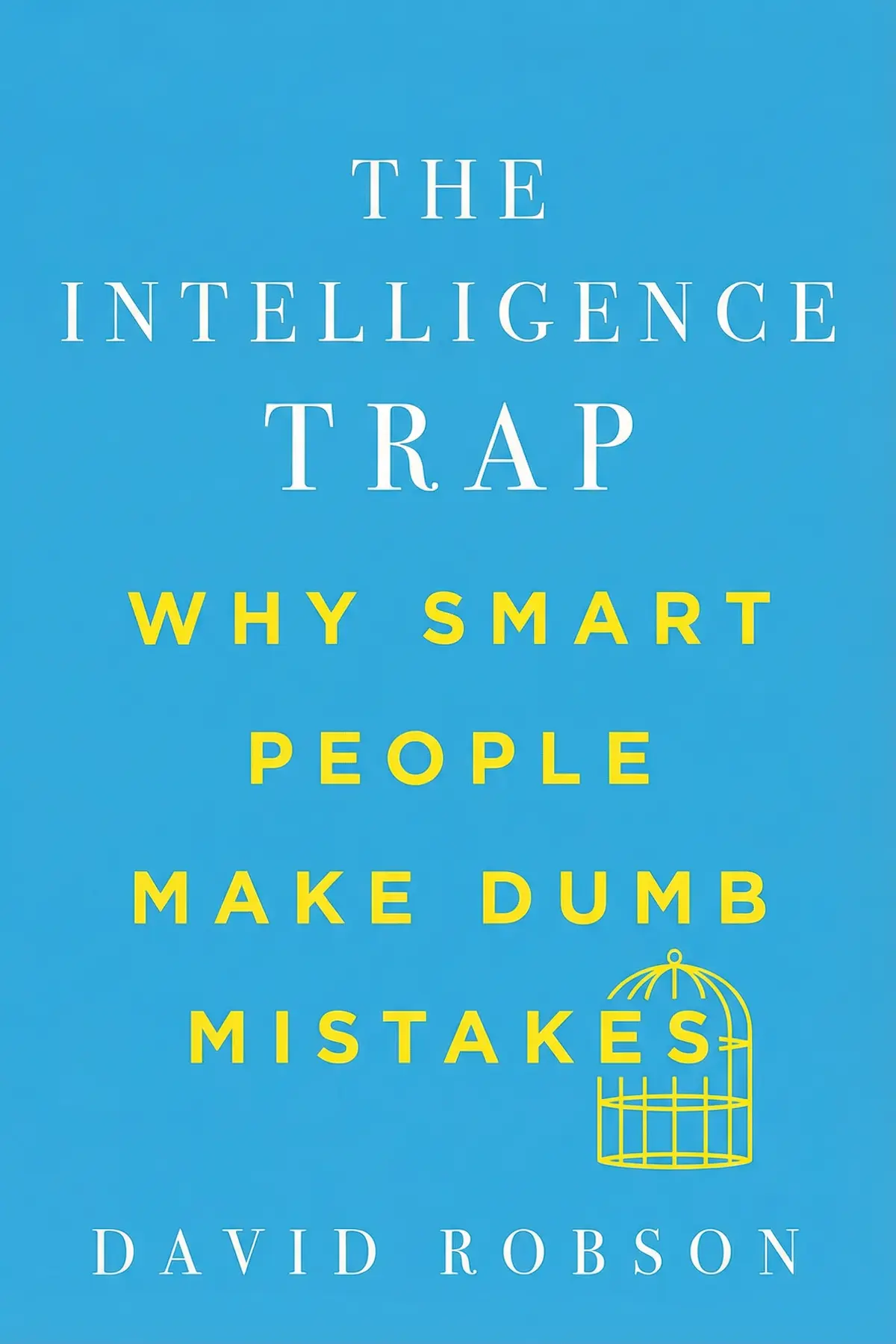
Table of Content
1. Introduction
1 min 12 sec
Being the cleverest person in the room feels like protection against bad decisions. In The Intelligence Trap, science journalist David Robson argues that a high IQ, a good education and deep expertise can actually make certain mistakes more likely. His opening case is Kary Mullis, a winner of the Nobel Prize in Chemistry who also believed in astrology and astral travel, and who denied that HIV causes AIDS.
Robson’s explanation is that smart people often find it harder to learn from errors or accept advice, and easier to build clever defenses for views they already hold. Yet the same argument carries good news. Wisdom, he says, rests on a separate set of skills, cognitive reflection, intellectual humility and emotional awareness, and anyone can train them, whatever their IQ.
The evidence runs from Arthur Conan Doyle at a séance to a Japanese classroom that looks cruel and works, and to teams whose success is only modestly linked to how clever their members are. The payoff is a way to catch your own mind arguing for you before it costs you a decision.
2. Learn how to stop brainpower misleading your judgment
1 min 38 sec
Students with top test scores, gifted children with off-the-chart IQs and highly trained doctors all appear in the evidence. What they share is a weakness that their talent hides from them, and it can be costly.
3. Spot the blind spot that fools clever minds
1 min 57 sec
The man who invented the most logical detective in fiction sat at a séance table, convinced. His skeptical friend saw the cracks at once. The gap between them reveals a bias that grows with confidence.
4. Expect your intelligence to argue for your side
1 min 57 sec
On the issues people care about most, extra brainpower should help them find the truth. Robson argues it often does the opposite, and the examples include scientists, a famous founder and an entire political debate.
5. Weigh big decisions the way Franklin did
1 min 52 sec
One old technique settles hard choices with a sheet of paper and some simple arithmetic. Paired with a few sharp questions, the same habit helps you resist claims designed to feel true.
6. Learn more by staying confused a little longer
1 min 58 sec
An American researcher watched a Japanese teacher send the worst artist in the class to the blackboard and thought it was cruel. The science of learning suggests the teacher understood something Western classrooms often miss.
7. Build a team on social sensitivity, not just IQ
1 min 57 sec
Rooms full of brilliant experts have produced some spectacular failures. One researcher measured what actually predicts a team’s success, and the members’ average IQ turned out to be only a modest predictor.
8. Conclusion
1 min 11 sec
Robson’s book ends up as a case for steering. Intelligence is the engine, and it will carry a person wherever it is pointed: toward vitamins as a cancer cure, toward fairies in a faked photograph, toward an oil spill that careful thinking could have prevented. Wisdom is the set of controls that chooses the direction, and unlike IQ it can be practiced: reflecting before you trust a first answer, admitting what you do not know, and paying attention to the people around you.
The habits the book supports are modest. For your next major decision, write out the reasons on each side, give each one a weight and strike out the pairs that cancel, as Franklin did. When a claim lands in your feed or your inbox, ask who gains if you believe it before you pass it on. When learning something new feels hard, read that as a sign it is working, and resist the comfort of feeling finished. And in any group you lead, make sure the quietest person speaks before the most senior one decides.
Doyle could invent a detective who noticed everything. It was Houdini, the skeptic who still agreed to sit at the table, who noticed that the spirit wrote in a language his mother never knew.
About this book
What is this book about?
A Nobel Prize winner who believed in astrology. The creator of Sherlock Holmes, convinced that fairies were real. Science journalist David Robson starts from a puzzle: why do brilliant, well-educated people so often make choices that others can see are foolish? His answer is the intelligence trap. Brainpower, education and expertise can magnify errors, because clever people use their reasoning to defend views they already hold, take advice less readily and fail to see their own biases. Robson draws on studies of high SAT scorers, gifted children and doctors' diagnostic mistakes, and on group failures from NASA to the Deepwater Horizon oil spill. The book then turns to a remedy Robson calls evidence-based wisdom. Its three parts can be trained whatever your IQ: cognitive reflection, intellectual humility and emotional awareness. Readers get concrete tools, among them Benjamin Franklin's moral algebra for big decisions, a set of questions for testing claims, the learning value of struggle, and what makes some teams far wiser than their members.
Book Information
Who it's for
Confident experts and achievers
Experts and high achievers who trust their own judgment and want to catch the errors it hides.
Managers of talented teams
Managers and team leads whose talented groups still make avoidable mistakes.
Wanting lasting study habits
Teachers, students and lifelong learners who want study habits that actually stick.
About the Author
David Robson
David Robson is a science writer who has worked as a features editor at New Scientist and as a senior journalist at the BBC. His articles have run in the Guardian, the Times, the Atlantic and the Wall Street Journal. The Intelligence Trap, his book on why smart people make poor decisions, has been published in 15 languages. Another of his books, The Expectation Effect, explores how mindset can shape health, fitness, happiness and longevity, and it won the British Psychological Society Book Award.
Ratings & Reviews
Ratings at a glance

What people think
Listeners find the book enlightening, with one review highlighting its demonstrations of various critical thinking styles. Moreover, the work is praised for being easy to read, with one listener noting its particular relevance for leaders and academics. Listeners also value the depth of information, with one review mentioning the inclusion of a useful glossary of key terms.
Top reviews
Kru
David Robson delivers a masterclass in how our own cognitive machinery can occasionally betray us. This book should be mandatory reading for anyone in a leadership position who thinks their high IQ makes them immune to blunders. I particularly enjoyed the section on 'intellectual humility'—it’s a quality we desperately need more of in today's polarized world. The writing style is incredibly accessible, moving from complex psychological theories to engaging anecdotes without ever feeling dense. Robson even includes a convenient glossary of key terms at the end, which is a lifesaver for referencing concepts like dysrationalia later. Frankly, it changed how I approach my own decision-making process at work. If you want to sharpen your critical thinking and avoid the pitfalls that even Nobel laureates fall into, start here.
Show moreCholada
Finally got around to reading this, and it’s a total game-changer for my professional life. As someone who manages a large team, the chapter on 'dream teams' and how to avoid organizational disasters was worth the price of admission alone. Robson’s breakdown of how NASA’s culture contributed to their tragedies was both haunting and enlightening. He doesn't just point out problems; he provides a 'bullshit detection kit' that is genuinely useful for navigating the misinformation age. The prose is snappy and the sentence lengths vary enough to keep the energy high throughout the entire 300 pages. It is rare to find a book that is this academically grounded while remaining so readable. I’ve already bought three copies to give to my colleagues this Christmas. Definitely a must-read for any lifelong learner.
Show moreOksana
Wow, this really puts things into perspective regarding the fake news epidemic we are seeing today. I have so many well-educated friends who share unverified nonsense on WhatsApp, and I never understood why until I read this. Robson explains that education doesn't erase stupidity; sometimes, it just gives people the tools to be more convincingly wrong. The book is filled with 'aha!' moments that make you look at your own habits differently. I especially loved the section on how curiosity can be a shield against motivated reasoning. It’s written in a way that feels personal yet remains grounded in scientific studies. Not gonna lie, I felt a bit called out by some of the logic puzzles, but that’s exactly why I needed to read it. Highly recommended for everyone.
Show moreWacharapol
After hearing a lot of hype about this, I’m happy to report it actually lives up to it. The central premise—that our intelligence can be a trap—is explored through so many diverse lenses, from the FBI to Steve Jobs' medical choices. It’s a sobering reminder that our brains are experts at self-deception. What sets this apart from other pop-psych books is the focus on 'wisdom' as a distinct, measurable skill that we can actually improve. The prose is clear, the chapters are well-organized, and the takeaways are practical. It really highlights why we need to value intellectual humility over just having a high IQ score. If you're looking for a book that challenges how you think about thinking, this is the one. I’ll be rereading this one for years to come.
Show moreRay
Ever wonder why a brilliant scientist might suddenly start believing in ghosts or weird conspiracy theories? This book tackles that exact paradox with a lot of grace and clear-headed analysis. Robson explains the 'bias blind spot' perfectly, showing how the more intelligent you are, the better you become at justifying your own flawed logic. I loved the variety of stories, especially the parts about the Mount Everest tragedy and the FBI’s missteps. These real-world examples make the abstract concepts of heuristics and biases much easier to digest for a casual reader. My only minor gripe is that the author occasionally repeats himself to drive home a point. Still, the practical advice on how to cultivate curiosity over certainty is invaluable. It’s a solid 4-star read that will definitely make you second-guess your own 'genius' moments.
Show moreJavier
As a professional who spends a lot of time in academia, I find the 'bias blind spot' concept incredibly relevant to my daily interactions. We often assume that because someone has a PhD, they are rational actors, but Robson proves that the opposite can be true. High intelligence often acts like a fuel that allows people to build more elaborate defenses for their prejudices. The book’s exploration of dysrationalia was particularly fascinating to me because it explains that gap between raw brainpower and actual wisdom. I did think the critique of Michael Shermer was a bit unnecessary, but it didn't ruin the overall message. The glossary at the back is a nice touch for those of us who like to keep the terminology straight. It's a thoughtful, well-researched book that encourages a much-needed sense of intellectual humility.
Show moreArnav
The breakdown of organizational failures in the final section of this book is absolutely stellar. Robson looks at how even the most successful companies, like Nokia, can fall into a tailspin because of the very things that made them smart in the first place. I appreciated how he linked individual 'intelligence traps' to broader systemic issues within teams. It makes you realize that being a 'smart' person isn't enough; you need to be a 'wise' one who knows how to listen. The tone is perfectly balanced between being authoritative and being conversational, which makes the pages fly by. I would have liked a bit more focus on how to implement these changes in a non-corporate setting, but that's a small critique. Overall, it’s an insightful look at the limits of the human mind.
Show moreDimitri
While I appreciated the deep dive into why smart people do stupid things, I couldn't help but feel that much of this was a rehash. If you have already read Thinking, Fast and Slow or Sway, you might find yourself skimming through several chapters. To be fair, Robson does a great job of synthesizing the information, but the 'intelligence trap' concept felt a bit thinly stretched across the various case studies. The examples involving Steve Jobs and Arthur Conan Doyle were interesting, yet they felt like cherry-picked anecdotes rather than a robust scientific proof. I also found the pace to be a bit sluggish in the middle sections where the author focuses heavily on SAT scores and IQ metrics. It is a decent summary for beginners, but seasoned readers of popular psychology might find it lacking in fresh insights.
Show moreTim
To be fair, Robson is a talented writer, but I had a hard time getting past some of the case studies. Using the 1980 US Olympic hockey team to discuss 'too many stars' felt a bit like a reach for this specific topic. I also felt that the author relied too heavily on previously published works like 'Surely You're Joking, Mr. Feynman!' which made the content feel less original. Look, it’s not a bad book, and the focus on deep learning principles is actually quite good. However, if you've been following the field of decision science for a while, you won't find many surprises here. It functions better as a 'Greatest Hits' of cognitive bias research rather than a pioneering new theory. Good for a plane ride, but don't expect it to change your worldview entirely.
Show moreChamlong
Maybe it's just me, but I found this book to be another example of poorly quantified psychology that misses the bigger picture. The author suggests that high-IQ individuals are more prone to certain mistakes, but he completely ignores a control group of 'low-RAM' thinkers who likely make even more errors. Truth is, all mistakes are just natural consequences of being active and making choices. Robson’s use of the Iceland soccer team as an example of 'lacking stars' felt forced and lacked the connective tissue needed to prove his thesis on collective intelligence. I felt the book tried too hard to spin a narrative around well-known failures without providing truly new evidence. If you want rigorous data, look elsewhere; this felt more like a collection of stories than a scientific breakthrough. Dropped it halfway through.
Show moreQuestions about this book
What is the main idea of The Intelligence Trap?
David Robson argues that intelligence, education and expertise do not protect people from error and can even magnify it. Smart people tend to resist advice, learn less from their mistakes and use their reasoning to defend beliefs they already hold. The remedy he calls evidence-based wisdom: cognitive reflection, intellectual humility and emotional awareness, skills anyone can build regardless of IQ.
What is dysrationalia in The Intelligence Trap?
Dysrationalia is the term Robson uses for the gap between intelligence and rational belief. His key example is Arthur Conan Doyle, creator of Sherlock Holmes, who believed in séances and faked fairy photographs. At a séance, his friend Houdini pointed out that a supposed spirit wrote perfect English his mother never knew, yet Doyle’s belief held firm, and when Houdini called mediums tricksters, Doyle decided Houdini must be paranormal himself.
How can I avoid the intelligence trap in my own decisions?
The book suggests weighing big choices with Benjamin Franklin’s moral algebra: list reasons for and against, give each a weight and cross out pairs that cancel. Practice considering the opposite of your first judgment. For any claim, ask who is making it and why, what you assumed at first, and whether it is packaged to feel true. Seek out evidence that challenges your views.
What does The Intelligence Trap say about learning?
Robson argues that struggle is part of real learning. He describes James Stigler watching a Japanese class where a boy with messy cube drawings worked at the board while being corrected. The Bjorks’ research on desirable difficulties, such as attempting problems before being taught, shows weaker results at first but deeper understanding and better recall later.
What makes a team smart according to David Robson?
Robson cites Anita Williams Woolley’s finding that a team’s success was only modestly linked to its members’ average IQ. Social sensitivity, being attuned to each other’s emotions, and equal participation predicted success far better. Leaders who show humility, encourage open talk and act as servants to the team help groups avoid failures like those Robson describes at NASA and BP.
Readers also enjoyed



A Liberated Mind: How to Pivot Toward What Matters
Steven C. Hayes


Acting with Power: Why We Are More Powerful Than We Believe
Deborah Gruenfeld


Age of Propaganda: The Everyday Use and Abuse of Persuasion
Anthony Pratkanis



AUDIO SUMMARY AVAILABLE
Listen to The Intelligence Trap in 15 minutes
Get the key ideas from The Intelligence Trap by David Robson, plus 5,000+ more nonfiction titles.
- 5,000+ titles
- Listen as much as you want
- 7-day free trial
- Cancel anytime









