

15 min 07 sec
Available in: English
The Hidden Brain: How Our Unconscious Minds Elect Presidents, Control Markets, Wage Wars, and Save Our Lives
Shows how an unconscious autopilot shapes what you notice, whom you trust and how you judge, from tips and honor boxes to votes, death sentences, pay gaps and emergencies, and why naming bias weakens it.
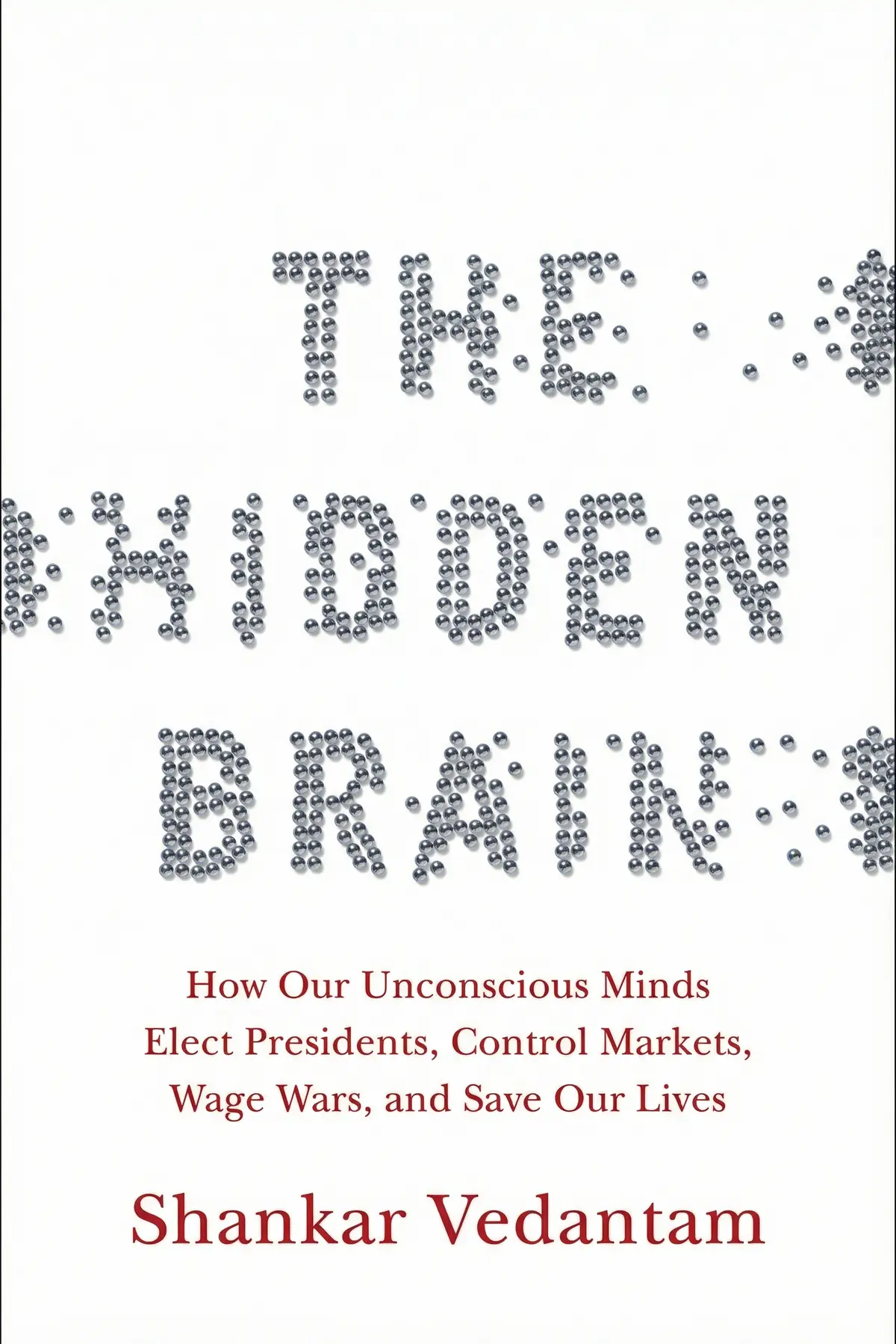
Table of Content
1. Introduction
52 sec
Most of us trust that our choices come from what we know and intend. Yet in an office in Newcastle, a small picture of eyes on a price list made coffee drinkers pay three times as much into an unwatched honor box. In The Hidden Brain, journalist Shankar Vedantam argues that this unseen steering is the mind’s normal state.
The autopilot that lets us read a stranger’s face also soaks up patterns we never chose. Those patterns shape how children see race, how voters choose leaders, how courts sentence, how women are paid and how groups act when a building is burning. His central claim is that the hidden brain keeps us social and safe, and that its biases only lose their grip once we name them. Follow his evidence and you learn to catch your own autopilot deciding for you, along with a few concrete ways to correct it.
2. Spot the small cues that steer your choices
1 min 30 sec
Nobody sitting in a quiet office kitchen paid attention to the image printed above the prices. Yet it changed how much they paid, and a study at a restaurant in the Netherlands found a similar lever in a waitress’s own words.
3. Your autopilot is what keeps you social
1 min 43 sec
A woman stopped a stranger to ask about his tattoos. A man at lunch demanded to swap plates with his friend. Both reveal what happens when a part of the mind we never notice stops working.
4. Teach children fairness by naming race out loud
1 min 43 sec
Parents who never voiced a prejudice found their preschoolers holding one anyway. A Canadian psychologist traced where it came from, and why a well-meaning silence leaves it in place.
5. Catch the bias hiding inside political messages
2 min 10 sec
Millions of people have taken a test that measures preferences they do not know they hold. Mapped against election results, the scores raise uncomfortable questions about what voters respond to and how candidates court them.
6. See how a defendant's face tilts a sentence
1 min 43 sec
Volunteers rated photographs without knowing who the men were or what had happened to them. Their ratings lined up with a pattern in death sentences that one man’s rushed trial makes painfully concrete.
7. Recognize the current carrying some careers forward
2 min 01 sec
A vacation swim felt easy until the author turned back toward shore. That moment became his picture of how bias works in offices, helping some people without their noticing and wearing others down.
8. Be the one who breaks a frozen group
2 min 16 sec
Two floors of the same firm heard the same noise and at first reached the same consensus to stay put. One floor emptied and one stayed, and the difference came down to one man and an old instinct everyone shares.
9. Conclusion
1 min 09 sec
For bias at work, Vedantam offers the image of a swimmer who only notices the current once he turns to swim back. For most men at work, unconscious gender bias is that current. It carries us through conversations, reads faces for us and keeps us close to the group, and most of the time we feel only our own effort. Trouble starts when the same current sorts children’s adjectives, voters’ fears, death sentences and paychecks, while everyone involved sincerely believes they chose freely. Naming it is what lets people build homes, offices, courts and safety plans that correct for it.
The book supports a few concrete moves. Talk to children about race directly, with stories of friendship across it, instead of trusting silence. When you judge a candidate, a colleague or a defendant, test the verdict by picturing the same facts with a different face. And in any team you belong to, decide early who will be the one to say leave now while everyone else waits.
The current never stops, but you can learn which way it runs.
About this book
What is this book about?
We like to think our choices come from knowledge and clear intention, and our schools, courts, markets and elections are built on that belief. Journalist Shankar Vedantam argues that the evidence points elsewhere. Much of the time we run on autopilot, and the same hidden processes that let us read faces and fit in with others also absorb associations we never chose. Vedantam follows this hidden brain from small moments to high stakes. A picture of eyes changes what office workers pay for coffee. Preschoolers with tolerant parents still link positive words to white faces. Maps of unconscious bias line up with voting patterns, a defendant's features predict death sentences, women earn less and are less often wanted as bosses, and two floors of the same firm made opposite choices on September 11. The book offers a clearer view of when your own judgments are being made for you, plus practical responses it proposes: talking to children about race, having courts weigh unconscious bias, discussing bias openly at work and preparing someone to break a group's dangerous consensus.
Book Information
Who it's for
Judging talent at work
Professionals who hire, promote or set pay and want to see where their snap judgments come from.
Parents and teachers
Parents and teachers wondering how to raise children who are fair about race.
Questioning how they decide
Curious listeners who suspect their votes and choices are less deliberate than they feel.
About the Author
Shankar Vedantam
Shankar Vedantam is an American journalist and writer who reports on human behavior and the social sciences. At the Washington Post he served as a national correspondent and columnist, and from 2006 to 2009 he wrote its Department of Human Behavior column. In 2010 he held a Nieman Fellowship at Harvard University. Today he hosts Hidden Brain, both a podcast and a public radio show, and his book The Hidden Brain became a New York Times national bestseller.
Ratings & Reviews
Ratings at a glance
What people think
Listeners find the work highly accessible and expertly written, enjoying its intriguing investigation into the mechanics of the subconscious through engaging case studies. Furthermore, they value the author's gift for narrative and clear presentation, with one listener remarking that it explains complex ideas in regular everyday language. The text also gains positive remarks for its insights into cognitive power, as one review emphasizes its explanation of decision-making processes. Conversely, the book's rhythm receives a range of reactions, with one listener describing the structure as poorly assembled.
Top reviews
Ryan
Ever wonder why we make such illogical choices in our daily lives? Vedantam’s exploration into the unconscious is nothing short of eye-opening for the average reader. He breaks down complex psychological concepts into everyday language that doesn’t require a PhD to grasp. I was particularly struck by the way he illustrates how our autopilot mode handles everything from social interactions to major life decisions. The storytelling is vivid, making the data feel alive rather than just a dry recitation of lab results. While some might find the narrative detours a bit long, I thought they added necessary color to the underlying science. It really makes you question your own objectivity and the 'rational' choices you think you're making every day.
Show morePatcharaporn
The chapter on gender bias alone is worth the price of admission. Hearing the accounts of professors who transitioned and experienced the world from both sides of the gender divide was a revelation. It perfectly illustrates how the hidden brain influences our respect and attention levels without us even realizing it. Vedantam has a gift for taking these abstract 'subroutines' of the mind and making them visible through sharp, engaging case studies. I’ve read 'Influence' and other psych books, but this felt more grounded in modern social reality. It’s an essential read for anyone who wants to understand why our society is so polarized and how we can start to fix it. Absolutely fascinating stuff.
Show morePornpimon
Wow. This book should be required reading for anyone in a leadership position. It provides such a clear window into the decision-making processes that we think are rational but are actually driven by ancient biases. The way Vedantam explains the collective hidden brain of societies helped me understand current events in a much clearer way. It’s not just about individual quirks; it’s about the bedrock of our political and economic institutions. The writing is top-notch and kept me engaged from start to finish. Not gonna lie, it’s a bit humbling to realize how little control we actually have over our own perceptions, but knowing is the first step toward change. Truly brilliant work.
Show morePear
In my experience, books on the unconscious mind are either too dry or too 'self-help.' The Hidden Brain hits that sweet spot right in the middle. It’s incredibly well-written and uses fascinating case studies to prove its points. I especially liked the analysis of how crowds behave in disasters; it’s the kind of information that could actually save your life one day. Vedantam’s background as a journalist shines through in his ability to tell a compelling story while still keeping the focus on the underlying research. It’s a fantastic look at the 'epidemiology' of human behavior. I highly recommend pairing this with Leonard Mlodinow’s Subliminal for a full picture of our internal workings.
Show moreVimolwan
Picked this up after hearing Shankar on NPR and it didn't disappoint. The way he frames our 'hidden brain' as a passenger that occasionally grabs the steering wheel is a perfect metaphor. I found the sections on racial bias and the 'terrorist mind' to be exceptionally well-handled and thought-provoking. He manages to explain why we fail to react to global tragedies while obsessing over individual stories without sounding judgmental. My only gripe is that it relies heavily on anecdotes rather than hard neuroscience, which I was hoping for more of. Still, as a work of popular psychology, it's very readable and manages to distill complex institutional issues into something personal. It definitely changed how I view my own snap judgments.
Show moreSun
As someone who usually sticks to fiction, I found this remarkably easy to get through. The author uses regular everyday language to explain why we do the weird things we do. It’s a deep dive into the 'autopilot' settings of the human mind, and it's both terrifying and enlightening. I loved the variety of case studies, ranging from 9/11 survivor stories to how we perceive puppies versus human suffering. Look, the pacing can be a bit slow in the middle when he dives deep into the 'terrorist mind' chapters, but the payoff is usually worth it. It’s a great book for starting conversations about implicit bias without being overly academic or preachy. Definitely worth a spot on your shelf.
Show moreKasemsan
After hearing so many people recommend this, I finally gave it a go. The core idea—that we have a secret mental life dictating our choices—is explored through some truly gripping real-world experiences. Vedantam is a master at synthesizing disparate research into a narrative that flows well. I appreciated the discussion on how our hidden brain can be destructive on a global scale, like with climate change. However, I have to agree with some critics that he occasionally ignores evidence that doesn't fit his narrative, particularly regarding some aspects of sexism research. Despite that, it's a solid 4-star read because it forces you to confront your own mental shortcuts. Very informative for anyone interested in decision-making processes.
Show moreOmar
Frankly, the book felt more like a collection of long-form magazine articles than a cohesive scientific thesis. While the premise is fascinating, the author often gets lost in his own anecdotes. There were moments where the stories, like the one about the puppy on the oil tanker, went on for pages and I actually forgot what psychological bias he was trying to illustrate. To be fair, Vedantam is a journalist, so the writing is smooth and accessible, but it lacks the scientific rigor I was expecting. If you’ve already taken a 101 course in social psychology, a lot of this material will feel like a recap of things you've heard elsewhere. It’s a decent entry point for beginners, though the pacing is definitely uneven and poorly assembled in spots.
Show moreCha
The content is interesting, but the presentation is a bit of a slog. I found myself skimming through the 50-page sections on disaster survival just to find the actual psychological takeaway. Every story seemed to be about 100 words too long with unnecessary details about lunch bags and car colors. To be fair, the research on how we value one life over millions (the puppy on the tanker example) was incredibly poignant. I just wish there was more 'brain' and less 'journalism' in the mix. It feels like it was written for people who have never read a psychology book before. If you're well-versed in the field, you might find it a bit repetitive and lacking in new revelations.
Show moreMaria
Not what I expected from a book about the brain. I was looking for deep neurological insights, but instead, I got a lot of fluff and South Philadelphia atmosphere. The author spends way too much time describing what people were wearing or what the weather was like before getting to the actual point. For instance, the story about Raymond Fiss felt like it belonged in a true crime novel rather than a science book. Truth is, the analysis feels average at best and many of his points are just common sense wrapped in flowery prose. It’s poorly assembled and feels like a series of disjointed anecdotes that don't always lead to a satisfying conclusion. Disappointing for those seeking depth.
Show moreQuestions about this book
What is the main idea of The Hidden Brain by Shankar Vedantam?
Vedantam argues that much of what we do runs on an unconscious autopilot. It helps us read faces and fit in with others, but it also absorbs associations we never chose. Those hidden biases shape tipping, honesty, how children see race, how people vote, who gets a death sentence, how women are paid and how groups behave in emergencies. Naming them is the first step to designing fairer institutions.
What is the eyes experiment in The Hidden Brain?
Researcher Melissa Bateson tracked an honor-system drinks station in a Newcastle office for ten weeks. Every week she swapped the little image above the prices on the sheet, alternating between pictures of eyes and pictures of flowers. In the weeks with eyes, people paid three times as much, even though nobody consciously registered the picture or knew the box was being watched.
How does The Hidden Brain suggest parents prevent racial bias in children?
Psychologist Frances Aboud found that 70 percent of 80 white preschoolers in Montreal linked positive words to a white face and negative ones to a Black face, although their parents were not consciously racist. The children were absorbing patterns from a mostly white world. Aboud advises parents not to avoid the topic but to encourage tolerance openly, through stories and conversation that highlight friendship across race.
What does The Hidden Brain say about behavior in emergencies?
On September 11, staff on two floors of the same firm in the South Tower made opposite choices. The 89th floor agreed to stay and nearly everyone died; on the 88th, J.J. Aguiar shouted for everyone to leave and almost all survived. Vedantam stresses luck played a part, but the episode shows how people cling to group consensus, so he suggests training chosen employees to break it.
How can I apply The Hidden Brain at work?
Start by assuming small cues shape your choices and double-checking big decisions. Repeat colleagues’ and clients’ exact words so they feel in step with you. When hiring or judging, imagine the same facts attached to a different face. Discuss unconscious bias openly, since Madeline Heilman found four out of five volunteers unconsciously preferred a male boss, and agree in advance who will push the team to act in a crisis.
Readers also enjoyed

59 Seconds: Change Your Life in Under a Minute
Richard Wiseman




A Liberated Mind: How to Pivot Toward What Matters
Steven C. Hayes


Acting with Power: Why We Are More Powerful Than We Believe
Deborah Gruenfeld


Age of Propaganda: The Everyday Use and Abuse of Persuasion
Anthony Pratkanis
AUDIO SUMMARY AVAILABLE
Listen to The Hidden Brain in 15 minutes
Get the key ideas from The Hidden Brain by Shankar Vedantam, plus 5,000+ more nonfiction titles.
- 5,000+ titles
- Listen as much as you want
- 7-day free trial
- Cancel anytime









