

16 min 06 sec
Available in: English
The Happiness Industry: How the Government and Big Business Sold Us Well-Being
Shows how the drive to measure happiness, from Bentham to neuroscience and social media, became a way for governments and companies to manage moods for profit, and why your own account of how you feel matters.
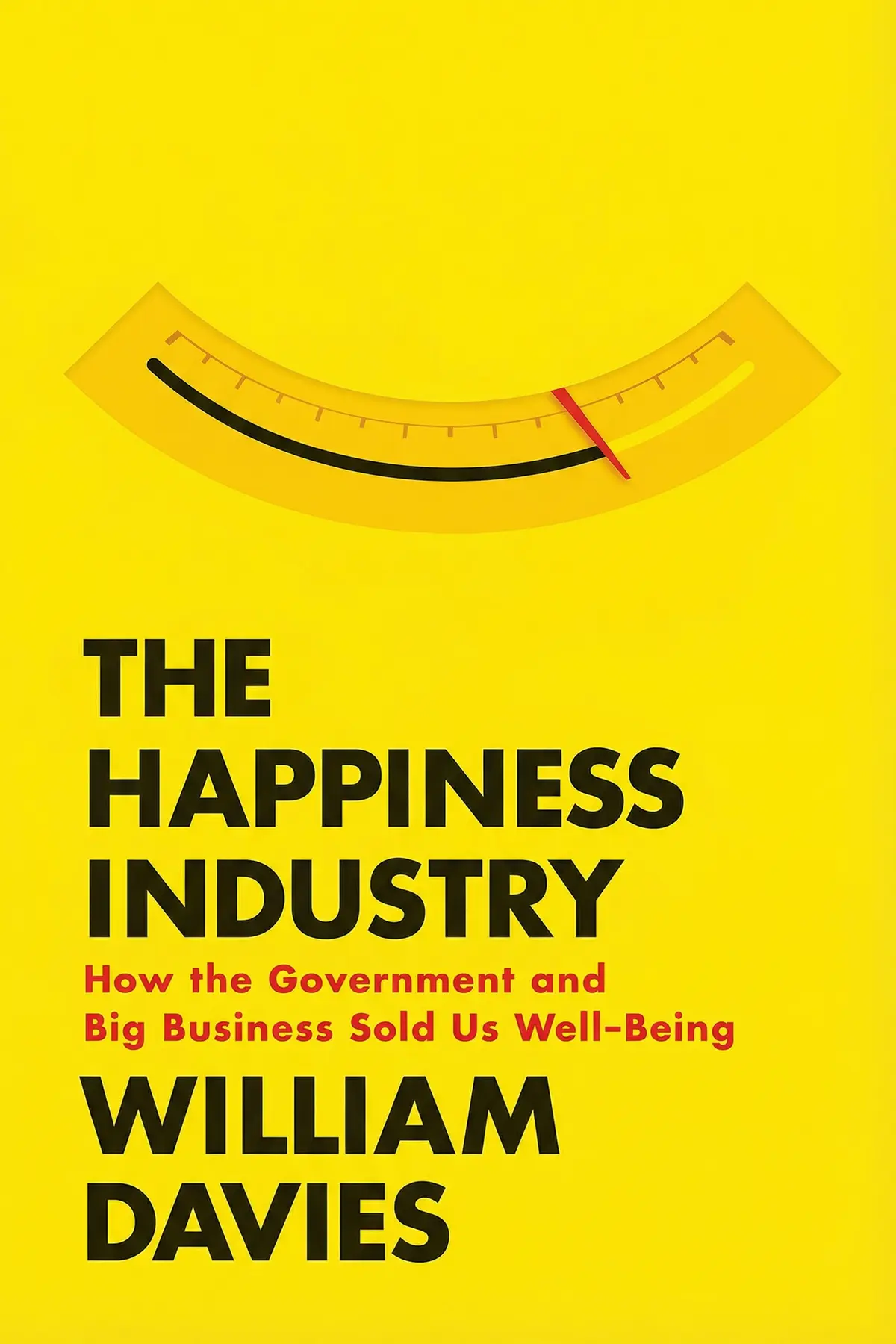
Table of Content
1. Introduction
56 sec
If you have ever been asked to rate your mood, your job or a phone call on a scale, you have met an idea from the 1780s. In The Happiness Industry, political theorist William Davies traces the urge to measure feelings back to Jeremy Bentham and shows how it now sits at the center of the way governments and companies manage people. His argument is that the science of happiness serves power. It reads our moods so we can be sold to, worked harder and calmed down, and it turns social problems into private faults.
The trail runs from pulse rates and price tags to advertising labs, office gyms, psychiatric manuals and Facebook feeds. Follow it and you learn to ask who profits whenever someone offers to measure how you feel, and why your own words remain the best evidence of it.
2. Spot the old idea behind every happiness score
1 min 51 sec
A philosopher writing in the 1780s held that a wire pumping good feelings straight into the brain was as valid as charity or jogging, so long as it gave equal happiness. His thinking still shapes the apps and surveys that ask how you feel.
3. Money became the ruler for measuring joy
2 min 10 sec
Nineteenth-century thinkers dreamed of reading society’s hidden desires, and they found a device that seemed to do it. That device still decides what counts as a good life in economic thinking, and it has powerful fans.
4. Learn why wanting a product beats owning it
2 min 05 sec
A famous psychologist walked out of a university for an advertising agency that paid him four times as much. What he brought with him explains a great deal about the ads that reach you today.
5. See what office wellness perks are really for
1 min 56 sec
Relaxation rooms, free coffees and in-house mindfulness guides look like kindness. A few numbers about engagement and output suggest another motive, and one question shows what these perks are designed to leave untouched.
6. Read a low mood as a message about your world
1 min 56 sec
Two weeks of sadness after a death can now be diagnosed as an illness. How psychiatry got there, and who helped pay for the change, reshapes how you might think about your own bad stretches.
7. Tell real help from resilience training
1 min 45 sec
Jobless people reciting upbeat affirmations, schoolchildren learning mindfulness between exams, a monk addressing world leaders in Davos. Davies sees one political choice behind all three, and it changes how you judge the next program offered to you.
8. Spot how friends and feeds became mood sensors
2 min 04 sec
A supermarket’s singing thank you, a beauty ad millions shared, a newsfeed experiment few users knew about. The tools that read your feelings are now everywhere, and some of them arrive through the people you trust most.
9. Conclusion
1 min 23 sec
Davies closes by reversing that bet. Writing in a mood he calls not very optimistic, yet hopeful, he insists on the authority of the human voice: the only real way to understand how people feel is to take what they say seriously, and he cites Occupy as a movement that gave people that voice. Much misery, he argues, could be relieved through politics and collective institutions instead of new behaviors, pills or products, since inequality, unemployment, isolation and loneliness rank among its causes. He notes that happiness shares a root with happenstance. It once meant something that simply happens, so deliberate efforts to engineer it often defeat themselves; meanwhile depression, stress and loneliness keep rising despite all the tracking, and Davies doubts the obsession works at all.
So treat your own account of how you feel as better evidence than any score or wristband. When someone measures your mood, ask who paid for the measurement and what they will do with it. When you or a colleague feels low, look at the work and the circumstances before blaming the person, and listen to the words they use. Bentham dismissed those words as mere sounds. Davies hears in them the start of change.
About this book
What is this book about?
Surveys ask how happy you are. Your watch tracks your heart rate, your employer offers a mindfulness session and your social feed seems to know your mood. William Davies asks where this obsession with measuring feelings came from and who gains from it. His answer starts in the 1780s with Jeremy Bentham, who treated happiness as a bodily signal that could be measured and steered through punishment and reward. Davies follows that idea through psycho-physics and early economics, then into Madison Avenue advertising, workplace wellness programs, the psychiatric manuals that redefined depression, and the data machines of social media. Each time, he argues, measuring a feeling becomes a way to manage the person who has it. The circumstances causing that feeling get left alone. Readers get a sharp history of the happiness industry and a way to see it at work in their own offices, feeds and shopping habits. The book's alternative is plain: take seriously what people say about their lives, and treat much of their misery as a political problem as well as a personal one.
Book Information
Who it's for
Employees questioning wellness perks
Professionals offered wellness perks and mindfulness sessions who wonder what they are really for.
HR and team managers
Managers and HR leads tempted to treat low morale with perks instead of looking at the work itself.
Skeptics of mood management
Anyone uneasy about mood-tracking apps, targeted ads and diagnoses that make sadness a personal fault.
About the Author
William Davies
William Davies, born in 1976, writes political and social theory with a focus on consumerism, happiness and the part experts play in society. He co-directs the Political Economy Research Centre at Goldsmiths, and his writing has appeared in The Guardian, the London Review of Books, The Atlantic, New Left Review and the Financial Times. The Happiness Industry, published in 2015, examines how consumer capitalism, big data and positive psychology are connected.
Ratings & Reviews
Ratings at a glance
What people think
Listeners find this work to be thoroughly researched, with one listener portraying it as an intellectual tour de force. They value its accessibility and feel it provides a perceptive examination of the topic. While the analysis draws varied responses, some characterize it as a powerful critique of the capitalist state.
Top reviews
Jong
Davies has produced a genuinely frightening yet essential intellectual tour de force that unmasks the darker side of our modern obsession with wellbeing. By tracing the history from Jeremy Bentham’s pleasure-pain calculus to modern-day neuroscience, he reveals how our emotions have become just another metric for corporate efficiency. It’s well-researched and surprisingly readable for such a dense subject. I especially loved the critique of 'resilience' as a tool used to keep us working in toxic environments without complaining. Truly, it’s a powerful critique of the capitalist state that everyone should read if they feel like the world is slowly crushing them.
Show moreSamart
This is a gutsy and courageous takedown of the entire 'wellness' movement that has exploded since the Global Financial Crisis of 2008. Davies argues that instead of fixing the systemic issues that cause misery, we are told to medicate ourselves and practice mindfulness to become better cogs in the machine. The historical context regarding behaviorism and the measuring of pain was fascinating. It really changed how I view those 'wellness' packages and performance reviews. This is a deadly serious and incredibly insightful book. If you feel like your workplace is toxic, this will explain exactly why you're being told to just 'grin and bear it' while the world burns.
Show moreMonthon
Ever wonder why your office is suddenly offering lunchtime yoga sessions instead of actual raises or better benefits? This book provides a chilling answer by looking at how the 'happiness industry' treats workers like machines to be calibrated for maximum output. Davies connects the dots between early Taylorism and contemporary positive psychology in a way that feels both scholarly and urgent. While some of the sections on economic history got a little slow, the overall insight into how we medicalize social problems is brilliant. It’s an eye-opening look at the subject that will make you rethink your 'engagement' score.
Show moreDen
After hearing about this from a colleague, I was skeptical, but the intellectual depth Davies brings to the table is genuinely impressive. He manages to make the medicalization of depression feel like a high-stakes conspiracy by showing how big data and neuroscience are used to monitor our moods. The writing style is sharp, and the sentences move quickly through complex ideas about Taylorism and productivity. I did think the ending was a little abrupt, leaving me wanting more solutions. Still, it’s a powerful critique of how our society is organized to crush the soul while telling us to smile for the camera.
Show moreDao
Finally got around to finishing this, and the connection Davies makes between the 'happiness' agenda and the decline of trade unions is absolutely fascinating. He shows how we’ve moved from collective bargaining to individual 'wellness' packages that do nothing to solve the real, structural issues we face. The book is very readable despite the heavy focus on Taylorism and productivity metrics. My only gripe is that it can be quite bleak at times without offering much hope. However, the insight into how advertising treats us as emotional data points is worth the price of admission alone. It’s a very necessary read.
Show moreJulian
As someone who has always been wary of the 'positive psychology' trend, this book felt like a massive validation of all my suspicions. Davies does a brilliant job of showing how 'resilience' is often just a code word for accepting terrible working conditions without any complaint. The way he traces the origins of these ideas back to the 18th century is truly impressive and shows how deep the roots go. It’s a scholarly and powerful work that isn’t afraid to be funny and biting. It definitely changed the way I think about those 'wellness' apps everyone seems to be using at my office lately.
Show moreTen
To be fair, the research here is top-notch, but I found the narrative a bit too focused on the history of neoliberalism for my taste. I was looking for a deeper philosophical exploration of what happiness actually is, rather than a history lesson on the University of St. Louis psychiatry and behaviorism. The author is clearly brilliant, and his critique of the 'always-on' workforce is biting. However, the tone felt a bit repetitive by the final third of the book. It’s worth a read if you enjoy socio-economic history, but it might be a struggle for a casual reader looking for self-help.
Show moreMeen
Personally, I think the first half of the book is much stronger than the second half. The exploration of how Jeremy Bentham’s ideas influenced modern psychiatry was an intellectual tour de force, but the later chapters felt a bit scattered. I appreciated the critique of the capitalist state and its obsession with 'engagement' as a way to avoid talking about wages. Yet, I found myself wanting more focus on the actual brain science and less on the economic history. It’s an insightful look at the subject, even if it feels a bit uneven in its execution and pacing across the chapters.
Show moreNiramai
Picked this up hoping for some actual strategies for finding balance in a hectic world, but it turned out to be a dense political treatise against the current state of capitalism. To me, it felt like the author had a massive axe to grind that overshadowed the actual science of psychology. The chapters on Jeremy Bentham and the history of utilitarianism were frankly quite dry and hard to get through. I understand the critique of 'resilience training,' but the book offers very little in the way of a positive alternative. It was just a bit too cynical and academic for what I wanted.
Show moreSukit
The truth is, I just couldn't get into the author's writing style, which felt overly academic and detached throughout. There was a lot of primer material on the origins of neoliberalism and workplace management that felt like a college lecture I didn't sign up for. I was expecting something more along the lines of a social commentary on modern life, but this was more of a history of economic thought. While it is clearly well-researched, it didn't resonate with me personally as a reader. I think I am simply not the target audience for this specific type of academic critique.
Show moreQuestions about this book
What is the main argument of The Happiness Industry by William Davies?
Davies argues that the drive to measure happiness, which he traces to Jeremy Bentham in the 1780s, has become a tool of power. Governments and corporations monitor and quantify moods to sell more, raise productivity and change behavior. In doing so, they treat unhappiness as an individual fault to be managed, when it often signals social and economic problems such as inequality, insecurity and loneliness.
Does Davies think happiness can be objectively measured?
He is skeptical. Davies questions how meaningful any measurement of feelings can be, and he asks why experts prefer to measure brain chemistry instead of asking people how they feel. He criticizes Bentham’s habit of trusting bodily data over people’s own words, and he sees that same bias in today’s wristbands, sentiment analysis of tweets and smile-tracking webcams.
What does The Happiness Industry say about workplace wellness programs?
Davies notes that companies care about happiness because it affects output: some economists estimate a happy employee is 12 percent more productive. Gyms, relaxation rooms, free lunches and in-house mindfulness guides follow from that. His concern is that putting a dollar value on unhappiness pushes managers to treat symptoms with perks, while they stop questioning the nature of the work that causes stress.
How does Davies connect depression to the happiness industry?
He argues that psychiatry, from the DSM-III onward, began classifying symptoms without asking about causes, and so stopped seeing distress as a possible response to hard circumstances. Drug industry money and the dropped grief exemption deepened this. Davies points instead to environment, noting much higher depression rates in the US and Britain than in most Northern European nations.
How can I apply the ideas in The Happiness Industry?
Trust your own account of your feelings over any score, device or survey. When someone measures your mood, ask who benefits and what the data will be used for. When you or a colleague feels low, examine the work and the circumstances before blaming the person. And when a program offers resilience training, ask which real problems it leaves untouched.
Readers also enjoyed


A Splendid Exchange: How Trade Shaped the World
William J. Bernstein

Afropean: Notes From Black Europe
Johny Pitts




All About Love: New Visions
bell hooks


Adults in The Room: My Battle With Europe’s Deep Establishment
Yanis Varoufakis
AUDIO SUMMARY AVAILABLE
Listen to The Happiness Industry in 15 minutes
Get the key ideas from The Happiness Industry by William Davies, plus 5,000+ more nonfiction titles.
- 5,000+ titles
- Listen as much as you want
- 7-day free trial
- Cancel anytime









