

14 min 48 sec
Available in: English
 ไทย
EnglishไทยThe Happiness Hypothesis: Putting Ancient Wisdom and Philosophy to the Test of Modern Science
Shows why emotion steers most of your choices more than reason does, and how to train it and build the relationships, work and sources of meaning that keep people happy after other gains fade.
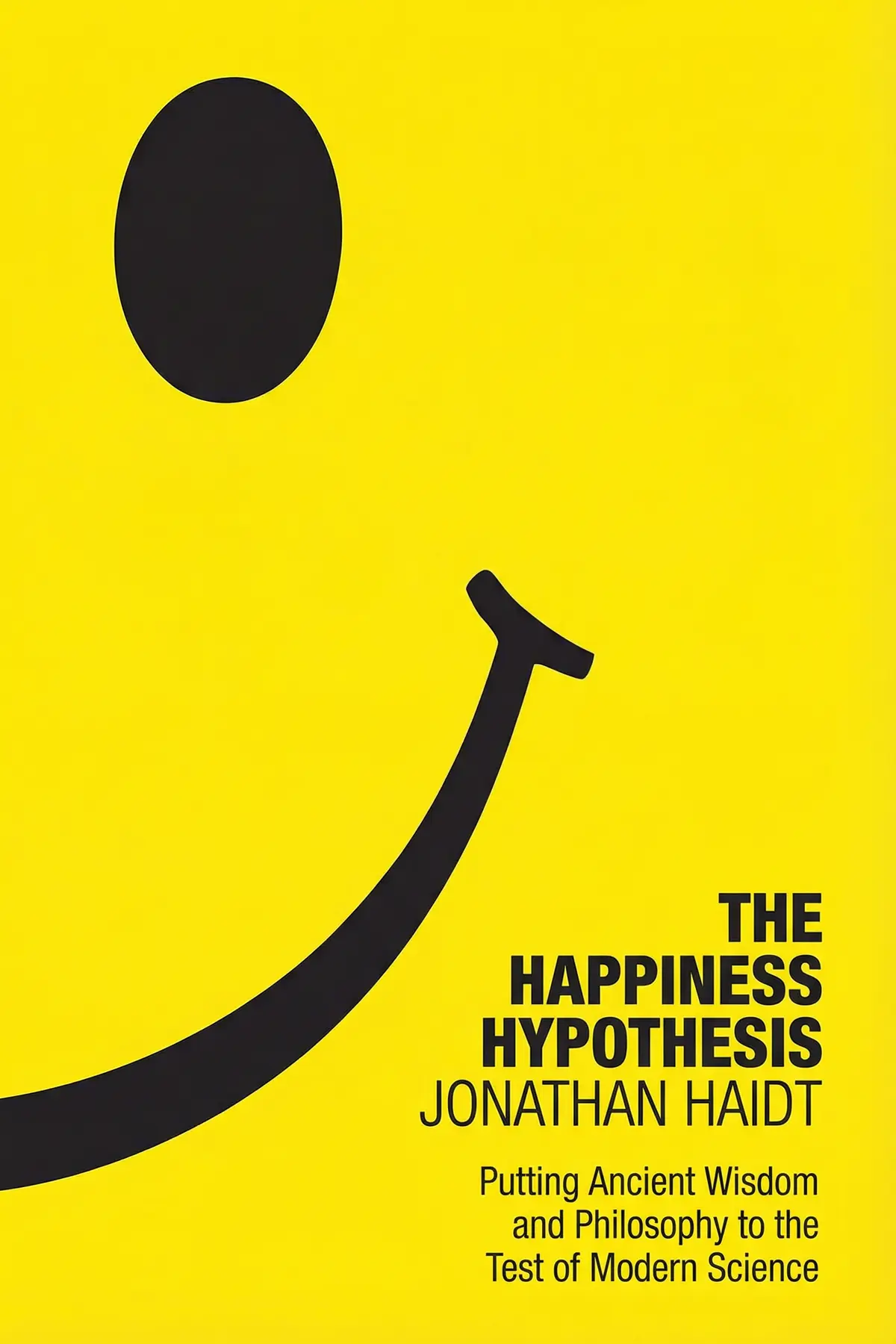
Table of Content
1. Introduction
1 min 01 sec
If your plans to be happier keep collapsing, discipline may not be the real problem. In The Happiness Hypothesis, social psychologist Jonathan Haidt pictures the mind as a small rider on a large elephant: reason holds the reins, but emotion and instinct usually choose the direction. He sets ancient ideas about the good life beside modern science to see which ones hold.
His conclusion is that happiness cannot be commanded by willpower, and it rarely arrives from outside. It grows when you train the elephant and build the right relationships: with other people, with your work, with your own story and with something larger than yourself. Along the way, Haidt explains why a stranger’s Christmas card makes you write back, why passion fades after about six months and why helping others may do more for you than being helped. The payoff is a clear sense of where effort pays and where it is wasted.
2. Stop blaming willpower when resolutions fail
1 min 37 sec
Making a resolution is easy and keeping it is not. A picture of a small rider on a large animal explains why, along with the reason your heartbeat ignores every order you give it.
3. Train a worried mind toward a brighter outlook
1 min 34 sec
Evolution tuned the mind to fret over a work presentation as if it were a wild animal. Genes add their own pull, yet two well-tested practices can slowly shift the balance.
4. Turn a hard season into lasting strength
1 min 37 sec
Some people sink after a loss while others come out stronger. Haidt identifies three gains hardship can bring and the age range that benefits most, which may not be the one you expect.
5. Fairness shapes every relationship you have
1 min 29 sec
Offered a few dollars for free, most people would rather walk away with nothing. That strange choice reveals the rule beneath every friendship, team and family, and what happens to those who break it.
6. End arguments by naming your own mistakes first
1 min 30 sec
Two flatmates each swear they carry the housework. Both are sincere, both are blind to something, and the way out of their endless argument starts with an uncomfortable search.
7. Put your effort where happiness actually lasts
1 min 31 sec
Lottery winners and people with severe paralysis mostly drifted back to their own earlier levels of happiness within months. Yet a few parts of life never lose their power to lift us, and choosing them changes where effort pays.
8. Let lasting love grow after the passion fades
1 min 28 sec
The rush of new romance has a limited life, and the brain treats it much like a drug. Many couples misread what comes next and walk away just before something sturdier could begin.
9. Build meaning through helping, good work and awe
1 min 51 sec
Hospital janitors doing the same job felt very differently about their days. Their story, a study of older helpers and a sky full of stars point to what a busy, practical life tends to leave out.
10. Conclusion
1 min 10 sec
Haidt’s hypothesis turns out gentler than the slogan that thinking alone decides everything. The mind’s large emotional half sets most of our mood, and it was built to worry. Reason cannot command it. Reason can train it slowly, through meditation, kinder thoughts and steady practice, and it can steer us toward the few things the elephant never tires of: close relationships, work that fits our strengths and values, love that keeps growing after passion, and moments of awe.
Happiness, in this view, is a matter of fit between a person and their surroundings. While lottery winners drift back to their old mood, other evidence points to friendships, good marriages and helping others as sources of lasting lift.
The most direct advice concerns work and conflict. Let enjoyment and your own values decide your next job, with salary as a lesser concern. And in your next quarrel, list a few of your own mistakes before naming anyone else’s.
Think of the Christmas card from a near stranger. Offer something first, and most people answer in kind.
About this book
What is this book about?
Most people try to become happier by changing their circumstances or by forcing themselves to think differently. Social psychologist Jonathan Haidt suggests both strategies miss how the mind is built. He pictures it as a rider on an elephant: conscious reason sits on top, but instinct and emotion, shaped by evolution and partly by genes, usually decide where we go. Setting old ideas about the good life beside modern research, Haidt explores why we worry more than we need to, why we return favors from near strangers, why we miss our own faults in an argument, and why lottery winners drift back to their old mood within months. He also looks at the difference between passionate and companionate love, the conditions under which hardship makes people stronger, and the role of awe and shared values. Readers get a clear account of what lasting happiness depends on: training the emotional mind through practice, and building the right ties with other people, with work that fits their strengths and values, and with something larger than themselves.
Book Information
Who it's for
Professionals always chasing more
Professionals who keep chasing raises and purchases that stop satisfying within months.
Stuck in repeating fights
Anyone stuck in repeating fights with a partner, flatmate or colleague.
Students and young adults
Students and young adults working through a breakup, a loss or a search for meaningful work.
About the Author
Jonathan Haidt
Jonathan Haidt is a social psychologist who earned his PhD at the University of Pennsylvania in 1992. After teaching for sixteen years at the University of Virginia, he moved in 2011 to the Stern School of Business at New York University, where his title is Thomas Cooley Chair of Ethical Leadership. He co-developed Moral Foundations theory, co-founded Heterodox Academy and writes the After Babel Substack. His other books include The Righteous Mind, The Coddling of the American Mind with Greg Lukianoff, and The Anxious Generation.
Ratings & Reviews
Ratings at a glance

What people think
Listeners find the book highly inspirational, including one who shares how it reveals fresh paths in life. Furthermore, the writing is polished and accessible, creating an enjoyable listening experience. The quality of the research is also well-regarded; one listener remarks that it offers a thorough survey of psychological discoveries. Listeners also prize the self-help insights provided, with one pointing out how the content aids in understanding both personal motivations and the behavior of others.
Top reviews
On
Picked this up thinking it was another fluff-filled self-help book, but I was pleasantly surprised by the intellectual rigor. Haidt’s central metaphor of the rider and the elephant is genuinely one of the most useful ways to conceptualize the struggle between our conscious will and our unconscious drives. It makes so much sense why we fail at our New Year's resolutions when you realize the rider is just a tiny advisor to a six-ton beast. The way he weaves together Buddhist philosophy with modern neuroscience feels seamless rather than forced. It’s a dense read at times, but the insights into why we do what we do are worth the effort. Frankly, it changed how I view my own anxieties and the 'cortical lottery' I was dealt at birth. This isn't just about being happy; it’s about understanding the mechanics of the human soul through a scientific lens.
Show moreJulian
Wow. This book didn't just give me things to think about; it actually shifted the direction of my daily habits. I’ve started a meditation practice after reading his explanation of how it retrains the 'elephant' to be less reactive to negative stimuli. The 'Happiness Formula' (H = S + C + V) is a brilliant way to break down what we can actually control versus what we just have to accept. It’s rare to find a book that respects both the spiritual insights of Buddha and the rigorous data of modern psychology. I felt like I was sitting in on a world-class lecture series that actually cared about my well-being. If you’ve ever felt like your brain is working against you, this book provides the roadmap to a ceasefire.
Show moreGrace
The chapter on the 'Great Divide' between our moral foundations was worth the price of the book alone. Haidt has this incredible ability to take complex social theories and make them feel relevant to your Sunday afternoon. I loved the deep dive into the concept of 'elevation' and how witnessing acts of virtue can physically change our state of mind. It’s a beautiful exploration of the human condition that refuses to settle for easy answers or 'life hacks.' The writing is elegant, moving from Ben Franklin to cognitive science without ever losing the reader in jargon. It’s one of those rare books that makes you feel smarter while also making you want to be a better person. Truly a comprehensive review of what it means to flourish in the modern world.
Show moreNam
After hearing so many people mention the 'Elephant and Rider' metaphor, I decided to see what the fuss was about. This book is a masterpiece of synthesis. It’s one of the few things I’ve read that actually bridges the gap between the lab and the living room. The sections on cognitive therapy were life-changing for me, providing a structured way to identify the 'cognitive demons' that keep me in a loop of negativity. I appreciate that Haidt doesn't promise a quick fix; he acknowledges that changing the elephant is a slow, arduous process. The research quality is top-notch, and you can tell he spent years curating these insights. It’s an essential read for anyone trying to navigate the complexities of modern life with some semblance of peace.
Show moreArjun
As someone who usually avoids the psychology section, this book felt like a breath of fresh air because of its historical grounding. I loved how Haidt doesn’t just give you 'tips' but explains the evolutionary logic behind things like gossip and the reciprocity reflex. Knowing that our brains are essentially wired for social survival makes it easier to forgive my own neurotic tendencies. The discussion on cognitive therapy and how it mirrors ancient Stoic wisdom was particularly eye-opening for me. It’s well-written and avoids the patronizing tone you often find in this genre. However, some of the later chapters on the 'divinity' dimension felt a bit abstract compared to the practical brilliance of the first half. Still, it’s a comprehensive review of what makes life meaningful.
Show moreWachira
Ever wonder why winning the lottery doesn't actually make people happy in the long run? Haidt explains the 'hedonic treadmill' with such clarity that it fundamentally changed my relationship with my career goals. We spend so much time chasing the next big thing, oblivious to the fact that our baseline happiness is largely determined by our genetics. The book is easy to understand, even when he’s diving into the neurochemistry of Prozac or the philosophy of Epictetus. I particularly enjoyed the section on how we use gossip to regulate social behavior; it’s a bit cynical but rings incredibly true. My only gripe is that he occasionally meanders into political commentary that feels a bit dated now. Overall, it’s an inspirational read that offers real substance instead of empty platitudes.
Show moreCarter
Finally got around to reading this after seeing it on every 'must-read' list for a decade, and it mostly lives up to the hype. The synthesis of ancient wisdom and modern research is impressive, especially when he discusses the importance of social connections. He makes a compelling case that 'no man is an island' isn't just a cliché, but a biological reality for our species. I found the chapters on the 'adversity hypothesis' quite challenging—the idea that we actually need some trauma to grow is a tough pill to swallow. It’s a very masculine, analytical approach to happiness, which worked for me, but might feel a bit cold to others. It’s definitely helped me understand the people around me better, even the ones I disagree with politically.
Show moreTern
Jonathan Haidt is a gifted storyteller, and he uses that skill to turn a psychology textbook into a page-turner. I was fascinated by the discussion on how our brains are wired for reciprocity and how that affects everything from our friendships to our politics. The book provides a great framework for understanding why we are so prone to hypocrisy—we are designed to see the faults in others while remaining blind to our own. While I didn't agree with every conclusion he drew about 'sacredness,' I appreciated the way he challenged my liberal biases. It’s a thought-provoking journey that manages to be both intellectual and deeply personal. It’s a solid 4-star read that I’ll likely be thinking about for a long time.
Show morePick
To be fair, this is a well-argued book, but I couldn't shake the feeling of 'pop-psychology' fatigue while reading it. While the elephant and rider metaphor is catchy, I worry about how much of the cited research holds up given the recent replication crisis in psychology. Haidt writes with a lot of confidence, but many of the studies he mentions feel like they might be oversimplified for the sake of a good narrative. I also found his constant comparisons to Steven Pinker a bit exhausting, as if there’s a specific 'intellectual' club they're both trying to lead. The insights on the liberal-conservative divide were interesting, yet they felt somewhat disconnected from the core theme of individual happiness. It’s a decent primer if you’re new to the subject, but read it with a healthy dose of skepticism.
Show moreTawee
Look, I wanted to like this, but the 'evo-psy' smarm was just too much for me to handle. Haidt seems to have an answer for everything, usually rooted in some vague evolutionary 'logic' that conveniently supports the status quo. It feels like he’s writing from a position of immense privilege, telling the 'losers' of the cortical lottery that they should just meditate their problems away. His dismissal of certain Buddhist concepts because they don't fit his 'stability' model felt narrow-minded and intellectually dishonest. Also, his obsession with 'purity' and 'divinity' as essential for happiness feels like a back-door way to justify conservative social structures. There are some interesting facts buried in here, but the tone is so patronizing that I struggled to get through it.
Show moreQuestions about this book
What is the main idea of The Happiness Hypothesis?
Jonathan Haidt argues that the mind is divided, like a rider on an elephant. Conscious reason is the rider, while emotion and instinct form the much stronger elephant. Happiness cannot simply be willed, and outside gains like money fade as we adapt. What lasts is training the elephant through practice and building the right relationships with other people, with work that fits your strengths and values, and with something larger than yourself.
What do the rider and the elephant mean in The Happiness Hypothesis?
The rider stands for conscious, rational thought, which uses language to plan and advise. The elephant stands for automatic processes such as instinct, emotion and gut reactions. Haidt links the split to brain structure, with older regions handling drives like hunger and the neocortex handling restraint. He argues that in everyday choices emotion usually takes the lead, which means the elephant is generally the stronger partner and the rider the weaker.
Does money make you happier, according to Jonathan Haidt?
Not for long. Haidt describes a study comparing lottery winners with people paralyzed from the neck down. The winners were happier at first, but after several months most people in both groups had returned to their earlier level of happiness. A few conditions resist this adaptation: the number and depth of your relationships, and activities that use your strengths, which keep rewarding you over time.
How can I apply The Happiness Hypothesis in daily life?
Start small. Try daily meditation or catch self-blaming thoughts and replace them with more positive ones. In your next argument, name a few of your own mistakes first, since reciprocity makes the other person likely to do the same. Choose work that fits your values instead of the salary alone, help others regularly, and give companionate love time to grow when early passion fades.
Readers also enjoyed


A Theory of Justice
John Rawls


A Liberated Mind: How to Pivot Toward What Matters
Steven C. Hayes


Acting with Power: Why We Are More Powerful Than We Believe
Deborah Gruenfeld


Age of Propaganda: The Everyday Use and Abuse of Persuasion
Anthony Pratkanis

AUDIO SUMMARY AVAILABLE
Listen to The Happiness Hypothesis in 15 minutes
Get the key ideas from The Happiness Hypothesis by Jonathan Haidt, plus 5,000+ more nonfiction titles.
- 5,000+ titles
- Listen as much as you want
- 7-day free trial
- Cancel anytime









