
14 min 39 sec
Available in: English
 ไทย
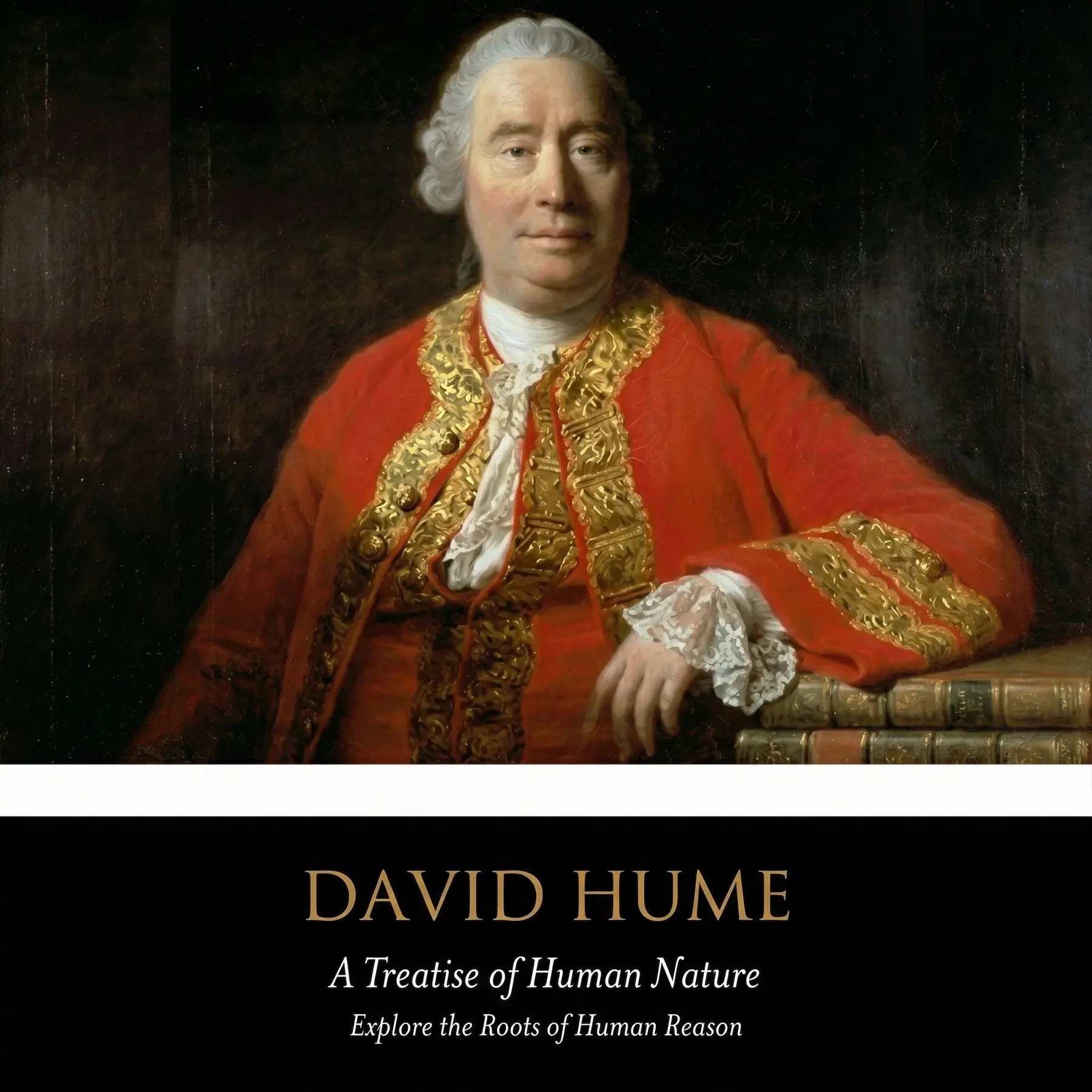
EnglishไทยA Treatise of Human Nature: Being an Attempt to Introduce the Experimental Method of Reasoning into Mor
By David Hume
Hume shows that our ideas come from experience, our sense of cause and effect from habit, and our morals from feeling, so we learn to judge our own certainties more honestly.

Table of Content
1. Introduction
1 min 04 sec
Most of us assume we think our way to what we know and what we value. In A Treatise of Human Nature, published in 1740, the Scottish philosopher David Hume makes the opposite case: every idea we hold began as something we sensed, and passion rather than reason steers what we do. Even the confidence that the sun will rise tomorrow, he argues, rests on habit that no proof can back up.
That claim is the thread through the whole book. Experience supplies our ideas, custom turns them into expectations, feeling builds our emotions and our sense of right and wrong, and human agreement creates our rules of justice. Hume studied all of this the way a scientist studies nature, and his doubts about reason helped lay the ground for modern psychology, with an influence reaching from Kant to Darwin.
His argument hands you a practical habit of mind: spotting when a belief, an emotion or a moral verdict comes from custom and sentiment, and holding it with exactly the confidence it deserves.
2. Trace any idea back to what you sensed
2 min 03 sec
You can picture a creature that has never existed, yet Hume insists nothing in your mind arrives from nowhere. Following his reasoning shows where the edges of your own knowledge really lie.
3. See how your surest beliefs rest on habit
2 min 03 sec
Boiling water and the morning sunrise feel like certainties. Hume looked closely at what we actually observe when one thing causes another, and found a gap that logic has never been able to close.
4. Doubt everything, then act on experience anyway
1 min 53 sec
Pushed to its end, Hume’s reasoning seems to leave nothing we can honestly claim to know. His way out is neither blind faith nor paralysis, and it fits ordinary working life surprisingly well.
5. Read pride and love as two-part feelings
2 min 10 sec
A beautiful house can fill its owner with pride, and Hume wanted to know exactly why. His answer reveals a hidden structure behind the strongest feelings we have about ourselves and about other people.
6. Discover how moral judgments start in feeling
2 min 12 sec
A young tree that grows tall enough to kill the tree that seeded it does, in one sense, what a murderer does. Hume uses that strange comparison to locate where right and wrong really come from.
7. See justice as a tool people built together
1 min 57 sec
Property, promises and government can feel as permanent as the weather. Hume traces them to a far more human origin, and that origin explains why rules differ between societies and keep changing.
8. Conclusion
1 min 17 sec
Hume’s Treatise turns philosophy around to face the mind doing the philosophizing. He sets aside the hunt for eternal truths and asks how a creature made of sense impressions, habits and feelings comes to believe, love, judge and cooperate. His answer is consistently humbling. Our ideas are copies of experience, our expectations are custom, our pride and love are associations, our morals are felt, and our justice is a set of useful agreements.
None of this leaves us helpless. Hume’s own response was to keep reasoning and acting, with a clear sense of where certainty ends. That stance travels well into an ordinary week. When you feel sure about what will happen next, count how many times you have actually seen it happen. When a debate jumps from facts to what someone ought to do, look for the moral premise that made the jump. When a rule seems untouchable, ask what quarrel it was designed to prevent.
Think again of the unicorn, a horse and a horn joined by imagination. Much of what we take for pure reason is built the same way, from experience and feeling, and seeing the seams is where good judgment begins.
About this book
What is this book about?
Most people assume that careful reasoning sits behind what they know, how they feel and what they judge to be right. David Hume, writing in 1740, set out to test that assumption by studying human nature the way a scientist studies the natural world. He concluded that passion and experience do far more of the work than reason does. The Treatise follows that idea through the whole mind. Every idea, Hume argues, is a copy of something we once sensed. Our belief in cause and effect rests on habit, because we never observe the connection itself. Emotions like pride and love arise from a double relation of ideas and impressions. Moral verdicts come from feelings of approval and disapproval, and justice, property and promises are rules people invented in order to live together. Readers get a clear map of one of the most influential arguments in philosophy, one that shaped thinkers from Kant to Darwin. They also get a habit of mind they can use: checking where a belief comes from and holding it with the confidence it actually deserves.
Book Information
Who it's for
Students new to philosophy
Students meeting philosophy for the first time who want Hume's core arguments in plain language.
Professionals deciding on patterns
Professionals who decide on patterns and want to know how far past experience can be trusted.
Curious why feelings win
Readers curious why emotions and moral feelings so often outrun logic.
About the Author
David Hume
David Hume (1711-1776) was a philosopher, historian, economist and essayist born in Edinburgh, Scotland. He is known for empiricism, philosophical skepticism and a naturalistic approach to the study of people. The Treatise drew little notice at first, and in his lifetime he was best known for his bestselling History of England. He later wrote An Enquiry Concerning Human Understanding, and Immanuel Kant credited Hume with waking him from his dogmatic slumbers.
Ratings & Reviews
Ratings at a glance
What people think
Listeners find this philosophical work significant, with one observer noting how it establishes an intellectual framework. Additionally, the annotations are well-received. However, the text quality and readability get mixed reactions; some find the writing accessible, while others find it hard to track. The binding's durability is also a worry, with multiple listeners reporting that it completely fell apart.
Top reviews
Tar
Wow, I finally understand why Kant said this book woke him from his dogmatic slumber. Hume’s skepticism is absolutely brutal, tearing down our assumptions about induction and the very nature of reality itself. Personally, I found the chapters on the 'passions' a bit of a chore to get through compared to the brilliance of the first volume. The way he describes reason as a slave to the passions feels incredibly modern, almost like he’s predicting 21st-century psychology. Look, this isn't a breezy beach read, and you’ll likely need the annotations to keep track of his specific terminology. The notes in this version were a lifesaver for clarifying his stance on moral subjects versus natural philosophy. It’s an essential text, even if his views on certain social customs feel incredibly dated now.
Show moreKanchana
Mind control or just brilliant philosophy? After watching that Jared Henderson video, I had to see if the hype was real. It turns out Hume is just that good at making you doubt your own existence through sheer cold logic. His exploration of how we associate ideas through resemblance and contiguity is still relevant to cognitive science today. In my experience, the first book is the strongest, while the later books on morality feel slightly less rigorous. The truth is that his writing style is an acquired taste, and the text quality here could be much sharper. It’s an essential intellectual framework, but don’t expect to breeze through it in a weekend. It’s a heavy, clunky, brilliant mess of a book that changed how I view my own perceptions.
Show moreVipawan
After hearing so much about how this book 'destroyed' science by attacking induction, I had to read it for myself. Hume doesn't actually hate science; he just wants us to realize that our knowledge is based on habit rather than absolute certainty. There’s a certain humility in his skepticism that I find really refreshing compared to other dogmatic philosophers. Personally, I found the discussion on the 'slave of the passions' to be the most relatable part of the entire treatise. The sentence structure is definitely a challenge, with some thoughts spanning several lines, but the rhythm eventually makes sense. It’s a brilliant, exhausting journey that provides a comprehensive framework for understanding the human mind. Just watch out for the poor binding quality on this specific print—it's definitely a 'read once then buy a better copy' situation.
Show moreSarawut
Picked this up because a YouTuber named Jared Henderson listed it as a top ten essential read, and man, it lives up to the hype despite being a slog. Hume is trying to build a literal science of the mind here, mapping out how our impressions turn into faint ideas. To be fair, the prose is incredibly dense, reflecting that 18th-century Baroque style where one sentence lasts an entire paragraph. I found the section on personal identity particularly haunting since he basically argues the 'self' is just a bundle of perceptions. It’s a foundational intellectual framework that every philosophy student needs to grapple with eventually. My only gripe is the physical quality of this specific edition; the binding started cracking before I even finished Book I. If you can get past the dry language, the insights into cause and effect are genuinely mind-bending.
Show moreNathan
As someone who usually sticks to modern ethics, tackling Hume’s original treatise felt like a daunting rite of passage. He approaches human nature with the same experimental method used in physics, which was a revolutionary shift for his time. The distinction between strong impressions and weak ideas provides a solid foundation for everything that follows in his system. Not gonna lie, the middle section on pride and humility felt repetitive and arguably less impactful than his work on the understanding. You can see the seeds of the 'age of reason' here, even if his skepticism eventually leads to a kind of productive nihilism. It’s a heavy lift, but the annotated footnotes help clarify his more abstruse arguments about space and time. This is mandatory reading for anyone who wants to understand how we moved away from purely metaphysical speculation.
Show moreAndrew
This book is an absolute masterpiece of skepticism that manages to be both enlightening and deeply frustrating at the same time. David Hume is clearly a genius, yet his tendency to ramble for twenty pages on a single point is exhausting. I loved the way he deconstructs justice as an artificial virtue created for social utility rather than something dictated by nature. Frankly, the text quality in this reprint is a bit hit-or-miss with some faint ink, but the overall framework is vital. It’s amazing to think he wrote the bulk of this in his twenties while most of us were still figuring out life. Highly recommended for the patient reader, but keep some glue handy because the binding is notoriously weak.
Show moreHassan
Finally got around to finishing the whole thing and I feel like my brain has been through a blender. Hume’s 'veil of perception' makes you question every single interaction you have with the physical world. I’ll be honest, I struggled with the sections on the infinite divisibility of time because the logic felt circular at points. But then he hits you with a brilliant insight about sympathy and moral approbation that makes it all click. The annotations were surprisingly helpful, providing historical context that I definitely would have missed on my own. It’s definitely not a book for everyone, and the readability is quite low if you aren't used to Baroque prose. Still, there’s a reason this is a top 10 book for so many philosophers. Just be prepared for a slow burn that demands your full attention.
Show moreChanon
Ever wonder if your 'self' is actually just a collection of fleeting memories and sensory inputs? Hume dives deep into that abyss, and honestly, the conclusion is a little bit terrifying for anyone who wants to believe in a soul. This book sets up an incredible intellectual framework for empiricism, though the 18th-century phrasing makes it feel like you're wading through molasses. Truth is, I spent more time re-reading paragraphs than I did moving forward, but the payoff for understanding 'cause and effect' is worth it. I really appreciated the annotations in this edition because they bridge the gap between his archaic English and modern philosophical concepts. However, the physical book itself is poorly made; the pages began falling out of the spine by the time I hit the third book. Great content, but the publisher really dropped the ball on the binding strength.
Show moreSiriphen
Not what I expected at all, considering how much people talk about Hume being a 'clear' writer. Compared to Kant or Hegel, sure, he’s a breeze, but he’s still an 18th-century Scot with a love for complex sentences. The way he breaks down our perceptions into impressions and ideas is a great starting point for empiricism. Gotta say, the binding on this edition is atrocious and I had to tape the cover back on twice. Despite the physical flaws, the intellectual content is top-tier and the annotations provide a lot of needed clarity. He really tackles the big questions about why we believe in the persistence of objects when we aren't looking at them. It’s a slog, but it’s a foundational slog that everyone interested in the 'age of reason' should attempt.
Show moreYui
The chapter on personal identity is the only reason I didn't throw this across the room in frustration. Hume is a precise thinker, but he desperately needed an editor to cut about two hundred pages of repetitive filler. To be fair, his goal was ambitious—creating a total science of human nature—so some density is probably expected. I found his arguments against the idea of 'cause' as a necessary connection to be the most challenging part of the work. It’s a classic for a reason, but the actual experience of reading it feels like a total chore most of the time. Also, my copy completely fell apart before I reached the section on morals, which seems to be a common complaint. If you want the ideas without the headache, maybe just find a summary or his later, shorter works.
Show moreQuestions about this book
What is the main idea of A Treatise of Human Nature?
Hume argues that people are guided by experience, habit and feeling far more than by pure reason. All our ideas are copies of sense impressions, our belief in cause and effect comes from repeated observation, emotions like pride and love arise from a double relation of ideas and impressions, morality rests on sentiment, and justice is a set of rules humans invented to cooperate.
What does Hume say about cause and effect?
Hume points out that we never observe the connection between a cause and its effect, only one event following another. After seeing the pairing many times, the mind forms a habit of expecting the second event when the first appears. Since no argument proves the future will match the past, much of what we call knowledge is really probability based on experience.
Why does Hume think morality is based on feeling?
Moral judgments move us to act, and Hume holds that reason alone cannot do that, so morality must come from sentiment. He adds that the same relations reason could detect appear in cases nobody calls moral, like a young tree killing its parent tree. He also warns that facts alone never yield an ought without a moral premise already assumed.
How can I apply Hume's ideas in daily life?
Treat strong expectations as probabilities drawn from experience, and ask how much experience actually backs them. In arguments, find where facts end and a moral premise begins. When pride or resentment flares, separate what connects the thing to you from how the thing itself makes you feel. And judge rules by the cooperation problem they were built to solve.
Readers also enjoyed


A Guide to the Good Life: The Ancient Art of Stoic Joy
William B. Irvine

A Little History of Philosophy
Nigel Warburton

A Theory of Justice
John Rawls

Becoming Beauvoir: A Life
Kate Kirkpatrick
Being and Nothingness: A Phenomenological Essay on Ontology
Jean-Paul Sartre
Being and Time
Martin Heidegger
AUDIO SUMMARY AVAILABLE
Listen to A Treatise of Human Nature in 15 minutes
Get the key ideas from A Treatise of Human Nature by David Hume, plus 5,000+ more nonfiction titles.
- 5,000+ titles
- Listen as much as you want
- 7-day free trial
- Cancel anytime









