
15 min 55 sec
Available in: English
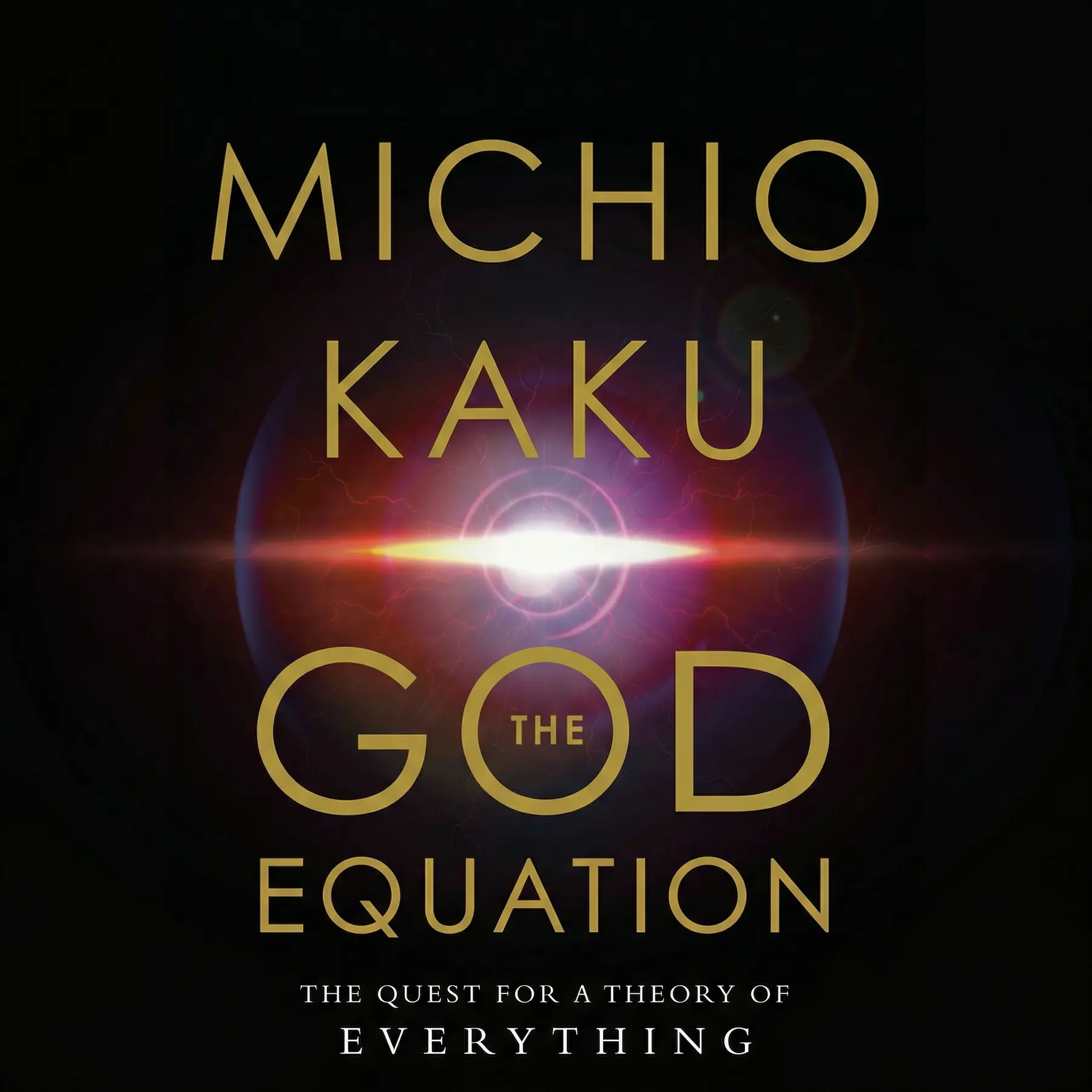
The God Equation: The Quest for a Theory of Everything
By Michio Kaku
Explains how physics moved from Newton's gravity to Einstein, quantum theory and the Standard Model, and why one final step remains: a single equation joining gravity to the quantum world, possibly through string theory.
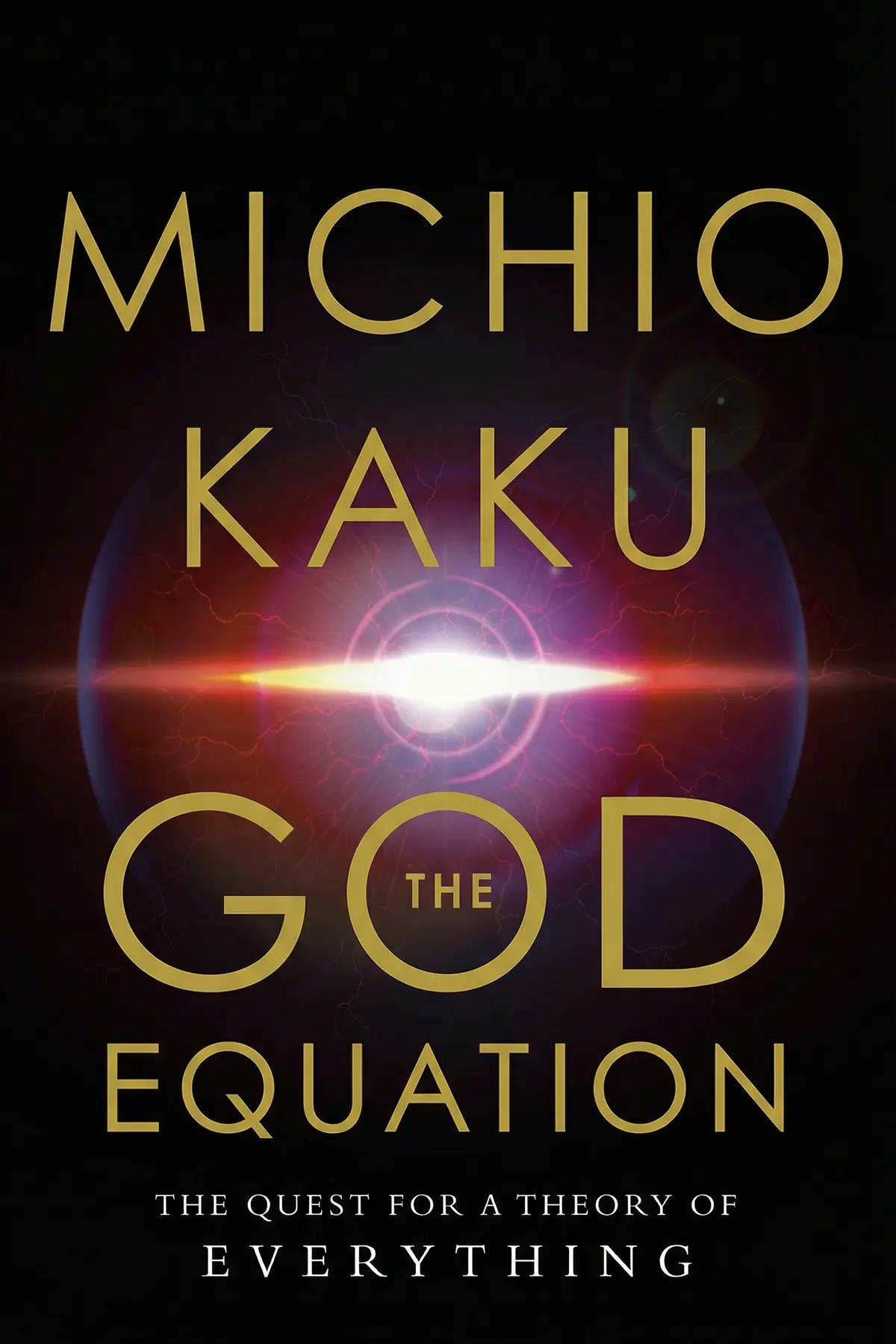
Table of Content
1. Introduction
1 min 04 sec
Physics has two rulebooks. Both work brilliantly, and they flatly contradict each other: one covers gravity and the very large, the other the tiny world inside atoms. In The God Equation, theoretical physicist Michio Kaku, a co-founder of string field theory, tells the story of the hunt for a single equation that would merge them.
His throughline is easy to state. Some of the biggest steps in physics, from Newton and Maxwell to the Standard Model, came from showing that things once seen as separate follow one set of rules. The last leap, if it comes, would join gravity to the quantum world in a theory of everything.
The story moves from Newton’s falling apple to Einstein’s curved space, and from a cat that is alive and dead at once to strings vibrating in ten dimensions. By the end, the headlines about black holes, the Higgs boson and the multiverse fit together, and you hold a clear map of what physics knows, what it suspects and what is still open.
2. Spot the pattern behind every big physics leap
1 min 53 sec
For most of history, people assumed the sky and the ground ran on different rules. Two English thinkers proved otherwise, and the move they made became the template for everything physics has tried since.
3. Picture gravity as a bowling ball on a mattress
1 min 52 sec
A train racing a beam of light exposed a contradiction at the heart of physics. Resolving it changed what time, space and gravity mean, and clocks on airplanes have since confirmed the strange result.
4. Discover that atoms are mostly empty and full of chance
1 min 53 sec
The solid table under your hands is almost entirely empty, and the rules inside it run on odds instead of certainty. Even Einstein called those rules absurd, yet they gave us lasers and transistors.
5. Know which forces are joined and which are missing
1 min 58 sec
A giant machine in Geneva confirmed one of the most successful theories in science in 2012. So why do physicists still call it unfinished, and what exactly is it leaving out?
6. Read black holes as tests of today's theories
1 min 57 sec
Fifty-three million light-years away sits an object so heavy that light cannot escape it. Einstein thought such things impossible. Today they are among the best laboratories physicists have for finding the cracks in their own ideas.
7. See how tiny strings could join gravity and quantum
2 min 08 sec
Every attempt to add gravity to quantum math produced nonsense, until a few physicists imagined particles as vibrations. The idea works on paper, but it demands extra dimensions, and spotting its graviton would take an accelerator a quadrillion times more powerful than the Large Hadron Collider.
8. What a final equation could and couldn't answer
1 min 58 sec
Strangers wrote to Einstein asking whether he believed in God, and his answer surprised many of them. It also hints at what a theory of everything would truly change, and what it would leave untouched.
9. Conclusion
1 min 12 sec
The God Equation keeps returning to one move. Newton tied the apple to the moon, and Maxwell tied electricity to magnetism. Einstein tied gravity to the shape of space, and the Standard Model drew three forces into one framework. Each step made the world look stranger and simpler at the same time. The step still missing is the hardest: placing gravity in the same equation as the quantum world.
That frame makes physics news easy to sort. When a story mentions a black hole, a ripple left by the big bang or a new particle found in Geneva, ask whether it helps bridge Einstein’s rulebook and the quantum one. When someone calls string theory proven, or waves it away as fantasy, give the fair version. It is elegant and mathematically consistent, it needs ten dimensions, and testing it would take a machine a quadrillion times stronger than any we have.
When the conversation turns to God, Einstein’s answer is worth borrowing. What he believed in was the conviction that the universe is orderly enough to be written down, and the search for that equation is still going on.
About this book
What is this book about?
Physics runs on two rulebooks that both work extremely well and do not fit together. Einstein's relativity describes gravity, planets and black holes. Quantum mechanics describes the tiny, uncertain world inside atoms. Theoretical physicist Michio Kaku tells the story of the search for one equation that would join them, a theory of everything he calls the God equation. Kaku follows a single pattern through four centuries. Newton showed that one force moves an apple and the moon. Maxwell merged electricity and magnetism. Einstein recast gravity as curved space-time, and the Standard Model brought three of the four fundamental forces into one framework. Gravity is still the one left out. Kaku looks at how black holes and the afterglow of the big bang test current theories. He then makes the case for string theory, which pictures particles as tiny vibrating strings in ten dimensions, and he is open about the fact that no experiment has confirmed it. Readers get a clear map of modern physics: what is settled, what is still argued over, and the philosophical questions a final theory would still leave open, from Einstein's idea of God to the multiverse.
Book Information
Who it's for
Professionals who follow science
Curious professionals who follow science news but cannot connect relativity, quantum theory and the Higgs boson.
Starting physics or philosophy
Students starting physics or philosophy who want the big picture before the details.
Drawn to multiverse questions
Readers drawn to questions about the multiverse and what science can say about God.
About the Author
Michio Kaku
Michio Kaku is a professor of theoretical physics at City College of New York and the CUNY Graduate Center, and a co-founder of string field theory. Four of his books became New York Times best sellers, among them Physics of the Impossible and The Future of the Mind. He has hosted TV specials for the BBC, Discovery Channel, History Channel and Science Channel. In 2021 he received the Sir Arthur Clarke Lifetime Achievement Award for linking science with science fiction.
Ratings & Reviews
Ratings at a glance
What people think
Listeners value the thorough overview of breakthroughs in physics and how the work turns difficult concepts into understandable material. The prose is straightforward and easy to grasp, as one listener points out its success in demystifying intricate ideas, and many consider the text simple to track. The title earns praise for its handling of string theory, particularly one review that calls attention to the storytelling approach used. Reactions to the tempo are varied; some feel the delivery is direct while others characterize it as disorganized.
Top reviews
Nattapong
Kaku has a gift for making the most brain-bending concepts in theoretical physics feel like common sense. In this book, he traces the history of unification from the ancient Greeks all the way to the controversial world of string theory. I found the narrative regarding Maxwell’s equations and Einstein’s pursuit of a 'God equation' to be particularly gripping. It’s a slim volume, but it packs a punch by explaining how symmetry serves as a guiding light for physicists. While some might find the later chapters on the multiverse a bit speculative, I personally loved the ambition of his vision. It’s rare to find a science book that feels this poetic and accessible without sacrificing the intellectual weight of the subject matter.
Show moreLek
Finally got around to reading this during a weekend trip, and it was exactly the kind of mind-expansion I needed. Kaku frames the universe as a symphony of vibrating strings, which is a beautiful way to visualize the 'God equation.' I particularly appreciated how he addressed the philosophical implications of these theories, mentioning how Einstein’s God was one of order and elegance rather than a personal deity. The book is remarkably fast-paced and avoids getting bogged down in dense mathematics, making it perfect for the layperson. It makes you realize that behind the chaos of the world, there is a hidden mathematical harmony that we are only just beginning to decode. Absolutely fascinating and highly recommended for curious minds.
Show moreAmy
Wow, what a journey through the eons of human thought. In an era defined by daily stressors and political noise, reading about the fundamental vibrations of the cosmos is incredibly soothing and puts everything into perspective. Kaku is a master communicator who doesn't talk down to his audience. He starts with the ancient Greeks and Thales of Miletus, showing that the quest for a single substance is one of our oldest instincts. The way he describes string theory as a 'music' that makes up all matter is just stunning. It’s the kind of book that reminds you why science is so important—it’s not just about gadgets, but about fulfilling our basic human desire to understand where we came from. Five stars.
Show moreWittaya
The concept of a single 'God equation' that governs everything from the expansion of the universe to the tiny dance of subatomic particles is the ultimate scientific holy grail. Kaku’s book is a brilliant tribute to the people who dedicated their lives to finding it. I loved the specific details about how Maxwell's work paved the way for the electronic age, and how Einstein’s E=mc² changed our understanding of reality itself. Some might call the book 'pop-science,' but there is real depth in how he frames the importance of symmetry in the world of particle physics. It’s a short read, but it’s dense with big ideas that will stay with you long after you close the cover. A must-read for any science lover.
Show moreLogan
If you're looking for a crash course on how we got from Newton to String Theory, this is it. Kaku’s writing is exceptionally clear, and he manages to distill centuries of complex discovery into a very readable timeline. To be fair, the first half of the book covers ground that most science buffs will already be familiar with—Newton, Faraday, and the standard model. However, the way he connects these milestones to the current quest for a theory of everything is quite masterfully done. My only real gripe is that the pacing felt a little rushed toward the end when he finally gets into the weeds of 11-dimensional membranes. Still, for a general audience, this is a top-tier introduction to the field.
Show moreNathan
The transition from Maxwell’s electromagnetism to Einstein’s relativity is handled with such narrative grace that it feels more like a detective story than a science textbook. I’ve always struggled to understand why gravity is the 'odd man out' in the standard model, but Kaku explains the conflict between general relativity and quantum mechanics better than most. Not gonna lie, the 10th and 11th dimensions still make my head spin, but the author's clear prose helps keep you grounded. The book does feel a little short for such a massive topic, and I wish he had spent more time discussing rival theories like loop quantum gravity. Regardless, it’s an inspiring read that makes you feel the weight of our scientific heritage.
Show moreJom
After hearing Kaku on a podcast, I expected a dense tome, but I was pleasantly surprised by how briskly this moves. He has a way of summarizing complex breakthroughs—like the unification of the weak and electromagnetic forces—in just a few paragraphs without losing the core meaning. The 'God' in the title might be a bit of a marketing gimmick, but it serves to highlight the ultimate goal of physics: a single, elegant equation for everything. The truth is, it’s a very optimistic book. Even when he discusses the potential heat death of the universe, he offers the hope of the multiverse. It’s a quick, punchy read that left me thinking about the cosmos for days afterward.
Show moreParichat
In my experience, most physics books for the layperson either treat the reader like a child or lose them by page ten with complex math. Kaku finds a solid middle ground here. He walks us through the four fundamental forces with ease, though the pacing can feel a bit uneven at times. Some chapters fly by while others linger on historical anecdotes that feel slightly repetitive. Personally, I found the discussion on St. Thomas Aquinas and the 'first mover' argument to be a surprising and welcome addition. It shows that science and philosophy are often asking the same questions. While it’s not a deep dive into the math, it provides a very clear roadmap of where physics is heading.
Show moreOscar
Is this book for everyone? Probably not if you’ve already devoured everything by Brian Greene or Stephen Hawking. Frankly, I found this to be a very superficial overview of the history of physics. The first 140 pages are mostly a recap of things we’ve heard a dozen times before, and the actual 'string theory' content feels like an afterthought. Kaku writes with great energy, and his enthusiasm is definitely contagious, but there isn't much here for someone seeking deep technical insight. It’s a great 'entry-level' book for a teenager or someone new to the topic, but seasoned readers might find it a bit like a greatest hits album with no new tracks. It's fine, just not groundbreaking.
Show moreKavya
Look, I wanted to love this, but the heavy reliance on 'symmetry' as the sole proof of scientific truth felt more like an aesthetic preference than rigorous physics. Kaku spends a lot of time praising the beauty of equations, but as some critics have pointed out, nature isn't always symmetrical—just look at gastropods or the irregular shape of the Earth. The historical sections also felt a bit sloppy and hagiographic, especially his portrayal of Newton. He brushes over the fact that Newton was deeply involved in alchemy and the occult, presenting a sterilized version of history. By the time we get to string theory, it’s all hand-waving and 'what-if' scenarios without enough focus on the lack of experimental evidence. It felt more like a sales pitch than a balanced analysis.
Show moreQuestions about this book
What is the main idea of The God Equation by Michio Kaku?
Kaku argues that physics advances by uniting forces once thought separate. Newton joined earthly and heavenly motion, Maxwell joined electricity and magnetism, and the Standard Model joined three of the four fundamental forces. Gravity, described by Einstein, still stands apart. A theory of everything, which Kaku calls the God equation, would bring all four together, and he sees string theory as the most promising candidate.
Why are relativity and quantum mechanics incompatible?
Relativity treats gravity as the curving of space-time and makes firm predictions, while quantum mechanics governs the tiny world of atoms and deals only in probabilities. To join the two, you need a carrier particle for gravity, the graviton, and in Kaku’s account every standard calculation that includes it yields meaningless results. String theory claims to fix this by treating particles as vibrations of tiny strings.
Has string theory been proven?
No. Kaku acknowledges that no experiment has confirmed it. Detecting the graviton the theory predicts would take a particle accelerator a quadrillion times more powerful than the Large Hadron Collider in Geneva. Its appeal lies in its mathematical symmetry, which lets troublesome terms cancel, and Kaku reports that many physicists still regard it as the best model so far.
Does a theory of everything prove or disprove God?
Neither, in Kaku’s telling. Such a theory would reveal one elegant order behind all of reality, close to what Einstein meant by Spinoza’s God. It could explain how the universe works, yet not why it exists, what set its laws in place or what came before it. Some people call that unknown source the First Mover, and for some it is God.
Who should read The God Equation?
It suits readers who want a clear, nontechnical map of modern physics, from Newton and Maxwell through Einstein, quantum theory and the Standard Model to black holes and string theory. It also suits anyone interested in the philosophical side of science, such as the multiverse, extra dimensions and what a final theory would and would not answer.
Readers also enjoyed

A Planet of Viruses
Carl Zimmer

A Short History of Nearly Everything
Bill Bryson

A Thousand Brains: A New Theory of Intelligence
Jeff Hawkins




Alien Earths: The New Science of Planet Hunting in the Cosmos
Lisa Kaltenegger


AUDIO SUMMARY AVAILABLE
Listen to The God Equation in 15 minutes
Get the key ideas from The God Equation by Michio Kaku, plus 5,000+ more nonfiction titles.
- 5,000+ titles
- Listen as much as you want
- 7-day free trial
- Cancel anytime









