
12 min 34 sec
Available in: English
 ไทย
EnglishไทยHyperspace: Journey Through Parallel Universes and the 10th Dimension
By Michio Kaku
Explains in plain terms why many physicists suspect the universe has ten dimensions, how hidden dimensions could unite the four forces of nature, and why string theory remains unsolved and untested.
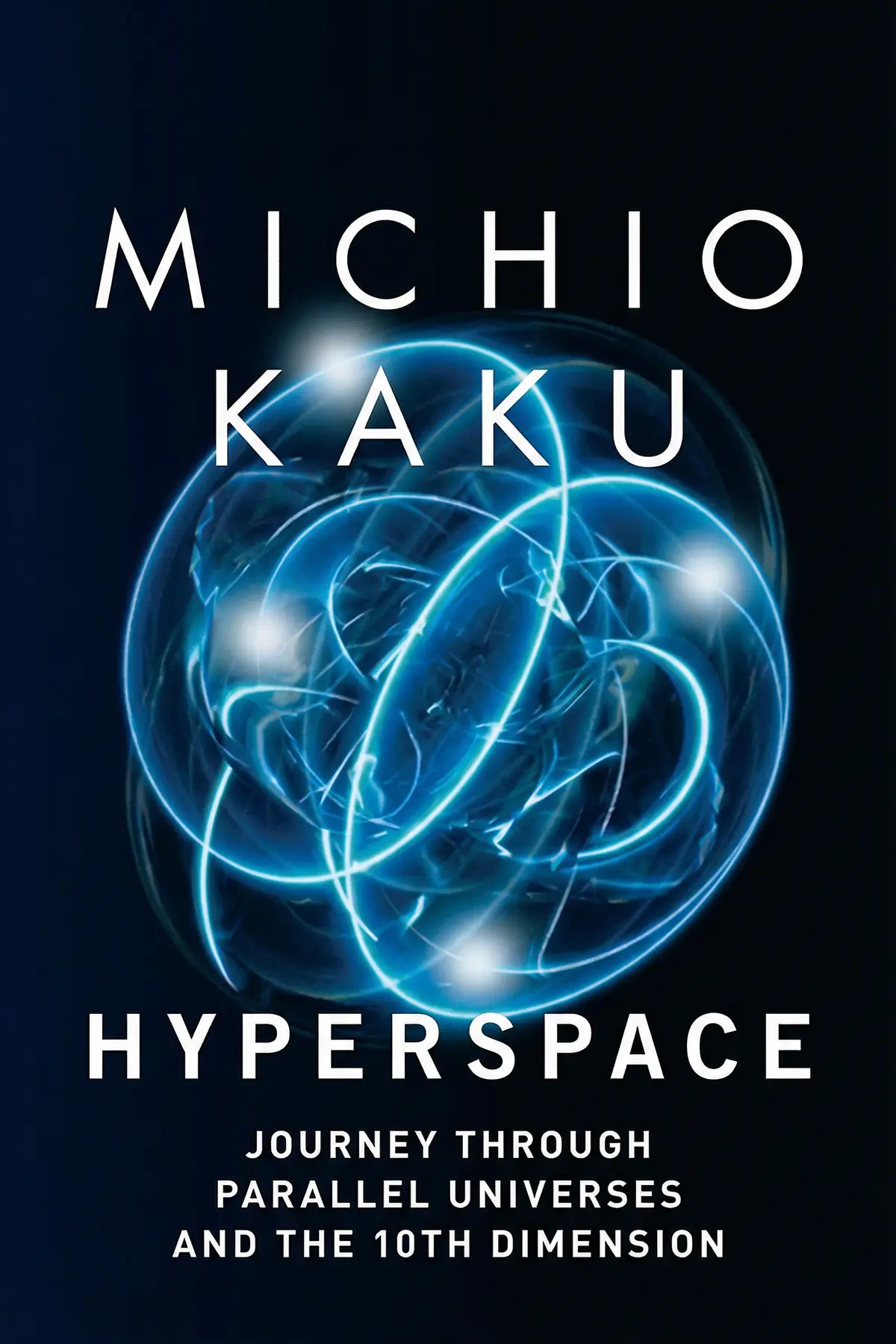
Table of Content
1. Introduction
59 sec
If the phrase string theory makes you nod politely and change the subject, the core idea is simpler than its reputation: the universe may have ten dimensions, and the four forces of nature may look like one only when all ten are counted. That is the case theoretical physicist Michio Kaku makes in Hyperspace. He argues that the laws of physics seem scattered because we study them in the cramped space we can perceive, and that they become simple and unified in higher-dimensional space, which he calls hyperspace.
The idea runs from a letter Einstein received in 1919, through string theory, to black holes that may connect separate universes. Kaku is also frank that none of it has been tested yet. Follow the thread and you will be able to tell a friend what a hidden dimension is, why physicists take it seriously, and exactly what stands between the theory and proof.
2. See how extra dimensions could simplify nature's laws
1 min 51 sec
Most of us live comfortably with three dimensions plus time. A group of physicists thinks that picture is too small, and a caged cheetah helps explain what we might be missing about the forces of nature.
3. See how a fifth dimension joins light and gravity
2 min 11 sec
In 1919 Einstein opened a letter from an unknown mathematician offering an answer he had failed to find himself. The catch was a dimension nobody could see, and a reason why nobody ever would.
4. Picture every particle as a tiny vibrating string
2 min 18 sec
After one promising theory collapsed into meaningless infinities, physicists found a new way to picture matter itself. It seemed to hold everything together, but it demanded one oddly specific number that nobody can explain.
5. Know what stands between string theory and proof
2 min 02 sec
A theory that may explain everything has a problem most enthusiasts skip over. Pooling every country’s treasury would not pay for the test, and one canceled machine shows how far away proof still sits.
6. See black holes as possible doors to other universes
2 min 03 sec
Falling into a black hole should be the end of any story. A spinning star and a mathematician’s solution from the 1960s suggest it could instead be a doorway to somewhere else entirely.
7. Conclusion
1 min 10 sec
Hyperspace, in the end, is an argument about where to look. Kaku’s claim is that nature only seems divided because we see it from inside three dimensions of space, the way a caged cheetah seems less than it is. Give the equations more room and things start to fit. Kaluza’s fifth dimension produced light from gravity, and string theory’s ten dimensions hold relativity and quantum mechanics in one frame. The same room lets black holes become tunnels and our universe become one bubble among many.
The honest part of the book is as useful as the daring part. The theory has too many solutions and no experiment strong enough to test it, and Kaku says so openly. That gives you a way to talk about the frontier of physics without hype and without dismissal. When you next hear about parallel worlds or time machines, ask two things: does the math require it, and could any machine check it? For string theory today, the first answer is yes and the second is not yet.
Kaluza’s fifth dimension waited decades for a second look. Ten dimensions may simply need longer.
About this book
What is this book about?
Physics describes four forces that look nothing alike: electromagnetism, the strong and weak nuclear forces, and gravity. Since Einstein, physicists have searched for one theory that brings them together. Michio Kaku argues that the search may only succeed once we stop limiting ourselves to the dimensions we can perceive. Kaku traces the idea from a 1919 letter in which the mathematician Theodor Kaluza showed that a fifth dimension could join gravity and light. He follows it through supergravity to string theory, which pictures every particle as a vibrating loop and works only in ten dimensions. Then he takes hyperspace into black holes, wormholes and the possibility of parallel universes. Readers get a clear account of what string theory claims and why some physicists see it as a theory of everything. They also get an honest map of its problems: equations with millions of possible solutions, and experiments that would need far more energy than any machine or budget can supply.
Book Information
Who it's for
Professionals curious about multiverses
Curious professionals who keep hearing about string theory and parallel universes and want to explain them clearly.
Beginning physics students
Students starting physics who want the big picture of unification before the heavy math.
Sci-fi fans
Science fiction fans who want to know which ideas about wormholes and time machines physicists take seriously.
About the Author
Michio Kaku
Michio Kaku, born in San Jose in 1947, is a professor of theoretical physics at City College of New York and the City University of New York Graduate Center, and a co-founder of string field theory. Four of his books, among them Physics of the Impossible and The God Equation, became New York Times best sellers. He has presented television specials on Science Channel, History Channel, Discovery Channel and the BBC, and in 2021 he received the Sir Arthur Clarke Lifetime Achievement Award for connecting science and science fiction.
Ratings & Reviews
Ratings at a glance

What people think
Listeners find this science book to be an absorbing and straightforward read, featuring lucid breakdowns of intricate topics. The prose is expertly crafted, and listeners value the way it delivers massive concepts in a reachable format. They appreciate the work’s deep dive into the speculative side of contemporary physics, especially Quantum Theory, and find it mentally stimulating; one listener even highlighted how the text renders the most abstract notions fascinating.
Top reviews
Amara
Wow, my brain is officially melted in the best way possible. Kaku has an incredible gift for making the most abstract concepts in theoretical physics feel not just understandable, but genuinely exciting to think about. I’ve always been intimidated by things like string theory and the curvature of space-time, yet this book laid everything out with such a lightness of touch that I actually felt like I was following along. Truth is, the way he uses the Flatland analogy to explain higher dimensions is one of the clearest explanations I’ve ever encountered in any medium. The transition from the historical work of Maxwell and Einstein into the speculative future of civilizations was absolutely seamless and kept me hooked until the final page. It’s rare to find a book that challenges your worldview while remaining this accessible to a general audience. This is essential reading for anyone who has ever looked at the stars and wondered about reality.
Show moreCherry
Picked this up because I wanted to understand the hype around string theory without needing a PhD in mathematics. It did not disappoint. Kaku manages to explain the evolution of dimensional theories in a way that feels like a grand adventure story. I was especially captivated by the descriptions of how our universe might have started with ten dimensions before six of them collapsed. It sounds like science fiction, yet the author grounds it in the actual developments of modern physics. Not gonna lie, some of the concepts are truly mind-bending, but the pictures and analogies help keep things grounded. Even though it’s an older book, the core concepts are still the foundation for what’s happening in physics today. It’s a well-crafted piece of literature that makes you feel smarter just for having read it. If you’re a fan of authors like Brian Greene, you absolutely have to add this one to your collection.
Show morePalm
After hearing so many people recommend Michio Kaku, I finally dove into Hyperspace and I'm kicking myself for waiting so long. This is easily one of the most engaging science books on my shelf. The way Kaku explores the possibility of parallel universes and higher dimensions is nothing short of inspiring. As a science fiction writer, I found the sections on the Kardashev scale and the energy requirements for a Type II civilization to be incredibly useful for world-building. But beyond the 'fun' stuff, the book provides a really solid foundation in the history of physics. Seeing how different theories have been overthrown and replaced over time gives a great sense of perspective on where we are today. The writing is clear, the chapters are well-paced, and the ideas are absolutely massive. It's the kind of book that makes you want to go out and buy five more just like it immediately.
Show moreTum
The chapter on Type I, II, and III civilizations completely reframed how I think about our future as a species. Kaku doesn't just explain the math of higher dimensions; he explains why it matters for the long-term survival of intelligence in the cosmos. His 'lightness of touch' makes even the most difficult parts of string theory feel like a breeze to read through. I loved the recurring references to the great scientists like Newton and Maxwell, as it grounded the more 'out there' theories in a historical context. Some might say it's a bit speculative, but in my experience, that's exactly what makes pop-science worth reading. It pushes the boundaries of what we think is possible. This book left me feeling incredibly optimistic about the power of human curiosity. It is a superb piece of writing that manages to make the Planck length seem just as exciting as a galaxy-spanning empire.
Show moreAnthony
This book acts as a perfect bridge between hard science and the kind of wonder you usually only find in top-tier science fiction. Kaku explores the evolution of dimensional theories with a clarity that is rare in this field, moving from the foundational laws of Newton to the complexities of a ten-dimensional universe. I particularly appreciated the historical context provided; seeing how Faraday and Maxwell paved the way for modern quantum theory makes the current research feel like part of a grander human story. Not gonna lie, some of the sections on hyperspace are heavy, but the author’s enthusiasm is infectious enough to carry you through the denser parts. The speculation about how an advanced civilization might eventually manipulate space-time is both haunting and inspiring. It is a thought-provoking journey that manages to make even the most abstract theories feel grounded in a quest for truth.
Show moreJackson
Ever wonder how many dimensions actually exist beyond the four we experience every day? This book tackles that head-on with some of the most accessible explanations of quantum physics I’ve ever come across. Kaku does a great job of walking the reader through the evolution of these theories, starting with the early pioneers and moving into the mind-bending world of hyperspace. I loved the way he utilized the Flatland concept to help visualize higher dimensions; it made the math feel tangible. However, the last quarter of the book leans very heavily into speculative futurology. While exploring how an advanced civilization might harness the power of a star is fun, it felt a little less 'hard science' than the rest of the text. Still, for a book written decades ago, it holds up remarkably well as a foundation for understanding string theory. It’s a thought-provoking read that will definitely leave your mind buzzing with new possibilities.
Show moreThida
Kaku has a real knack for taking these incredibly dense mathematical constructs and turning them into something a layman can actually visualize. I particularly enjoyed the historical sections where he discusses the contributions of Faraday and Maxwell. It’s fascinating to see how the search for a unified theory has shifted over the centuries from simple geometry to the ten dimensions discussed here. The writing style is engaging and mostly easy to follow, though I’ll admit I had to re-read a few sections on the Planck length to really grasp the scale. Personally, I found the discussion of the 'God equation' a bit repetitive, as Kaku tends to circle back to the same points quite often. That minor gripe aside, the book is a masterclass in making complex topics interesting. It’s a solid 4 stars for anyone who wants a deep dive into the fabric of reality without getting lost in the equations.
Show moreNong
To be fair, the first half of the book is much stronger than the second. The explanation of how dimensions were 'rolled up' during the early stages of the universe is absolutely brilliant and helped me understand string theory better than any YouTube video ever has. Kaku is a gifted communicator, and his enthusiasm for the subject really shines through in every chapter. However, the book gets a little lost in its own speculation toward the end. The chapters on wormholes and time travel felt more like a sci-fi pitch than a physics text, which might be a turn-off for some purists. I didn't mind it too much because it was entertaining, but the shift in tone was noticeable. Overall, it's an excellent piece of popular science that presents big ideas in a way that feels urgent and important. It definitely inspired me to look further into modern theoretical physics.
Show moreRung
It’s hard to ignore that this was published back in the early 90s. While Michio Kaku is clearly a brilliant physicist, the book suffers from being a bit of a 'greatest hits' reel of popular science tropes that have been covered better elsewhere. One moment he’s talking down to the reader with overly simplistic metaphors, and the next he’s diving into technical details that feel like they belong in a college lecture. I enjoyed the speculative bits about the Kardashev scale and Type III civilizations, but they felt disconnected from the earlier chapters on string theory. Look, the science is interesting, but the organization is a mess. It feels like he’s trying to hit every possible buzzword—from the anthropic principle to parallel universes—without ever settling on a singular point. It's an okay introduction if you’ve never read a physics book before, but seasoned readers might find it repetitive and slightly unfocused.
Show moreAnchalee
Frankly, I found this a bit of a slog. While the premise of 10-dimensional physics is inherently fascinating, Kaku’s delivery felt surprisingly dry and disjointed for such a celebrated pop-science book. I was expecting a narrative that flowed like a novel, but instead, it felt like a collection of vignettes that struggled to hold a central theme together. To be fair, the analogies were there, but many felt uninspired or repeated; the wood versus marble comparison, in particular, didn't do much to clarify the heavier concepts for me. It’s also quite dated at this point, which makes some of the futurology sections feel more like retro science fiction than actual science. If you're a complete beginner, you might find the sudden jumps from basic geometry to complex particle physics a bit jarring. I really wanted to love this, but it felt more like reading a series of academic papers than a cohesive exploration of the universe.
Show moreQuestions about this book
What is the main idea of Hyperspace by Michio Kaku?
Kaku argues that the four forces of nature, electromagnetism, the strong and weak nuclear forces and gravity, look unrelated because we only measure them in the dimensions we can perceive. In higher-dimensional space, which he calls hyperspace, their laws become simpler and may unify. String theory, which needs ten dimensions, is his leading candidate for that unified theory, and it also makes ideas like wormholes and parallel universes worth serious study.
Why does string theory need ten dimensions?
According to Kaku, the mathematics of string theory only works when space-time has exactly ten dimensions. Physicists do not know why this specific number is required. When they work through the equations, they keep meeting unusual modular functions, and the number ten keeps appearing. The extra dimensions build on an older idea from Theodor Kaluza, who showed in 1919 that a fifth, tiny curled-up dimension could join gravity and light.
Has string theory been proven or tested?
No. Kaku describes two obstacles. The main calculating method, perturbation theory, produces millions of possible solutions, and nobody has identified the one that matches our universe. Testing the theory would also need energy a quadrillion times greater than what is available today. The Superconducting Super Collider, expected to cost $11 billion, was canceled after political opposition, and even the strongest cosmic ray recorded on Earth was 100 million times too weak.
Does Hyperspace say wormholes and time travel are possible?
Kaku presents them as possibilities that scientists now take seriously, while stressing that none has been proven. Karl Schwarzschild’s mathematics of black holes implies a mirror universe linked by an Einstein-Rosen bridge. In the 1960s, Roy Kerr showed that a spinning collapsed star might let a probe pass through along its axis of rotation. Such a tunnel would be a wormhole, and if wormholes exist, a time machine could in principle be built.
Who should read Hyperspace?
It suits curious readers who want string theory and higher dimensions explained without equations, students who want the big picture of the search for unification, and science fiction fans who want to know where real physics ends and speculation begins. Kaku is a theoretical physicist and co-founder of string field theory, and he is open about the theory’s unsolved math and missing experiments.
Readers also enjoyed


A Life Decoded: My Genome: My Life
J. Craig Venter

A Planet of Viruses
Carl Zimmer

A Short History of Nearly Everything
Bill Bryson

A Thousand Brains: A New Theory of Intelligence
Jeff Hawkins




Alien Earths: The New Science of Planet Hunting in the Cosmos
Lisa Kaltenegger

AUDIO SUMMARY AVAILABLE
Listen to Hyperspace in 15 minutes
Get the key ideas from Hyperspace by Michio Kaku, plus 5,000+ more nonfiction titles.
- 5,000+ titles
- Listen as much as you want
- 7-day free trial
- Cancel anytime









