
15 min 45 sec
Available in: English
 ไทย
EnglishไทยThe Future of Humanity: Terraforming Mars, Interstellar Travel, Immortality, and Our Destiny Beyond Earth
By Michio Kaku
Michio Kaku sorts out the real obstacles to living beyond Earth, from radiation and thin air to cost and distance, and explains the technologies he expects to answer them, from reusable rockets to robots and light sails.
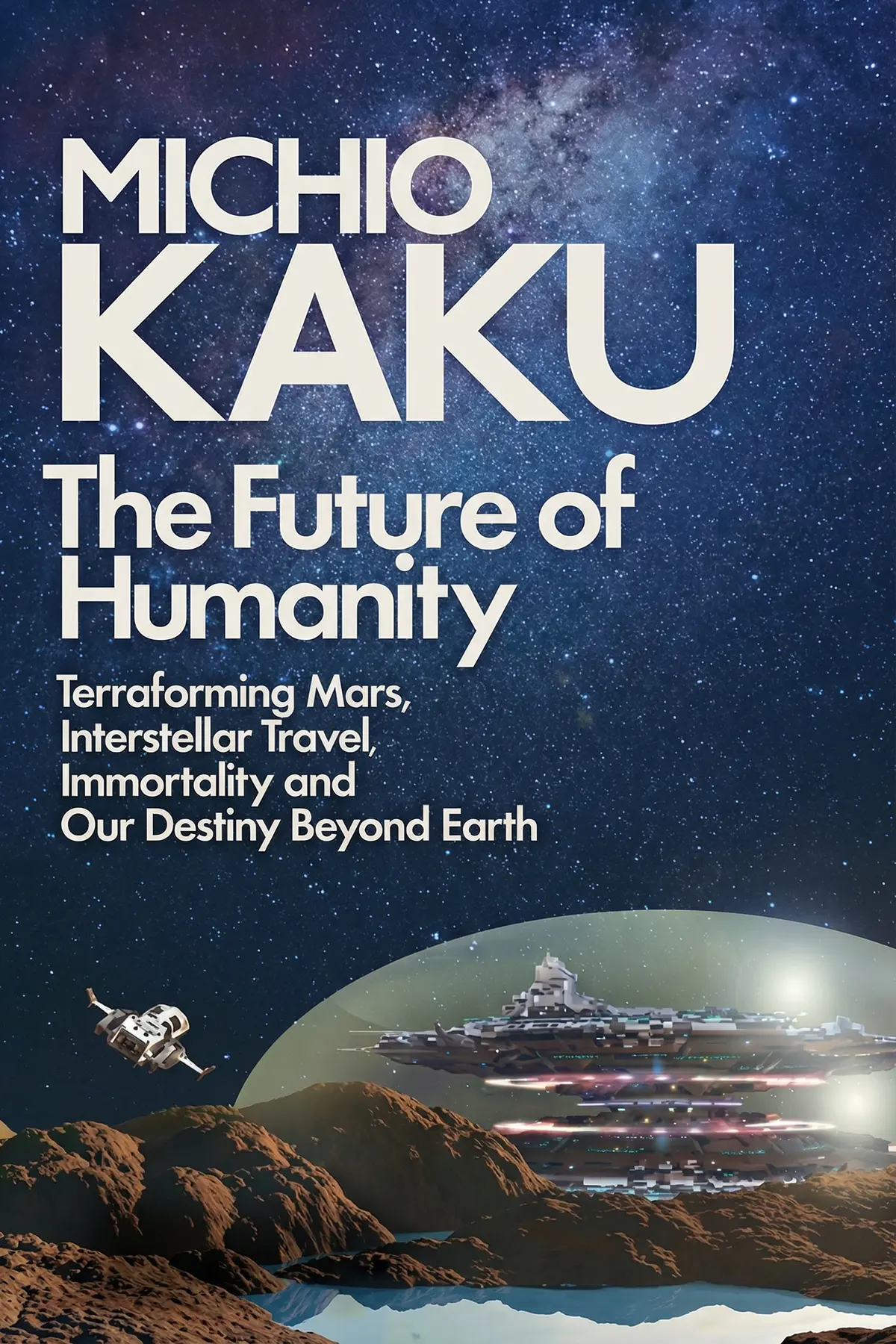
Table of Content
1. Introduction
1 min 00 sec
Most of us meet space colonies in films, where giant ships carry whole towns and domed cities sit on hostile worlds. In The Future of Humanity, theoretical physicist Michio Kaku argues that much of this is turning into an engineering problem, because private fortunes are now building supply lines between Earth, the moon and Mars.
His case has a twist. Rockets are the part we already understand. What decides whether people can live beyond Earth is everything after the launch: air, water, shelter from radiation, affordable building materials, workers who never tire, and ways to cross distances that take centuries. Kaku takes each obstacle in turn and names the technology he expects to answer it, from ancient lava tubes to a spaceship the size of a thumb pushed by light.
Follow his reasoning and any space headline becomes easy to judge with one test: does this solve getting there, or staying there?
2. Trace spaceflight back to one equation
1 min 38 sec
The rockets in today’s headlines rest on a formula published over a century ago. The path from that page to a weapon falling on European cities says a lot about what rocketry can and cannot do.
3. Discover how billionaires are bringing the moon back into focus
1 min 38 sec
After the triumph of 1969, the moon was all but abandoned for decades. What brought it back has less to do with governments than with a handful of very wealthy people and their long-term plans.
4. Air, water and shelter on the moon
1 min 39 sec
The moon has no breathable air and bakes under a sun that can cause cancer. Yet hidden in its shadows and beneath its surface are resources that could make a settlement possible.
5. Cheaper rockets bring Mars closer, not close
1 min 46 sec
One company cut the price of reaching orbit to a small fraction of what it used to be. But on the red planet, a tiny tear in a suit could do something truly alarming to your blood.
6. Let nanotubes and robots build the city
1 min 49 sec
Building on Mars the usual way could bankrupt entire countries. Kaku’s alternative depends on a material we can only make in tiny pieces and on workers who do not yet fully exist.
7. Scout other stars with a thumb-sized ship
1 min 38 sec
A spacecraft smaller than your thumb could reach the moon in seconds and our nearest star system within a lifetime. Making it work, though, would take far more power than any plant on Earth produces.
8. Surviving centuries between the stars
1 min 42 sec
Even if we find a second Earth, the trip could outlast many human lifetimes. The two ways around that problem raise awkward questions about freedom on one side and scientific hope on the other.
9. What any intelligent alien will share with us
1 min 45 sec
Forget the creatures from the movies. Reasoning from evolution alone, Kaku predicts several things any intelligent alien would almost certainly have, and one of them mirrors exactly what we hope to do in space.
10. Conclusion
1 min 10 sec
Kaku’s book works as an inventory of what is still missing. The rocket, hero of every space story, turns out to be the oldest and best understood piece, worked out on paper in 1903. Everything after the launch is where the future of humanity gets decided: oxygen pulled from lunar ice, homes inside dead lava tubes, walls of rolled carbon, robots willing to dig sewers under the hot Martian sun, light sails pushed by lasers parked on the moon.
His motive is plain. With pollution warming the planet, he argues, people are looking to the stars for a backup, which means either finding another habitable world or making the moon and Mars livable. Neither, in his view, will come from rockets alone.
The next time a launch makes headlines, try his test. Ask what it solves for air, water, radiation, gravity and cost, and which of those still waits on nanotechnology or intelligent machines. Most of the honest answer will sit in that second group.
Leaving Earth is the old part of the dream. Making a home somewhere else is the work still ahead.
About this book
What is this book about?
Space colonies have long belonged to films and novels: giant ships carrying whole towns, domed cities on hostile planets. Theoretical physicist Michio Kaku argues that much of this is now becoming an engineering question, as billionaires like Jeff Bezos and Elon Musk pour money into rockets and supply lines to the moon and Mars. His angle is that the rocket is the easy part. It was worked out on paper more than a century ago. The hard part comes after landing: making oxygen and finding water, hiding from radiation, keeping bodies healthy in weak gravity, and building homes without shipping every beam from Earth. Further out lie bigger problems, such as finding another Earth-like planet and surviving a trip that could take centuries. Kaku walks through each obstacle and the technology he expects to meet it: ice in lunar craters, ancient lava tubes, graphene sheets rolled into nanotubes, tireless AI-driven robots, thumb-sized nanoships pushed by lasers, multigenerational starships and anti-aging research. Readers get a clear map of what separates science fiction from a real future off Earth, and a test for judging the next space headline.
Book Information
Who it's for
Professionals who follow spaceflight
Curious professionals who follow SpaceX and Blue Origin news and want to know what is realistic.
Science and engineering students
Students of science and engineering looking for a clear map of the problems of living off Earth.
Science fiction fans
Science fiction fans who want to separate plausible futures from movie fantasy.
About the Author
Michio Kaku
Michio Kaku is a professor of theoretical physics at City College of New York and the City University of New York Graduate Center, and a co-founder of string field theory. Four of his books, including Physics of the Impossible and Physics of the Future, became New York Times best sellers. He has hosted television specials for the BBC, Discovery Channel, History Channel and Science Channel, and in 2021 received the Sir Arthur Clarke Lifetime Achievement Award for linking science with science fiction.
Ratings & Reviews
Ratings at a glance
What people think
Listeners find the material absorbing and straightforward, praising the high-quality prose that clarifies dense scientific subjects. They admire the author’s skill in revitalizing challenging themes, and one listener highlights how he distills elaborate theories. This narrative guides them through potential futures, instilling a sense of optimism, with listeners calling the result mind-blowing and entertaining.
Top reviews
Sombat
Dr. Kaku has a rare gift for making the most mind-bending concepts of astrophysics feel like a casual conversation over coffee. While some science books bury you in jargon, this one floats on a cloud of infectious optimism about where we are headed as a species. I was particularly gripped by the discussion on the Kardashev Scale and the idea of us becoming a Type I civilization within a couple of centuries. The way he bridges the gap between current NASA projects and the wilder shores of science fiction—like laser-propelled nanoships—is nothing short of masterful. You don't need a PhD to appreciate his vision of terraforming Mars or building cities on the moon. It’s a hopeful, sweeping journey that reminds us that our problems on Earth are just the beginning of a much larger story. If you’ve ever looked at the stars and wondered 'what if,' this is the roadmap you’ve been waiting for.
Show moreBrooklyn
Ever wonder what it would actually take to leave our solar system and find a new home among the stars? Kaku takes that question and runs with it, exploring everything from antimatter engines to the possibility of leaving our universe entirely if it ever faces a 'Big Crunch.' This isn't just a book about rockets; it's a philosophical inquiry into what it means to be human as we transition from a Type 0 to a Type I civilization. The chapters on bioengineering humans to survive on acid-resistant worlds were particularly thought-provoking, even if they felt a bit like a fever dream. Personally, I love how he weaves in references to pop culture and sci-fi to ground these astronomical concepts. He paints a future where we aren't just survivors, but masters of our own cosmic destiny. It’s an exhilarating read that left me feeling genuinely excited about the next few hundred years.
Show moreOmar
Wow, this book totally changed the way I look at the night sky. Kaku has this amazing ability to take something as dense as String Theory and make it feel as simple as a piece of twine. I was particularly blown away by the section on laser sails and how we could send tiny nanoships to Alpha Centauri within our lifetime. It’s rare to find a science book that is this entertaining while still being deeply informative. The vision he presents is one of ultimate hope—that humanity has the potential to outlive the Earth and even the sun itself. I especially liked the breakdown of the different types of civilizations and where we currently stand on that scale. Not gonna lie, some of the stuff about multi-dimensional travel hurt my brain a little, but Kaku’s enthusiasm is so contagious that I kept pushing through. This is a must-read for any dreamer.
Show moreNim
Finally got around to reading this, and it’s easily one of the most accessible books on astrophysics I’ve ever encountered. Michio Kaku doesn’t talk down to his readers; instead, he invites them on a journey to the ends of the universe. I loved the way he categorized the book into leaving Earth, voyaging to the stars, and finally, life in the universe. It felt like a natural progression of our species' growth. The concept that we might one day become 'the gods we once feared' is a powerful recurring theme that gives the book a lot of weight. Whether he’s talking about the composition of moon rocks or the mechanics of a black hole, his prose remains clear and vibrant. This is exactly the kind of book that inspires the next generation of scientists. I’ll definitely be checking out his other works like 'Physics of the Impossible' after this.
Show moreJom
The chapter on terraforming Mars alone is worth the price of admission. Kaku does a brilliant job explaining how AI, nanotechnology, and biotechnology—the 'fourth wave' of science—will be the keys to our survival. I’ve always been fascinated by the idea of making the Red Planet habitable, and this book provides the most lucid explanation of how we might actually do it. He doesn't shy away from the immense challenges, but his focus is always on the solutions. Frankly, it’s refreshing to read someone who believes in our potential to solve the biggest problems imaginable. From the chemistry of the moon’s interior to the physics of warp drives, every page offers a new 'wow' moment. It’s an informative, mind-blowing, and ultimately very human book. If you're looking for a reason to be hopeful about the future of our species, look no further than Kaku’s vision.
Show moreSai
Picked this up on a whim after seeing Kaku on a documentary, and I'm glad I did. The text is incredibly easy to follow, even when he dives into the nitty-gritty of String Theory and the potential for a multiverse. Truth is, some of the earlier chapters on Mars felt a bit like retreading old ground if you’ve already read about Elon Musk's plans, but Kaku adds a layer of theoretical physics that makes it feel fresh. He makes the 'impossible' seem like a simple matter of engineering and time. My only real gripe is that he occasionally repeats himself to drive a point home, which can slow the pace down for faster readers. Still, the section on transhumanism and modifying our DNA to survive the rigors of deep space was absolutely fascinating. It’s a solid 4-star read for anyone who wants a digestible look at our cosmic destiny.
Show moreSoontorn
After hearing Kaku speak on a podcast, I decided to dive into his latest work, and it didn’t disappoint. He starts with the practicalities—mining asteroids and establishing a permanent moon base—before launching into the truly wild possibilities of the far future. My background is in biology, so I found the parts about genetic adaptation to new worlds to be the most compelling section of the whole book. The idea of 'methane-metabolizing' humans is wild, but Kaku provides enough scientific context to make it feel plausible. Look, it’s a very optimistic book, and he does gloss over some of the political and social barriers to these advancements. But as a purely scientific and visionary exercise, it is incredibly well-written. The chapters are short and punchy, making it easy to digest in small sittings. If you want a break from the doom and gloom of the daily news, this is the perfect antidote.
Show moreScarlett
Not what I expected from a theoretical physicist, but in a good way! I thought this would be a dry textbook, but it reads more like a high-speed tour of the future. The details are what make it—like the explanation of why you’d suffocate and your blood would boil if you stepped onto the moon without a suit. It’s those visceral examples that make the science stick in your mind. While the later chapters on immortality and digital consciousness felt a little speculative, the foundation is solid. The truth is, Kaku is a master at simplifying complex ideas without making them feel watered down. I did feel like the transition from Mars to interstellar travel happened a bit too fast, but that’s a minor complaint in an otherwise stellar book. It’s an engaging, fast-paced read that leaves you with plenty to think about.
Show moreWit
As someone who loves hard science, I had mixed feelings about how much speculation is packed into these pages. Kaku is a brilliant communicator, and his explanation of the history of the moon and its composition was top-notch. However, once he moves into the distant future with dimensional portals and 'energy beings,' the book starts to feel more like a screenplay for a movie than a science text. To be fair, he does distinguish between what is possible now and what might be possible in a thousand years, but the line gets blurry. It’s an entertaining read, but I wish there had been a bit more focus on the immediate technological hurdles we face today. The writing is punchy and accessible, which I appreciated, but the 'gee-whiz' tone got a bit exhausting by the final third. It’s a decent overview, just be prepared for a heavy dose of 'what if' rather than 'how to.'
Show moreMint
Maybe it’s just me, but I found the writing style here to be incredibly repetitive and almost too simplistic for an adult audience. I went in expecting deep scientific insights, but many of the 'grand ideas' presented felt like tired tropes from 1950s sci-fi novels rather than cutting-edge physics. He spends pages explaining basic concepts like why our blood would boil on the moon, which is fine for a middle-schooler but felt a bit patronizing here. I’m not saying the information is wrong—Kaku clearly knows his stuff—but the tone just didn't click with me at all. It felt more like a collection of optimistic TED Talks than a cohesive scientific exploration of our future. If you’re already well-versed in space exploration, you might find yourself skimming through most of the chapters out of boredom. It’s certainly accessible, but for me, it lacked the intellectual weight I was looking for.
Show moreQuestions about this book
What is The Future of Humanity by Michio Kaku about?
Kaku examines whether humans could live beyond Earth, on the moon, on Mars or on planets around other stars. He traces rocketry from Tsiolkovsky’s 1903 equation to SpaceX, then focuses on the harder problems after launch: air, water, radiation, weak gravity, construction costs and huge distances. For each, he describes the technology he expects to help, such as lava tube shelters, graphene, AI-driven robots, light-sail nanoships and anti-aging research.
How could people survive on the moon according to Kaku?
Kaku points to ice hidden in shadowed lunar craters, estimated at six hundred metric tons at the north pole alone, as a source of drinking water and oxygen. Chemical reactions can also pull oxygen from soil. Solar panels on polar peaks where the sun never fully sets could supply energy, and settlers could shelter from cancer-causing radiation inside lava tubes left by ancient volcanoes.
Why does Kaku think robots and graphene are needed to build on Mars?
Building a Martian city with human crews and materials shipped from Earth could cost enough to bankrupt NASA or even nations, Kaku says. Graphene, about two hundred times stronger than steel, can be rolled into carbon nanotubes for buildings and bridges, though today only stamp-sized sheets can be made. AI-driven robots suit construction work that is dangerous, dull and dirty, and they never tire.
What is a nanoship and how would it reach another star?
A nanoship is a thumb-sized craft carrying a chip with billions of sensors, pushed by a light sail that catches the pressure of a laser or sunlight. It needs no rocket fuel and could reach Alpha Centauri, four light years away, in about twenty years. The challenges are power, at least 100 gigawatts, and precise laser aim, which Kaku suggests solving with stations on the moon.
Who should read The Future of Humanity?
It suits readers who follow private space companies and want to know what stands between today’s rockets and real settlements. Students get a clear overview of the technical problems of off-world living, from thin Martian air to weak gravity. Science fiction fans get a physicist’s view of which familiar ideas, from generation ships to alien life, have a scientific basis.
Readers also enjoyed

A Life Decoded: My Genome: My Life
J. Craig Venter

21 Lessons for the 21st Century
Yuval Noah Harari

A Planet of Viruses
Carl Zimmer


A Short History of Nearly Everything
Bill Bryson


A Thousand Brains: A New Theory of Intelligence
Jeff Hawkins
AI 2041: Ten Visions for Our Future
Kai-Fu Lee


AUDIO SUMMARY AVAILABLE
Listen to The Future of Humanity in 15 minutes
Get the key ideas from The Future of Humanity by Michio Kaku, plus 5,000+ more nonfiction titles.
- 5,000+ titles
- Listen as much as you want
- 7-day free trial
- Cancel anytime









