

15 min 33 sec
Available in: English
The Future of Work: Robots, AI, and Automation
West shows how robots, AI and connected sensors are already replacing human work. He argues that pay, benefits, training and politics must change now if the shift to a digital economy is to stay orderly.
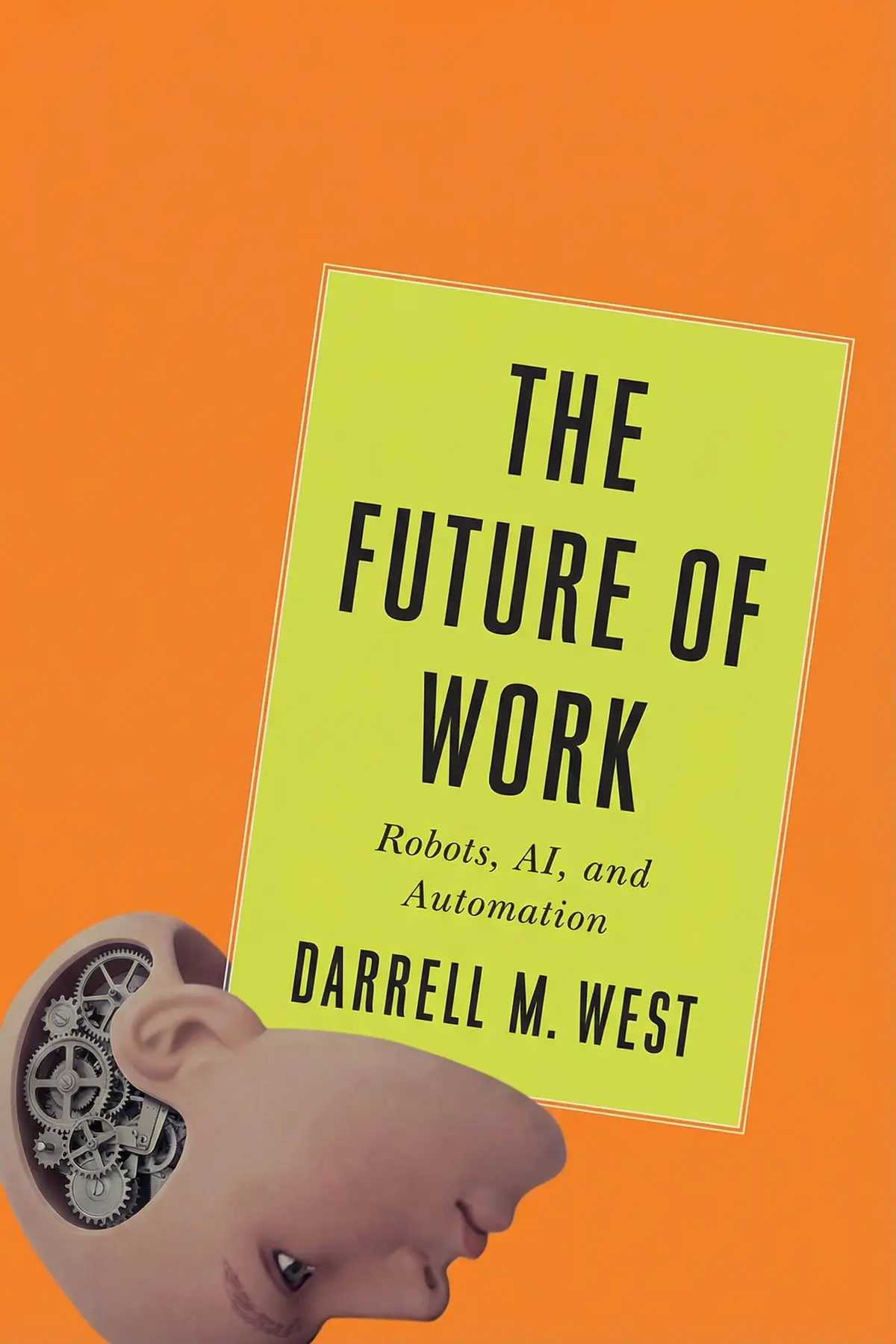
Table of Content
1. Introduction
1 min 05 sec
If your work runs on routine, a machine may already be cheaper than you, and the politicians who could soften the blow are barely talking about it. In The Future of Work, Darrell M. West of the Brookings Institution shows how close this is: one factory robot bought for $35,000 now does the work of four people, and it never needs health insurance. West describes the transition out of an industrial economy and into a digital one as a megachange, comparable to the United States shifting from farms to factories around 1900, an upheaval that government needed decades to absorb.
His throughline is direct. The machines will arrive either way. Whether they bring chaos or a smooth transition depends on how fast society rethinks which work gets paid, how benefits reach people, how long learning lasts and how politics makes decisions. By the end you will know which jobs are most exposed, where AI’s judgments go wrong and which policy ideas could keep a working life from falling apart.
2. See which jobs automation reaches first
2 min 04 sec
A metal parts maker and a phone factory show how fast the math has turned against human labor in some of the steadiest jobs open to people without a degree. Their numbers explain why companies will keep going.
3. Read every AI verdict as a human choice
2 min 11 sec
One official said AI was a century away; a tech chief called it a threat to civilization. Meanwhile, in Chicago, software was already deciding where police should look, and residents noticed something troubling about its choices.
4. Connected sensors are set to remake health and cities
1 min 58 sec
A city in Taiwan watches the hearts of older residents through free wi-fi, and some American towns hear gunshots before anyone calls for help. Sensors are changing public services in ways that touch almost every household.
5. Value the work that has never earned a wage
2 min 10 sec
Parenting, mentoring and volunteering keep communities running, yet none of them earns a salary or a pension. A novel from 1888 imagined a world where that changed, and one government has already moved part of the way.
6. A safety net that follows you between jobs
2 min 11 sec
A famous exchange on a Ford factory floor in 1954 exposed a flaw in automation that companies still overlook. Fixing it may mean changing where health insurance and pensions come from altogether.
7. Stalled politics makes the shift to a digital economy riskier
2 min 32 sec
In the United States, the people who could prepare workers for automation are barely discussing it. A handful of campaign donors and an old voting rule help explain why, and the cost falls hardest on one group of workers.
8. Conclusion
1 min 22 sec
West’s book adds up to a warning about timing. The robots, the learning software and the sensors are arriving because they make business sense, and no one expects a company to ignore a machine that does four people’s work. What is still undecided is whether the people they replace land somewhere or simply fall. The last megachange, from farms to factories, took decades to absorb, and West’s case is that this one cannot be allowed to drift that long.
His proposals share one idea: support should be attached to people, not to particular jobs. That means paying for parenting, mentoring and community work, letting health cover and pensions travel in a citizen account, and treating education as something that continues long after 25.
For the listener, a few habits follow. Judge your own role by how routine it is, and build skill in the interpersonal work McAfee expects to last. When an algorithm makes a call about you, remember that people chose its data and its idea of fairness. And keep part of your identity outside your job title, in family, community and the things you would do anyway.
Reuther’s question still stands. Machines can make the goods, but someone has to be able to buy them.
About this book
What is this book about?
Self-checkout machines, menu tablets, trading algorithms and driverless trucks are no longer experiments. They are spreading because they cost less and often make fewer mistakes than people do, and together they are pushing the economy from an industrial model toward a digital one. Darrell M. West of the Brookings Institution treats this as a megachange on the scale of the old move from farms to factories, and he asks what it will take to get through it without chaos. He looks at the blue-collar jobs most exposed to robots, at artificial intelligence making decisions in banking, defense, medicine and policing, and at sensor networks reshaping healthcare and city services. His answer is a set of reforms. He wants pay for socially useful work such as parenting, mentoring and volunteering. He proposes portable citizen accounts that carry insurance, pensions and training credit from job to job, learning that lasts a whole life, and political changes that reduce the pull of a few wealthy donors. Readers get a clear picture of which work is most at risk and which safeguards could make the transition a smooth one.
Book Information
Who it's for
Workers in routine jobs
Workers in retail, restaurants, transport or routine office roles who want to know how exposed their jobs are.
Self-employed worried about benefits
Freelancers and contractors worried that health cover and pensions depend on an employer they may not have.
Hoping to prepare workers
Managers, trainers and policy-minded readers looking for concrete ideas to prepare people for automation.
About the Author
Darrell M. West
Darrell M. West is part of the Governance Studies program at Washington, DC's Brookings Institution. Before that, he taught as a professor at Brown University in Rhode Island. His many books cover technology, governance and space, and besides The Future of Work they include Claiming the Cosmos: Who Owns the Final Frontier?
Ratings & Reviews
Ratings at a glance

What people think
Listeners find that although perspectives differ on whether the text provides fresh ideas beyond today's news, many value its broad analysis of how AI, automation, and the Internet of Things are altering conventional jobs. Additionally, they appreciate the inclusion of varied data and practical examples showing the likelihood of workforce displacement in areas such as finance and manufacturing. Furthermore, listeners highlight the author's progressive recommendations for social policy changes, like lifelong education and portable benefits, while one listener points out the book's perceptive look at how the healthcare industry might gain from such transitions.
Top reviews
On
After hearing about the inevitable robot uprising for years, I wanted a book that actually looked at the social infrastructure needed to survive it. West delivers exactly that with his focus on portable benefits and lifelong education. The way he explains the shift from traditional employment to a more fluid, digital economy is both brilliant and terrifying. It’s not just about robots taking jobs; it’s about how we value human contribution outside of a paycheck. He makes you realize that the safety net of the 20th century is completely inadequate for the 21st. The real-world examples from companies like Ford and McDonald’s provide a grounded perspective that balances out the more theoretical policy discussions.
Show moreOwen
The chapter on healthcare alone is worth the price of admission for this book. West shows how AI and automation can actually lead to better patient outcomes by freeing up humans for the caring aspects of the job. It’s a refreshing take. In a genre that is usually filled with nothing but doom and gloom, this stands out. He backs up his claims with a wealth of diverse statistics that show the complexity of the current job market. The idea of portable benefits—social safety nets that follow the worker rather than being tied to an employer—is a policy shift that we desperately need to discuss. This isn’t just a tech book; it’s a blueprint for a more humane future.
Show moreIsabella
As someone who spends way too much time worrying about job security, this was an eye-opening read. West manages to weave together the impact of AI and the Internet of Things into a coherent narrative that feels urgent without being purely alarmist. I especially appreciated the deep dive into how healthcare might actually see improvements even as manufacturing jobs vanish. To be fair, some of the policy suggestions regarding portable benefits feel like a pipe dream given our current political climate. However, the data points regarding the decline in the worker share of income are impossible to ignore. It’s a solid, statistics-heavy look at why our old ways of thinking about 9-to-5 employment are essentially dead.
Show moreRotjanee
Finally got around to this one, and I was impressed by how West uses historical anecdotes to paint a picture of our shifting economy. The story about Walter Reuther at the Ford factory asking how robots would buy cars is a classic for a reason, and it fits perfectly here. While many authors just talk about tech, West specifically looks at how the digital economy disrupts everything from finance to the service industry. I found his argument for lifetime education to be the most compelling part of the entire book. We can't expect a four-year degree to last forty years anymore. My only real gripe is that he glosses over the 'now what' for people who might not have the aptitude for high-level STEM roles.
Show moreAnawin
To be fair, the statistics West pulls together from sources like the Bureau of Labor Statistics and the IMF are incredibly useful for anyone thinking about this topic. He avoids the trap of being too academic, keeping the prose lean and moving the reader through the various dominos of displacement. I was particularly struck by the quotes from tech CEOs like Andrew Puzder, who basically argued that machines are better employees because they never take vacations or sue for discrimination. It's a wake-up call. The book makes a strong case that we are at a turning point similar to the Industrial Revolution. While it’s heavy on US-centric politics towards the end, the global implications are made very clear.
Show moreWoravit
Looking at the current economic landscape, it is clear that we are in the middle of a massive shift, and West captures that transition perfectly. He doesn't just focus on the machines; he focuses on the people and the systems that govern us. I appreciated the specific examples, like the McDonald's kiosks and the mentions of Harmony the sex doll, which make the theoretical threat of automation feel very real. The truth is, we are not prepared for the level of disruption coming our way. While I found the author’s tone a bit dry at times, the substance of his policy recommendations provides a necessary starting point for debate. It’s a comprehensive overview that manages to be both informative and unsettling.
Show moreYok
Darrell West provides a decent enough overview of the automation crisis, but it frequently feels a bit repetitive. He hits all the major notes: AI displacement, political polarization, and the need for universal basic income or similar reforms. Look, the statistics are well-researched. However, the book lacks a certain spark that makes the reader feel like they’re discovering something truly groundbreaking. I found the section on the Internet of Things (IoT) interesting, especially regarding its application in smart cities. But the author’s optimism about political reform seems misplaced considering how gridlocked everything is right now. It’s a good primer. If you are new to the subject, buy it, but seasoned readers might find it a bit thin.
Show moreAom
Ever wonder why our political leaders seem so out of touch with the digital revolution? West explores this gap quite well, showing how political inaction is the biggest hurdle to a smooth transition into the automated future. This is serious. The book does a fine job explaining the Internet of Things and how it facilitates real-time monitoring of everything from health to infrastructure, which is a massive change from how things used to work just a decade ago. Personally, I would have liked more focus on the ethical dilemmas of AI-driven surveillance. The solutions offered—like rethinking work to include volunteering—are intriguing. They lack a roadmap. It’s a thought-provoking read, though it leaves you with more questions than answers.
Show moreAroha
This book reads like a collection of news headlines that were hastily glued together. I was looking for a deep investigation into which specific jobs would be lost, but instead, I got a surface-level summary of things most people already know. Truth is, if you’ve been following tech news for the last five years, you won't find many new insights here. West spends too much time on the "what" and not nearly enough on the "how" or the "when." The writing feels dry and heavily padded with statistics that don’t always support his conclusions. Frankly, I expected more intellectual rigor from a Brookings scholar rather than a repetitive call for government-funded retraining.
Show morePrinya
A truly frustrating experience that left me feeling like I’d just read a long-winded government brochure. West clearly believes the state is the only answer to every problem, ignoring the fact that government inefficiency is often what holds us back in the first place. His proposals for reimagining work are just thinly veiled excuses for massive tax hikes and more bureaucracy. The book fails to define the actual technical limits of AI. It treats it instead as a magical force that will simply replace everyone overnight. Not gonna lie, I felt like I was being lectured by someone who hasn't stepped foot in a private-sector office in decades. It’s a waste of time for anyone looking for practical, market-based insights.
Show moreQuestions about this book
What is the main idea of The Future of Work by Darrell M. West?
West argues that robots, artificial intelligence and connected sensors are moving the economy from an industrial model to a digital one, a megachange as large as the old shift from farms to factories. Because automation saves companies money, it will continue. Whether the transition is smooth depends on rethinking which work gets paid, making benefits portable, treating education as lifelong and fixing a political system too divided to act.
What is a citizen account in The Future of Work?
A citizen account is a portable bundle of protections that some economists propose and West supports. Every worker would be entitled to it, whether employed full-time, part-time or not at all. It would include health and life insurance, retirement savings and unemployment pay, plus credit for further education and new skills. The aim is to stop basic security depending on a single employer.
Which jobs does the book say are most at risk from automation?
The first wave hits restaurants, retail and transport, long reliable for people without a college degree. Tablets are taking over parts of waitstaff work, self-checkout is replacing cashiers and driverless trucks threaten a job paying an average of $43,590. AI is also reaching finance, where bank branches could cut up to half their staff. MIT economist Andrew McAfee expects interpersonal jobs such as therapy and social work to last longest.
What ethical problems with AI does Darrell West describe?
West warns that AI can never be fully objective. Its predictions depend on the amount and quality of its data and on how designers define fair criteria. In Chicago, police use AI to predict which areas will see crime, and residents complain that innocent people there are being harassed. He also notes AI’s growing role in defense through the US military’s Project Maven.
How can I apply the ideas in The Future of Work?
Start by asking how much of your role is a repeatable routine a machine could do faster, and build skills in interpersonal work that is likelier to last. Treat learning as ongoing, using flexible online courses. When an algorithm judges you, ask what data it used. And keep part of your identity in family and community, as West notes people did for most of history.
Readers also enjoyed

A Warning
Miles Taylor



AI 2041: Ten Visions for Our Future
Kai-Fu Lee

Abolish Rent: How Tenants Can End the Housing Crisis
Tracy Rosenthal


Abortion: Our Bodies, Their Lies, and the Truths We Use to
Jessica Valenti


Adults in The Room: My Battle With Europe’s Deep Establishment
Yanis Varoufakis
AUDIO SUMMARY AVAILABLE
Listen to The Future of Work in 15 minutes
Get the key ideas from The Future of Work by Darrell M. West, plus 5,000+ more nonfiction titles.
- 5,000+ titles
- Listen as much as you want
- 7-day free trial
- Cancel anytime









