

15 min 14 sec
Available in: English
The Five Elements of Effective Thinking
Shows how to think more clearly and originally through five learnable habits: mastering the basics, learning from failure, asking sharper questions, building on earlier ideas and committing to steady change.
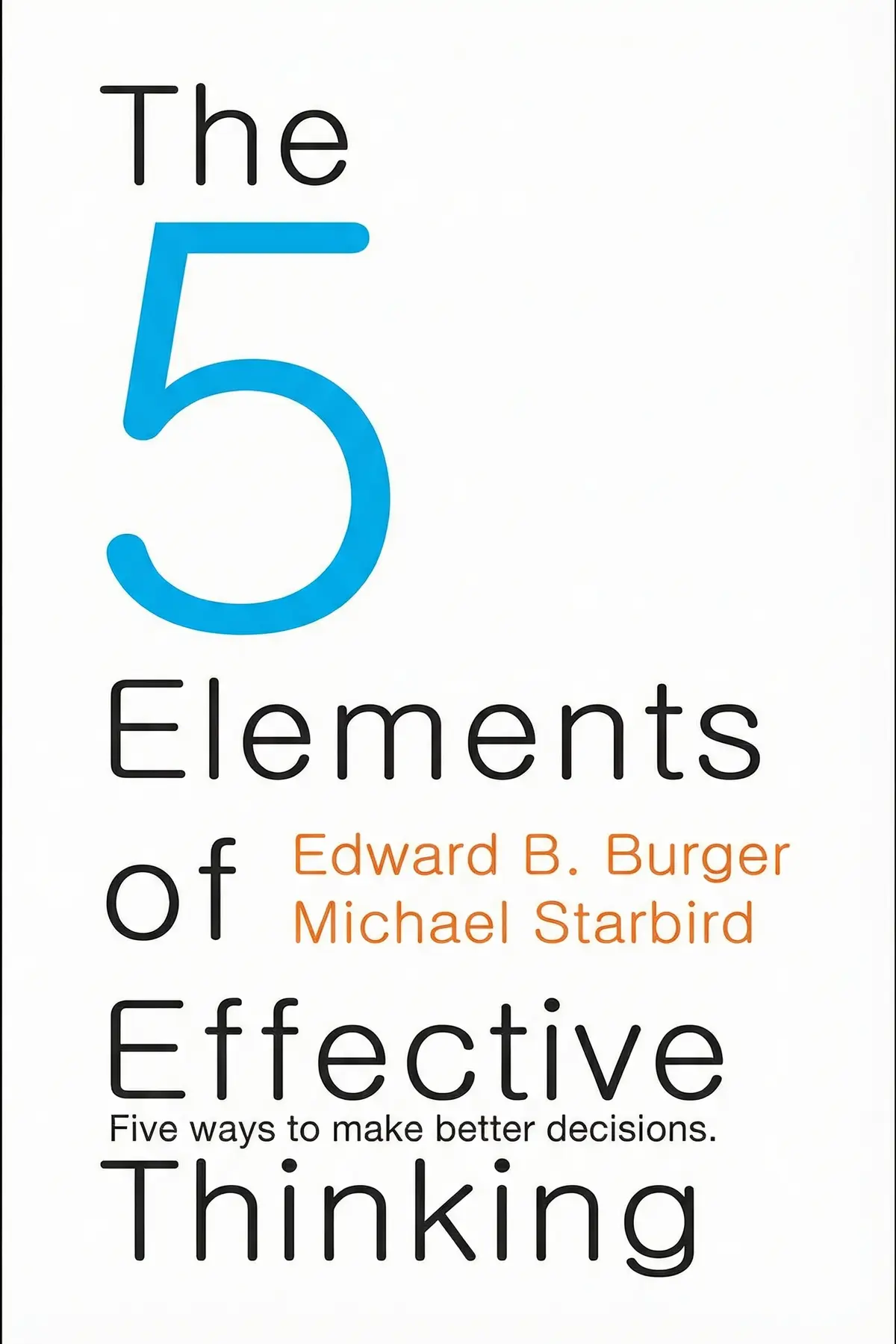
Table of Content
1. Introduction
1 min 08 sec
Most people facing a hard problem either push harder in the same direction or freeze. In The Five Elements of Effective Thinking, mathematicians Edward B. Burger and Michael Starbird argue that clearer, more original thinking is a set of habits anyone can practice, and that extraordinary people are mostly ordinary ones who use them.
They organize those habits around the classical elements. Earth means grounding yourself in the basics and the true center of a problem. Fire means learning from failure, including failure you invite on purpose. Air means asking sharper questions, and Water means letting each idea flow from older ones into new ones. Change, a fifth element, keeps the others going.
Their examples range from a trumpet master’s beginner exercise to a glue too weak to be useful that became the Post-it note. Along the way you pick up small exercises, such as a blank-page test of what you really know and a plan to fail nine times, that turn better thinking into something you can start tomorrow.
2. Master the basics experts never stop practicing
1 min 59 sec
A room of accomplished soloists played their hardest pieces brilliantly, then a simple exercise left them speechless. What their teacher showed them changes how you should prepare for any demanding exam, role or project.
3. Spot the real problem behind the obvious answer
1 min 47 sec
For a very long time, people were sure they knew how flight worked, and they were wrong. Two simple habits of observation help you avoid the same trap with the problems on your own desk.
4. Turn every mistake into your best teacher
1 min 47 sec
An inventor counted his thousands of failed attempts as discoveries, and a glue that failed its one job ended up on desks everywhere. Both stories suggest you may be throwing away your most useful results.
5. Fail on purpose to find weak spots sooner
1 min 53 sec
Expecting to fail sounds like a recipe for giving up. The authors argue it does the opposite, and they borrow tricks from product testers and paid hackers to show how planned failure gets you to a working answer faster.
6. Understand anything deeper by teaching it
1 min 51 sec
In the authors’ lecture halls, one randomly chosen student usually ended up understanding and remembering more than everyone else in the room. The reason had nothing to do with talent, and you can copy it in your next meeting or study session.
7. Ask the questions that actually lead somewhere
1 min 41 sec
Two men running from a bear, and a driver fuming in traffic, show how the question you ask decides the answer you can find. A small rewrite turns a dead-end worry into a plan.
8. Treat every solution as the start of the next idea
1 min 48 sec
The cartoon light bulb is a poor picture of how breakthroughs happen. The story of calculus, from six pages to thirteen hundred, shows where new ideas really come from and why finishing is the wrong moment to stop.
9. Conclusion
1 min 20 sec
The fifth element, change, is what keeps the other four alive. The authors recall an old saying that insanity means doing the same thing again and again while expecting different results. If your work or life is not going the way you want, staying on the same path and hoping it improves will not fix it. The elements supply the tools, but you have to bring a willingness to change, and to keep changing.
Burger and Starbird picture this as renovating a city. Nobody rebuilds a whole city at once. You repair one district, which takes time, then the next, and when you believe you are done, you go back and start on the first one again.
That image is worth keeping: good thinking as repair that never quite ends. You can begin this week with a blank page, writing down everything you know about a subject you claim to understand and checking it against a better source. When a problem leaves you frozen, try an approach you expect to fail and study the result. Before your next meeting, sharpen one vague question until it points to an action. Extraordinary people, the authors argue, are ordinary people who think differently, and thinking differently can be rebuilt one district at a time.
About this book
What is this book about?
Most people who hit a hard problem either push harder in the same direction or freeze. Edward B. Burger and Michael Starbird, two mathematicians with long teaching careers, argue that thinking well is less about talent than about habits anyone can practice. They organize those habits around the classical elements. Earth stands for mastering the basics and finding the real core of a problem. Fire stands for treating mistakes, even deliberate ones, as the best source of lessons. Air stands for asking questions, and for learning which questions lead somewhere. Water stands for the way ideas flow from older ones and keep flowing after a solution is found. A fifth element, change, keeps the others in motion. The examples are memorable and concrete: a trumpet master who made a beginner's exercise sound like a concert piece, a glue too weak to be useful that became the Post-it note, a student assigned to ask questions who learned more than everyone else. Readers get simple exercises, from a blank-page test of what they really know to a plan to fail nine times, that make sharper thinking a daily practice.
Book Information
Who it's for
Shaky on the fundamentals
Students and professionals who cram facts but still feel shaky on the fundamentals.
Avoiding new projects
Anyone who avoids new projects because they dread getting it wrong.
Team leads and teachers
Team leads and teachers who want people to ask better questions and build on each other's ideas.
About the Author
Edward B. Burger
Edward B. Burger is a mathematician and educator who taught at Williams College, served as a vice provost at Baylor University and became president of Southwestern University. He has written more than 60 research articles, books and video series and became a Fellow of the American Mathematical Society in 2013. Michael Starbird has taught mathematics at the University of Texas at Austin since 1974, specializing in topology. His teaching has won over a dozen awards, including the 2007 national teaching award from the Mathematical Association of America, and he directs the university's Inquiry Based Learning Project.
Ratings & Reviews
Ratings at a glance
What people think
Listeners find that this guide offers deep insights into educational techniques and productive ways to boost creative thought, featuring useful illustrations that are simple to track. Beyond that, they admire the brief yet polished prose, deeming it an essential read for university students and well worth the time and money. Finally, they appreciate the inventive strategies provided for solving complex problems.
Top reviews
Tun
This book should be mandatory for every incoming college student who thinks they already know how to study. Burger and Starbird cut through the academic noise to focus on what actually matters: understanding simple things deeply. Most people try to jump straight to complex theories, but the authors argue that true mastery starts with the basics. I was particularly struck by the Winston Churchill quote about moving from failure to failure with enthusiasm; it framed 'failing by intent' in a way that felt like a superpower rather than a setback. The writing is incredibly direct and clear, making it a quick read that packs a massive punch. If you want to refine your cognitive habits and stop just 'getting through' material, this is worth every penny and minute of your time. It’s a grounded, imaginative approach to problem-solving that I’ll be revisiting for years to come.
Show moreHugo
Ever wonder why some people process information so much more efficiently than the rest of us? This book provides the answer through its focus on deep understanding and effective questioning. Look, the way the authors describe 'creating questions out of thin air' is a total game-changer for active listening. I’ve started asking 'What if...' even when I think I know the answer, and it has opened up so many new perspectives in my work. The section on the 'flow of ideas' helped me see my current projects as being 'under construction' rather than fixed failures. I especially loved the Peter Drucker quote about the uselessness of doing efficiently what shouldn't be done at all. This book is a rare find: simple language, profound insights, and immediately applicable exercises. It’s easily one of the best learning-how-to-learn books I’ve encountered recently.
Show moreTaw
Wow, the simplicity of these five pillars is exactly what makes them so powerful. I’ve always been a fan of the 'always in beta' mindset, and seeing it formalized here as a core element of effective thinking was very validating. The authors don't just tell you to think better; they give you specific questions to ask, like 'How could the current solution be refined?' and 'What is the goal of this task?' These are the kinds of questions that provoke real change. The book is imaginative and practical, making it a perfect gift for anyone entering a creative field or starting a new academic journey. Frankly, the advice on 'finding the right question to the wrong answer' is worth the price of the book alone. It’s a concise, beautifully written guide that turns the daunting task of 'thinking' into a manageable, even fun, process.
Show moreWacharapol
Picked this up during a career transition and, frankly, I wish I had found it a decade ago. The core idea of 'clearing the clutter' to find the essential elements of a problem is something we often overlook in our rush to be productive. The authors use great examples, like the Sylvan Goldman shopping cart story, to show how a simple question can lead to a massive breakthrough. Truth is, the concept of being 'always in beta' really resonates with my current workflow. I did find a few of the illustrations to be a bit repetitive, but the advice on 'failing intentionally' to find the right question is solid gold. It’s an insightful guide that shifts your mindset from passive consumption to active, deep engagement. It’s a very practical manual for anyone looking to sharpen their mental toolkit without getting bogged down in dense psychological jargon.
Show moreYindee
Finally got around to finishing this, and I’ve got to say, the chapter on mistakes was a revelation. We are so conditioned to fear errors, but Burger and Starbird argue that our errors are actually 'portals of discovery.' They encourage failing by intent, which sounds crazy until you actually try it and see how it clarifies the real problem. The book is short, punchy, and avoids the fluff that plagues most self-help titles. I did feel that some of the 'Exercises' were a bit hit-or-miss, but the overall framework is very strong. I’ve started using the 'What’s the real question?' technique in my daily meetings, and it’s already helping me cut through the noise. It’s a must-read for anyone who feels stuck in their current problem-solving methods and needs an imaginative nudge to see things differently.
Show moreYothaka
As someone who spends way too much time in their own head, this was a breath of fresh air. It’s essentially a guide to developing better mental habits through simple, iterative steps. The advice to 'see what’s missing' really changed how I look at my own writing projects; it’s about noticing the gaps as much as the content. To be fair, some of the quotes felt a bit like 'greatest hits' from other business books, but the way they are woven into the 'five elements' narrative works well. The authors emphasize that deeper thinking isn't about being a genius, but about being more engaged with the material. It’s an insightful, quick read that offers a lot of value for its price. I especially liked the section on overcoming bias by intentionally asking 'Do I really know this?' It’s a healthy dose of intellectual humility.
Show moreNang
The chapter on asking the right questions really struck a chord with me. In my experience, most people spend all their energy patching leaks in a 'chronically leaking boat'—as the Buffett quote mentions—rather than just finding a better vessel. This book encourages you to step back and look at the flow of ideas rather than just the immediate problem. It’s an insightful look at how to deepen your understanding by clearing out the clutter and focusing on the essential. While I think a few of the sections could have been more concise, the overall impact is very positive. It provides a great roadmap for anyone looking to enhance their creative thinking and problem-solving skills. Definitely a solid addition to my library and a book I’ve already recommended to a few colleagues who are feeling stuck in their current projects.
Show moreSangduan
To be fair, the central premise here is incredibly powerful, but the execution felt a bit thin for a full-length book. The five elements—earth, fire, air, water, and change—serve as a nice metaphor for understanding, failing, questioning, flowing, and evolving. However, I found myself thinking 'I already knew this' more often than not. The authors provide many unnecessary illustrations for what are essentially very basic ideas. Don't get me wrong; the advice to focus on the 'flow of ideas' and to see what is missing is valuable, but it could have been a long-form essay rather than a book. It’s a decent introductory text for someone who has never thought about their own thinking processes, but for seasoned learners, it might feel a bit like a collection of common-sense platitudes disguised as profound wisdom. It's okay, just not groundbreaking.
Show moreYaowaluk
Gotta say, I'm a bit torn on this one. On one hand, the writing style is wonderfully accessible and the 'learning how to learn' tips are genuinely helpful. On the other hand, it feels a bit like a condensed version of other, more comprehensive books on the same topic. I recently read 'Six Thinking Hats,' and while this is less theoretical, it didn't feel as revolutionary as I hoped. The authors provide a good overview of creative thinking, but I wanted more on the 'how-to' and fewer stories about the Articles of Confederation. Still, the message about 'mastery of simple things' is a good reminder for anyone in a fast-paced environment. It’s a solid 3-star book for me—useful for a weekend read, but maybe not something I’ll keep on my permanent reference shelf.
Show moreRoo
Not what I expected based on the glowing reviews I've seen online. While I appreciate the sentiment of 'understanding simple things deeply,' the book itself felt a bit too elementary for my taste. It reads more like a motivational pamphlet than a serious dive into cognitive science or effective thinking. The anecdotes, like the one about the assembly line, felt like filler for concepts that are fairly intuitive. Personally, I found the constant repetition of the 'five elements' metaphor to be more distracting than helpful. If you’re a high school student or perhaps a struggling freshman, this might offer some value. However, if you've already read any modern books on habits or learning, you've likely encountered these ideas in much more depth elsewhere. It’s well-written, sure, but it lacks the meat I was looking for in a book about 'effective thinking.'
Show moreQuestions about this book
What is The Five Elements of Effective Thinking about?
Edward B. Burger and Michael Starbird argue that clear, original thinking is a set of learnable habits. They group them under five elements: Earth for mastering basics and finding a problem’s essence, Fire for learning from failure, Air for asking questions, Water for building on earlier ideas, and Change for continually improving. Their central claim is that extraordinary people are ordinary people who think differently.
What are the five elements of effective thinking?
Earth means understanding the fundamentals deeply and seeing what is really there, including what is missing. Fire means treating mistakes as lessons and even failing on purpose. Air means questioning constantly and choosing focused questions. Water means seeing every idea as part of a flow from past ideas to future ones. Change, the fifth element, is the willingness to keep improving, step by step, without ever declaring yourself finished.
How do you fail on purpose, according to Burger and Starbird?
The authors suggest expecting at least nine failures before success, so each miss counts as progress. They recommend writing ideas down without judging whether they are right, leaving evaluation for later. And they advise pushing ideas to extremes so their flaws appear, the way manufacturers run stress tests on products or companies hire hackers to probe their own computer systems for weak spots.
How can I test whether I really understand something?
Grab an empty page and list all that you already know on the topic, then check your list against a more authoritative source to spot the holes in your fundamentals. The authors also suggest preparing a short lecture for a friend or colleague, then writing an exam on it and checking whether your lecture lets you answer every question correctly.
Who should read The Five Elements of Effective Thinking?
It suits students preparing for demanding exams, professionals facing unfamiliar problems, and anyone held back by fear of failure. Team leads and teachers can use its classroom ideas directly, such as naming one person in a meeting or lecture as the questioner, a practice the authors found helped that person understand and remember the material better than anyone else.
Readers also enjoyed

59 Seconds: Change Your Life in Under a Minute
Richard Wiseman





A Guide to the Good Life: The Ancient Art of Stoic Joy
William B. Irvine


A High-Performing Mind: Strengthen Your Mind and Live Your Best Life
Andrew D. Thompson
AUDIO SUMMARY AVAILABLE
Listen to The Five Elements of Effective Thinking in 15 minutes
Get the key ideas from The Five Elements of Effective Thinking by Edward B. Burger, plus 5,000+ more nonfiction titles.
- 5,000+ titles
- Listen as much as you want
- 7-day free trial
- Cancel anytime









