

13 min 55 sec
Available in: English
The Filter Bubble: How the New Personalized Web Is Changing What We Read and How We Think
By Eli Pariser
Shows how personalized search engines and social feeds narrow the news and ideas each person sees, why that breeds overconfidence and weakens curiosity, and how to notice the filters and step beyond them.
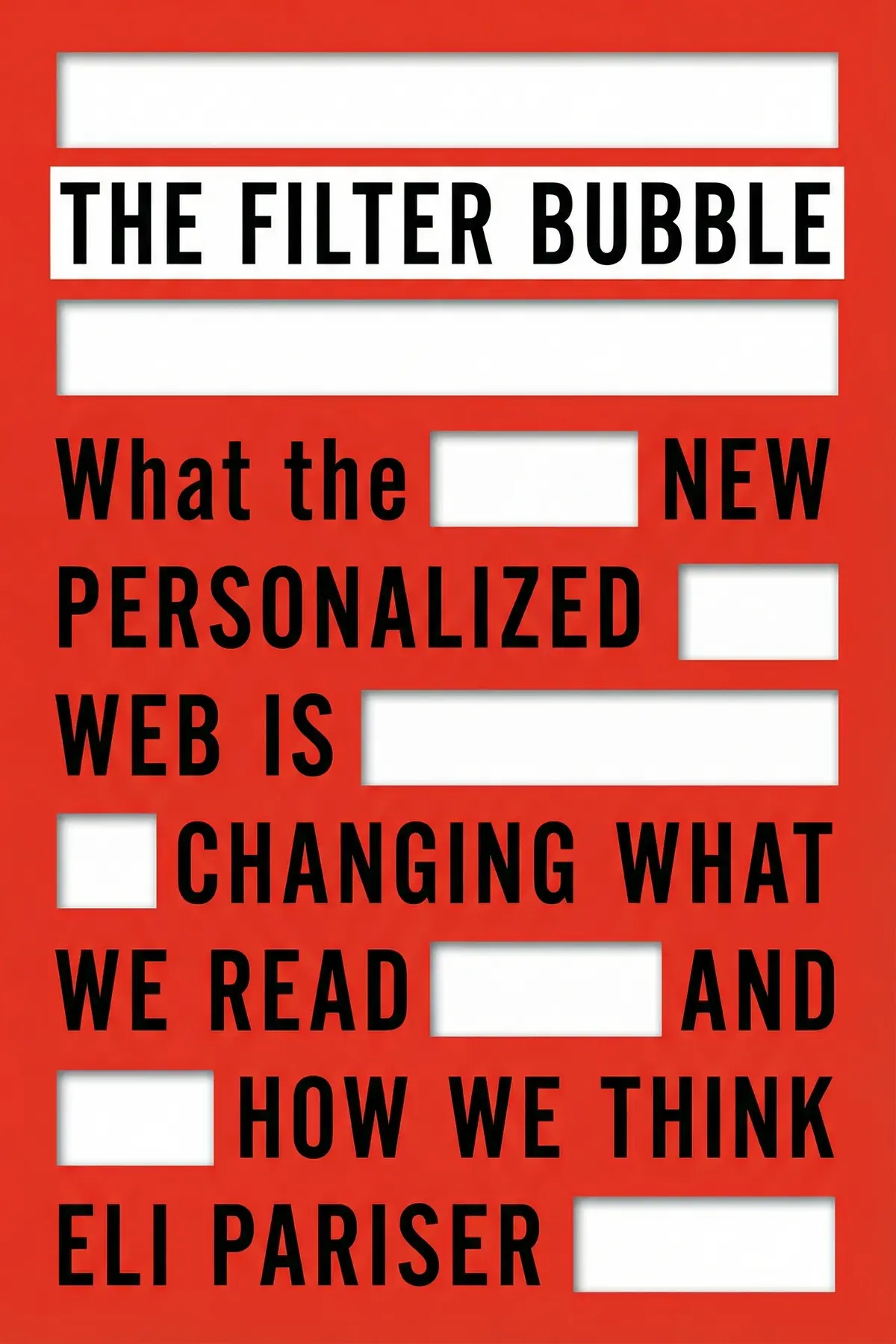
Table of Content
1. Introduction
1 min 10 sec
Most people treat a search page or a news feed as a window onto the whole world. In The Filter Bubble, Eli Pariser, who led MoveOn.org and co-founded Upworthy, argues it works more like a mirror. Companies such as Google, Facebook and YouTube build each person’s web around the data they hold on that person, so the view rarely reaches past what you already like and believe.
Pariser’s case runs in one line. Personalization began as a genuine answer to an overwhelming flood of information. But relevance feeds on personal data, and once the same filters began choosing the news, they started confirming our beliefs, starving our curiosity and even nudging who we become. The way out starts with knowing the bubble is there.
Along the way you will hear how much one company is believed to know about a typical household, why a newsroom scandal from 2004 shows both the promise and the risk of online news, and how a billboard in Tokyo reads the faces of people walking by. Above all, you will learn to notice when your own feed has narrowed.
2. See how filters tamed the internet's data flood
2 min 00 sec
Every day the web produces more than any person could read in a lifetime. Pariser starts by admitting that the tools sorting it for us solved a real problem, which is exactly why their hidden cost is so easy to miss.
3. See how much the web learns from every click
2 min 01 sec
A search result can only fit you if the system knows you, and the better the fit, the deeper the knowledge. One company is believed to hold about 1,500 details on almost every American household.
4. Spot the moment your news gets chosen for you
2 min 03 sec
The internet once humbled a famous television anchor and gave ordinary readers real power. The same flood of news then created a need that software, not editors, now fills, and it knows which way you lean.
5. Spot how a tailored feed dulls your curiosity
1 min 55 sec
A feed that always agrees with you feels informative. Pariser argues it affects us in two ways at once, and one of them is explained through the wrapping paper on a present.
6. Keep a company's guess from becoming who you are
1 min 55 sec
Liking a couple of science films can be enough for a company to decide who you are. Pariser explains how that thin guess can start steering your clicks, your communities and eventually your personality.
7. Prepare for a world where your face is searchable
1 min 40 sec
Untagging an awkward photo used to be enough. Pariser describes a near future, already visible on one Tokyo street, in which simply walking past a camera tells advertisers who you are.
8. Conclusion
1 min 11 sec
The internet Pariser describes is far richer than it looks from inside any one person’s feed. The irony is that the tools built to make that richness usable are the ones hiding it. Filters were a fair answer to the attention crash, but they run on intimate data and are tuned to please, so they slowly trade the open web for a familiar room. Inside that room, beliefs feel settled before the other side has spoken, curiosity has nothing to push against, and a thin company theory of you hardens into the real you. The business underneath is advertising, which pays for matching your tastes and has no reason to widen them.
Pariser does not ask anyone to leave the internet. He asks them to stay aware of the walls. In practice that means reading a serious source you expect to disagree with, searching now and then for something your history would never predict, and noticing when your recommendations describe a smaller person than you are.
When a feed agrees with you every single time, that agreement tells you a lot about the filter. It tells you very little about the world.
About this book
What is this book about?
The internet holds more information than anyone could take in, so most of us rely on search engines, feeds and recommendations to sort it. Eli Pariser argues that this sorting comes at a price we rarely see. Companies such as Google and Facebook tailor the web to each user, and the better they get at it, the more they need to know and the less of the world each user actually meets. Pariser follows personalization from its honest beginnings as a cure for overload to its role in choosing our news. He shows how click signals and logins let Google build detailed profiles, how software began picking articles that suit our politics, and how a feed that always agrees with us breeds confirmation bias and removes the gaps that make us curious. He describes a feedback loop in which a company's rough theory of who you are slowly shapes who you become, and he looks ahead to face recognition and billboards that read passersby. Readers get a clear model of how their personal web is built and practical reasons to widen it on purpose.
Book Information
Who it's for
Professionals wondering what's missing
Professionals who get most of their news from search and social feeds and want to know what they are missing.
Young workers and students
Students and young workers forming their views online who want to avoid false certainty.
Uneasy about online privacy
Anyone uneasy about how much tech companies know about them.
About the Author
Eli Pariser
Eli Pariser became executive director of MoveOn.org in 2004 and helped pioneer ways of engaging citizens online. He co-founded Upworthy, which focuses on viral content with meaning, and Avaaz, an international citizens' organization. The Filter Bubble, a bestseller, introduced the phrase "filter bubble". He describes his work as getting technology and media to support democracy, and his writing has appeared in The Washington Post and The Wall Street Journal.
Ratings & Reviews
Ratings at a glance

What people think
Listeners find the work enlightening and thorough, noting the impressive research and quality of the writing. They also value the focus on internet personalization and view it as essential reading. That said, opinions on the tempo are varied, as several listeners feel it gets redundant. Furthermore, reactions to the core concept are mixed, with one listener even labeling it a conspiracy theory book.
Top reviews
Chanon
Finally got around to reading this, and wow, the research is incredibly comprehensive and well-structured for a non-fiction tech book. Pariser does a fantastic job explaining the 'Filter Bubble'—that invisible algorithmic editing of the web that limits what we see based on our behavior. I was particularly fascinated by the chapter on the 'Adderall Society,' where he compares our hyper-focused, filtered internet feeds to the effects of a stimulant. Some might find his tone a bit urgent, but I think it’s necessary given how much control we’ve handed over to Facebook and Google without even realizing it. The book is well-written and easy to digest, making complex data science concepts accessible to the average reader. Personally, I think this should be mandatory reading in schools. We need to be aware of the invisible walls being built around our digital lives before we forget there’s a world outside of them.
Show moreFelix
The concept of the 'You Loop' is something everyone needs to understand before they click another 'like' button. I was absolutely terrified reading about how much information companies like Google have 'captured' regarding our private lives and habits. Pariser writes with a sense of urgency that is totally infectious; I finished the whole thing in just two sittings. He brilliantly illustrates how our online identity is being shaped by algorithms that prioritize engagement over truth or civic health. In my experience, most people have no idea that their Facebook feed is a customized mirror of their own beliefs. This book pulls back the curtain on that process in a way that is both intellectually stimulating and deeply personal. It’s a must-read for the tech-savvy and the casual browser alike. Truly one of the most important books on the social impact of the internet.
Show moreTak
This book is essentially a deep dive into the themes Pariser first introduced in his famous TED talk, and it remains a vital read for anyone trying to navigate the modern web. I found the research into how companies like Acxiom and Google collect our data to be incredibly enlightening, even if some of the conclusions felt a bit alarmist. The author argues that we’re losing our common ground because algorithms are constantly tailoring our experiences to fit our existing biases. While the prose is a bit repetitive toward the middle, the core concept of the 'You Loop' is brilliant. It describes how our past clicks dictate our future information, effectively trapping us in a cycle of the familiar. Truth is, I hadn't realized how much the shift from human editors to automated algorithms would change the fabric of our democracy. It’s a bit scary to think about how much has changed in just a decade since this was published.
Show morePridi
As a frequent internet user, I found the breakdown of how Google and Facebook curate our worlds to be genuinely unsettling. Pariser explains that we are no longer seeing the same internet as our neighbors, which has massive implications for how we discuss politics and social issues. The way he describes the 'user as content' is spot on; our every click is a signal used to further narrow our horizons. Look, the book isn't perfect—it gets a bit bogged down in the technical weeds sometimes—but the message is incredibly important. I appreciated the specific examples of how search results for 'Climate Change' can vary wildly between users. It really makes you question what you're missing out on. Even if you don't agree with his political leanings, the questions he poses about transparency and algorithmic accountability are ones we can't afford to ignore any longer.
Show morePenelope
Ever wonder why your search results look nothing like your neighbor's? This book explains the invisible machinery behind that phenomenon with clear, engaging prose. I’ve been following this topic since the Mosaic browser days, and Pariser captures the shift from the 'free anarchy' of the early web to the corporate-controlled silos of today perfectly. He argues that by giving us exactly what we want, the internet is depriving us of what we need: challenging, diverse viewpoints. The section on how advertisers bypass our cognitive defenses was particularly eye-opening for me. While some of the tech references feel slightly dated now, the underlying principles of social engineering are more relevant than ever. My only real gripe is that he doesn't offer many concrete solutions at the end, leaving the reader feeling a bit helpless. Still, it’s a comprehensive look at a problem that has only grown since 2011.
Show moreSomkid
Truth is, I appreciated how Pariser stays relatively non-partisan despite his background in activism. He treats the subject of information filtering with a level head, focusing more on the technical and cognitive aspects than the political ones. The chapters on how programming and algorithms work were particularly useful for a non-tech person like me. He makes a strong case for why we need 'serendipity' and 'challenge' in our information diets to remain functional citizens in a democracy. I did find the book a bit repetitive at times, as if he was trying to hit a specific page count, but the quality of the insights kept me going. It’s a fascinating look at the 'unintended consequences' of making the web more user-friendly. If you value your privacy and your ability to think for yourself, give this a read.
Show moreAroon
Look, the writing style can be a bit rhetorically inflamed at times, but the core message is vital for our current era. Pariser warns us that we are becoming passive consumers of a reality that is being curated just for us, often to serve the interests of advertisers. I found the examples of how personalization affects everything from job searches to political outreach to be very well-researched. Gotta say, it changed the way I think about my daily browsing habits almost immediately. I now find myself actively seeking out 'contrarian' news just to try and pop my own bubble! While it lacks a clear 'how-to' guide for fixing the problem, the awareness it provides is a great first step. A very well-written and comprehensive look at a complex issue that affects every single one of us.
Show moreTar
After hearing so much about the 'Filter Bubble' concept, I expected a more cohesive and tightly argued book. Instead, what I got was a bit of a mixed bag that felt repetitive by the halfway mark. Pariser is clearly a talented writer, and he makes some excellent points about how personalization can lead to a lack of 'serendipity' in our information diets. However, his suggestion that we are all being manipulated into separate universes feels a bit like an oversimplification of how people actually consume media. Not gonna lie, the chapter titles are often more exciting than the content underneath them—'The Robot with Gaydar' was a particularly disappointing section that didn't deliver on its heading. It’s a decent primer on the dangers of big tech, but it lacks the depth I was hoping for after seeing his talk. It’s a solid B+ effort that could have been a great long-form article.
Show moreRoydao
Picked this up from the library on a whim and came away with mixed feelings. On one hand, the research is top-notch and the concept of information filtering is something we all need to be more aware of in our daily lives. On the other hand, the author's tone can be quite biased, and he often assumes that any form of filtering is inherently 'evil' or manipulative. To be fair, I agree that we should have more control over our data, but Pariser seems to want to return to a world where a few elite editors decide what news is important for everyone. Isn't that just another kind of filter bubble? The pacing is also a bit off, as the same points are hammered home repeatedly across different chapters. It’s an enlightening read, but take some of the more dire predictions with a grain of salt.
Show moreNikolai
Is this a legitimate look at technology or just a collection of paranoid conspiracy theories? Frankly, I found the book to be a series of essay fragments that were stretched out way too long to fill a book-length manuscript. Pariser’s central complaint is that personalization is 'hiding' things from us, but he seems to long for a 'golden age' of objective journalism that never actually existed. Libraries and newspapers have always been curated; he just doesn't like that a computer is doing it now. His argument in the 'Adderall' section felt like a reach, using guilt-by-association rather than actual logic. Also, the use of endnotes instead of footnotes is a pet peeve of mine; it makes it much harder to check his sources while reading. To be fair, he raises some interesting points about data privacy, but the rhetorically inflamed style made it hard to take the more serious arguments seriously.
Show moreQuestions about this book
What is the main idea of The Filter Bubble?
Eli Pariser argues that companies like Google and Facebook personalize the web for each user, which helps people cope with information overload but narrows what they see. Because filters run on personal data and favor content that fits each person’s tastes and politics, users end up in a bubble that reinforces existing beliefs, weakens curiosity and can even shape their identity.
What is a filter bubble according to Eli Pariser?
Pariser uses the term for the personalized internet environment each person lives in, which algorithms build from data like the websites you visit, the links you click and the things you share. The bubble feels complete because every search returns plenty of material, yet it hides the fact that anything is being filtered, so challenging or unfamiliar information rarely reaches you.
How does the filter bubble affect curiosity and beliefs?
Pariser describes two effects. A feed tailored to agree with you strengthens confirmation bias, making beliefs feel settled before both sides have been heard. It also removes what psychologist George Loewenstein calls the information gap, the barrier between us and unknown knowledge that makes us curious. Without that gap, people meet fewer surprising ideas and learn less.
What is the you loop in The Filter Bubble?
The you loop is Pariser’s name for a cycle in which a company forms a rough theory of you from limited data, such as an interest in science and a couple of films. It then shows you communities, news and ads matching that theory. Each click confirms the guess and brings more of the same, slowly molding your personality toward it.
How can I get out of my filter bubble?
Pariser’s main advice is to remember the bubble exists and step outside it whenever possible. In practice, that can mean reading sources you expect to disagree with, searching for topics outside your usual interests, noticing when a widely discussed story never appears in your feed, and thinking about what a login lets a company connect about you.
Readers also enjoyed









AUDIO SUMMARY AVAILABLE
Listen to The Filter Bubble in 15 minutes
Get the key ideas from The Filter Bubble by Eli Pariser, plus 5,000+ more nonfiction titles.
- 5,000+ titles
- Listen as much as you want
- 7-day free trial
- Cancel anytime









