

14 min 43 sec
Available in: English
The Fear Factor: How One Emotion Connects Altruists, Psychopaths and Everyone in Between
Marsh shows that fear underlies empathy. Spotting fear in others predicts generosity, its absence marks the psychopath, and reading and compassion meditation can strengthen the care that fear makes possible.
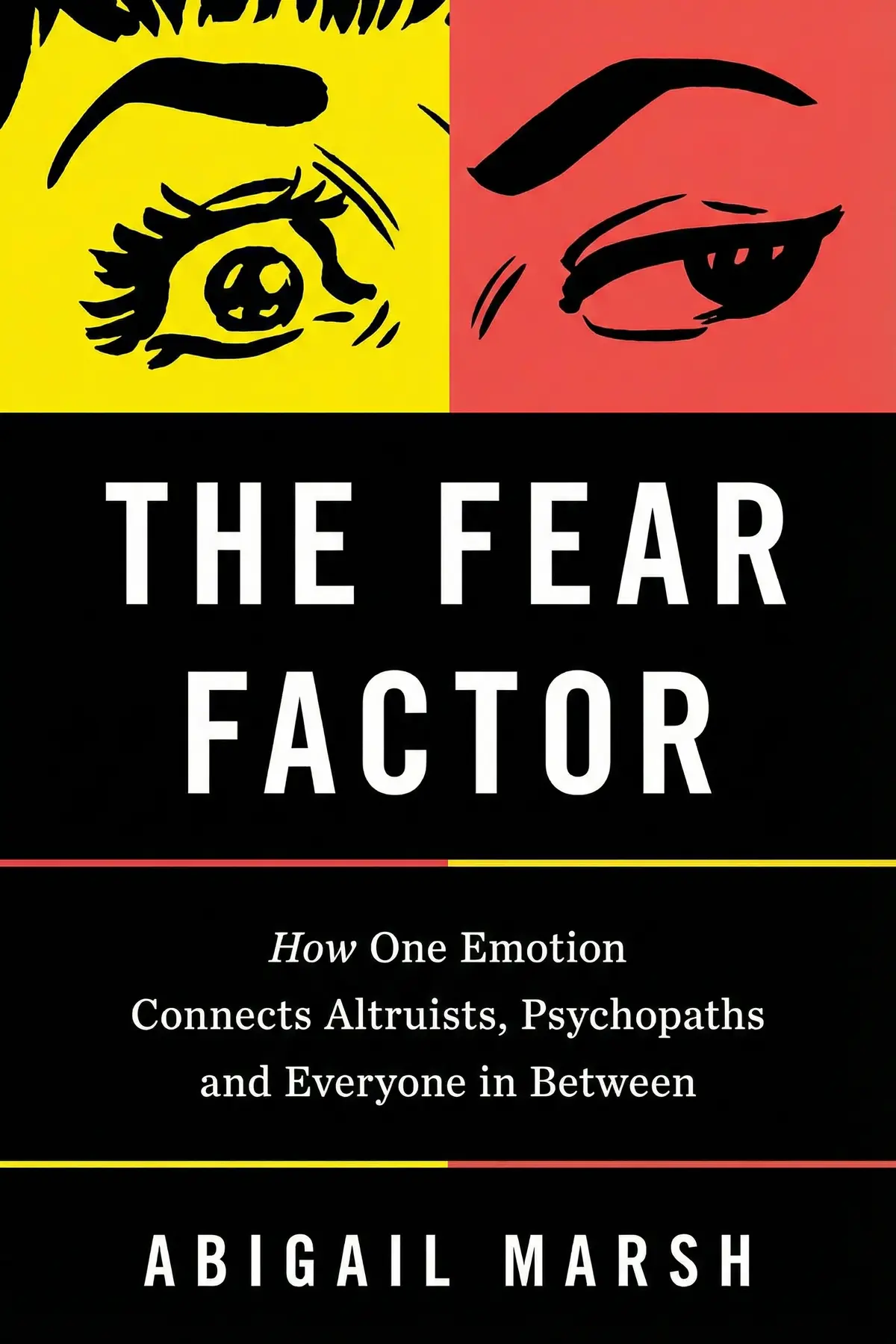
Table of Content
1. Introduction
1 min 02 sec
Most of us treat fear as a flaw, something to hide or push past. Psychologist Abigail Marsh found something that turns that view around: people who are quick to spot fear on someone else’s face tend to give more to a stranger in need. In The Fear Factor, Marsh, who studies altruism at Georgetown University, follows that thread from the brains of psychopaths to the brains of people who gave a kidney to someone they never met.
Her argument is that fear, both feeling it and recognizing it in others, is the root of empathy and of the costly kindness we call altruism. Take fear away and you get the cold detachment of the psychopath. Keep it, and the right biology and practice can turn it into the urge to help. Along the way she explains what rescuers feel in the moment of danger, which hormone stops a frightened parent from fleeing, and two everyday habits that make a person kinder over time.
2. Shift your focus to feel more empathy
1 min 47 sec
Two groups heard the same story about a young woman raising her siblings alone. One small instruction before they listened changed how much they gave her, and a test of faces revealed who gave the most.
3. Psychopaths miss fear in others, and you learn why
1 min 45 sec
A man who had assaulted several victims told an interviewer he could see they were frightened. What he said next shows why seeing fear and understanding it are two very different things.
4. Read the brain signature of true generosity
1 min 48 sec
Twelve people who gave a kidney to a stranger agreed to look at faces inside a brain scanner. Their response to one expression stood out, and a clever follow-up ruled out the obvious explanation.
5. Brave people feel fear and act anyway
1 min 48 sec
A politician ran into a burning house to save his neighbor, and kidney donors faced major surgery for strangers. Their courage looks effortless from outside, but what they reported feeling tells a different story.
6. The hormone that keeps you from running away
1 min 44 sec
A scared parent runs toward the crash in the next room, not away from it. Experiments with a nasal spray and with rats point to one substance that may let fear and courage exist together.
7. Build empathy one book at a time
1 min 49 sec
The world’s most generous country also has very high literacy. Marsh asks whether there is a connection, and an experiment in which people read a woman’s note about her break-up suggests that reading can change how we treat others.
8. Train kindness into a lasting habit with compassion meditation
1 min 44 sec
Mother rats kept caring for their pups even after the brain wiring that started the behavior stopped working. That finding hints at how a short daily practice could make compassion run on its own.
9. Conclusion
1 min 16 sec
Marsh’s picture of fear is close to the reverse of the popular one. The emotion people hide and try to conquer turns out to be how we register another person’s distress. A man who cannot feel fear can watch his victims tremble and feel nothing. A donor who gets nervous on planes can still hand a kidney to a stranger. What separates them is whether fear is present, noticed and then pushed past for someone else.
That changes what a kind person looks like. It may be the anxious colleague who notices when you are scared, more than the bold one who never seems shaken. And the capacity is not fixed. Attention can be steered toward feelings, as the listeners who heard Katie’s story showed. Stories read from the inside can soften prejudice. A meditation that stretches love from family to enemies can, with repetition, become a habit that holds.
So the next time fear rises in you, treat it as information about what matters to you and about what others may be feeling. The people who run into burning houses are rarely the ones who feel no fear.
About this book
What is this book about?
Fear has a bad reputation. Most people see it as a weakness to hide or push past. Psychologist Abigail Marsh argues the opposite: fear is how we register other people's distress, and it is the starting point of empathy and of costly, selfless kindness. Marsh follows this idea through her own experiments and the work of others. Listeners who tuned in to a struggling woman's feelings gave her more money. Psychopaths, whose amygdala often works poorly, can see their victims' terror without understanding it. Anonymous kidney donors show stronger brain responses to fearful faces, yet they are far from fearless themselves. A hormone, oxytocin, seems to let frightened people stay and help instead of running. The book ends with hope. Empathy is not a fixed trait. Readers learn why books may build understanding better than screens, how a simple Buddhist meditation can stretch care toward strangers, and why kindness, once practiced, can become a habit that keeps itself going.
Book Information
Who it's for
Seeing anxiety as weakness
People who see their own anxiety as a weakness and want to understand its hidden value.
Teachers, managers and caregivers
Managers, teachers and caregivers curious about what makes some people help and others harm.
Into psychopathy and heroism
Readers interested in psychopathy, heroism and the brain science of kindness.
About the Author
Abigail Marsh
Abigail Marsh is a professor at Georgetown University in the Department of Psychology and the Interdisciplinary Neuroscience Program, where she directs the Laboratory on Social and Affective Neuroscience. After a Ph.D. at Harvard and postdoctoral work at the National Institute of Mental Health, she has studied why people help others at a cost to themselves, using brain imaging alongside behavioral, genetic and pharmacological methods. She has published more than 80 papers and won the Cozzarelli Prize from the Proceedings of the National Academy of Sciences.
Ratings & Reviews
Ratings at a glance
What people think
Listeners consider this book a mandatory read that provides a psychology classic, while one listener points out how it explores scientific, anatomical, and physiological details. Additionally, the writing is elegantly produced and clear, ensuring it is reachable for everyday readers. They value the narrative style, and one listener specifically calls out the intriguing chapters focused on psychopaths. Furthermore, listeners appreciate the book's empathetic tone and feel it is a worthwhile investment.
Top reviews
Tuck
Few books manage to balance heavy neuroscientific research with such a compassionate approach, but Abigail Marsh succeeds brilliantly. She explores the anatomical and physiological roots of empathy, specifically focusing on how the amygdala dictates our response to others' fear. I was particularly gripped by the sections on extreme altruists, like anonymous kidney donors, and how their brain activity differs from psychopaths. It is truly a psychology classic that makes complex concepts accessible for any lay reader interested in human nature. The writing is beautifully crafted and feels like a genuine journey of discovery rather than a dry lecture. Even when she delves into the role of oxytocin and parenting instincts, the storytelling remains compelling. This is worth the investment for anyone wanting a more optimistic view of humanity. Truth is, we often focus on the negative, but Marsh proves that kindness is our biological norm.
Show moreSarawut
This book completely shifted my perspective on what it means to be a hero. Abigail Marsh writes with such warmth and clarity that you forget you are learning about complex neuroanatomy. Her fascinating chapters on psychopaths were particularly gripping—the story of the prisoner who only recognized a fearful face as 'what people look like before I stab them' is chilling. On the flip side, the stories of kidney donors who act out of pure empathy are deeply moving. The connection she makes between literacy, meditation, and increased empathy was a highlight for me. In a world that feels increasingly divided, her optimistic conclusion that goodness is common is refreshing. The writing is easy to read and deeply informative. If you only read one nonfiction book this year, make it this one.
Show moreThanakorn
After hearing her TED talk, I knew I had to pick this up, and it did not disappoint. Abigail Marsh manages to turn anatomical research into a page-turner that is as compelling as any novel. I was especially interested in the link between individualistic cultures and higher rates of altruism toward strangers. It’s an eye-opening look at why some of us are wired to care more than others. Her personality shines through the prose, making the heavy science feel like a conversation with a brilliant friend. I loved the optimism regarding how humans are generally getting kinder over time. It’s a beautifully crafted piece of work that addresses the best and worst of our species. Every chapter taught me something new about the human mind. Truly a fascinating study on the nature of compassion.
Show moreTong
While the research is incredibly rigorous, the heart of this book is its storytelling. Marsh takes us into the minds of people on both ends of the empathy spectrum, and the results are often surprising. I found the 'Milk of Human Kindness' chapter particularly enlightening regarding how oxytocin shapes our desire to nurture. The book feels like a psychology classic because it tackles the big questions—life, death, and why we care—with such clarity. It is rare to find a scientist who can write this well for a general audience. Not gonna lie, I was skeptical of the focus on fear at first, but she builds a very convincing case. The idea that recognizing another's vulnerability is the key to our survival as a species is powerful. This is a brilliant, optimistic, and deeply necessary book for our times.
Show morePear
Marsh attempts to provide a Darwinian answer for why we help strangers, and the result is a thought-provoking look at the 'altruism problem.' It is fascinating to see how the same brain mechanisms used for parenting are hijacked to facilitate heroism toward people we don't even know. The storytelling is excellent, especially the opening account of her own rescue on a bridge. However, I do think she over-analyzes some of these sublime deeds by reducing them strictly to neurotransmitters and gray matter. Sometimes the wonder of a selfless act gets lost in the talk of oxytocin levels and hippocampal volume. Despite that, the book is a must-read for fans of popular psychology. It offers a unique lens on the spectrum between the most caring and the most callous among us. It's well-researched and gives you a lot to think about regarding our capacity for goodness.
Show moreLeila
Picked this up because I’ve always been fascinated by why some people lack a moral compass while others are incredibly giving. Marsh provides a fantastic scientific and physiological background for these differences. Her research on how psychopaths literally cannot see fear is a game-changer for the field. I appreciated how she framed altruism as a mammalian instinct linked to parenting rather than just a social construct. My only real gripe is that the book feels a bit long-winded in the final third. She makes her point effectively in the first few chapters and then spends a lot of time reinforcing it with less interesting data. Regardless, her compassionate approach to the subject matter makes it a very rewarding read. It’s a great choice for anyone who enjoys the work of writers like Oliver Sacks or Malcolm Gladwell.
Show moreGun
The chapters on the amygdala and the research on 'super altruists' were the strongest parts of this book. I loved learning about how fear recognition correlates with our willingness to help others. However, the author’s frequent mentions of Cory Booker felt a bit repetitive—he’s a great example, but maybe not the only one? Look, the science is there, but the book feels a bit like a collection of separate essays that don't quite form a unified whole. I also wasn't entirely convinced by her dismissal of the 'hedonic boost' argument; she brushes off the idea that people do good to feel good a bit too quickly. It’s a decent read for the scientific background, but it could have used a much tighter edit to avoid the filler. Still, the core message about our shared mammalian heritage is worth considering.
Show morePridi
Ever wonder what makes a person risk their life for a stranger? Marsh explores this question through the lens of the amygdala, contrasting the brains of kidney donors with those of psychopaths. It’s a solid premise, and the early chapters on fear recognition are genuinely illuminating. However, I found myself skimming the later parts of the book where she focuses on statistical charts and global trends. The writing style is accessible, but it leans a bit too much into personal anecdote for my taste. I don’t really care about her personal vacations, regardless of whether they connect to the theme of the chapter. To be fair, the book is worth reading for the insights into psychopathy alone. Just be prepared for some repetition and a few sections that feel like forced add-ons. It's a bit of a mixed bag.
Show moreHang
Frankly, the author’s constant need to remind us that she is petite was incredibly distracting and felt bizarrely out of place in a science book. While the initial premise about the amygdala and fear recognition is fascinating, the book becomes frustratingly repetitive by the halfway point. I found her dismissal of 'rape culture' as merely an epidemic of awareness to be tone-deaf and entirely unnecessary for her argument. It felt like she was trying to force a provocative take where it didn't belong. Much of the personal fluff about her vacations and family felt like filler to turn a solid journal article into a full-length book. To be fair, the research on how psychopaths can't identify fearful expressions is solid, but the narrative is disjointed. I struggled to finish it because the structure just wasn't cohesive.
Show morePierre
I’ll admit I found the author's reductionist view of altruism a bit hard to swallow. She tries so hard to find an evolutionary reason for everything that she ends up stripping the soul out of heroic acts. If you don't believe everything is just a result of brain chemistry, you might find her conclusions about God and morality a bit lacking. Beyond the philosophical issues, the book is just messy at the end. She jumps from Buddhist meditation to global literacy rates in a way that feels like she was just trying to hit a word count. Why do I need to know about her beach trip to see baby turtles in the middle of a discussion on psychopathy? It’s a shame because the underlying research into how the brain processes fear is actually quite interesting. It just wasn't pulled together well.
Show moreQuestions about this book
What is the main idea of The Fear Factor by Abigail Marsh?
Marsh argues that fear is the root of empathy and altruism. People who recognize fear in others tend to give more, while psychopaths, whose amygdala often works poorly, neither feel fear nor understand it in their victims. Brave altruists are not fearless; they feel fear strongly and act anyway. Marsh also argues that empathy can be strengthened through reading and compassion meditation.
What does The Fear Factor say about psychopaths?
Marsh links psychopathy to a dysfunctional amygdala, the almond-shaped brain area that detects threats and triggers the fear response. Without it, psychopaths rarely experience fear, so they cannot empathize with frightened victims. She cites criminal psychologist Robert Hare’s interview with an offender who knew his victims were scared but said he did not really understand fear. Her studies also suggest psychopaths miss the moral meaning of threatening violence.
Are altruists braver or less fearful than other people?
Braver, but not less fearful. Marsh found that kidney donors who gave to strangers generally avoided risk and felt anxious about flying or running out of fuel. Cory Booker was terrified while rescuing a neighbor from a burning house in 2012. What sets altruists apart is a sharp awareness of others’ fear and a willingness to push past their own when someone needs help.
How can I become more empathetic according to Abigail Marsh?
Marsh points to three approaches. Focus on what people feel when they tell you their story, as listeners did in her experiment with Katie’s interview. Read books, which let you enter a character’s inner life and may build empathy better than screens. And try Buddhist compassion meditation, which stretches the affection you hold for a loved one outward to colleagues, strangers, enemies and yourself.
What role does oxytocin play in The Fear Factor?
Oxytocin is a hormone tied to nurturing. In Marsh’s study, a nasal dose made people respond more warmly to babies and read their fearful expressions better. A 2016 rat experiment found that rats given oxytocin showed signs of fear in a threatening situation but did not freeze or flee. Marsh concludes the hormone may let people feel fear while staying to help.
Readers also enjoyed

Acting with Power: Why We Are More Powerful Than We Believe
Deborah Gruenfeld


Age of Propaganda: The Everyday Use and Abuse of Persuasion
Anthony Pratkanis




59 Seconds: Change Your Life in Under a Minute
Richard Wiseman


AUDIO SUMMARY AVAILABLE
Listen to The Fear Factor in 15 minutes
Get the key ideas from The Fear Factor by Abigail Marsh, plus 5,000+ more nonfiction titles.
- 5,000+ titles
- Listen as much as you want
- 7-day free trial
- Cancel anytime









