

9 min 38 sec
Available in: English
The Evolution of Desire: Strategies of Human Mating
Explains why men and women tend to want different things in a partner, tracing modern preferences for support, looks and commitment back to the unequal costs our ancestors paid to raise children.
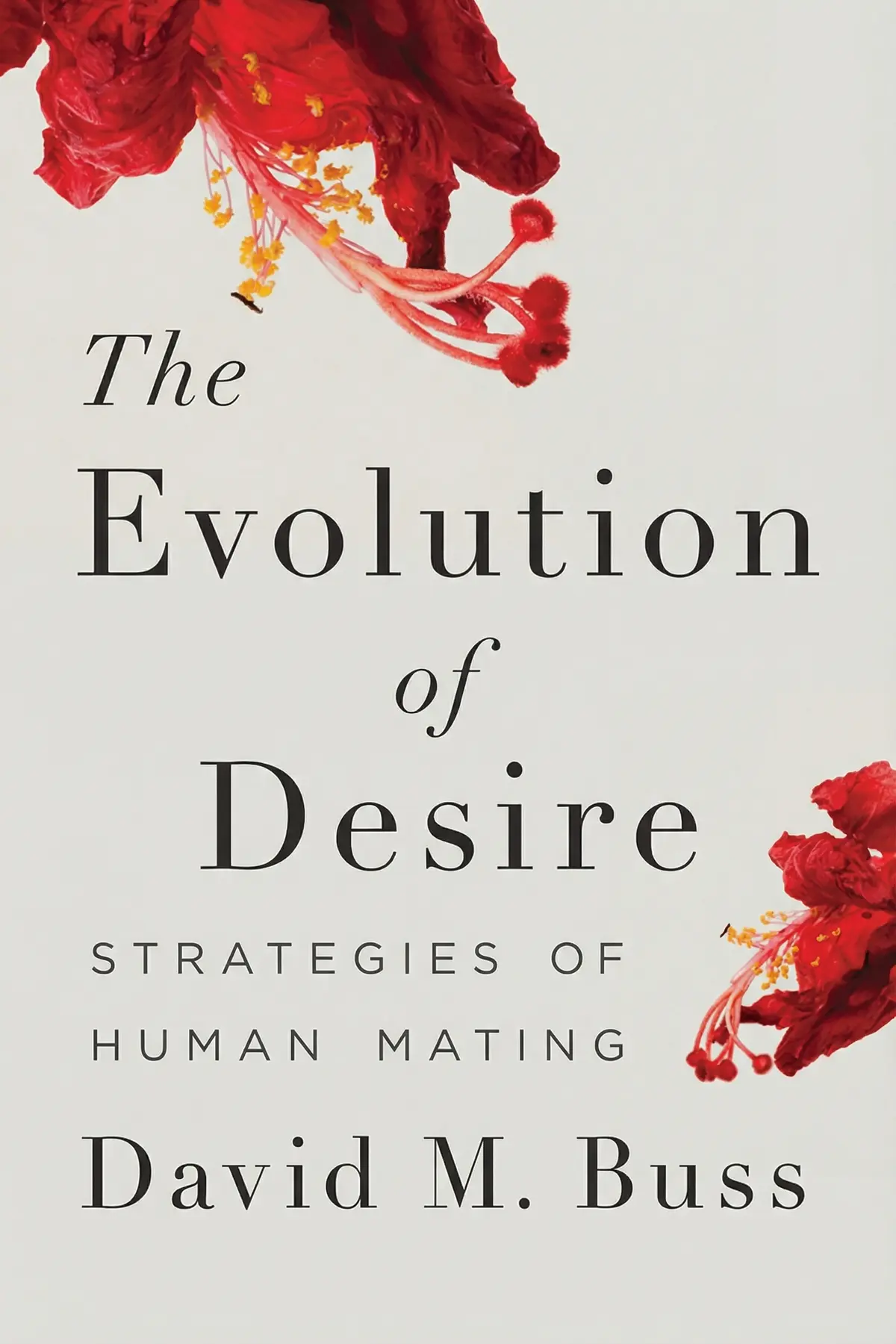
Table of Content
1. Introduction
1 min 05 sec
Attraction can feel random, a mix of chemistry, timing and luck. In The Evolution of Desire, evolutionary psychologist David M. Buss argues that it follows a much older logic, one that has barely moved even though dating customs have changed beyond recognition. Using a study of more than 10,000 people across 37 cultures, Buss traces modern preferences back to two things our ancestors needed from a mate: the capacity to supply resources and the capacity to bear children.
His central claim is that men and women carried very different costs in reproduction. Those costs shaped different desires, and the desires still steer how we choose partners, stay with them and judge them. Follow his reasoning and you can see why a financially independent woman may still want a partner who gives time and energy, why men’s attention so often lands on looks, and why age changes desirability differently for each sex. It gives you a way to name the preferences you, your friends and your partner already have.
2. Understand the old bargain behind commitment
1 min 52 sec
For one sex, a child meant years of effort and a body put at risk. For the other, it could mean almost nothing. That imbalance set the terms of a deal most couples still make without knowing it.
3. Read what a partner's support really signals
2 min 00 sec
Women today can earn, save and live without depending on anyone. Studies Buss cites show something persists anyway, and it reveals which ancestral concerns never went away once money stopped being the issue.
4. See the health signals hidden in attraction to looks
1 min 50 sec
Men are often called shallow for caring so much about appearance. Buss argues the habit carries real information, and a detail about cultures where food was scarce shows how flexible that information can be.
5. Desire shifts with age, then returns to its roots
1 min 44 sec
Fewer people now plan to have children, and older women increasingly date younger men. Yet Buss makes a bold forecast about where human desire is heading, and it is not where modern habits might suggest.
6. Conclusion
1 min 07 sec
The Evolution of Desire adds up to one claim with a long reach. The rules of courtship have changed many times, but the minds doing the choosing were shaped by an ancient imbalance. One sex paid with years and a body, the other with far less, and each learned to want whatever made that cost worth paying. Women came to prize health and dependable support. Men came to prize the signs of youth and fertility. Commitment became the price both could accept.
None of this tells anyone whom to love. It explains the pulls people feel. When you catch yourself drawn to someone’s looks, or reassured by a partner who gives time and energy without being asked, you can name the old logic at work and decide whether it serves the life you actually want. And when a friend insists that support no longer matters because they earn their own money, Buss’s evidence suggests that financially independent women still want a partner’s support, be it money, time, or energy.
Customs change fast. The desires underneath them, Buss argues, move on a clock measured in generations.
About this book
What is this book about?
Dating customs have changed many times over the centuries, but the preferences behind them may have changed far less. David M. Buss, an evolutionary psychologist, argues that what people want in a partner still reflects two things our ancestors needed from a mate: the capacity to supply resources and the capacity to bear children. Drawing on a study of more than 10,000 people in 37 cultures, Buss explains how the heavy cost of pregnancy and child rearing led women to value health, dependable support and a partner's capacity to grow. Men, who paid far less for a single encounter, learned to read beauty as a sign of youth and fertility. Commitment emerged as the bargain both sides could accept. Buss also looks at gay and lesbian partners, at how local scarcity changes what counts as attractive, and at how age affects desirability differently for women and men. Readers get a clear framework for understanding their own attractions and those of the people around them. It also explains why the wish for a supportive partner survives even when women are financially independent.
Book Information
Who it's for
Curious about attraction patterns
Curious readers who want to understand why attraction often follows predictable patterns.
Noticing old dating expectations
People dating again later in life, or without plans for children, who notice old expectations resurfacing.
Psychology students
Students of psychology looking for an accessible entry to evolutionary views of mating.
About the Author
David M. Buss
David M. Buss is an American evolutionary psychologist and a professor at the University of Texas at Austin, and he is counted among the founders of evolutionary psychology. He earned his PhD at the University of California, Berkeley in 1981 and taught at Harvard and the University of Michigan. His research covers mating strategies, conflict between the sexes, status and jealousy. He has written more than 200 scientific articles and books including The Dangerous Passion and The Murderer Next Door.
Ratings & Reviews
Ratings at a glance
What people think
Listeners find the work exceptionally educational and skillfully written, clarifying many aspects of human mating habits. They also appreciate its accessible style, with one listener describing it as vital reading for everyone. Furthermore, the book earns praise for its tempo, as one individual mentions how it shifts their perspective on social dynamics. Nevertheless, listeners express conflicting opinions regarding its ease of reading and entertainment value.
Top reviews
Paiboon
Ever wonder why you're attracted to specific traits while your friends have totally different taste? Buss provides a compelling, if slightly unsettling, look at the biological blueprints that govern our dating lives. The writing is incredibly smooth, making complex evolutionary concepts accessible without feeling like a dense textbook. I appreciated how he broke down the different strategies for short-term flings versus long-term commitments, as it explains so much about modern social dynamics. Frankly, it’s one of those essential reads that fundamentally alters how you view every interaction at a bar or on a dating app. While some data points feel rooted in the 80s, the core logic remains hard to argue against. This book doesn't just describe behavior; it explains the deep-seated 'why' behind our most intimate choices.
Show moreNing
Finally got around to reading this classic and it definitely lived up to the hype. The Evolution of Desire doesn't just tell you what people want; it explains the 'why' behind the 'what' in a way that feels incredibly intuitive once you see the patterns. I loved the distinction between what we seek in casual encounters versus what we demand in a spouse, as it clears up so much confusion regarding 'mixed signals.' The pacing is excellent for a science book, moving quickly through various global studies to prove that these aren't just Western cultural quirks. It’s a powerful reminder that we are, at our core, biological beings shaped by the survival of our ancestors. Definitely a must-read for anyone trying to understand the human condition without the fairy-tale filters.
Show moreTawee
Wow. This is easily one of the most informative books I’ve read in the last five years. It provides a comprehensive map of the human heart, stripped of all the flowery language and romantic illusions we usually hide behind. Buss’s research into what women want (status/resources) versus what men want (youth/fertility) might seem like common sense, but seeing the cross-cultural data makes it undeniable. The book is well-written and flows logically from one topic to the next, covering everything from infidelity to the evolution of the female orgasm. Truth is, you’ll never look at a first date the same way again after finishing this. It’s an essential guide to the hidden forces that drive our most intimate decisions. Every human should read this to understand their own hidden motivations better.
Show moreKasemsan
After hearing about this book on a podcast, I decided to see if the controversy was justified. What I found was a brilliant, evidence-based exploration of human nature that answers questions I didn't even know I had. The way Buss connects male risk-taking to the desire for status—and ultimately, mate access—is a masterclass in psychological reasoning. It’s incredibly readable for such a data-heavy book, and it moves at a pace that keeps you turning pages. I particularly enjoyed the concluding chapters where he emphasizes that we aren't slaves to our genes. Knowing why we feel certain urges allows us to make better, more conscious choices in our relationships. Personally, I think the 'sexist' labels are a misreading of what is actually a very objective look at our biological history.
Show moreYui
The chapter on sexual conflict was worth the price of the book alone. Buss manages to take the most confusing, emotional aspects of our lives and lay them out with scientific precision. You get to see how the competing interests of men and women have shaped our very psychology over millions of years. Look, this isn't a book that's going to tell you what you want to hear, but it is going to tell you what the data shows across dozens of different cultures. It’s informative, occasionally provocative, and essential for anyone who wants a deeper understanding of social dynamics. It definitely changed my perception of how we choose our partners and why we fight to keep them. If knowledge is power, this book is a massive power-up for your social intelligence.
Show morePlernpiriya
Buss’s work is a landmark in evolutionary psychology for a reason. Instead of looking at love through a purely romantic lens, he treats human mating as a series of calculated, adaptive strategies designed over millennia. The chapter on mate retention and why we experience jealousy was particularly enlightening, even if it makes you feel a bit like a programmed machine. I did find the pacing to be a bit uneven in the middle sections, particularly when he dives deep into cross-cultural survey data. However, the insights into how women and men prioritize different resources are backed by a mountain of evidence. It's a challenging read that might ruffle some feathers, but the truth isn't always comfortable. It is a solid framework for understanding, though perhaps not all-encompassing.
Show moreAdam
Picked this up after seeing it referenced in a dozen other sociology books. The central thesis—that our mating habits are a set of evolved strategies—really changes how you perceive social interactions in your day-to-day life. Buss explains the 'sexual marketplace' with a level of cold logic that is both fascinating and slightly depressing. I was especially intrigued by his take on the roots of patriarchy and how female choice actually drove a lot of male competition. It’s not a light beach read, but it’s far from a dry academic slog. My only gripe is that it occasionally feels like it’s trying too hard to fit every single human behavior into a neat evolutionary box. Still, the data on how we select and replace mates is eye-opening for any thinking person.
Show moreNattapong
As someone who identifies as a feminist, I went into this book prepared to be annoyed, but I actually found it quite nuanced. Buss doesn't say that 'biology is destiny' or that we should excuse bad behavior just because it has an evolutionary root. Instead, he argues that understanding our wiring is the only way to actually overcome it. The discussion on how men try to control female reproductive choices was particularly eye-opening and provided a different perspective on the history of gender power dynamics. It’s a dense read with a lot of data to chew on, and while I didn't agree with every single deduction, the overall framework is hard to dismiss. It’s a polarizing but necessary piece of the puzzle for anyone interested in human reproduction and social hierarchy.
Show moreMan
The information presented is undeniably important, but I found the tone a bit dry and unengaging at times. Buss spends a lot of time on mate attraction and retention strategies, which is great, but the actual 'evolution' part felt a bit glossed over in favor of survey results. Not gonna lie, some of the conclusions about gender roles felt a bit like they were looking for evidence to support a preconceived notion rather than following the data wherever it led. It’s an adequate introduction to evolutionary psychology, yet it lacks the imaginative spark found in newer works like Sapiens. If you want a basic framework for understanding human attraction, it’s worth a look, just don’t expect it to explain everything about your love life. It feels more like a collection of data than a narrative.
Show morePrae
This book left a sour taste in my mouth. While I expected a scientific exploration of how desire actually evolved from a biological standpoint, what I got was a collection of outdated surveys from the late 80s that seem to justify some pretty regressive social views. His arguments regarding male violence and rape as 'evolutionary strategies' felt less like objective science and more like a way to hand-wave away inexcusable behavior. To be fair, the writing style is clear enough, but the methodology is incredibly narrow and fails to account for how much culture shifts our 'innate' preferences. It’s an interesting historical artifact for the field of psychology, but I wouldn’t call it an accurate map of modern human behavior. I found the conclusions to be presumptuous and quite unfair.
Show moreQuestions about this book
What is the main idea of The Evolution of Desire?
David M. Buss argues that human mating preferences come from a long evolutionary history. Because bearing and raising a child cost women far more than men, the sexes developed different desires. Women came to value health and a partner who provides support, while men came to value beauty as a sign of youth and fertility. Buss draws on a study of more than 10,000 people in 37 cultures.
What do women want in a partner, according to David Buss?
Buss describes concerns before and after a child arrives. Before birth, a partner’s health mattered most. After birth, the question was whether he would provide food, shelter, time and energy, judged through traits like status, emotional stability and intelligence. Some women also weighed his capacity to grow and any debts or earlier children. Financially independent women, studies show, still prefer a supportive partner.
Why do men focus on looks, according to The Evolution of Desire?
Buss argues that for ancestral men, beauty carried information. Features like glossy hair, clear skin, full lips and good muscle tone signaled health and youth, which in turn signaled fertility. The exact ideal varied with conditions: where food was scarce, a fuller body suggested health and wealth and was considered more attractive than a slim one.
How does age affect desirability in Buss's view?
Historically, a woman’s desirability fell with age because fertility declines, though her value as a parent rises and her nurturing helps her children start families. Today, with many people choosing not to have children, age matters less and more women date younger men. Men tend to gain resources and status over time, so their appeal as providers often lasts into old age.
How can I apply the ideas in The Evolution of Desire?
Use the book as a lens on your own reactions. When an attraction or a dismissal comes instantly, ask what signal you are responding to and whether it still means what it once did. When judging a partner, look at the support they reliably give in time and energy, not only income. And when commitment becomes a sticking point, ask what each person is investing.
Featured in
Readers also enjoyed

59 Seconds: Change Your Life in Under a Minute
Richard Wiseman




A Liberated Mind: How to Pivot Toward What Matters
Steven C. Hayes


Acting with Power: Why We Are More Powerful Than We Believe
Deborah Gruenfeld


All About Love: New Visions
bell hooks
AUDIO SUMMARY AVAILABLE
Listen to The Evolution of Desire in 15 minutes
Get the key ideas from The Evolution of Desire by David M. Buss, plus 5,000+ more nonfiction titles.
- 5,000+ titles
- Listen as much as you want
- 7-day free trial
- Cancel anytime









