

13 min 55 sec
Available in: English
The Eureka Factor: Creative Insights and the Brain
Explains where sudden creative insights come from in the brain and how calm, rest, broad knowledge, good moods and reward-seeking goals make them more likely, so stubborn problems at work or home can finally give way.
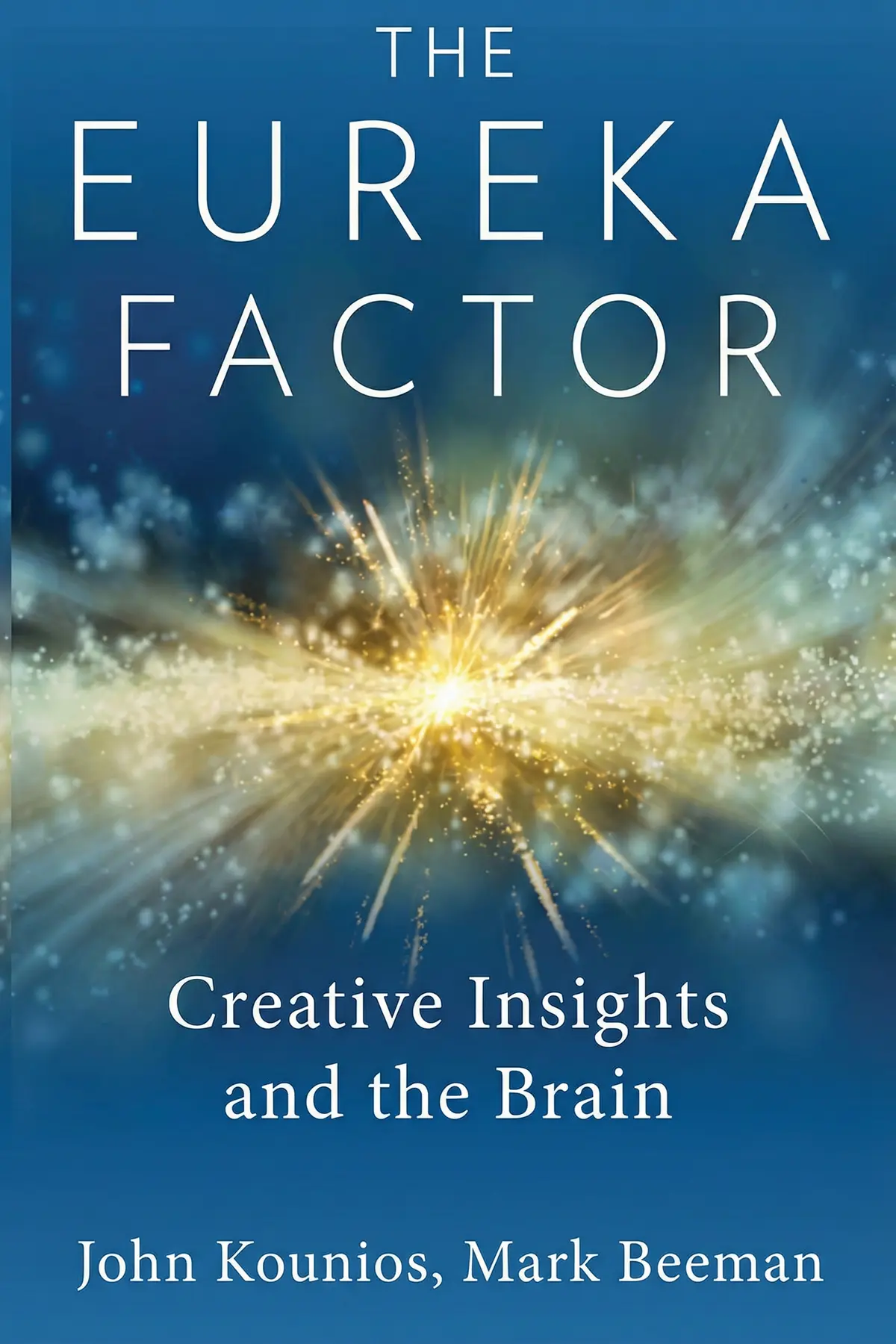
Table of Content
1. Introduction
1 min 01 sec
When a problem at work refuses to budge, more hours of staring at it rarely help; the answer tends to arrive later, often in the shower. In The Eureka Factor, psychologists John Kounios and Mark Beeman explain why: a sudden insight is a change of perspective, and the brain produces it when its careful, rule-following side steps back. They describe neuroscientists catching these moments as sparks of activity on the brain’s right side, overriding the habits that usually keep our thinking tidy.
Their case is that insight is not reserved for a gifted few. It follows conditions anyone can set up: fewer distractions, wide knowledge, less anxiety, a lifted mood and goals that pull you forward. The stories run from Archimedes in his bath to Paul McCartney waking with a melody, and they end in small changes to how you rest, where you work and what you aim for, so the next stuck problem has a better chance of breaking open.
2. Find the angle that makes a problem give way
1 min 38 sec
An ancient king needed to test his crown without destroying it, and the best mind in his city was stuck. The way out came from an unlikely place, and it reveals what every real breakthrough has in common.
3. Spot the invisible rules that keep you stuck
1 min 33 sec
A group of nobles insisted that anyone could have done what Columbus did. He answered them with a plate of boiled eggs, and the lesson applies to every option you have already ruled out.
4. Get past the sensible brain that filters out fresh ideas
1 min 52 sec
A child may dream up ice cream flavors no grown-up would consider, since the adult frontal lobe narrows the options. Brain scientists found the reason, and it explains why insight feels like a spark.
5. Give your mind quiet time and varied ingredients
1 min 39 sec
Paul McCartney awoke with the tune of “Yesterday” running through his head. The authors explain what his sleeping mind was doing, why the shower works the same way, and what it needs from you first.
6. Calmer teams and brighter moods produce more breakthroughs
1 min 49 sec
One kind of workplace runs on freedom and play, another on deadlines and pressure. Only one of them gets more good ideas out of the same people, and a sudden rush of feeling plays a part.
7. Think like a punk to stretch your creativity
1 min 43 sec
Some people seem born to have clever ideas, and the authors agree that genes play a part. But a trip to Tokyo, imagined in two different ways, shows how far a small mental shift can carry you.
8. Chase rewards and shape a space for ideas
1 min 42 sec
Running from a threat and running toward a prize can look like the same effort. To the brain they are very different, and only one leaves room for the kind of idea that changes your plans.
9. Conclusion
58 sec
Archimedes did not turn into a genius in the bath. He was a man in warm water who had stopped forcing the problem, with enough experience in his head for two facts to meet. That is the picture Kounios and Beeman leave behind: insight is a moment the brain allows when its tidy filter relaxes, and much of what relaxes it is within your reach.
The practice is plain. When a problem has you stuck, put it down and sleep on it, or take it into the shower, and let incubation do part of the work. Feed your mind with subjects far from your own, so there is more to combine when the spark comes. Frame goals as something to win, set some of them far in the future, and notice when anxiety starts running the show. If you shape a team or a workspace, aim for calm, color and good humor over pressure, and make room for people who think differently.
The egg will not stand until someone is willing to crack it a little.
About this book
What is this book about?
Most of us know the feeling of grinding away at a problem that will not move, only for the answer to appear later in the shower or on waking. Psychologists John Kounios and Mark Beeman set out to explain that flash of understanding. They show what it is, why it comes so rarely and what makes it more likely. Their answer starts with perspective. An insight, they argue, is a sudden new way of seeing a task, the kind that let Archimedes test a crown without melting it. The brain's analytical side, built to narrow choices quickly, normally filters such ideas out. Brain researchers have watched insight appear as bursts of activity in the right hemisphere that override that filter. From there the book turns practical. Distraction, anxiety, low moods and fear-driven goals suppress insight. Quiet moments, sleep, wide knowledge, positive emotion, thinking about the distant future and calm, open surroundings encourage it. Readers learn why breakthroughs look obvious afterward, why showers and naps help, and how to shape their habits, teams and workspaces so that good ideas arrive more often.
Book Information
Who it's for
Knowledge workers wanting breakthroughs
Knowledge workers who get stuck on problems and want their best ideas to come more often.
Leaders deciding on deadlines
Managers and team leads deciding whether deadlines or freedom will get more creativity from their people.
Analytical thinkers feeling uncreative
Analytical thinkers who believe they are not creative and want practical ways to change that.
About the Author
John Kounios
John Kounios is a professor of psychology at Drexel University, where he leads the doctoral program in Applied Cognitive and Brain Sciences and studies insight, creativity, problem solving and memory. Mark Beeman is a professor of psychology and neurosciences at Northwestern University who has spent much of his career studying aha moments. Working together, they reported in 2004 that insight arises in a region of the brain's right hemisphere, and their brain-imaging research has been covered by major newspapers, radio and television.
Ratings & Reviews
Ratings at a glance
What people think
Listeners find the content to be both captivating and scientifically grounded, with one listener drawing attention to the way it shares stories from many different disciplines. Listeners also give high marks to the book's smooth readability and well-crafted writing.
Top reviews
Wissanu
Finally got around to finishing this, and I must say the final two chapters alone are worth the price of admission. Many books on creativity are just fluff, but this one is grounded in real fMRI studies and EEG data. I was fascinated by the concept that morning people are actually more creative in the evening. It’s counter-intuitive, yet it makes perfect sense when you realize how a 'sleepy' brain allows for more remote associations. Truth is, I’ve already started changing my workspace to include softer lighting and more natural elements based on their findings. This isn’t just for artists; it’s for anyone who needs to solve problems more effectively. It’s a joy to read and highly relatable.
Show moreNatnicha
After hearing about the 'Aha!' moment for years, it was refreshing to see the actual brain mechanics behind it explained so clearly. Kounios and Beeman do a fantastic job of showing that creativity isn't some mystical gift but a state that can be cultivated. I loved the advice about switching off cell phones and fostering a sense of psychological distance to encourage abstract thought. It’s a masterclass in how to manage your mental states to avoid the 'blinkers' of analytical focus. The summary at the end of the book is particularly helpful for those who want a quick refresher of the key takeaways. This is essential reading for anyone in a creative field.
Show moreDen
Direct and insightful, this book offers a fascinating look at the cognitive processes that drive innovation. I was particularly struck by the advice to avoid switching back and forth between analytical and insightful mindsets, as it wastes precious mental energy. The authors explain that it takes time to 'sink into' a creative state, which is a lesson I desperately needed. Every page feels like it’s backed by years of rigorous study, yet it never feels heavy or inaccessible. From the importance of soft lights to the role of positive emotions, the book provides a comprehensive roadmap for anyone looking to increase their 'eureka' moments. Simply put, it's a must-read.
Show moreSarocha
This book manages to bridge the gap between hard neuroscience and practical application without feeling like a dry textbook. Kounios and Beeman dive deep into the 'Aha!' moment, explaining why our brains sometimes light up with sudden clarity. I particularly enjoyed the sections discussing how our environment—like being in nature or even just having rounded corners in a room—impacts our cognitive flexibility. While some of the advice about sleeping well or taking breaks feels a bit like common sense, the scientific backing provided makes it much more compelling. It’s a well-researched exploration that actually gives you the tools to foster a more insightful mindset. The writing is accessible, though it does get a bit repetitive in the middle chapters as they hammer home the same psychological principles.
Show moreNatchaya
The chapter on how the barcode scanner was invented was a standout moment for me in a book that is otherwise quite dense. It’s a classic example of how a specific environment can trigger a massive breakthrough. I found the distinction between analytical thinking and insight thinking to be incredibly useful for my own work habits. Not gonna lie, I used to feel guilty for taking breaks, but now I see them as a necessary part of the incubation process. The authors write with a clear, engaging style that makes complex brain functions easy to grasp. My only gripe is that the tone can feel a bit like a standard American motivational book at times, which might turn off more academic readers.
Show moreAraya
Wow, I never realized how much my 'peak' time was actually hindering my most creative thoughts. The revelation that we are more likely to have insights during our off-hours—when our inhibitory control is lower—was a total game-changer for me. This book is scientifically informed yet remains very readable for a general audience. The stories from various fields, from science to the arts, keep the momentum going. I did find the sections on mindfulness a bit repetitive since that topic is everywhere lately, but the specific context of using it for insight was a nice touch. Overall, it's an engaging guide to unlocking your brain's hidden potential.
Show moreAkira
As someone who struggles with 'writer's block' frequently, I found the strategies for enhancing the creative process in the second half of the book quite practical. The idea of seeking out unusual people and remote environments is something I’m eager to try on my next vacation. In my experience, most business books are just common sense dressed up in jargon, but 'The Eureka Factor' uses genuine research to support its claims. The writing quality is top-notch, making even the technical parts about EEG sensors feel like a narrative. It’s a solid 4-star read that offers a good mix of theory and practice, even if some parts feel a bit like a pep talk.
Show moreArjun
Ever wonder why your best ideas come in the shower? 'The Eureka Factor' tries to answer that, but it takes a long road to get there. To be fair, the research presented is solid, and the authors are clearly experts in the field of cognitive neuroscience. However, I found the book to be overly anecdotal, filled with story after story that eventually started to blend together. I was hoping for more 'how-to' and less 'here is another person who had an insight.' The actual advice—like working during your non-peak hours or practicing mindfulness—is tucked away towards the end. It’s a decent summary of creativity research, but if you’ve read similar books, you might find yourself skimming a lot of the familiar territory.
Show moreRafael
Picked this up because I’ve always been interested in the intersection of intuition and logic. The authors, who seem like very analytical types, do an admirable job trying to quantify something as elusive as an insight. Look, the core message is great, but the delivery is a bit plodding. They spend a lot of time on the 'what' and 'why' before finally getting to the 'how' in the concluding sections. I appreciated the discussion on how a positive mood can broaden your attention, but did we really need dozens of examples to prove the point? It’s a beneficial read if you have the patience, but it could have been sixty pages shorter without losing much substance.
Show morePia
Not what I expected given the high praise I had heard from colleagues. While the science is undoubtedly legitimate, the actual 'lessons' felt like things my grandmother could have told me: get some sleep, stay positive, and go for a walk. Frankly, the book is bloated with too many stories about famous people and not enough unique, actionable data. I found myself getting frustrated with the repetitiveness by the halfway point. It’s well-written in terms of prose, but the signal-to-noise ratio is just too low for my taste. If you want a deep dive into neuroscience, there are better options out there that don't bury the lead under layers of anecdotes.
Show moreQuestions about this book
What is the main idea of The Eureka Factor?
John Kounios and Mark Beeman argue that insight is a sudden change of perspective that breaks rules we unknowingly impose on ourselves. The brain’s analytical side normally filters such ideas out, but researchers have seen insight appear as bursts of activity in the right hemisphere. The authors show that calm, rest, varied knowledge, good moods and reward-seeking goals make these moments more likely for anyone.
Why do good ideas come in the shower, according to Kounios and Beeman?
The authors explain that insight appears once distractions are under control, and a shower blocks most of them. The sound of the water masks other noise and the spray fills your sense of touch, leaving the mind free to work. Showers also give an idea time to incubate, the same process that let Paul McCartney wake up with the melody of Yesterday.
Does stress help or hurt creativity?
In the authors’ view, anxiety always reduces insight because it makes it harder to connect ideas. Workplaces that rely on tight deadlines and pressure should expect fewer aha moments, while those that allow freedom, joy and time to unwind should expect more. Bursts of positive emotion can also sharpen intuition, while a long low mood tends to smother it.
Can you become more insightful if you are not naturally creative?
Yes, the authors argue. Genes play a part, but small changes help: thinking less like a conformist, even imagining yourself as a punk, and thinking about the distant future rather than tomorrow. Pursuing rewards instead of avoiding threats frees the mind to look for new routes, and calm, airy surroundings with varied company make insight more likely.
How can I apply The Eureka Factor at work?
When you are stuck, step away and nap, walk or shower so your mind can incubate the problem. Read widely outside your field to give it more to combine. Set goals you want to win and explore several ways to reach them. If you lead a team, cut needless pressure, protect open time and, as the authors suggest, treat good moods as part of creative work.
Readers also enjoyed

Acting with Power: Why We Are More Powerful Than We Believe
Deborah Gruenfeld


Age of Propaganda: The Everyday Use and Abuse of Persuasion
Anthony Pratkanis




A Room of One’s Own
Virginia Woolf

59 Seconds: Change Your Life in Under a Minute
Richard Wiseman
AUDIO SUMMARY AVAILABLE
Listen to The Eureka Factor in 15 minutes
Get the key ideas from The Eureka Factor by John Kounios, plus 5,000+ more nonfiction titles.
- 5,000+ titles
- Listen as much as you want
- 7-day free trial
- Cancel anytime









