

13 min 56 sec
Available in: English
The Elephant in the Brain: Hidden Motive in Everyday Life
Explains why people hide selfish motives, even from themselves, and how the urge to compete for status and partners shapes ambition at work, shared rules, body language, shopping and art.
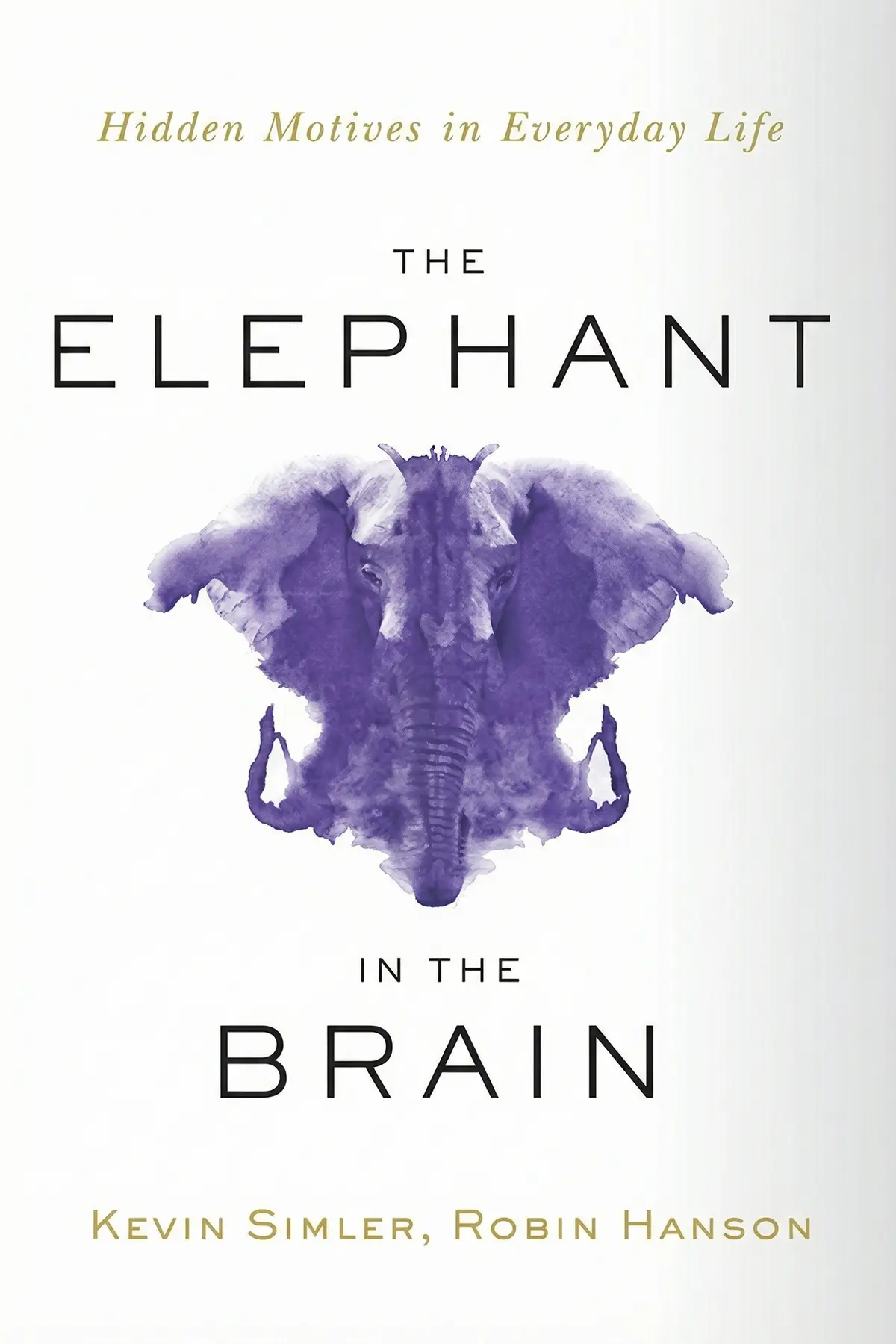
Table of Content
1. Introduction
1 min 03 sec
Most of us explain our own behavior in flattering terms, and the explanation often leaves out the real reason. In The Elephant in the Brain, writer and software engineer Kevin Simler and economist Robin Hanson argue that people act on selfish, competitive motives they keep hidden, often even from themselves. Aristotle called humans political animals and set us apart from the rest of nature. Simler and Hanson put us back inside it: the urge to survive, win status and attract a mate still steers ordinary choices, from how we ask for a promotion to what car we park outside.
Their argument is simple to state and uncomfortable to accept. We compete constantly, we present that competition as something nobler, and the disguise works best when we believe it ourselves. Follow it from grooming chimpanzees to decorating bowerbirds, and you gain a sharper eye for the motives behind a colleague’s pitch, a stranger’s posture, a friend’s purchase and your own.
2. Read the deal behind friendly gestures
1 min 31 sec
Zoo chimpanzees carry on picking at each other’s fur well after there is nothing left to clean. A primatologist’s explanation for that odd persistence reveals what simple kindness can also be doing, in apes and in people.
3. Spot the motive you hide from yourself
1 min 39 sec
Someone angling for a promotion rarely feels selfish while doing it. The authors explain why the brain keeps that motive out of view, and why the blindness turns out to be useful rather than accidental.
4. See how rivalry built your brain
1 min 38 sec
The heroic story says our big brains grew to outwit tigers, hunger and fire. The authors favor a less comfortable rival, and a forest of trees racing for light shows what it was.
5. Make shared rules stick by enforcing them together
1 min 38 sec
An office bully nobody dared to confront was fired before long, once colleagues turned to gossip about him. What removed him says a lot about how groups keep their most competitive members in line.
6. Hear what bodies say before words do
1 min 36 sec
You can know someone dislikes you without hearing a single word about it. The same silent channel carries the motives society tells us to hide, and most of the time neither side notices it running.
7. See the status message in what people buy
1 min 53 sec
Shoppers in one experiment tended to pick the planet-friendly product under one simple condition. It had nothing to do with price, quality or belief, and it changes how you might read your own purchases.
8. What a bowerbird teaches about attraction
1 min 42 sec
A small bird spends hours decorating a structure it will never live in. Its effort helps explain one of the oldest puzzles about our own species: why we pour time into things that keep nobody alive.
9. Conclusion
1 min 16 sec
The Elephant in the Brain asks you to give up a flattering self-image. In the authors’ account we are animals first: grooming partners for alliances, growing tall like trees to catch the light others want, building bowers. Much of what we call taste, kindness or ambition is also a bid for resources, status and mates, and the bid succeeds best when we do not see it.
That sounds bleak, yet the book points to something useful. Once you expect hidden motives, behavior that seemed puzzling starts to make sense: the colleague’s careful jargon, the stranger’s posture, the shopper who goes green only when watched. Norms and gossip show that the same competitive species can also hold itself in check when people act together.
The ideas work in small, daily ways. When you make a case for yourself, admit privately what you actually want before you wrap it in professional language. When you buy something, ask who you picture seeing it. And in any room, watch the bodies as well as the words.
The elephant does not leave when you notice it. But a motive you can see is a motive you can choose whether to follow.
About this book
What is this book about?
We like to believe we act for good reasons: we work hard because we care, buy green because we love the planet, make art for its own sake. Kevin Simler and Robin Hanson argue that this flattering story leaves out the real drivers. Humans are animals shaped by competition, and many everyday choices are bids for status, resources and mates. The authors start with chimpanzees that keep grooming each other after their fur is clean, then turn to humans. Because we can read each other's minds, we have reason to hide our motives, and the best way to hide a motive is to hide it from ourselves. From there they follow the competitive instinct through the evolution of the social brain, the norms and gossip that hold it in check, the body language that carries what words cannot, the luxury goods and public green purchases that signal status, and the art that shows off spare capacity, like a bowerbird's decorated bower. Readers come away with a sharper eye for the motive behind a pitch, a posture or a purchase, including their own.
Book Information
Who it's for
Curious about office politics
Professionals who want to understand the status games behind promotions, pitches and office politics.
Curious about unwritten rules
Team leads curious why unwritten rules and gossip shape how a group behaves.
Doubting their own motives
Curious readers of psychology and evolution who suspect their own choices are less noble than they seem.
About the Author
Kevin Simler
Kevin Simler is a writer and software engineer in Brooklyn, New York, with ten years as a programmer, product designer and engineering director; he also advises startups on technology, leadership and recruiting. Robin Hanson, born in 1959, is an associate professor of economics at George Mason University. He holds a social science doctorate and master's degrees in physics and philosophy, spent nine years in artificial intelligence research, invented market scoring rules, researched signalling and wrote The Age of Em.
Ratings & Reviews
Ratings at a glance
What people think
Listeners find the work both readable and informative, with one review noting it is well-researched and filled with fascinating counterintuitive observations. Furthermore, they value its plausible ideas regarding human behavior, and one listener highlights its balanced view of human nature. The prose also earns favorable comments; one listener describes the book as bringing readers down to earth with a positive message. Conversely, the author style and the conclusion draw mixed reactions from listeners.
Top reviews
Oksana
Ever wonder why we act against our own stated interests so frequently? This book provides a chillingly logical framework for understanding the 'press secretary' in our heads that spends all day spinning our selfish motives into altruistic tales. The section on charity completely upended my perspective on why we give. It turns out, we aren't necessarily trying to help the recipient; we’re signaling to our peers that we are reliable, compassionate allies. Bob gives to the visible beggar because it's a social signal, while Alice calculates her effective altruism in a spreadsheet, often missing the social mark entirely. The writing is incredibly accessible, moving quickly through complex evolutionary psychology without feeling like a textbook. It’s the kind of read that makes you look at every human interaction—from a doctor's visit to a church service—with a newfound, slightly cynical clarity. It’s easily one of the most provocative things I’ve read all year.
Show moreMoon
Wow, this was a total trip. I’m currently virtue signaling like crazy just by posting this review, which is exactly what the authors would expect. I loved the section on art and the 'replica museum' thought experiment. Why do we value an original Mona Lisa but scoff at a perfect copy? Because art isn't about the image; it's a signal of the artist’s ability to waste time and resources on something difficult. That insight alone changed how I walk through a gallery. The book is filled with these 'wow' moments that make you rethink your daily habits. It’s definitely a bit of a downer if you want to believe humans are inherently selfless, but it’s ultimately a positive message about understanding our true nature so we can build better institutions. Highly recommended for anyone who likes 'Freakonomics' or 'Nudge'.
Show moreSaranya
Finally got around to reading this, and it lived up to the hype. The most interesting takeaway for me was the 'third-party' theory of advertising. We don't buy a BMW because the ad brainwashed us; we buy it because we know that *other* people have seen the ad and will recognize the car as a status symbol. It’s all about creating common knowledge. This book is packed with 'aha!' moments like that. It’s rare to find a book that challenges your fundamental assumptions about why you do things like go to church or buy expensive mops (or why you don't buy expensive mops!). It’s witty, well-structured, and doesn't pull any punches. If you want to understand the hidden gears of society, this is essential reading.
Show moreGor
The core idea here is that our brains are built to hide our real motives from us so we can be more convincing liars to everyone else. It sounds like a conspiracy theory, but Hanson and Simler make a compelling case using the 'press secretary' metaphor. We are like the split-brain patients who make up excuses for why they stood up, even when the real reason was a hidden command. Personally, I loved the breakdown of 'conspicuous consumption' in industries we usually consider sacred, like healthcare and religion. The idea that we go to the doctor for 'conspicuous caring' rather than just health outcomes explains so much about our bloated medical system. The prose is punchy and the short chapters keep the momentum going. My only gripe is that it can feel a bit repetitive toward the end, but the individual nuggets of insight make it well worth your time.
Show moreSook
The chapter on healthcare alone is worth the price of admission. It posits that we value the 'showing of concern' more than the actual efficacy of the treatment, which is a total lightbulb moment for anyone wondering why we spend so much on end-of-life care. To be fair, the book is quite cynical. It strips away the veneer of our 'good intentions' and reveals a lizard brain obsessed with status and social positioning. I appreciated the authors' willingness to go after 'sacred cows' like education and charity without being unnecessarily obnoxious about it. The writing style is conversational, and the use of diagrams helps clarify the more abstract signaling loops. It’s a great companion piece to 'The Righteous Mind,' though perhaps a bit less academically grounded. Still, it’s a fascinating look at the hidden architecture of human behavior that most people would rather ignore.
Show moreSumalee
To be fair, I expected this to be a dry academic slog, but it’s actually quite the opposite. Simler and Hanson have a very light, almost playful touch with their prose. The 'Elephant in the Brain' metaphor is a great way to describe those hidden selfish motives we all have but refuse to acknowledge. I found the discussion on religion and the 'free-rider problem' particularly enlightening. It explains why religious communities demand such high costs from their members—it’s a way to filter out people who aren’t fully committed to the tribe. While some of the science feels a bit speculative, the logic holds up well under scrutiny. It brings you down to earth in a way that is both humbling and strangely liberating. You start to realize everyone else is playing the same signaling games you are.
Show morePia
Picked this up after hearing a podcast interview with Robin Hanson. In my experience, most books in this genre are 200 pages too long, but this one actually keeps things tight. The authors explore how we are 'designed' to be ignorant of our own motives because it makes us better social players. If we don't know we're signaling, we don't look like we're bragging. It's a brilliant, if slightly uncomfortable, realization. I did find the tone a bit too 'economist-brained' at times, especially when discussing voting and altruism, but the overall framework is incredibly sturdy. It’s a great tool for anyone interested in behavioral economics or social psychology. Just be prepared to feel a little bit like a hypocrite for a few days after finishing it.
Show moreLucia
Look, if you’ve already read Kahneman, Haidt, or Trivers, a lot of what Simler and Hanson are selling here will feel like a retread. The central thesis—that we deceive ourselves to better deceive others—is foundational to modern evolutionary psychology, but this book doesn't offer much in the way of new empirical data. To be fair, the authors acknowledge this, but the 'Elephant' metaphor feels a bit stretched by the final chapters. I found the discussion on education particularly frustrating; it reduces the entire schooling system to mere signaling while ignoring the nuances of actual skill acquisition or cultural evolution. While it's well-written and the 'winking' tone is fun, it feels like it was written primarily for an audience of economists who are just now realizing that humans aren't rational actors. If you're new to the field, it’s a great primer. If not, you might find yourself skimming through the more derivative sections.
Show moreWipada
As an educator, I found the chapter on schooling to be both insightful and incredibly annoying. The authors argue that school is mostly about signaling intelligence and conformity rather than learning, which feels like a gross oversimplification. While their points about 'credentialism' are valid, they dismiss the actual human element of growth and mentorship. That said, the book is very readable. The authors have a knack for taking complex evolutionary concepts and turning them into digestible anecdotes. I just wish there was a bit more balance between the biological motives and the cultural ones. The conclusion felt a bit rushed, leaving me with a lot of questions about how we’re supposed to apply these insights to real-world policy. It’s a thought-provoking exercise, but I wouldn't take every chapter as gospel.
Show moreDing
Frankly, the authors fall into the same trap they criticize: they spend the whole book storytelling while pretending they are doing hard science. As a researcher, I found the lack of scientific rigor incredibly off-putting. They rely heavily on Geoffrey Miller’s ideas about the brain as a fitness advertisement, but there is very little empirical support for those claims beyond 'it sounds plausible.' They completely ignore the massive strides made in cultural evolution, choosing instead to stick to a 'biology all the way down' approach that feels twenty years out of date. The chapter on art was especially disappointing, failing to account for the intrinsic human appreciation for beauty that exists outside of resource signaling. It’s an entertaining read, but don't mistake these 'just-so stories' for established biological fact. It lacks the depth of something like Joseph Henrich’s work and ends up feeling quite bleak and one-sided.
Show moreQuestions about this book
What is the main idea of The Elephant in the Brain?
Kevin Simler and Robin Hanson argue that humans, like other animals, are driven by competition for resources, status and mates. Because people can read each other’s minds, we hide these selfish motives, often even from ourselves, since believing our own cover story makes it more convincing. The elephant in the brain is an important motive we refuse to admit, and it shows up in work, shopping, body language and art.
What does the elephant in the brain mean?
It plays on the elephant in the room, the obvious topic a group avoids. The authors use it for a motive that matters but goes unacknowledged inside one person’s head, such as wanting to rise above capable colleagues while believing you are just doing good work. They note we are not fully blind to it: honest reflection or a frank friend can reveal it.
What is the green shopping study in The Elephant in the Brain?
The authors cite a 2010 study by psychologist Vladas Griskevicius. Participants chose between environmentally friendly and unfriendly versions of a product, some online and some in public. Those who knew they were watched tended to choose the green option, while online shoppers leaned toward the other one. The authors read this as a sign that being seen to choose well mattered more than the environment.
Why do people make art, according to the book?
Drawing on evolutionary psychologist Geoffrey Miller, the authors say art does little to help survival but helps in sexual selection. Spending time and energy on something useless signals a surplus of health, energy and wealth, which suggests good genes and the ability to provide. The male bowerbird does the same, decorating structures it never uses as nests to impress females.
How can I apply The Elephant in the Brain in daily life?
Start by naming the plain, selfish goal behind your own pitches and self-reviews alongside the noble reason. Before buying something, ask whether you would still want it if nobody saw it. In meetings or negotiations, watch body language as closely as words, since the book argues that unspoken motives tend to leak out there. If you lead a team, remember that norms only hold when people enforce them together.
Readers also enjoyed


A Liberated Mind: How to Pivot Toward What Matters
Steven C. Hayes


Acting with Power: Why We Are More Powerful Than We Believe
Deborah Gruenfeld


Age of Propaganda: The Everyday Use and Abuse of Persuasion
Anthony Pratkanis



AUDIO SUMMARY AVAILABLE
Listen to The Elephant in the Brain in 15 minutes
Get the key ideas from The Elephant in the Brain by Kevin Simler, plus 5,000+ more nonfiction titles.
- 5,000+ titles
- Listen as much as you want
- 7-day free trial
- Cancel anytime









