

15 min 51 sec
Available in: English
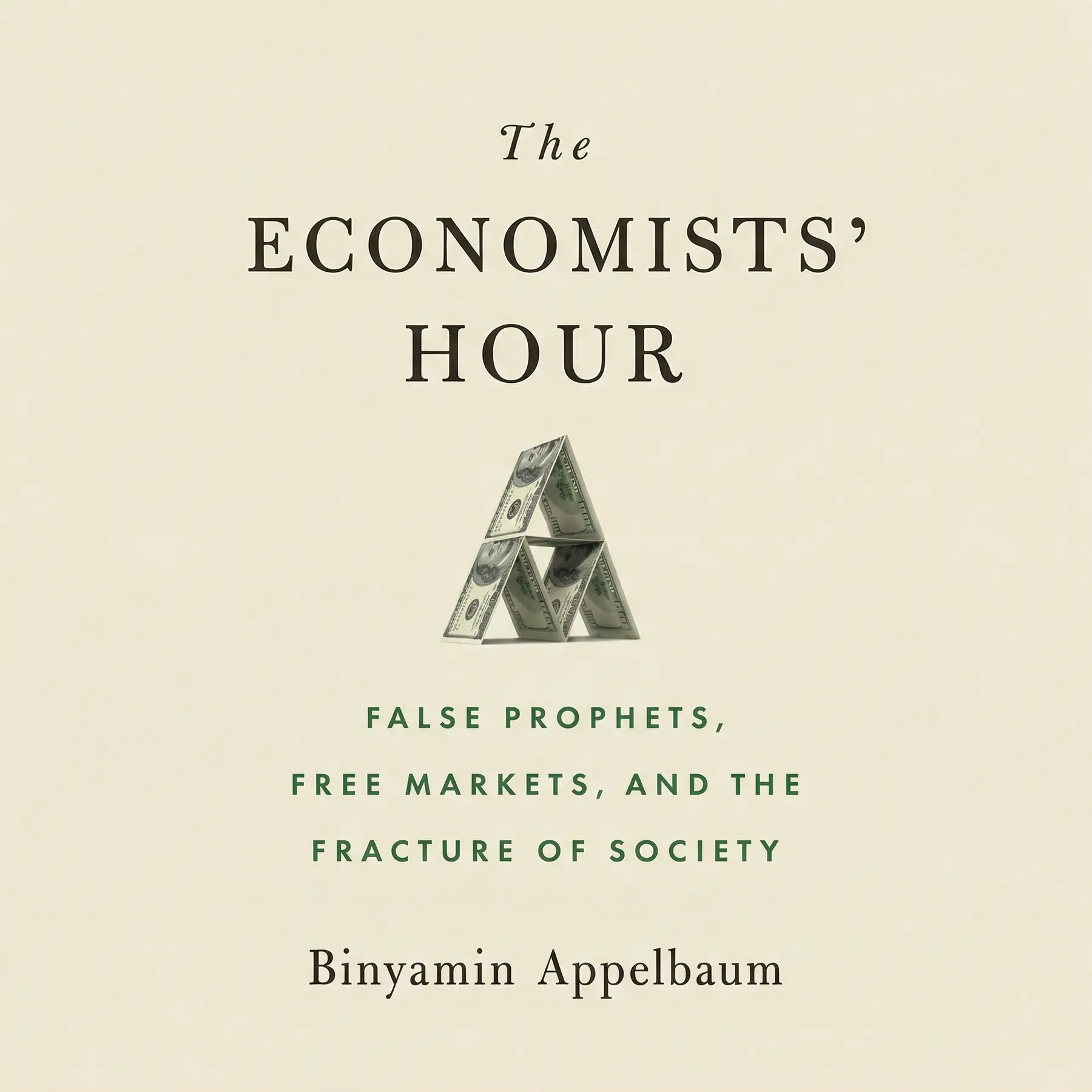
The Economists’ Hour: False Prophets, Free Markets, and the Fracture of Society
Shows how a few postwar economists turned free-market theory into policy on the draft, taxes, regulation, money and finance, and why Appelbaum blames their victory for stagnant wages, weaker industry and deep inequality.

Table of Content
1. Introduction
1 min 00 sec
Tax cuts, deregulation and deficits can feel like weather that nobody chose. In The Economists’ Hour, Binyamin Appelbaum shows who did choose them. After World War Two, a handful of once obscure economists, among them Walter Oi, Arthur Laffer and Milton Friedman, moved from lecture halls into the rooms where policy is made.
Their creed was simple: let markets decide, keep taxes low and get government out of the way. Appelbaum argues that they won the argument across the United States and far beyond, and that the bill arrived as stagnant wages, weakened factories and historically high inequality. The story runs from a student protest in Chicago to a coup in Santiago and the crash of 2008. Follow it and today’s policy fights trace back to a few specific ideas, which gives you sharper questions to ask whenever an expert promises efficiency.
2. See how one memo can outweigh street protests
1 min 31 sec
Students stormed buildings to end the military draft, and history mostly thanks them. Another group was pushing for the same result, for very different reasons, and its weapon was a document handed to a presidential candidate.
3. Understand the old fight over who steers the economy
1 min 52 sec
Every modern argument about stimulus and interest rates replays a feud from the 1960s. One side had rescued the country from the Depression; the other offered a cure for rising prices that came with painful side effects.
4. Understand how a strong dollar empties factories
1 min 33 sec
A summer decision at a presidential retreat cut the dollar loose and sent currency values swinging. Shoppers gained from it, but a different group of Americans spent the next fifteen years discovering the cost.
5. Judge tax-cut promises by who gains first
1 min 37 sec
Cut taxes at the top, the theory went, and prosperity would flow down to everyone else. A president put it to the test on a grand scale, and the results still shape budget fights today.
6. Question the price tag put on a life
1 min 45 sec
A truck crash kills three people, and costly extra parts could keep future crashes from being fatal. Whether the fix gets made can depend on a number most people never hear about, set by an economist in 1972.
7. Spot when efficiency turns into monopoly power
1 min 47 sec
A phone giant once handed its rivals the blueprint for its most valuable invention, under orders. Decades later, four airlines carry most American travelers. The change between those two moments came from a classroom.
8. Read Chile as the warning about pure markets
1 min 55 sec
Two years after a bloody coup, the world’s most famous free-market economist flew to Santiago to advise the general in charge. What followed was the purest test of his ideas, run where no one could vote against it.
9. Learn how unchecked finance keeps ending in crisis
1 min 33 sec
One central banker believed the best financial rule was no rule at all, and he held that view for decades. A bankrupt county, a collapsed British bank and a global crash all tested his conviction.
10. Conclusion
1 min 18 sec
The Economists’ Hour tells how a theory became common sense. A small circle that included Friedman, Shultz, Laffer and Stigler persuaded presidents, judges and a dictator that low taxes, light rules and a smaller state would serve everyone. Appelbaum’s verdict is that the United States and many Western countries tried it and got stagnant wages, weaker manufacturing and historically high inequality.
The deeper lesson concerns whose costs get counted. The draft debate waved away worries about poorer recruits. The floating dollar left factory workers behind, tax cuts skipped the bottom of the ladder, and a $200,000 figure turned lives into a budget line. Each time, the model measured what was easy to measure and ignored the rest.
That leaves a habit worth keeping. When a policy is sold on efficiency, ask who carries the cost the model leaves out, and look for proof that the promised gains reached them. When an industry shrinks to a few giants, or a financial product resists oversight, remember the airlines and Orange County. The economists earned their hour by sounding certain, and the next one belongs to whoever keeps asking who pays.
About this book
What is this book about?
For most of the twentieth century, economists were academics with little say over how countries were run. Binyamin Appelbaum tells how that changed after World War Two, when a group led by thinkers such as Milton Friedman, Arthur Laffer, George Stigler and Walter Oi talked their way into the offices of presidents, judges and central bankers. Their creed was consistent: let markets set prices and wages, keep taxes low, cut regulation and keep government small. Appelbaum follows it through a series of victories, from ending the military draft and floating the dollar to Reagan's tax cuts, putting a dollar value on human life, weakening antitrust enforcement, advising Pinochet's Chile and leaving derivatives and subprime mortgages unregulated. His verdict is critical. In the United States and other Western countries, he argues, the experiment delivered stagnant wages, a hollowed-out manufacturing sector, repeated financial crises and historically high inequality. Readers get the backstory to today's arguments over taxes, monopolies and banking, along with a habit of asking who pays when a policy is sold on efficiency.
Book Information
Who it's for
Economic news watchers
Professionals who follow economic news and want the backstory to today's fights over taxes, monopolies and banking.
Social science students
Students of economics, history or politics looking for a critical account of free-market thinking in power.
Business founders and managers
Founders and managers who want to see how policy shapes the markets they compete in.
About the Author
Binyamin Appelbaum
Binyamin Appelbaum is an American journalist who leads business and economics writing for the editorial board of The New York Times. From 2010 to 2019 he covered economic policy in Washington for the Times, including the Federal Reserve. He previously reported for The Washington Post, The Boston Globe, The Charlotte Observer and the Florida Times-Union. His work on subprime lending won a George Polk Award and made him a Pulitzer Prize finalist in 2008. He studied history at the University of Pennsylvania.
Ratings & Reviews
Ratings at a glance
What people think
Listeners consider this an exceptional record of economic history that is both rigorously researched and skillfully composed. They describe the experience as highly engaging and accessible, with one listener highlighting the fascinating stories about the key figures involved. While the text provides a solid overview of economic policy, some listeners express mixed opinions regarding its economic substance. Additionally, listeners disagree on how much the book relies on proposed solutions.
Top reviews
Look
Appelbaum has managed to turn what sounds like a dry academic history into a gripping narrative about the rise of the free-market era. The way he traces the influence of the Chicago School from the ivory tower into the halls of power is nothing short of masterful. I was particularly captivated by the chapter on how economists helped end the military draft by shifting the argument from civic duty to market efficiency. It’s a dense read at times, but the prose is so sharp that you rarely feel bogged down in the data. The book really highlights how a small group of thinkers, led by Milton Friedman, fundamentally reshaped our world for better and, often, for worse. You don't need a PhD to appreciate the storytelling here. It’s a definitive account of how we got to where we are today.
Show moreThongchai
Wow. Just wow. I never thought I’d be engrossed by a book about monetary policy, yet here we are. This isn't your standard boring textbook; it reads almost like a novel where the characters are ideas and the stakes are the global economy. I was fascinated to learn how recently we started putting a literal price tag on human life for regulatory purposes. It’s chilling to see how 'efficiency' was prioritized over equity for decades. The author’s background as a journalist really shines through in the way he humanizes these intellectual giants. Whether you agree with his skeptical view of free markets or not, the history he lays out is essential for understanding the 21st century. It totally transformed my outlook on how power and influence actually function in Washington. Absolutely worth the time.
Show moreSangduan
Finally got around to reading this and it blew my mind how much influence a small group of University of Chicago academics had on the world. The chapter on the draft was worth the price of the book alone. Honestly, I used to find economics gruelingly boring, but Appelbaum makes it feel vital and alive. He shows how 'efficiency' became a mantra that justified all sorts of social upheaval. The book is filled with little-known stories about the players involved, making it feel more like a biography of an era than a dry history. It’s enlightened my understanding of why the middle class has struggled while the top 1% has flourished. It’s a long read, but the short, punchy chapters keep you moving. Highly recommend for any news junkie or history buff.
Show moreNoah
Not what I expected from an economic history book. It reads more like a tragedy where the 'heroes' are brilliant minds whose obsession with efficiency blinded them to human costs. I was fascinated by the global scope—it wasn't just about the US, but how these theories exported instability to places like Taiwan and Iceland. The writing is insightful and vigorous, and I finished it feeling much more informed about the mechanics of our government. It’s rare to find a book that can explain the Laffer Curve and the collapse of the gold standard without putting you to sleep. Appelbaum has a gift for finding the human drama behind the data points. This is an essential document for anyone trying to make sense of the current political climate and our fractured economy.
Show moreSin
Look, I’m no expert on fiscal policy, but this book made me feel like I finally understood why our society looks the way it does. The author focuses on that pivotal window between 1969 and 2008 when economists became the high priests of American policy. While I think Appelbaum is a bit too one-sided in his criticism of deregulation, his research is impeccable. The stories about Iceland’s economic collapse and Chile’s 'Chicago Boys' were eye-opening and provided much-needed global context. My only real gripe is that the book meanders in the middle chapters, losing its narrative momentum. Still, it is a very enjoyable and easy-to-understand read for anyone interested in why 'efficiency' became the ultimate goal of government. It's a solid 4-star history that prompted a lot of reflection on my part.
Show moreSupaporn
As someone who generally favors market solutions, I found this to be a tough but necessary pill to swallow. Appelbaum doesn't just attack the ideas; he shows how their implementation in the real world led to unintended and often disastrous consequences. The breakdown of the Bretton Woods system and the subsequent rise of monetarism is explained with incredible clarity. I do think the author is slightly unfair to the economists of the late 20th century, treating their failures as malice rather than the limits of human foresight. No theory works forever. Nevertheless, the writing is vigorous and enlightening throughout. It’s a fascinating look at the hubris of the 'experts' who thought they had solved the business cycle. This book is an urgent read for anyone who cares about the intersection of policy and human well-being.
Show moreOm
Ever wonder how economists became more influential than politicians? This book provides a brilliant, carefully researched answer. It’s an outstanding document on economic history that manages to be both academic in its depth and accessible in its tone. I loved the specific details about the rivalry between Keynesianism and the rising tide of Reaganomics. My only complaint is that it feels a bit light on the tech era—the author focuses heavily on the post-war period but breezes through the complexities of the digital economy. Regardless, the way he connects economic theory to real-world outcomes like the 2008 crash is compelling. It’s a bit of a cautionary tale about what happens when we let abstract models dictate our social reality. If you want to understand the roots of modern populism, start here.
Show moreNuk
To be fair, the author’s perspective is clearly leaning toward more regulation, but the historical groundwork he lays is undeniable. The book is particularly strong when discussing the 1970s and the turning tide against the Great Society programs. It's a very important read that documents how the 'Economists' Hour' led to a world of hyper-globalism and unchecked corporate power. I appreciated that it wasn't just a dry list of dates; it was a character-driven story about how ideas take hold in a culture. Some of the sections on monetary policy were a bit dense for a casual reader, but the author usually pulls back to the big picture before you get lost. It’s a solid, thoughtful critique of our modern system. It definitely makes you question the 'common sense' of contemporary economics.
Show morePloy
The anecdotes here are top-tier, especially the bits about Milton Friedman and his persistent optimism regarding free markets. However, the structure of the book feels somewhat disjointed. It hops between budget debates and international financial crises without a clear sense of sequential cause and effect. Truth is, the author clearly has an axe to grind against market-based economics, which sometimes colors his analysis too heavily. He decries the destruction of the old system but offers very little in the way of concrete solutions for the future. I enjoyed the individual parables of the economists themselves, but as a cohesive argument, it fell a bit flat for me. It’s a decent history, but it feels like it’s missing a few key players like Greenspan or the behavioral economics movement. A bit of a mixed bag.
Show moreKavya
While the historical anecdotes are well-researched, the book is incredibly unbalanced in its criticism. The author seems to believe that the US economy hasn't done a single thing right in fifty years, which is a ridiculous stretch. He heaps all the blame for modern inequality on Milton Friedman and the Chicago School while completely ignoring the failures of the systems that came before. There is a lot of interesting history tucked away in these pages, but you have to wade through a swamp of bias to find it. Furthermore, the ending is a total letdown. He spends hundreds of pages tearing down market-based systems but provides no guidance on what should replace them. It’s easy to throw stones from an ivory tower, but much harder to build something functional. I expected a more objective analysis from a New York Times journalist.
Show moreQuestions about this book
What is The Economists' Hour about?
Binyamin Appelbaum traces how a group of postwar economists, including Milton Friedman, Arthur Laffer, George Stigler and Walter Oi, moved from academia into positions of influence. Their push for low taxes, deregulation and limited government shaped the end of the draft, the floating dollar, Reagan’s tax cuts, cost-benefit regulation, weaker antitrust and loose financial rules. Appelbaum argues the result was stagnant wages, weakened manufacturing and historically high inequality.
What does Appelbaum say about Milton Friedman and Chile?
In 1975, two years after Augusto Pinochet seized power in a violent coup, Friedman flew to Chile to advise him. Pinochet gave the economy to the Chicago Boys, economists trained at the University of Chicago, who cut public programs, tightened money and privatized industry. Appelbaum describes mass job losses, wealth for a small circle, record regional debt by the early 1980s and, by the decade’s end, less prosperity than Cuba.
How did deregulation affect monopolies, according to The Economists' Hour?
Appelbaum says economists like George Stigler shifted antitrust thinking from fairness to efficiency, judging firms only by consumer prices. Business-funded institutes taught this view, and by 1990 over 40 percent of federal judges had attended them. Mergers sped up: five meatpackers went from 25 percent to more than 70 percent of their market by 1992, and after airline deregulation four carriers ended up flying 80 percent of American passengers.
What is the main takeaway of The Economists' Hour?
Policies sold on efficiency often hide who pays for them. Appelbaum shows the same pattern repeating: a clean market theory wins the political argument, while the costs it leaves out fall on workers, from factory staff hurt by a strong dollar to families sold subprime loans. His book encourages readers to ask whose costs a model ignores and whether promised benefits actually reach ordinary people.
Who should read The Economists' Hour?
It suits readers who follow economic news and want to understand where today’s debates over tax cuts, regulation, monopolies and financial crises came from. Students of economics, history and politics get a critical history of free-market ideas in power. Business readers get context on how antitrust, currency and banking decisions shaped the industries they work in.
Readers also enjoyed



A Warning
Miles Taylor

Adults in The Room: My Battle With Europe’s Deep Establishment
Yanis Varoufakis




Abolish Rent: How Tenants Can End the Housing Crisis
Tracy Rosenthal

Abortion: Our Bodies, Their Lies, and the Truths We Use to
Jessica Valenti
AUDIO SUMMARY AVAILABLE
Listen to The Economists’ Hour in 15 minutes
Get the key ideas from The Economists’ Hour by Binyamin Appelbaum, plus 5,000+ more nonfiction titles.
- 5,000+ titles
- Listen as much as you want
- 7-day free trial
- Cancel anytime









