

14 min 47 sec
Available in: English
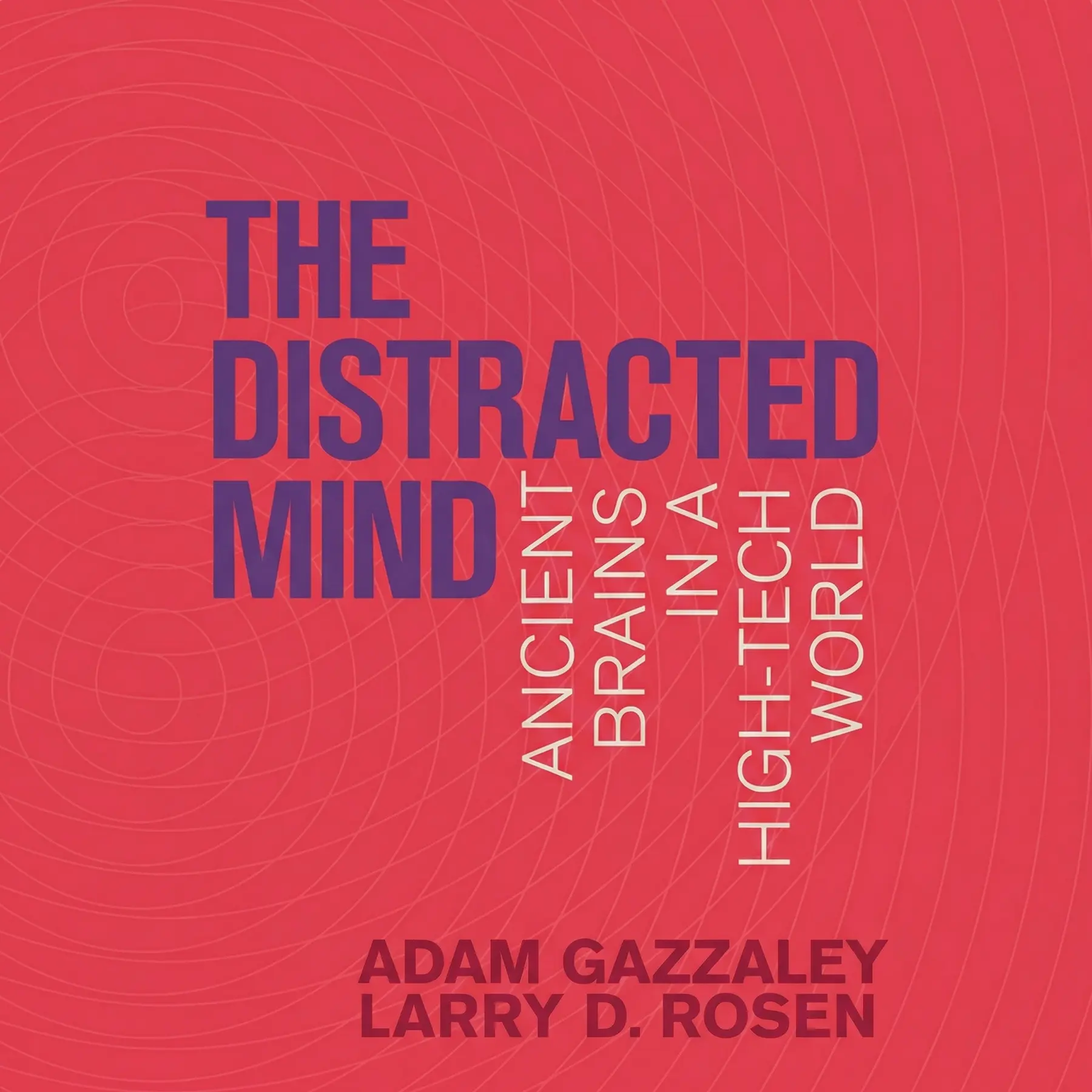
The Distracted Mind: Ancient Brains in a High-Tech World
Explains why an evolved brain loses focus so easily among phones, email and social media. It names the four forces behind every distracted glance and shows how exercise, training and small habit changes restore control.
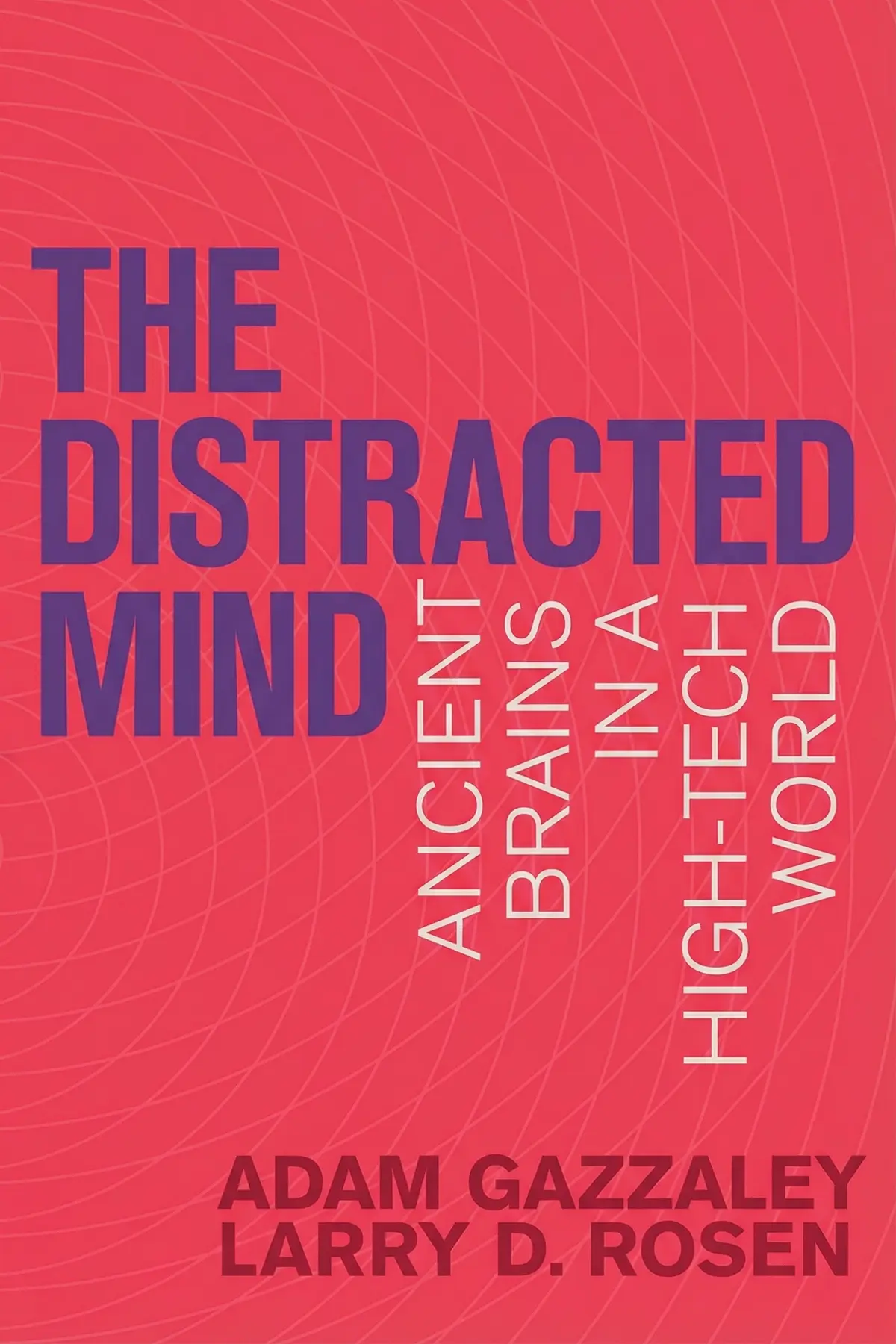
Table of Content
1. Introduction
1 min 02 sec
If your attention breaks every few minutes, the cause may be less weak willpower than a brain built for a different world. In The Distracted Mind, neuroscientist Adam Gazzaley and psychologist Larry D. Rosen argue that humans are far better at setting goals than at holding on to them, because the ability that keeps us on task evolved less than the ability that plans.
Phones, the internet and social media did not create that weakness. They press on it all day long. The authors trace distraction to its roots, from an old foraging drive that now hunts for information to four everyday forces that pull a hand toward a screen: boredom, anxiety, easy access and a lack of awareness of what your own mind is doing.
Once those forces have names, each becomes something you can adjust, and the brain itself turns out to be trainable. What follows is a plan for staying with one task, one road and one conversation at a time.
2. Keep your goals on track despite a distractible brain
1 min 47 sec
You can picture the finished project, the clean inbox, the errand done. Somewhere between deciding and doing, the goal slips away. The authors find the reason in how the brain itself was built.
3. Know which distractions you can never block
1 min 45 sec
Some interruptions grab you before you have any say in the matter, while others wait for permission. Telling the two apart changes where you should spend your limited self-control.
4. See your phone habit as an ancient hunger
1 min 32 sec
Glancing at your screen in the middle of an important meeting feels like a lapse of discipline. A study of monkeys suggests the urge comes from somewhere much older and much harder to argue with.
5. Spot the real cost of constant task switching
1 min 51 sec
Most of us believe we are handling several things at once. Measurements of students, adults and emergency room visits tell a different story about what our devices are doing to our days.
6. Name the four forces behind every phone check
1 min 55 sec
People keep walking into lampposts rather than put their phones away. Researchers at Stanford wired students with sensors and found that the body starts to stir before the mind decides to switch.
7. Build stronger focus with exercise and training
1 min 50 sec
Older adults who trained their attention years earlier were still showing the benefits a decade later, including on the road. Children on treadmills offer another clue about where better focus comes from.
8. Protect your drive and your dinner from phones
1 min 53 sec
You do not have to delete your accounts or go offline to stay safe and present. A phone sitting untouched in the room, one study found, still changes how two people feel about each other.
9. Conclusion
1 min 12 sec
The Distracted Mind builds a hopeful case on an unflattering fact. Our brains plan brilliantly and follow through poorly, they flinch at anything sudden, and they treat each new piece of information like found food. Phones, the internet and social media found those traits already in place and built a world that presses on them every few minutes. Because the weakness is shared and predictable, it can be planned around.
The authors’ advice is moderate. Keep the technology and change the conditions around it. Before reaching for your phone, name the force behind the reach, whether boredom, anxiety, easy access or plain inattention. When a conversation matters, take the phone out of the room, since its presence alone costs closeness. Let people know when you drive and when you eat, so no silence feels like something missed. And treat exercise, steady brain training and meditation as practice for attention, the kind that still showed in the ACTIVE trial participants’ driving ten years on.
Nothing in excess, the old saying goes, and that includes the glowing screen in your pocket.
About this book
What is this book about?
Most people can set an ambitious goal in seconds and then lose it within minutes to a buzzing phone. Neuroscientist Adam Gazzaley and psychologist Larry D. Rosen argue this is no personal failing. The brain's ability to plan evolved further than its ability to stay on task, and our ancient urge to forage now hunts for information, rewarding every check of a feed with a hit of dopamine. The authors show how the internet, smartphones and social media press on that weakness, with studies of students who hold focus for only three to five minutes and adults who switch tasks 17 to 27 times an hour. They then identify four forces that keep eyes on screens: boredom, anxiety, easy access and a lack of awareness of one's own mind. The answer is moderation. Readers learn how physical exercise, brain training and meditation can strengthen cognitive control, and how to apply the four forces to two everyday settings, the drive to work and the conversation at the dinner table.
Book Information
Who it's for
Interrupted office workers
Office workers who lose their train of thought every few minutes to email and notifications.
Learners keeping phones nearby
Students who study with a phone at hand and wonder why little sticks.
Families wanting phone balance
Parents and partners who want phone-free dinners and safer commutes without quitting technology.
About the Author
Adam Gazzaley
Adam Gazzaley is a neuroscientist and professor of neurology, physiology and psychiatry at the University of California, San Francisco, where he founded the research center Neuroscape. His lab studies neuroplasticity and builds tools such as custom video games to improve cognition, and he is credited as inventor of the first video game approved by the FDA as a medical treatment. Larry D. Rosen is a professor emeritus of psychology at California State University, Dominguez Hills, and an expert in the psychology of technology who has studied reactions to technology in more than 30,000 people across 23 countries.
Ratings & Reviews
Ratings at a glance
What people think
Listeners find this work exceptionally well-crafted and educational, with one noting how it grounds the narrative in scientific research. Furthermore, the book earns praise for its engaging examination of tech-driven distraction, mental performance, and focus, with one listener emphasizing its groundbreaking studies on attention and interference. Listeners also value its approachability, with one individual mentioning its clear analogies, and find the subject matter captivating. Yet, opinions on the prose style vary; some consider it a straightforward read, whereas others characterize the text as dense.
Top reviews
Noo
Ever wonder why your phone feels like an extra limb you can't stop checking? This book provides a fascinating deep dive into why our 'ancient' brains are fundamentally ill-equipped for the high-tech bombardment of the 21st century. Gazzaley and Rosen explain that our minds are essentially designed for foraging information, much like our ancestors foraged for food. This makes the 'pings' and notifications of modern life almost impossible to ignore. I found the distinction between distractions and interruptions particularly enlightening. While the prose can be a bit dense at times, the pioneering research from the Gazzaley Lab makes this an essential read for anyone feeling overwhelmed by their digital life. It is a persuasive wallop that might finally convince you to put the phone down during dinner.
Show moreArt
Picking this up was a total game-changer for how I manage my daily workflow. Not gonna lie, I used to pride myself on being a master multitasker, but Gazzaley and Rosen thoroughly dismantled that delusion. They show how we are actually just rapidly switching between networks, which creates a huge 'switching cost' in terms of brain power. The book is extremely well written and manages to stay grounded even when discussing complex topics like the Marginal Value Theorem. I especially loved the section on 'neuro-treatments' and how certain types of video games—like the ones developed in the Gazzaley Lab—might actually help improve cognitive control. It’s rare to find a book that is both this scientifically dense and this practically useful. Highly recommend for the digital age.
Show morePornpimon
This study of the intersection between ancient biology and modern technology is nothing short of exceptional. The authors, a neuroscientist and a psychologist, provide a dual-lens view that is both thorough and accessible. I was fascinated by the concept that our brains simply haven't evolved as fast as our tools. The statistics provided about distracted driving and lost productivity are genuinely frightening. What sets this book apart is that it doesn't just preach; it uses the Marginal Value Theorem to explain the 'why' behind our behavior. It’s a bit dense, but the analogies make it much easier to digest. If you want to understand the mechanics of your own mind and how to reclaim your focus, this is the book to read.
Show moreKwan
As a neuroscientist-psychologist duo, Gazzaley and Rosen bring a level of academic rigor that is often missing from the usual self-help fluff. They nest the entire discussion in solid research findings, moving beyond simple 'tech is bad' rhetoric to explain the actual cognitive limitations of the human brain. I was especially struck by the statistics on how even the mere presence of a smartphone in a room can diminish social connection. The authors use understandable analogies to explain complex neural processes, making the high-level science accessible to someone like me. My only gripe is that it can feel repetitive. Once the point about our limited top-down control is made, the book continues to hammer it home with study after study. Still, it’s a brilliant wake-up call.
Show moreSuthee
To be fair, the first half of this book is quite heavy on neuro-jargon, which might scare off some readers. However, if you stick with it, the insights into 'goal interference' are incredibly valuable. I learned that suppressing irrelevant information isn't a passive act; it’s an active process that requires significant energy. That explains why I feel so exhausted after a day of 'just' checking emails and Slack! The authors do a great job of explaining why we feel a constant need to forage for new information, even when it’s detrimental to our long-term goals. It isn't a quick, easy read, but the depth of information on cognitive performance is second to none. It definitely changed how I view my relationship with my laptop.
Show moreWatcharee
Look, the science is solid, but you have to be in the right headspace for this one. It isn't a thrilling page-turner; it’s a serious look at how we’re losing our ability to perform single tasks with any real efficiency. The authors cite shocking statistics—like how students can barely go three minutes without checking social media—which really put my own habits into perspective. I appreciated that they didn't just complain about the problem but actually prescribed solutions, such as taking 'tech breaks' and practicing mindfulness. The writing is a bit textbook-like, which makes it feel longer than it actually is, but the content is just too relevant to ignore. It’s a necessary deep dive into our collective attention crisis.
Show moreBoss
After hearing so much about the 'attention economy,' I wanted to understand the actual biology behind it. This book delivered exactly that. It's a compelling look at technology distraction and how it impacts everything from driving safety to our intimate relationships. The authors don't just blame the gadgets; they explain why our brains are vulnerable to them in the first place. I found the discussion on how aging affects our ability to filter out distractions particularly interesting (and a bit depressing!). While I would have liked even more practical tips in the earlier chapters, the scientific foundation they build is incredibly strong. It’s a sophisticated, informative read that nests its arguments in pioneering research rather than just anecdotes.
Show moreSarawut
The core message here is vital, but the delivery feels more like a dry, first-year college lecture than a compelling trade paperback. Truth is, the authors spend about 200 pages proving a point that most of us already intuitively understand: multitasking is a myth and technology is ruining our focus. I really appreciated the explanation of 'task switching' and how it degrades efficiency, yet the book suffers from a lack of personality in the writing. It feels like a very long magazine article stretched thin to meet a word count. If you can push through the plodding, textbook-like middle sections, the last two chapters offer some decent practical tips on meditation and exercise. It’s informative, just not particularly enjoyable to sit through.
Show moreViroj
Frankly, I expected more objectivity from authors with these credentials. While the premise is relevant, I noticed several glaring factual errors that made me question the rest of the data. For instance, citing that 860 million Europeans own smartphones when the entire population of the continent is much lower is a huge oversight. Beyond the typos, the tone feels heavily biased against younger generations, using loaded words like 'admit' for harmless phone habits. They also rely on some questionable studies, like the one about iPads and sleep where they had participants use maximum brightness in a dark room—hardly a realistic scenario. I wanted a scientific look at cognitive load, but what I got felt more like an 'old man yells at cloud' manifesto disguised as research. Disappointing.
Show moreMilk
My attention span was already struggling, and this book did absolutely nothing to help it. Imagine your most boring science teacher ever droning on for hours—that is the tone of this entire work. I was looking for a guide to help my distracted mind, but the writing is so devoid of life that I couldn't even finish it. It’s ironic that a book about focus is so difficult to focus on. To be fair, the science seems legitimate, but there is zero attempt to make the data engaging for a general audience. If you aren't already a neuroscientist or a dedicated academic, you will likely find this a chore. I felt betrayed by the positive blurbs on the back.
Show moreQuestions about this book
What is the main idea of The Distracted Mind?
Adam Gazzaley and Larry D. Rosen argue that the human brain is better at setting goals than at keeping them, because cognitive control evolved less than our planning abilities. An ancient drive to forage now seeks information and rewards us with dopamine. The internet, smartphones and social media exploit that weakness, but exercise, brain training and behavior changes can restore focus.
Why do we keep checking our phones according to The Distracted Mind?
The authors name four factors. Switching to entertainment relieves boredom. Checking eases anxiety, the fear of missing out, which appears in young adults after about 15 minutes away from a device. Phones are always within reach. And many people lack metacognition, the awareness that they are switching tasks at all, which makes the urge hard to resist.
Is multitasking real according to Gazzaley and Rosen?
The authors say most so-called multitasking is rapid switching between tasks, with none getting enough attention. In a 2013 study by one of them, students stayed on a single task for only three to five minutes. A 2012 study found younger adults switching 27 times an hour and older adults 17 times.
How can I improve my focus based on The Distracted Mind?
Train the brain and change your habits. The authors point to physical exercise, regular brain training that grows harder over time, and meditation. In daily life, lower boredom, anxiety and access while raising self-awareness: keep phones out of the dining room, use apps that block messages while driving, and tell people your schedule so you do not fear missing calls.
Do I need a digital detox to fix distraction?
Not according to the authors. They say quitting Facebook, Twitter or the internet makes sense only if you feel addicted. Their approach is moderation: use a little less, and cut interference in everyday settings such as driving and conversation, where in a 2013 University of Essex study a phone merely present in the room, never picked up, reduced closeness.
Featured in
Readers also enjoyed








AUDIO SUMMARY AVAILABLE
Listen to The Distracted Mind in 15 minutes
Get the key ideas from The Distracted Mind by Adam Gazzaley, plus 5,000+ more nonfiction titles.
- 5,000+ titles
- Listen as much as you want
- 7-day free trial
- Cancel anytime









