

12 min 53 sec
Available in: English
The Courage to Teach: Exploring the Inner Landscape of a Teacher's Life
Palmer shows how teachers can turn self-doubt and fear into trust. Bring your real self into the room, put the subject at the center, and protect your energy by building community with colleagues.
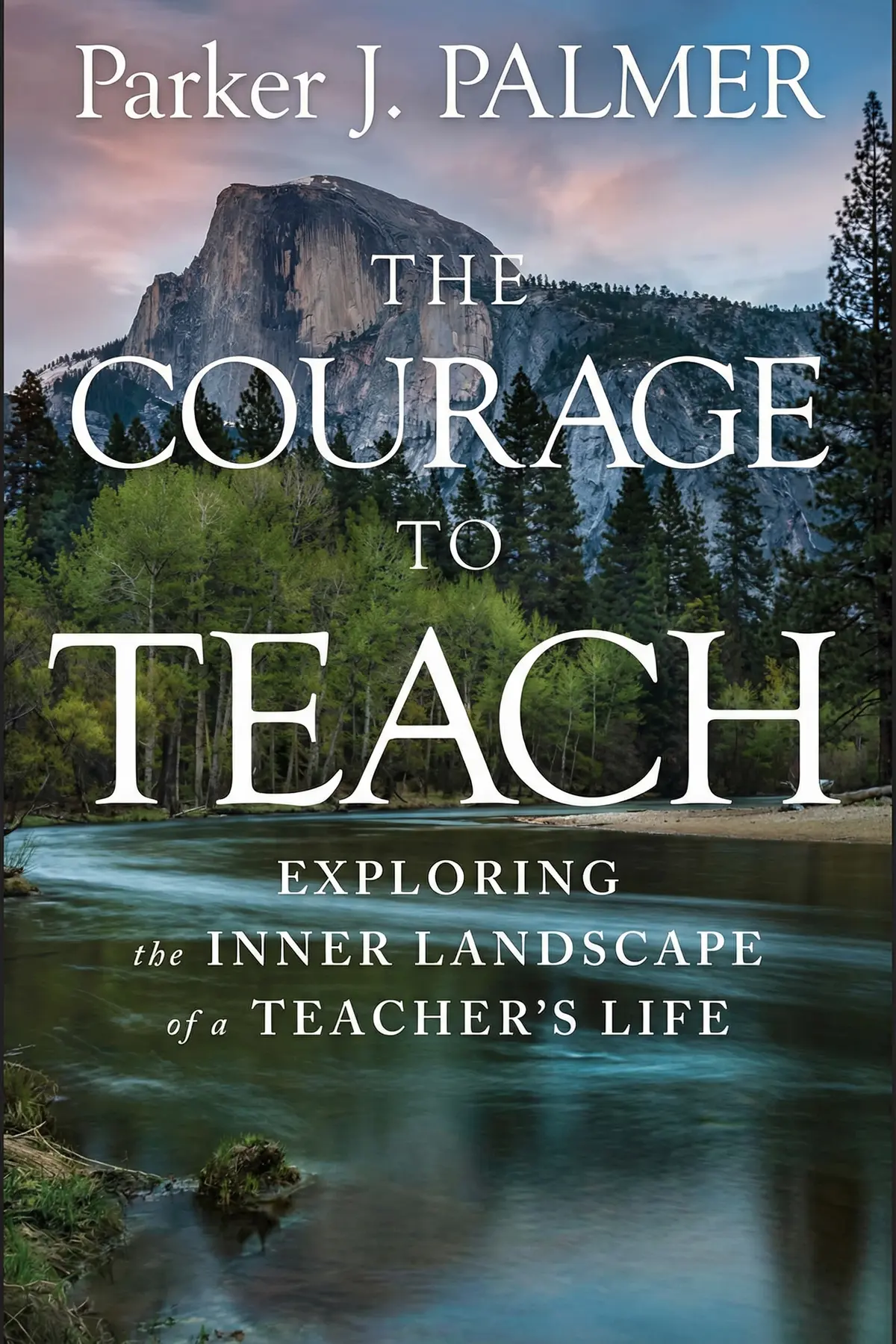
Table of Content
1. Introduction
1 min 03 sec
Most teachers are trained in methods and lesson plans. Then they discover that the hardest part of the job is standing in front of a room while doubting themselves. In The Courage to Teach, Parker J. Palmer argues that good teaching starts from the teacher’s identity, not from technique, and that the fears teachers hide can become the very thing that earns their students’ trust. Teaching less perfectly, he suggests, often means teaching better.
Palmer’s case moves from the inside out. A teacher who is present and honest, fears included, can step out of the spotlight and let students gather around the subject itself. The classroom that results depends heavily on conditions the teacher sets. It lasts only if the teacher’s own spirit is renewed among colleagues. The examples range from physics and music to history and math. Anyone who teaches, trains or leads a team will find small experiments to try in the very next lesson, and a way back to the reasons they started.
2. Turn classroom fear into a source of trust
2 min 13 sec
Every teacher walks in carrying a fear nobody mentions in staff meetings. A first-year math teacher found that the moment he dreaded most, being caught without an answer, changed how his students saw him.
3. Teach from who you already are
2 min 01 sec
Many new teachers put on a stern, formal manner because they think authority requires it. A physics teacher who dropped that act found her students suddenly seeing science through very different eyes.
4. Gather students around the subject itself
2 min 12 sec
When the teacher is the only expert in the room, students learn to chase approval and grades. A literature teacher who traded lectures for her students’ own questions saw them uncover meanings in the text she had not considered.
5. Read quiet students as a response to the room
2 min 16 sec
A class of blank faces looks like proof that students just don’t care. Yet the same students are loud and full of ideas in the hallway, and that contrast points somewhere uncomfortable.
6. A teaching life that refills instead of drains
2 min 04 sec
Idealism carries most teachers through their first years, then slowly leaks away. One teacher’s monthly dinner showed colleagues that what felt like personal failure was something else entirely.
7. Conclusion
1 min 04 sec
Palmer’s book asks for a kind of courage that rarely appears in training manuals: the courage to be seen. Admitting uncertainty, showing real enthusiasm, handing the center of the room to the subject and building a space where curiosity can breathe are all risks that no method removes. Those same risks are what make learning feel alive, for students and for the teacher. And because courage wears thin, it has to be refilled, in private habits and in the company of colleagues, until whole schools are shaped by it.
Pick one fear and test it this week, perhaps by letting a silence run to a count of ten before you speak. Bring one true part of yourself into a lesson, a meeting or a training session, and open it with a question you actually want answered. Then invite one colleague into your room, or ask to sit in theirs.
Rajesh lost nothing when he told his class he needed time to think. He gained a room that was willing to think with him.
About this book
What is this book about?
Teacher training covers methods and lesson plans. It says little about what it feels like to stand before a class while doubting yourself, or about the slow loss of enthusiasm that wears down so many educators. Parker J. Palmer argues that these inner struggles are where good teaching is decided. His view is that a teacher's identity shapes every moment in the classroom. Hiding behind a perfect, all-knowing front cuts off the connection that makes learning work. Palmer encourages teachers to admit uncertainty and let their real enthusiasm show. He also asks them to gather with students around the subject itself, so the teacher is no longer the only expert. Disengaged students, he suggests, are often reacting to the conditions in the room, and those conditions can change. Readers get small experiments to try in their next lesson, from counting to ten in a silence to opening class with a question they really want answered. They also get a case for caring for their own inner life and for opening classroom doors to colleagues, so the courage to teach keeps getting renewed.
Book Information
Who it's for
Teachers with fading enthusiasm
Teachers who feel their early enthusiasm fading and want to reconnect with why they started.
New educators hiding nerves
New educators who hide their nerves behind a stern, all-knowing front.
Trainers and team leads
Trainers and team leads who want quiet groups to speak up and colleagues to share their struggles.
About the Author
Parker J. Palmer
Parker J. Palmer was born in 1939 and grew up in the Chicago area. He earned a Ph.D. in sociology from the University of California, Berkeley. He founded the Center for Courage & Renewal and later became its Senior Partner Emeritus. The Courage to Teach is among his bestselling books. In 2010 he received the William Rainey Harper Award, an honor also given to Margaret Mead, Paulo Freire and Elie Wiesel.
Ratings & Reviews
Ratings at a glance
What people think
Listeners find the work accessible and full of wisdom, characterizing it as a motivating exploration of the mind. They value its instructional quality, with one listener highlighting how it assists educators in developing their professional identity while establishing safe environments for their pupils.
Top reviews
Penelope
This book is a masterclass in professional introspection. Parker Palmer takes us on an intellectual journey that feels both deeply personal and academically rigorous. He argues that we teach who we are, which means our identity and integrity are just as vital as our lesson plans. I loved the focus on building a trustworthy space for students to engage with the subject matter. However, you should be prepared for some heavy intellectual lifting throughout. The text is dense and demands your full attention to grasp the nuances of the 'community of truth.' It isn't a quick fix, but it's a profound exploration of the educator's soul. If you want a book that challenges your core beliefs about authority and connection, this is definitely the one for you.
Show moreRyan
Ever wonder why the classroom environment can feel so fragile and lifeless at times? Palmer suggests it’s because we’ve separated our personal selves from our professional roles, losing our integrity in the process. This book is a beautiful intellectual journey into the heart of what it means to lead a community of learners. He discusses creating a 'trustworthy space' where the subject can speak for itself, which was a revelation for my practice. It's a deeply inspirational read that focuses on the internal landscape of the teacher. While some might find the tone a bit mystical, I think it’s exactly what the profession needs right now. It is a powerful reminder that technique is useless without a grounded sense of self.
Show moreAudrey
Wow, this really hits on the vulnerability that defines our daily lives in the classroom. Palmer captures that specific brand of 'heartbreak' that comes from caring deeply about your students and your subject. The book explores how we can create a space that is both bounded and open, allowing for genuine inquiry without losing control. I felt like he was speaking directly to my own experiences with silence and the fear of judgment from the young. It’s an incredibly insightful look at how our internal landscape shapes our external performance. While it is certainly not a light read, the intellectual rewards are well worth the effort. This is a text I will keep on my desk for years to come.
Show moreTalia
The chapter on the 'Student from Hell' was surprisingly relatable and offered a great perspective on how we project our own fears onto our classes. Palmer’s writing is definitely an intellectual journey, moving far beyond simple tips and tricks. He emphasizes that good teaching comes from a capacity for connectedness, weaving together the teacher, the student, and the subject itself. I found the discussion on the 'inner ground' of teaching to be especially moving. While the tone is occasionally a bit abstract, the message about living an 'undivided life' is something every veteran teacher should hear. It helped me remember why I entered this profession in the first place, even if the 'community of truth' feels like a distant goal.
Show moreLuckana
As an educator who's felt the mid-year burnout, this book provided a much-needed moment of reflection. Palmer moves away from the usual 'how-to' guides and focuses on the vulnerability inherent in teaching. He argues that the courage to teach is the courage to keep one's heart open, even when things get difficult. I appreciated the emphasis on the 'community of truth' and how we can support one another as colleagues. Personally, some of the metaphysical debates about reality were a bit much for me during a busy week. However, the core message about integrity and identity is something I will carry with me. It’s a thoughtful, emotional exploration of the high stakes involved in our daily work.
Show moreNong
Finally finished this as part of a faculty book club, and the discussions it sparked were incredible. We spent hours talking about the idea that 'we teach who we are' and how our shadows affect our students. It’s a very different kind of professional development book because it doesn't give you a checklist of things to do. Instead, it invites you to explore your own identity and integrity as an educator. I did find some of the rhetoric a bit dense, but reading it with others helped me process the more metaphysical sections. The book is less about technique and more about the 'teacher within' that we often ignore in the rush of the school day.
Show moreWit
After hearing so much about the 'teacher within,' I decided to dive in during my 11th year of teaching. It’s a companion for anyone who feels they’ve lost their spark or their sense of self in the institution. Palmer’s wisdom regarding the 'coat with two pockets' really resonated with my current struggles. We often feel like dust, but there is gold in our work if we have the courage to look for it. To be fair, I did have to reread several paragraphs to catch his meaning because the writing is quite elevated. It’s not a book for a quick beach read, but it is perfect for deep reflection. It helped me find the confidence to be myself in front of my students again.
Show moreSakura
To be fair, I struggled with the dense prose in several sections. Palmer is clearly brilliant, but his writing style can be bogged down by fancy rhetoric that requires multiple readings to truly decipher. I was looking for a few more tangible strategies to implement in my classroom tomorrow morning. Instead, I found myself navigating a complex metaphysical debate about the nature of reality and communal inquiry. The idea of the 'coat with two pockets'—dust in one, gold in the other—is a beautiful metaphor for the teacher's ego, though. It’s a thoughtful read for those in a philosophical mood, but maybe not the best choice if you're currently overwhelmed and just need a 'steroid shot' of simple enthusiasm.
Show moreMats
Look, I appreciate Palmer’s focus on the human element of education, but parts of this felt a bit too 'mystical' for my taste. There is a fine line between reflective practice and self-help, and this book frequently dances right on that edge. Personally, I found the anecdotes from his own career to be the highlight, as they provided some much-needed context to his theories. The concept that we must remain true to our passion to maintain integrity is powerful. However, the academic jargon can be quite off-putting when you're just trying to survive a long week of grading. It’s a mixed bag that offers deep insights if you’re willing to wade through some very thick, rhetorical weeds.
Show moreLevi
Not what I expected when I picked this up during a particularly rough semester. I was hoping for something uplifting and practical, a way to reclaim my joy for the profession. Instead, the book felt like a series of philosophical ramblings that never quite grounded themselves in the reality of a modern classroom. When Palmer started diving into the metaphysical nature of community, I honestly lost my patience. It felt more like a new-age spiritual guide than a book on pedagogy. I really needed something concrete, but this stayed at such a high level of abstraction that it left me feeling more drained than inspired. It was a chore to finish and offered very little for the average K-12 teacher.
Show moreQuestions about this book
What is the main idea of The Courage to Teach?
Parker J. Palmer argues that great teaching depends on the teacher’s identity and presence more than on methods alone. Teachers who bring their real selves into the room, admit their fears and invite students to explore the subject alongside them build trust and deeper learning. That courage has to be sustained through care for the teacher’s inner life and through community with other teachers.
How does Parker Palmer suggest teachers deal with fear?
Palmer treats fear as a natural part of teaching and suggests facing it openly. Start with one specific anxiety, such as the silence after asking a question, and experiment: count to ten and treat the pause as thinking time. Examples like Rajesh, who admitted he needed to think about a hard question and gained his students’ trust, show how vulnerability can strengthen a class.
What is subject-centered teaching?
Palmer pictures the classroom as a circle with the subject at its center and teacher and students gathered around it. The teacher acts as a guide, not the only expert. Students engage with the material directly instead of trying to please the teacher. A simple way to begin is to open a lesson with a question you genuinely want answered, as Amara did with her geography class.
Why are my students disengaged, according to The Courage to Teach?
Palmer suggests that quiet classes often reflect the learning environment and not the students’ abilities, since the same students are lively outside the room. He recommends watching how students naturally interact before class, then building those patterns into lessons through partner discussions, group seating or shorter interactive segments, as teachers like David, Lin and Hassan did.
Who should read The Courage to Teach?
It suits teachers at any level who feel burned out, anxious or disconnected from their purpose, and new teachers tempted to hide behind a stern front. Trainers and team leads can also use its ideas, from letting silences breathe to inviting colleagues to observe and give feedback, to build groups where people feel safe to admit what they don’t know.
Readers also enjoyed


AUDIO SUMMARY AVAILABLE
Listen to The Courage to Teach in 15 minutes
Get the key ideas from The Courage to Teach by Parker J. Palmer, plus 5,000+ more nonfiction titles.
- 5,000+ titles
- Listen as much as you want
- 7-day free trial
- Cancel anytime









