
13 min 08 sec
Available in: English
The Coffee Bean: A Simple Lesson to Create Positive Change
By Jon Gordon, Damon West
A short fable that names the two usual ways people respond to pressure, giving up or turning cold. It then shows a third way, changing the situation itself, and explains why that choice has to be renewed each time.
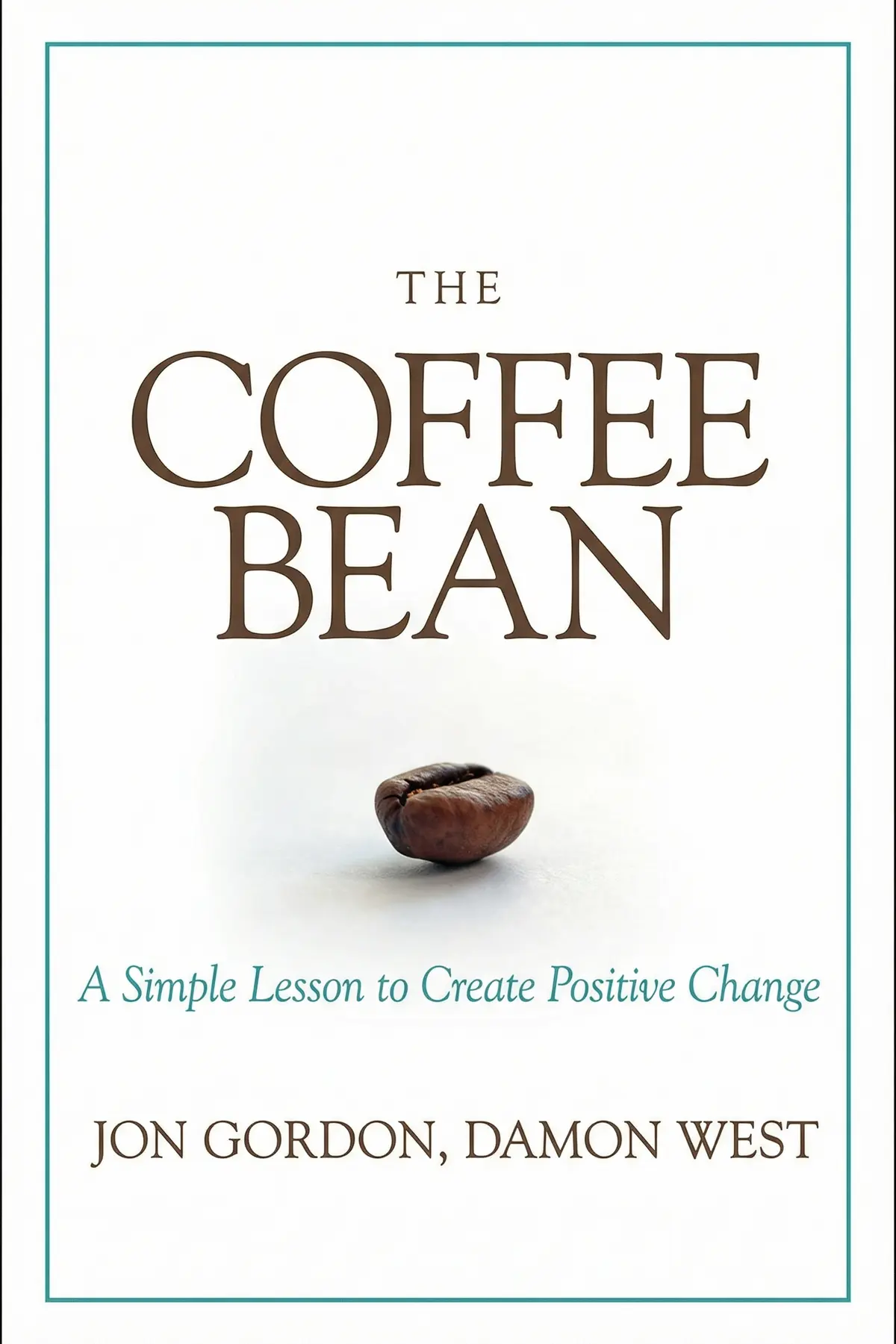
Table of Content
1. Introduction
59 sec
When pressure comes from every side at once, most people either crumble or turn cold, and both reactions let the situation decide who they become. In The Coffee Bean, keynote speaker Damon West and leadership consultant Jon Gordon offer a third response, built on a kitchen experiment. Drop a carrot into boiling water and it goes soft. Drop in an egg and it goes hard. Drop in coffee beans and the water itself turns into coffee.
The authors argue that hard circumstances only reshape us when we believe they are stronger than we are, and that anyone can instead change the setting around them. The choice is never made just once. It has to be made again in each new crisis. Following a teenager named Abe from a stressful senior year to a failing sales job, the book gives you a quick test for catching your own carrot and egg moments, and a way back to the bean.
2. Stop letting pressure soften you into quitting
2 min 04 sec
A teacher hears a student’s long list of troubles and answers with a strange homework task involving a vegetable and a pot of water. What the student sees on his stove points to the real reason people give up.
3. Toughness that turns cold is another loss
1 min 38 sec
Gritting your teeth through hard times sounds like the strong choice. A second item in the same pot of boiling water suggests it may be just as much a defeat as giving up.
4. Be the one who changes the water
1 min 41 sec
Abe expected his third experiment to end like the first two. Instead the pot held something nobody had put in it, and the result turns the whole question of coping with pressure upside down.
5. Turn a setback into a mission others join
1 min 51 sec
Right after his biggest win, Abe is on crutches with his football future in doubt. What he does with the empty weeks that follow changes far more than his own mood.
6. Keep your footing when forces beyond you squeeze
1 min 53 sec
Years after high school, Abe faces a problem no club or pep talk can fix: an industry shifting under his feet and a family depending on him. Even he forgets what he once taught everyone.
7. Choose the bean again in every new situation
1 min 45 sec
The man who changed his whole school later walked out on his wife mid-conversation. That reversal carries both a warning and a hope about how lasting any change of attitude can really be.
8. Conclusion
1 min 17 sec
On the surface, The Coffee Bean asks very little of its reader: remember a carrot, an egg and a handful of beans. Underneath, Gordon and West make a demanding claim. The heat in your life, from talk of divorce at home to a market turning against you at work, does not get to decide who you become unless you believe it is stronger than you. Going soft and going hard feel like opposite reactions, yet both hand control to the water.
The book’s most honest touch is that its hero fails. Abe, who once changed the mood of an entire school, later walks out on his wife mid-conversation and dreams of running away. The lesson never stopped working. He stopped remembering it.
So the useful moves are modest. When you feel the urge to quit, ask whether the problem has beaten you or whether you have only assumed it will. When you catch yourself answering coldness with coldness, name the egg. Then look for something you can add to the situation, a new relationship, a kind note, a fresh idea for your team, and bring a few people with you.
An hour in boiling water did not ruin the beans. It turned the water into coffee.
About this book
What is this book about?
When stress piles up at home and at work, most people react in one of two ways. Some go soft and start looking for a way out. Others turn hard and answer coldness with more coldness. In The Coffee Bean, Jon Gordon and Damon West argue that both reactions come from one mistaken belief: that outside forces are stronger than we are. The authors make the case through a fable. A high school football star named Abe, overwhelmed by his parents' fights and a big game, gets three strange homework assignments from his science teacher, Mr. Jackson. He has to boil a carrot, think about an egg and boil a pot of coffee beans. The beans change the water instead of being changed by it, and that image follows Abe through a knee injury, the army and a failing sales job. Readers get a simple, memorable test for spotting their own soft and hard reactions under pressure. They also learn why even people who once got it right can slip back, and how to bring others along when changing a school, a team or a company.
Book Information
Who it's for
Professionals under pressure
Professionals worn down by pressure at work and home who keep thinking about quitting or snapping at people.
Coaches, teachers, team leads
Team leads, coaches and teachers looking for a simple image to change a group's mood.
Students juggling many pressures
Students facing exams, big games and other people's expectations all at once.
About the Author
Jon Gordon
Damon West started at quarterback in Division 1 football at the University of North Texas until an injury ended his career. A methamphetamine addiction later led to a sixty-five year prison sentence in Texas, where a conversation with a seasoned convict changed his outlook. He left prison after more than seven years, lives in recovery, holds a master's degree in criminal justice and works as a college professor and keynote speaker. Jon Gordon studied at Cornell and Emory and runs a company that trains positive leaders and teams for clients including the Atlanta Falcons and Southwest Airlines. His book The Energy Bus has sold over 3 million copies.
Ratings & Reviews
Ratings at a glance

What people think
Listeners find this title highly accessible due to its straightforward framework and an impactful message that connects with people of all ages. By utilizing a relatable metaphor, the story offers lessons that listeners say are quite simple to use in their daily lives. They describe it as a short listen that packs a very powerful punch.
Top reviews
A
Rarely do I find a business fable that cuts through the noise so effectively with such a simple framework. The story of Abe and his teacher provides a relatable metaphor for anyone facing high-pressure environments. We often think our circumstances define us, but this book argues that our internal power determines how we transform the "boiling water" of life. It’s a very short read, perhaps only twenty minutes, but the message stays with you long after you put it down. While some might find it overly simplistic, I believe there is profound wisdom in its brevity. If you are feeling overwhelmed by negativity, this serves as a much-needed reset button for your perspective.
Show moreAroon
Damon West’s involvement adds a layer of grit and authenticity to this story that you won't find in typical self-help books. Knowing the backstory of how this message helped him survive a life sentence in prison makes every word feel earned rather than trite. The fable about Abe is heartwarming and the illustrations are truly beautiful, helping the message resonate on a deeper level. It teaches us that we aren't just victims of our surroundings; we have the innate ability to change the atmosphere wherever we go. Truth is, we all need a reminder that our internal light can outshine the darkness of the world.
Show moreNoah
The illustrations alone make this worth the purchase, especially if you have children or teenagers in the house. I read this with my son, and it sparked a really great conversation about how he handles stress at school and with his friends. It’s rare to find a book that communicates such high-level concepts in a way that an eight-year-old can grasp just as easily as an adult. We often get caught up in the blame game when things go wrong, but Abe’s story reminds us to look inward. This is a must-read for families who want to build a culture of positivity and resilience together.
Show moreRungrat
Finally got around to reading this after seeing it all over social media, and wow, it really lived up to the hype. In a world that often feels filled with hate and negativity, we need voices like Gordon and West to remind us of our own agency. The book proves that you don't need 300 pages to deliver a life-changing message. You can choose to be the bean! I’ve already started using the "coffee bean" terminology with my coaching clients, and they are finding it incredibly helpful for navigating their own obstacles. This is a tiny treasure that deserves a spot on everyone’s bookshelf.
Show moreSatit
Picked this up during a lunch break and finished it before my coffee even got cold. The authors use the carrot, the egg, and the coffee bean to illustrate how different people react to adversity. It's an easy-to-digest lesson that is incredibly simple to apply to your daily routine or professional life. Not gonna lie, I was skeptical at first about how much impact a tiny book could have, but the message is surprisingly powerful. It’s the kind of thing you want to buy in bulk and hand out to your entire team at work. The writing style is punchy and direct, making it accessible for literally any age group.
Show moreMats
Life has been throwing some serious curveballs lately, especially with the transition to remote work and the isolation that comes with it. This book was recommended by a colleague, and I’m glad I took the time to read through it. The framework of the coffee bean is remarkably easy to understand and share with others in a professional setting. Instead of complaining about the "hot water" of our current industry, it encourages us to be the ones who bring flavor and aroma to the situation. Personally, I found it helpful for reframing my current stresses as opportunities for transformation. It's a small book that packs a very powerful punch.
Show moreNannapat
Ever wonder why some people thrive in chaos while others completely fall apart? Gordon and West answer that question through a simple but effective story that takes less than half an hour to finish. The coffee bean metaphor is memorable and easy to visualize, which makes it much more likely to stick in your brain during a crisis. To be fair, it’s a very "high-level" look at mindset, so don't expect a scientific breakdown of cognitive behavioral therapy. It’s just a pure, distilled shot of inspiration. Sometimes the simplest lessons are the ones we need to hear the most when life gets loud.
Show moreSupranee
It’s a nice enough fable, but the book doesn’t really offer much beyond the central metaphor. You get the point within the first five pages: don't let the world harden you or weaken you, but instead, be the change agent. While the message is positive, I found the narrative a bit repetitive and lacked a concrete "how-to" for people struggling with real-world problems. Look, if you need a quick boost of motivation, this will definitely do the trick. However, if you’re searching for a deep dive into psychological resilience, you might find this a little too lightweight for your needs. It's a "snack" book, not a full meal.
Show moreNum
To be fair, the core concept here is excellent, but I wish the authors had spent more time on the implementation side of things. I love the idea of transforming my environment rather than being changed by it, but the transition from "carrot" to "coffee bean" isn't always as easy as a mantra. The writing is very accessible and the tone is incredibly encouraging throughout. I just felt like it ended right when it was getting to the meat of the matter. Still, for anyone stuck in a rut, it’s a solid three-star read that provides a decent starting point for personal growth.
Show moreAir
I'm going to be the contrarian here because this metaphor actually falls apart the moment you think about it for more than ten seconds. Are we really saying that being edible and nutritious—like the carrot or the egg—is a bad thing in this scenario? The logic suggests that becoming soft or hard is a failure, while the coffee bean is "better" because it changes the water, yet the bean itself is discarded afterward. Frankly, it feels like a shallow attempt at inspiration that ignores the nuance of real human suffering. It’s a quick read, sure, but it lacks the depth required to handle actual trauma or systemic issues. This felt more like a LinkedIn post stretched into a book.
Show moreQuestions about this book
What is the main idea of The Coffee Bean?
Jon Gordon and Damon West describe three responses to hard times using things placed in boiling water. A carrot goes soft, standing for fear and giving up. An egg goes hard, standing for anger and a closed heart. A coffee bean changes the water into coffee, standing for people who transform their surroundings. The authors argue that circumstances only reshape us when we believe they are stronger than we are.
What do the carrot, the egg and the coffee bean mean?
In the fable, the carrot is the person who weakens under stress and thinks about quitting a job or leaving a relationship. The egg is the person who turns hard-hearted and returns coldness with coldness. The coffee bean is the person who changes the environment, as Abe does by starting a club of small kind acts that shifts the whole mood of his school.
How can I apply The Coffee Bean at work?
Watch for both warning signs: planning an escape, which is the carrot, and withdrawing from people, which is the egg. Then ask what you can add. When Abe’s sales numbers collapsed in a hard market, he stopped feeling sorry for himself and focused on new relationships and opportunities. His results recovered, he became head of sales and marketing, and the company adapted with new ideas, technologies and products.
Is being a coffee bean a one-time decision?
No. The authors stress that the choice is made again in every new situation. Abe became a coffee bean in high school, then slipped back into carrot and egg reactions years later under financial pressure, and recovered only when a warm mug of coffee reminded him of the lesson. Forgetting to choose is the danger, and the ability to choose again never goes away.
Who should read The Coffee Bean?
It suits anyone under pressure from several directions at once, from students facing exams and expectations to parents and employees dealing with money worries. Coaches, teachers and managers can use it to shift a group’s mood, since Abe’s biggest changes came when he drew others in, first through a school club and later by leading his company’s sales team.
Readers also enjoyed

Be Obsessed or Be Average
Grant Cardone

Be Useful: Seven Tools for Life
Arnold Schwarzenegger

Can’t Hurt Me: Master Your Mind and Defy the Odds
David Goggins

Discipline Equals Freedom: Field Manual
Jocko Willink
AUDIO SUMMARY AVAILABLE
Listen to The Coffee Bean in 15 minutes
Get the key ideas from The Coffee Bean by Jon Gordon, plus 5,000+ more nonfiction titles.
- 5,000+ titles
- Listen as much as you want
- 7-day free trial
- Cancel anytime









