


59 Seconds: Change Your Life in Under a Minute
Richard Wiseman
 English
Matt Higgins argues that keeping a fallback plan weakens your commitment. He shows how to trust your instincts, use fear to perform better and turn each success into the start of your next bold move.
1 min 00 sec
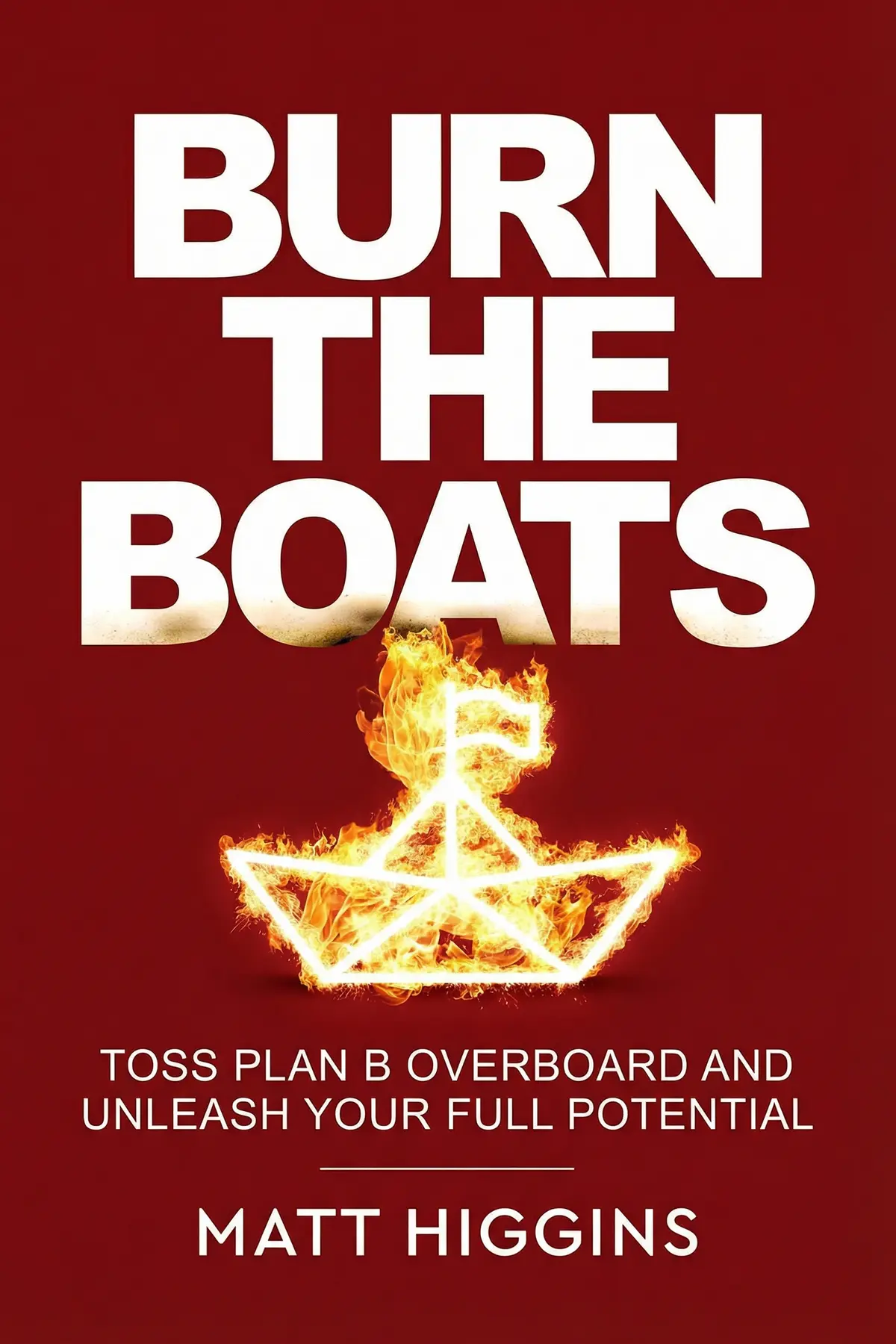
If you keep a safe option open while you chase something bigger, the safe option may be the thing that stops you. That is the claim at the center of Burn the Boats, by venture capitalist Matt Higgins, and he opens with a general who agreed. Julius Caesar landed on the English coast, saw that his army was outnumbered, and ordered his soldiers to set fire to their own ships, so that retreat was simply not available.
Higgins argues that a Plan B works the same way in an ordinary life. It gives you a reason to hold back at the exact moment you need everything. Real progress, in his telling, comes from cutting off the way back, trusting your instincts over convention, using fear as fuel, and then doing it all again each time you arrive somewhere new. Through his rise from a near-empty fridge in Queens, and the stories of a young publicist and a tech worker turned comedian, the book shows how to recognize when caution has become a trap, and what to do about it.
1 min 20 sec
A 14-year-old working at McDonald’s found a faster way out of poverty, but it only worked if nobody could talk him out of it. His method for making sure of that was extreme.
1 min 51 sec
A 26-year-old was offered two million dollars to start his own firm, and his first reaction was terror. What he did next shows which inner voices to ignore before a big move.
1 min 35 sec
Two pieces of career advice sound responsible and are repeated everywhere. Higgins argues both are fallback plans wearing a disguise, and a tech worker’s move into comedy shows what lies on the other side.
1 min 43 sec
On his first morning as a guest investor on a famous TV show, Higgins froze the moment the cameras rolled. The research he leans on suggests that fear was not the enemy it seemed.
1 min 44 sec
There is a line where useful nerves turn into panic that pulls you under. Higgins crossed it on camera, and a few sentences said to himself got him back in time to win his first deal.
1 min 30 sec
A night law student working in the mayor’s press office was passed over for promotion. His response looked like career suicide, and within months it had changed the story people told about him.
1 min 25 sec
A good title and a steady income can turn into the new safety net. Higgins’s path from Ground Zero through two football teams and a stadium plan that never got built shows how to keep moving.
1 min 10 sec
Higgins’s argument comes down to one reversal. A Plan B feels like protection, but in his account it works like an anchor, holding you near the shore at the very moment you need to commit. The boy who failed every class on purpose and the man who walked out of jobs with nothing lined up were following the same rule: make retreat impossible, and effort has only one direction left.
His stories also show that the fire is never lit just once. Derris jumped and built a firm he could sell. Higgins kept jumping, from City Hall to Ground Zero to the Jets and the Dolphins, and today runs his own venture firm, RSE Ventures, where he backs entrepreneurs chasing their own leaps.
Find the fallback you are holding on to and ask what it costs you in commitment. When fear arrives, prepare harder, and keep a sentence ready that reminds you why you belong. And when you reach the place you were aiming for, count what it gave you and start looking for the next shore.
Caesar burned the ships so his soldiers would have no reason to hold back. Higgins asks you to strike the match yourself.
Most career advice says to keep a safety net. Matt Higgins says the safety net is often the thing holding you back. Just as Julius Caesar burned his army's ships so retreat was impossible, Higgins argues that removing your Plan B is what makes you give everything to the goal in front of you. He builds the case from his own life. As a teenager in Queens he dropped out of high school on purpose so he could start college two years early. Later he walked away from jobs with no next step lined up, and each time he moved higher. He adds stories from others who took the leap, among them a young publicist who left a partnership to start his own firm and a tech worker who quit Google for comedy. The book gives readers a set of tests for spotting when caution has become a trap: waiting for the perfect time, waiting for approval, staying in your lane and climbing slowly by small steps. It also offers ways to handle the fear that follows a big move, and a habit of using each win to prepare the next leap.
Professionals who keep a safe job as a backup and sense it is holding them back.
Would-be founders and career switchers waiting for the perfect time or someone's approval.
Ambitious people who freeze under pressure and want a way to use their nerves.
Matt Higgins grew up in a struggling family in Queens, New York, left high school, earned a GED and started college at 16. At 26 he became the youngest mayoral press secretary in New York City's history. He later worked on rebuilding the World Trade Center site, held senior roles with NFL teams including the New York Jets, and was Vice Chairman of the Miami Dolphins. He co-founded the investment firm RSE Ventures, has been a guest investor on Shark Tank and lectures at Harvard Business School.

Listeners regard this work as a vital resource for entrepreneurs, packed with helpful life lessons and actionable tips on every page. Beyond the practical advice, they value the author's narrative approach—specifically his amazing life story and his determination to confront challenges without letting fear manage his decisions. The style is deliberately brief and highly relatable, with one listener highlighting how it leads with kindness and empathy.
Picked this up after seeing Matt on Shark Tank and was genuinely surprised by how much heart is in these pages. This isn't your typical dry business manual because it leads with vulnerability and a raw look at what it means to be truly desperate. Truth is, the story of him dropping out of high school at sixteen to buy groceries for his mother is more moving than any executive success story I’ve read recently. He explains how he used that initial 'burn the boats' moment to propel himself into becoming the youngest press secretary in New York history. The writing style is punchy, fast-paced, and filled with a sense of urgency that makes you want to go out and tackle your biggest fears immediately. While the idea of having no Plan B is terrifying to most, Higgins makes a compelling case for why a safety net actually holds us back from our full potential. It’s an emotional rollercoaster that provides actual, tactical advice on managing anxiety. I finished it in two days and I'm already rethinking my current career trajectory.
Show moreThe chapter on turning anxiety into a superpower hit me exactly where I needed it most. I’ve always struggled with that 'frozen' feeling before a big presentation or a risky move. Hearing Matt describe how he froze on the Shark Tank set, only to talk himself through it using his own history of resilience, was incredibly humanizing. It makes the success feel attainable. The book is chock-full of actionable strategies that aren't just fluff; he really digs into the research about why having a backup plan reduces your probability of success. Not gonna lie, I was skeptical of another VC writing a book, but Higgins leads with empathy and kindness. He honors his mother’s memory in a way that gives the business advice a much deeper meaning. This is a must-read for anyone who is tired of the 'incremental growth' trap and wants to make a massive leap. Just grab your matches and go for it!
Show moreWhat Matt Higgins has done here is package a lifetime of grit into a manual for the rest of us. It took him 48 years to live this book, and you can feel that weight in every chapter. Most business books feel like they were ghostwritten by someone who has never missed a meal, but Matt’s stories of hunger and poverty in Queens give him real credibility. I found the 'self-talk' techniques he used during his first Shark Tank deal to be genuinely transformative. The truth is, we all have that inner voice telling us we aren’t good enough. Higgins shows you how to shut that voice up by leaning into the crisis rather than running from it. The prose is sharp and the sentence lengths vary enough to keep the energy high throughout the entire read. It’s not just about business; it’s about owning your journey and refusing to stagnate. This is easily the best motivational book I’ve picked up this year.
Show moreThis book isn't just for business owners; it’s for anyone who feels like they’re playing it too safe in life. Ever since I finished it, I’ve been thinking about my own 'boats' and which ones I need to burn to finally get serious about my goals. The stories of Jesse Derris and Sarah Cooper provide a rare insight into the psyche of people who actually take the leap. Matt’s own story is the heartbeat of the book, though. From a McDonald's job to a Harvard professor—it’s the ultimate underdog story. The lesson is simple: a crisis forces you to act. If you always have a Plan B, you’ll never give Plan A the 100% effort it requires to succeed. The writing is relatable, leads with kindness, and offers a refreshing perspective on risk. I’ve already recommended this to three friends who are currently 'stagnating' in their careers. Grab your matches and start burning!
Show moreFinally got around to reading this because I’ve been feeling stuck in my corporate job lately. I found the central thesis—that we perform better when retreat isn’t an option—to be incredibly challenging in the best way possible. Frankly, I’ve always been a 'Plan B' person, so reading about Jesse Derris and Sarah Cooper taking massive leaps was a bit of a wake-up call for my own stagnant habits. To be fair, some of the advice feels a bit aggressive, and I’m not sure I’m ready to quit my job tomorrow without a backup, but the psychology behind why we sabotage our own 'Plan A' is fascinating. The chapter on corporate saboteurs was particularly relatable; I’ve definitely dealt with those 'Withholders' in my own office. My only minor gripe is that some of the historical comparisons, like Caesar, feel a bit repetitive if you’ve read a lot of leadership books. Still, the personal grit Matt shows throughout his life makes the advice feel earned rather than preached.
Show moreEver wonder why some people just seem to 'make it' while others stall out at the first sign of trouble? This book explores that gap by looking at the psychological safety nets we build for ourselves. Matt Higgins argues that these nets are actually cages. I loved the breakdown of how he navigated the 9/11 aftermath and the rebuilding of Ground Zero. It showed that 'burning the boats' isn't just a one-time thing; it's a muscle you have to build. Gotta say, the section on 'incrementalism' was a bit of a gut punch for me. I’ve spent years climbing rungs on a ladder I don't even like. While I think some of the case studies are a little too focused on extreme wealth, the underlying lessons about self-trust are universal. It’s a quick read, very engaging, and doesn't waste much time on filler. Definitely worth the time if you're looking for a push to finally pursue your true calling.
Show moreAfter hearing Matt speak on a podcast, I expected a standard business book, but this is much more vulnerable than that. He shares painful details about his mother's health, his own battle with cancer, and the crushing weight of poverty. These aren't just anecdotes; they are the foundation for his belief that we are more capable than we think when our backs are against the wall. The book is thoughtfully concise, which I love. It doesn't ramble. I particularly liked the '5 types of corporate saboteurs'—it helped me identify why I’ve been feeling so drained at my current firm. Frankly, the advice to 'chase the fear' is exactly what I needed to hear this month. My only critique is that the ending feels a little rushed, but the core message stays with you long after you close the cover. It’s a solid 4-star read for anyone needing a perspective shift.
Show moreAs someone who has been an entrepreneur for a decade, I found some of the advice here a bit too reckless for my taste. Look, the storytelling is top-notch and Matt's personal journey from poverty in Queens to a Harvard professor is undeniably inspiring. However, I worry that the 'burn the boats' mentality relies heavily on hindsight bias. We only hear from the people whose boats were burned and who happened to reach the shore; we don't hear from those who drowned. In my experience, a calculated risk is usually better than an all-or-nothing gamble. The book is well-written and the sections on turning anxiety into a 'superpower' are quite helpful for high-functioning professionals. I just think the core message needs a disclaimer: this isn't for everyone. If you have a family and zero savings, burning your only source of income might not be the 'breakthrough' move you need. It’s a great motivational read, but take the specific tactics with a grain of salt.
Show moreTo be fair, the writing style is incredibly engaging and fast-paced, but I'm not convinced 'no safety net' is a one-size-fits-all strategy. The book is a bit all over the place, going a mile wide and an inch deep on too many different people's stories. One minute we're talking about Sun Tzu, and the next it's Scarlett Johansson. While the stories are interesting, they sometimes feel cherry-picked to support a very specific thesis that might not apply to the average person. Personally, I found the parts about Matt’s own life—his time with Giuliani and the Jets—to be much more compelling than the general advice. The book is quite short, which I appreciated, but it did feel a bit like a series of blog posts stitched together. If you need a quick jolt of inspiration, it’s great. If you’re looking for a deep, nuanced dive into risk management, you might find it a bit shallow.
Show moreNot what I expected given the high ratings, as much of the book relies on hindsight bias to justify reckless decisions. I found the advice to be quite shallow and, at times, it felt like a case study in toxic productivity. Telling people to fail every class spectacularly just to force themselves into a GED program is a very specific type of gamble that could easily ruin a young person's life. Look, I get that it worked for Matt, but presenting it as a universal blueprint for success feels irresponsible. The 'facts' seem loosely supported by stories that don't always connect to the main point. It felt a lot like a collection of LinkedIn 'hustle culture' posts expanded into a book. To be fair, the writing is clear, but I found the content to be more clickbait-y than practical. I left it in the seat pocket of my flight because I couldn't see myself ever needing to reference it again.
Show moreHiggins argues that keeping a Plan B gives you a reason to hold back, so you never commit fully to your real goal. Like Julius Caesar burning his ships so his army could not retreat, he recommends removing the escape route, trusting your instincts over convention, using fear to prepare and perform, and repeating the leap each time you reach a new level.
Higgins talks about calculated risks, seeing openings that others miss. His own leaps had a clear purpose: he quit high school and began college two years ahead of schedule, so he could earn more for his family. He also prepared hard for his biggest moments, spending a year studying all 200 episodes of Shark Tank before going on the show. The book is about commitment, not carelessness.
He says some fear helps performance, so the goal is to manage stress and use it. He cites Barbara Fredrickson’s research on college students after September 11, which linked positive emotions during a crisis to longer-term resilience. When fear becomes overwhelming, he recommends self-talk: remind yourself of your strengths and that you belong where you are, as he did when he froze on Shark Tank.
Higgins treats the leap as a repeated practice, like a muscle that strengthens with use. After each success he consolidated his gains and moved on, from Giuliani’s press office to rebuilding Ground Zero, the New York Jets and the Miami Dolphins. His advice is to plan your next opportunity before the current one ends and use every advantage it gave you.
It suits people who sense that a safe job, a slow career ladder or a habit of waiting for approval is keeping them from a bigger goal. Would-be founders, career switchers and ambitious early-career professionals will find stories they can relate to, such as Sarah Cooper leaving Google for comedy and Jesse Derris leaving a partnership to start his own PR firm.
Richard Wiseman





William B. Irvine


Andrew D. Thompson


Deepak Chopra
AUDIO SUMMARY AVAILABLE
Get the key ideas from Burn the Boats by Matt Higgins, plus 5,000+ more nonfiction titles.









