

13 min 14 sec
Available in: English
The Power of a Positive Team: Proven Principles and Practices that Make Great Teams Great
By Jon Gordon
Shows why talented groups still fail and how any leader or member can build a positive team culture through shared energy, firm rules against negativity, real conversations, mutual care and steady daily improvement.
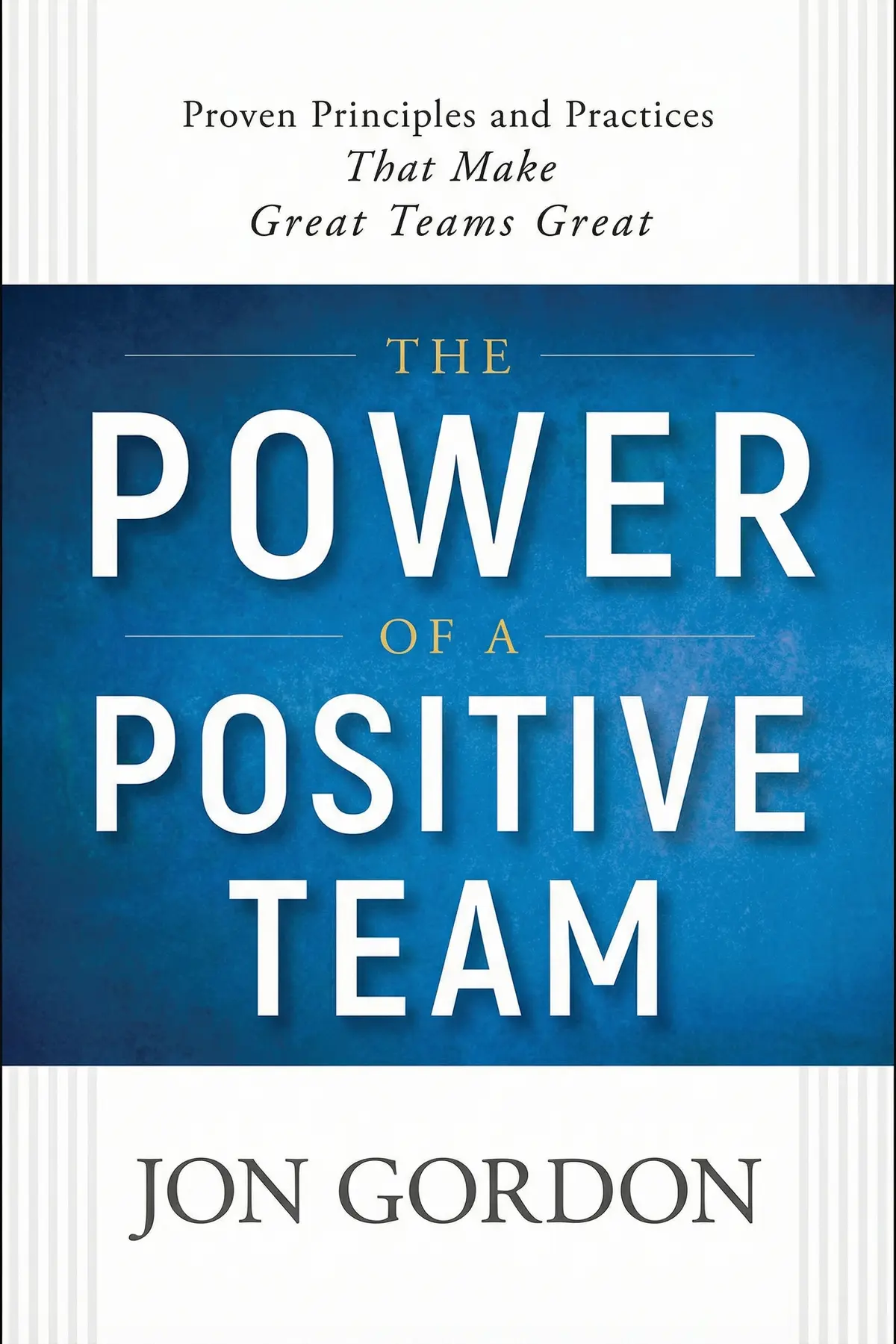
Table of Content
1. Introduction
58 sec
A room full of talented people can still become a team that fails, because talent does not decide how people treat each other when the work gets hard. In The Power of a Positive Team, leadership consultant Jon Gordon argues that the difference lies in culture: the rules, written and unwritten, that shape how a group behaves, and the energy every member carries into the room.
His case is that great teams are built day by day, by people who choose optimism, refuse to let negativity settle, talk face to face, care about one another and keep getting a little better. The stories range from a football coach who painted a vampire on his meeting room wall to Navy SEAL recruits surviving a week on almost no sleep. Whether you lead a team or simply belong to one, the book offers rules you can start using on Monday, and a clear reason why your own mood counts for more than you think.
2. Make optimism the reason good people follow you
1 min 47 sec
A hopeful outlook sounds like a soft extra for teams under pressure. Research on politicians, athletes and even married couples suggests it may decide who succeeds, and which leaders the most talented colleagues choose to work beside.
3. Your mood spreads, so shape your team's culture
1 min 51 sec
Apple built its identity around a phrase that seems to dismiss careful planning. Gordon explains what it really means, and why a bad mood you never voice may still be shaping the people sitting near you.
4. Stop negativity before it infects the team
1 min 53 sec
Most organizations reward good behavior and hope the grumbling fades on its own. A struggling college football team and a company voted one of America’s best workplaces tried something far blunter, and their methods are simple enough to copy this week.
5. Close the silences where rumors grow
1 min 59 sec
Teams have never had more ways to reach each other, yet many feel more disconnected than ever. Gordon explains the gap that opens when screens replace conversation, and what tends to rush in to fill it.
6. Commit to each other and outlast the hardest week
2 min 01 sec
During the most brutal stage of Navy SEAL selection, the recruits who quit first shared one trait, and it had little to do with strength. A painted fence explains the same idea at the level of daily work.
7. Grow one percent a day, together
1 min 41 sec
Thirty-five college athletes made a promise so small it could not even be measured, then did some very generous arithmetic with it. Their result shows why a modest daily commitment can lift a whole team.
8. Conclusion
1 min 04 sec
Gordon’s book adds up to a simple claim with demanding consequences: a team’s character is made in small daily acts, and nobody gets to be a bystander. A coach paints a vampire on a wall. A recruit keeps running because the man beside him is still running. A father paints the side of a fence no visitor will ever see. None of these depends on hiring a star. Each depends on someone deciding how they will show up.
That makes the book useful even if you have no authority over anything above you. Watch the mood you bring into a room, since others will feel it before you speak. Ask that complaints come with a proposed fix, starting with your own. Swap one stream of messages for a real conversation or a shared lunch this week. And before you criticize anyone, make sure they already know you care about them, because that is what lets the truth be heard.
Talent fills a roster. What turns it into a team is the energy each person chooses to spread, one ordinary day after another.
About this book
What is this book about?
Putting smart, skilled people in one room does not guarantee a good team. Many talented groups stall because of gossip, complaints, silence and people who look after themselves first. Jon Gordon argues that what separates great teams from the rest is culture, meaning the spoken and unspoken rules that shape how people work, talk and act, along with the energy each person brings in. Gordon draws on research about optimism and emotional contagion, and on stories from sport, business and the military: a University of Georgia football coach who painted a vampire on the meeting room wall, a chief executive who banned complaints that arrive without a solution, Navy SEAL recruits surviving Hell Week, and a lacrosse team that promised to improve one percent a day. Readers get simple rules they can bring to their own team: watch the mood you spread, make complaints come with fixes, replace message streams with real conversation, show care before you criticize and keep raising the standard together.
Book Information
Who it's for
Heads of souring teams
Team leaders whose talented people keep sliding into gossip, complaints and silence.
Leads with few one-on-ones
Managers of remote or busy teams who rarely talk to their people one to one.
Teammates without titles
Team members without a title who want to know how much their own mood and effort matter.
About the Author
Jon Gordon
Jon Gordon runs a training and consulting company that helps develop positive leaders, organizations and teams. He studied at Cornell University and later earned a master's degree in teaching from Emory University. His clients have included the Atlanta Falcons, Campbell's Soup, Southwest Airlines and the Los Angeles Dodgers. His book The Energy Bus has sold more than 3 million copies.


Ratings & Reviews
Ratings at a glance
What people think
Listeners consider this title an exceptional tool for fostering team unity, especially for those in coaching roles, and value the actionable tips that work across different environments. The material is packed with stories and offers useful perspectives, with one listener highlighting its effectiveness as a manual for leadership. Listeners commend the writer’s contributions and feel the concepts are simple to implement, ultimately resulting in enhanced group productivity.
Top reviews
Ratree
Jon Gordon delivers exactly what you'd expect: high-energy, actionable advice for anyone leading a group. I've been a fan of The Energy Bus for years, but this felt like a more mature evolution of those core principles. Truth is, most teams fail because they ignore the culture, and Gordon provides a solid blueprint to fix that. The anecdotes about the Navy SEALs and various sports teams really drive home the point that excellence isn't an accident. While some might find the tone a bit too optimistic, I think that’s exactly what’s missing in today’s cynical corporate world. It is a quick read that you can actually implement tomorrow morning during your stand-up meeting. Great for those who want to foster real connection.
Show moreNang
Ever wonder why some teams just 'click' while others fall apart at the first sign of trouble? This book answers that question by focusing on the intangible elements of connection and commitment that make or break a group. Jon Gordon has a gift for taking complex social dynamics and distilling them into simple, memorable mantras that stay with you long after you close the book. I loved the emphasis on purpose over rules; page 124 really hit home about how demands often lead to oppression rather than inspiration. We are actually planning to buy copies for the entire department to read as a group study. It is easily one of the most impactful team-building resources I've found this year.
Show moreSeksan
Picked this up on a recommendation from a fellow coach and it absolutely lived up to the reputation. The examples from the Clemson football team and the Miami Heat provided a perfect roadmap for how to handle the inevitable egos and setbacks that come with high-stakes competition. Gordon’s focus on the 'Power of a Positive Team' isn't about ignoring the negative, but about building a culture strong enough to survive it. The book is incredibly easy to read and the practical tools for building trust are something every leader should have in their toolkit. If you want your team to move from a group of individuals to a united front, buy this today. It is truly an outstanding resource.
Show moreChanida
Wow, this was exactly the jolt our department needed after a really rough year of transitions and uncertainty. The book provides a clear blueprint for addressing common pitfalls like complaining and selfishness without sounding like a lecture. I found the section on 'refining vs. defining' feedback to be particularly transformative for our performance review process. It’s a quick read, but the impact of the stories—from Navy SEALs to the Billions writing team—is lasting. This is the kind of book that works best if the whole team reads it together to get on the same page. Highly recommend for any leader who wants to cultivate a more resilient and positive office culture.
Show moreKob
After hearing so much about Gordon’s work, I finally dove into this one during our quarterly retreat. The framework he provides for overcoming negativity is practical, even if it feels a little familiar to those who have studied leadership before. I particularly appreciated the section on having difficult conversations; it's a skill my team really struggles with. Frankly, there are a lot of sports references which might alienate non-fans, but the underlying message about 'The Power of We' is universal. My only real gripe is that it feels a bit repetitive in the middle chapters. Still, it’s a valuable resource for any coach or manager looking to boost morale and create a more cohesive environment.
Show moreIsabelle
As someone who manages a small corporate team, I found the chapters on transforming negativity particularly useful for our current office dynamic. Gordon emphasizes that positive teams don't just ignore problems, but rather they confront reality together to find a way forward. I took several pages of notes on how to foster better communication and shared many of the quotes with my staff. Some parts of the book definitely felt a bit repetitive, and the author does reference his own previous books quite a bit. However, the 'self-study' guide format makes it very easy for a group to read this together and discuss the concepts. It's a solid 4-star read for anyone needing a culture reset.
Show moreThitima
Finally got around to reading this and I think the biggest takeaway is the concept of 'connectedness' being more important than just following a set of rules. The author explains that when people are connected to a shared purpose, they don't need to be micro-managed. I’ll admit that the constant self-promotion of his other titles got a little annoying after a while. However, the core principles are sound and I found myself highlighting several passages to turn into posters for our breakroom. It’s a great guide for anyone who wants to move away from a 'demand and control' leadership style. A very solid, albeit slightly repetitive, addition to any leadership library for those looking to improve performance.
Show moreMethinee
To be fair, the message here is undeniably good, but the execution felt a bit thin for my taste. The book is filled with anecdotal evidence from winning sports teams, which is fine, but I would have loved to see some actual research or data to support the claims. Everything is very 'rah-rah' and optimistic, which can be great for motivation, but it lacks the grit needed for truly toxic environments. I also noticed that Gordon repeats himself quite a bit, making me feel like this could have been a very long blog post instead of a full book. It's not a waste of time by any means, but it isn't groundbreaking either. Decent for a quick shot of inspiration.
Show morePairot
Not what I expected given the massive hype and all the five-star reviews surrounding this title. To be honest, I found the content to be largely oversimplified kumbaya drivel that lacks any real scientific backing or data-driven studies. It seems like the author is just recycling the same three ideas across twenty different books to keep the royalty checks coming in. If you have never had a leadership training in your life, you might find a nugget of gold here, but for most professionals, it's just surface-level fluff. The sports examples are constant and frankly, they start to feel very one-dimensional after the first fifty pages. I’d suggest looking elsewhere for something with more meat on its bones.
Show moreRosa
Look, I really wanted to like this because I’m a fan of positive psychology, but it felt more like a commercial for the author’s speaking business. The writing style is very elementary and the advice is so surface-level that it becomes almost meaningless for a seasoned professional. 'Love each other' and 'get on the bus' are nice sentiments, but they don't help much when you're dealing with budget cuts or complex structural issues. It’s a very short read, which is its only saving grace, but I’d recommend spending that hour on a book with more depth. I truly don't understand how this has such a high rating when it offers so little substance. Hard pass for me.
Show moreQuestions about this book
What is the main idea of The Power of a Positive Team?
Jon Gordon argues that talent alone does not make a great team. What matters is a positive culture, the spoken and unspoken rules that guide how people work and act, kept alive by every member. That means spreading good energy, confronting negativity, communicating face to face, caring about each other and the work, and committing to steady improvement together.
What is the no complaining rule?
The rule was created by Dwight Cooper, chief executive of the talent management company PPR. Team members may not complain unless they also offer a solution to the problem they raise. Gordon presents it as a way to remove thoughtless, draining complaints while turning frustration into practical ideas, and it can be adopted by any team without special tools.
What is the one percent rule in Jon Gordon's book?
Every member of the team commits to giving 1% extra in energy, effort, focus and time each day compared with the previous one. Gordon admits the gain cannot be measured precisely but says it works. A women’s college lacrosse team of 35 players adopted it, reasoning that together they would improve 35 percent a day, and Gordon reports the team improved remarkably.
How can a leader apply The Power of a Positive Team?
Start with your own tone, since Gordon cites research that emotions spread to people nearby. Introduce a rule that complaints must come with a fix. Hold regular conversations, such as a daily call, a weekly video meeting or lunch with a different colleague each week. And show genuine care for each person, because people accept criticism more readily from someone they believe is on their side.
Who should read The Power of a Positive Team?
It suits team leaders, coaches and managers dealing with low morale, gossip or disconnected remote staff, and team members who want to understand their own influence. The ideas are simple and concrete, drawn from Gordon’s work with sports teams and companies, so they can be tried quickly in an office, a club or a classroom.
Readers also enjoyed


A Bigger Prize: How We Can Do Better Than the Competition
Margaret Heffernan





A Year with Peter Drucker: 52 Weeks of Coaching for Leadership Effectiveness
Joseph A. Maciariello



Acting with Power: Why We Are More Powerful Than We Believe
Deborah Gruenfeld
AUDIO SUMMARY AVAILABLE
Listen to The Power of a Positive Team in 15 minutes
Get the key ideas from The Power of a Positive Team by Jon Gordon, plus 5,000+ more nonfiction titles.
- 5,000+ titles
- Listen as much as you want
- 7-day free trial
- Cancel anytime









