
14 min 10 sec
Available in: English
The Case Against Education: Why the Education System Is a Waste of Time and Money
By Bryan Caplan
Explains why degrees pay off mainly by signaling intelligence and diligence, not by teaching useful skills. It shows how to judge whether college is worth it for you and why ever more schooling wastes public money.
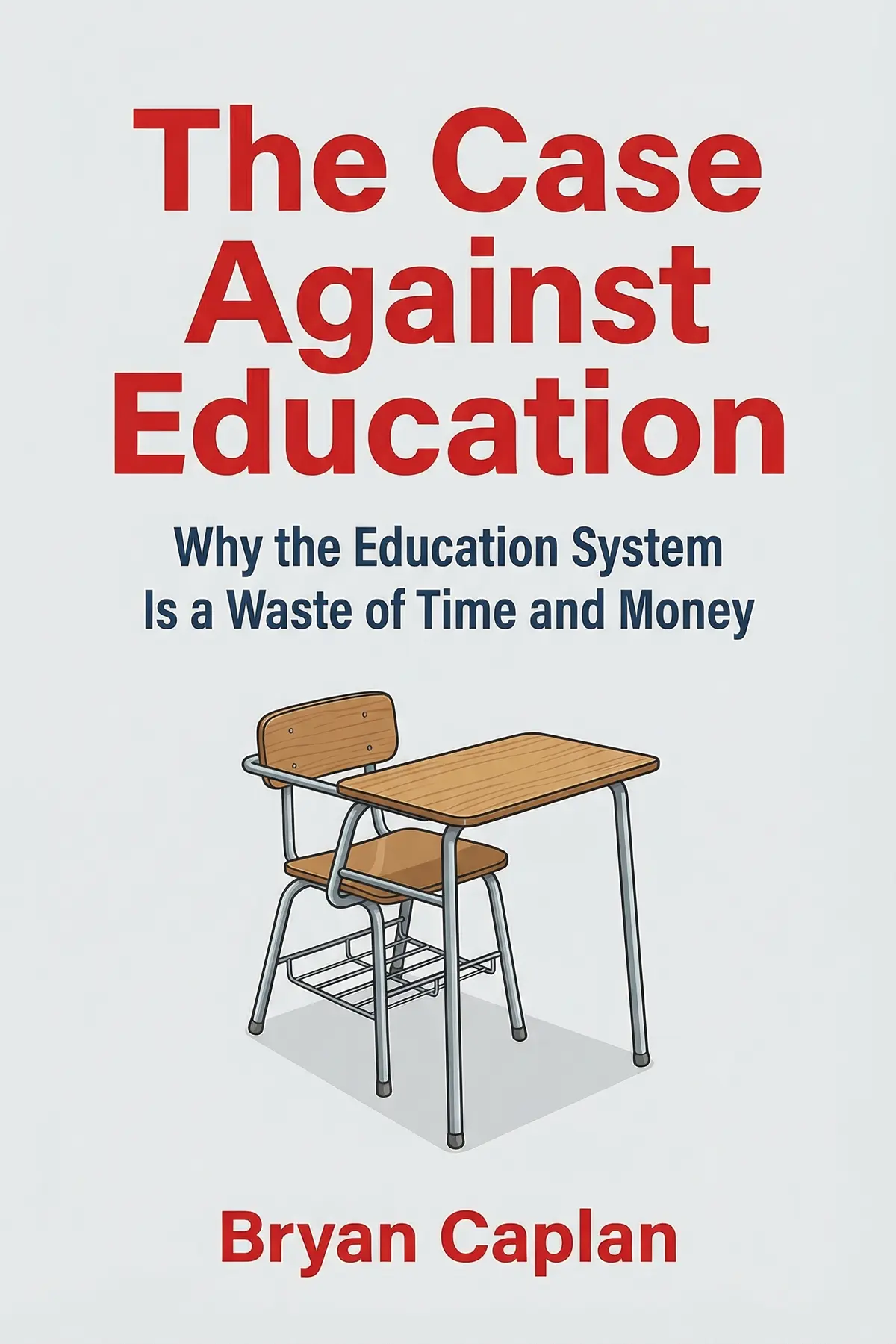
Table of Content
1. Introduction
59 sec
If you have ever sat through a class wondering when you would use any of it, Bryan Caplan thinks your hunch was mostly right. In The Case Against Education, the George Mason University economist argues that much of what schools teach is never used, and that degrees pay off largely because they announce traits a student already had. Economists call this signaling, and it runs through his whole case.
Because a diploma mostly certifies brains and effort, schooling is often a weaker deal for individuals than advertised and a poor one for society, where more degrees simply raise the bar for everyone. Caplan follows that logic from forgotten language lessons to a trillion-dollar budget, and then to reforms most people find shocking. What you get is a way to judge whether a degree is worth its price for you, a clearer view of what employers see on a résumé, and an explanation for why more diplomas have not made the world much richer.
2. Spot the lessons school never really taught you
1 min 59 sec
Years of classes in languages, literature and geometry are supposed to leave behind a sharper mind even after the facts fade. Researchers tested that promise outside the exam hall, and what they found is uncomfortable for every teacher.
3. See what employers actually buy with your degree
2 min 04 sec
An English graduate walks into a consulting firm and earns more than a peer without a degree, though nothing she read about novels helps her advise companies. Explaining that gap reveals what a diploma is really for.
4. Run the numbers before you enroll
2 min 03 sec
The usual comparison of graduate and non-graduate pay makes college look like a bargain for nearly everyone. Caplan spots a hidden flaw in that comparison, and his own calculation splits students into winners and losers.
5. See how more diplomas can leave everyone poorer
1 min 54 sec
Paying for more people to study sounds like the surest way to build a richer country. Caplan borrows an idea from money itself to show why the extra spending can leave workers running harder just to stay in place.
6. Know what it takes for school to feed the mind
1 min 54 sec
Educators insist that budgets miss the point, because school exists to nourish the soul. Caplan grants the ideal some truth, then tests it against what grown adults actually choose to look up online.
7. Cut the waste with less school and earlier work
2 min 03 sec
Caplan’s fixes for a trillion-dollar system are simple to state and hard to swallow. One of them asks society to rethink rules most people consider untouchable, and he defends it as being in young people’s interest.
8. Conclusion
1 min 14 sec
Caplan’s argument comes down to changing the lens. Treat a diploma as a bundle of skills, and schooling looks like an obvious good. Treat it as a certificate of brains, effort and obedience, and the picture changes. Much of what students learn fades or never transfers. Part of the pay premium simply reflects that graduates were already ahead. And when everyone races for the same certificate, the finish line moves, from diploma to bachelor’s to master’s, with taxpayers paying for every step.
That lens is useful long before any reform arrives. Before you sign up for a degree, or push someone toward one, run the numbers honestly, counting ability, the risk of not finishing and the full cost. If the answer is yes, pick a practical major at an affordable public college, then put the degree to work full-time. And when you hire, or apply, remember what a credential mostly proves, and look for other evidence of the same qualities.
The image Caplan leaves is a room of teenagers reading Shakespeare aloud in bored, puzzled voices, inside a $1.1 trillion system that still believes more is always better.
About this book
What is this book about?
Almost everyone agrees that more education is good for individuals and good for society. Economist Bryan Caplan thinks that belief is badly overstated. Much of what students study is never used, and research on transfer of learning suggests that classroom thinking skills rarely carry over into real life. So why do graduates earn more? Caplan's answer is signaling. Employers value a diploma because it certifies traits the student already had: intelligence, diligence and a willingness to follow rules. That explains why an English graduate can earn a premium as a business consultant. It also explains a costly side effect. As more people collect degrees, each one is worth less, and jobs that once asked for a high school diploma begin asking for a bachelor's. The book gives readers a practical way to judge whether college pays for a given student, with guardrails on major, school and work after graduation. It also makes a blunt case to society: trim the curriculum, stop subsidizing college and put young people into real work much earlier.
Book Information
Who it's for
Weighing a degree's cost
Students and parents weighing whether a degree is worth its cost and debt.
Weighing another credential
Professionals and career switchers wondering if another credential will actually pay.
Managers and policy watchers
Managers and policy-minded readers curious why rising education has not made workers much richer.
About the Author
Bryan Caplan
Bryan Caplan is an American economist who teaches at George Mason University. He studied economics at the University of California, Berkeley, and earned his doctorate at Princeton. He is a senior research fellow at the Mercatus Center and an adjunct scholar with the Cato Institute. His research focuses on public and behavioral economics, especially public choice theory, and his 2007 book The Myth of the Rational Voter challenged the idea that voters behave rationally.
Ratings & Reviews
Ratings at a glance

What people think
Listeners find the work highly deserving of their time, valuing the incredible amount of data and depth that build a persuasive argument. Furthermore, the book is praised for its practical analysis and stimulating material, as one listener points out the author’s serious treatment of student grievances. The logic is also brilliantly presented and viewed as highly significant by listeners, including one who emphasizes its discussion on the economic benefits of university degrees. On the other hand, perspectives on its cost-effectiveness vary, as several listeners felt the purchase was not worth the expense.
Top reviews
Tun
Picking up this book felt like finally hearing someone say the quiet part out loud about the modern degree mill. Caplan doesn't just complain; he uses a mountain of data to prove that most schooling is about signaling intelligence and conformity rather than actual learning. Frankly, the distinction between the "Human Capital" model and "Signalling" model changed how I view my own master’s degree. While I found his tone a bit arrogant at times, the logic behind the "sheepskin effect" is impossible to ignore. It’s a dense read but incredibly rewarding for anyone who suspects the system is broken. Even if you disagree with his libertarian solutions, you can't deny the depth of his research.
Show moreTar
Why are we still pretending that four years of 18th-century poetry makes someone a better accountant? This book is a devastating take-down of the "enlightenment" myths we use to justify trillions in educational subsidies. Caplan’s data on "learning transfer" is eye-opening, showing that students rarely apply academic concepts to real-world scenarios. Personally, I think the vocational training focus is the most important takeaway here. We need to stop shaming kids who want to learn a trade instead of sitting through boring lectures. It’s a brave, data-driven masterpiece that challenges every sacred cow in the Ivory Tower with brutal efficiency. A must-read for skeptics.
Show moreManop
Finally got around to reading this, and it’s easily one of the most important economic books of the decade. Caplan takes the student's perspective seriously, acknowledging that most of school is a boring waste of time that people only endure for the credential. The depth of the research is extraordinary, especially regarding how little "human capital" is actually built in the classroom. I appreciated his honesty about his own profession, essentially admitting that he’s part of a massive signaling machine. If you want a down-to-earth analysis of why your tuition is so high, this is it. It’s well worth reading for the economic utility it provides.
Show moreTalia
Most books on education are filled with fluffy platitudes, but Caplan brings a cold, hard shovel to the graveyard of academic myths. He convincingly argues that the education wage premium exists because degrees signal intelligence and conformity to employers. This isn't just theory; he backs it up with spreadsheets and decades of labor market statistics. Gotta say, I loved the "hot take" style of the writing, which keeps the pacing fast despite the heavy subject matter. It’s a compelling case that will make you question the value of every dollar you spent on your diploma. It is a very important work for understanding our economy.
Show moreGai
Wow, this was a punch to the gut for someone who spent six years in grad school. Caplan’s point that we celebrate when class is cancelled is such a simple, perfect proof that we value the credit more than the content. The book is superbly articulated and doesn't shy away from the harsh truth that many students would be better off in vocational programs. While it's true that the book is a bit pricey for some, the insights into the "marriage market" and social sorting are well worth the investment. It’s a rare, genuine work of scholarship that isn't afraid to be unpopular. I recommend it to everyone.
Show moreMint
As someone who works in corporate HR, the arguments regarding credential inflation hit home with uncomfortable precision. We often require degrees for roles that clearly don’t need them, simply because it's a convenient filter for conscientiousness and social conformity. Caplan’s analysis is superbly articulated, though I’ll admit the price of the hardcover felt a bit steep for the length. The truth is, we are over-investing in a system that produces more debt than usable skills. It's a provocative, down-to-earth analysis that more policy makers should probably read, even if they find his stance on cutting all subsidies a bit too extreme for reality.
Show moreDiego
Ever wonder why a degree is worth so much more than the knowledge it represents? Caplan explains this through the lens of signaling, arguing that 80% of the value is just showing you can jump through hoops. Look, I don't agree with his call to completely defund public education, but his critique of "useless" subjects like high-level math for non-STEM majors is spot on. The writing is punchy and direct, making a complex economic theory accessible to the average reader. To be fair, he can be a bit condescending toward the arts, but his core economic logic is hard to fault. It is a thought-provoking piece that takes student complaints seriously.
Show moreSamira
After hearing so much hype about Caplan’s radicalism, I found the actual book to be a mix of brilliance and absurdity. On one hand, his critique of credential inflation is a vital contribution to the national conversation about the economy. On the other hand, he completely ignores the social benefits of education, like making friends or learning to navigate adult environments. The style is a bit snooty, and he tends to recycle the same anecdotal evidence about his own students. To be fair, the data is compelling, but the policy recommendations are way too far-fetched for me. It's a useful perspective, even if it's flawed.
Show moreNarong
Not what I expected from a supposedly serious work of scholarship. While I agree that college is becoming too expensive, Caplan’s extreme suggestions, like relaxing child-labor laws, are completely divorced from social reality. The prose is incredibly repetitive, hitting the same three points about signaling for three hundred pages until your brain feels numb. I was particularly annoyed by the Socratic dialogues in the final chapter, which felt like lazy strawman arguments designed to make the author look smart. It’s a frustrating, reductionist tract that identifies real problems but offers only extremist tripe as solutions. It lacks the nuance needed for such a complex topic.
Show moreSienna
This is what happens when you let a tenured professor spend too much time in a libertarian echo chamber. The author suggests that history and foreign languages are "useless" simply because they don't immediately boost your salary in a specific job. What a myopic, soul-crushing view of what it means to be a human being! His "solution" to education is to throw the baby out with the bathwater by eliminating all government support. Frankly, the chapter on child labor made me want to toss the book across the room. It’s intellectually lazy, elitist, and offers no helpful suggestions for actual reform. Waste of money and time.
Show moreQuestions about this book
What is the main argument of The Case Against Education?
Bryan Caplan argues that the benefits of education are greatly overstated. Much of what students study is never used, and classroom thinking skills rarely carry over to real life. Degrees still raise pay, he says, mainly because they signal traits like intelligence, diligence and obedience. That makes schooling a weaker deal for many individuals and a wasteful one for society, since more degrees mostly fuel credential inflation.
What is signaling in education according to Bryan Caplan?
Signaling is the idea that employers value a degree because it certifies qualities a person already had, such as intelligence, hard work and a willingness to follow rules. Caplan contrasts it with human capital theory, which says school pays by teaching skills. Signaling explains why an English graduate can earn a premium working as a business consultant, even though the degree taught little about consulting.
Does Bryan Caplan say college is worth it?
For most students, his calculations say no. Good and excellent students may come out ahead, while weaker students would usually do better spending the time and money elsewhere, since many never finish. Graduate earnings are also overstated, he argues, because graduates tend to be smarter and more conscientious to begin with. For those who go, he advises a practical major, a good public college and full-time work afterward.
How can I apply the ideas in The Case Against Education?
Treat a degree as an investment and run the numbers for your own situation, including your ability and the chance of not finishing. If you go, choose science, technology, engineering, mathematics, business or economics at an affordable public college, and work full-time after graduating. When job hunting, remember that a degree mainly vouches for your ability and effort, so show those traits in other ways too.
What reforms does Caplan propose for education?
Caplan suggests dropping less practical material from the curriculum, since most students forget it quickly, and ending taxpayer subsidies for college to reduce credential inflation. In their place he favors vocational training, above all ordinary work. He wants young people to start jobs early and argues for changing child-labor laws to allow it, a proposal he knows many readers will find shocking.
Readers also enjoyed


A Splendid Exchange: How Trade Shaped the World
William J. Bernstein




Adults in The Room: My Battle With Europe’s Deep Establishment
Yanis Varoufakis



1929: Inside the Greatest Crash in Wall Street History--and How It
Andrew Ross Sorkin
AUDIO SUMMARY AVAILABLE
Listen to The Case Against Education in 15 minutes
Get the key ideas from The Case Against Education by Bryan Caplan, plus 5,000+ more nonfiction titles.
- 5,000+ titles
- Listen as much as you want
- 7-day free trial
- Cancel anytime









