

A Liberated Mind: How to Pivot Toward What Matters
Steven C. Hayes
 English
 ไทย
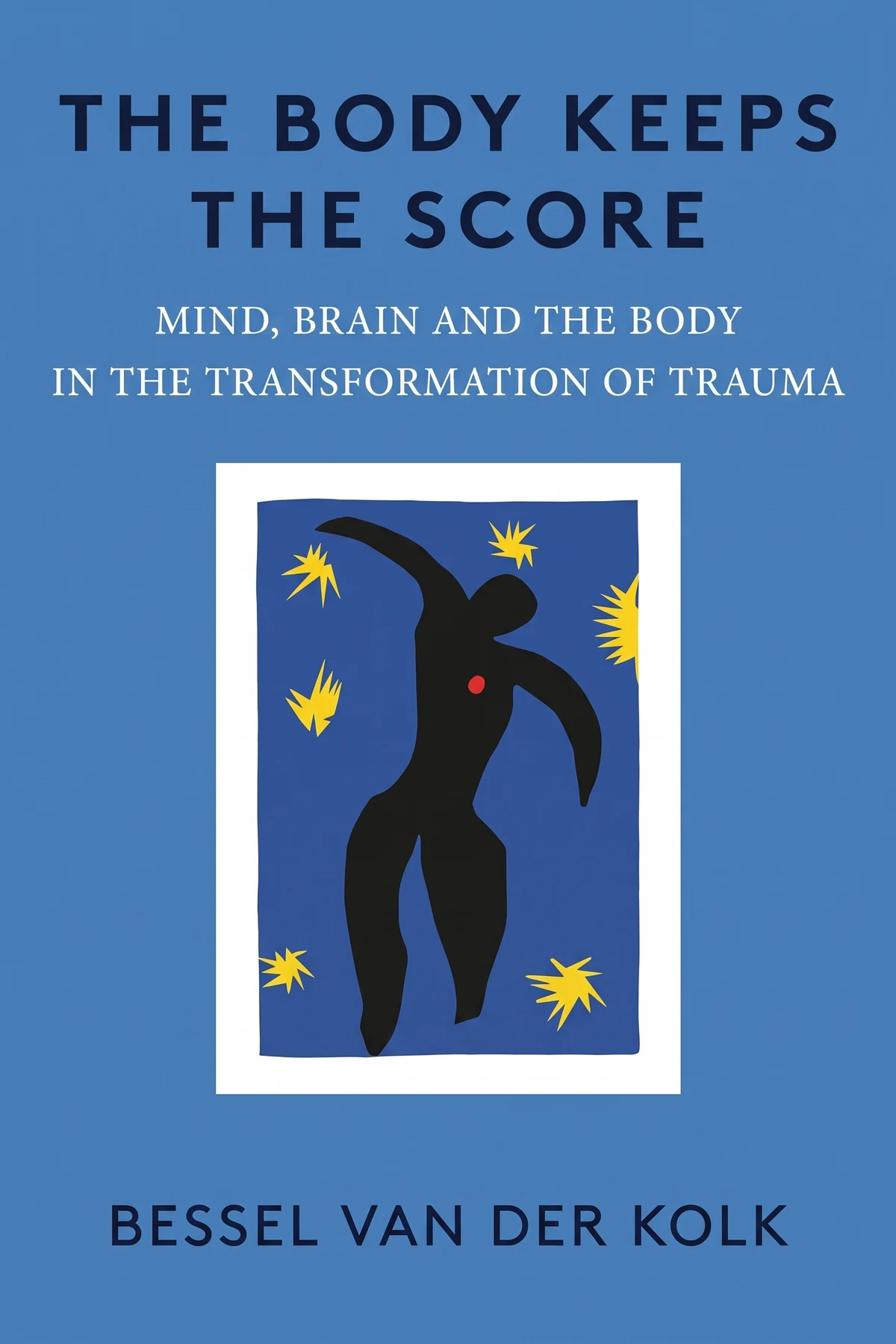
Shows how trauma lives on in the brain, the senses and the body long after the danger ends, and how EMDR, yoga, mindfulness, supportive people and neurofeedback helped patients recover.
57 sec
When an old wound keeps flaring up, in you or in someone you love, the past can feel as if it refuses to stay past. In The Body Keeps the Score, Boston psychiatrist Bessel van der Kolk shows why: during a flashback, brain scans reveal the speech region going dark and the brain’s rational left side shutting down, so a memory registers as a live threat.
His argument is that trauma lives on in body and brain as an alarm that keeps sounding, and that recovery means teaching both to accept that the danger is over. The evidence comes from brain scans, a Harvard study that tracked men’s memories for decades, and patients such as Marsha, Kathy and Annie.
By the end, a loved one’s distance or sudden panic will make more sense, and the routes back to calm that helped his patients, from EMDR to yoga and neurofeedback, will feel concrete.
1 min 54 sec
Most people picture trauma as something soldiers bring home from war. The real reach is much wider, and it explains why survivors so often push away the very people trying hardest to help them.
1 min 49 sec
A grieving mother lay in a scanner and listened to a recording of the worst day of her life. What the images showed explains why some people go silent and cannot think straight when the past returns.
1 min 50 sec
Most memories blur and shift each time we tell them. A Harvard study that followed 200 men for decades found one kind of memory that stays exactly the same, down to the smallest sensory detail.
1 min 45 sec
Shown a magazine photo of a father repairing his car, most children imagined a happy outing. Others imagined something terrible, and the difference revealed how early harm rewires expectations for life.
1 min 57 sec
One of the author’s most effective treatments involves little more than a moving finger. Even he cannot fully explain why it works, yet it helped a young woman rebuild her life after unthinkable abuse.
2 min 13 sec
For some survivors, a friendly pat on the back or a partner’s hug sets off panic. A rape survivor who kept returning to a yoga class discovered what her body had been trying to tell her.
2 min 02 sec
Soldiers who spent longer in combat produced less of the brain activity linked to feeling calm. A treatment that works a little like a video game showed that this pattern can be retrained.
1 min 15 sec
The Body Keeps the Score corrects a familiar picture. Trauma is usually imagined as a bad memory that a person should be able to put behind them. Van der Kolk describes something far more stubborn: a past the brain keeps replaying as the present, one that silences speech, turns a smell into an alarm and, as Marilyn’s failing eyesight suggests, can wear on the body for decades. Each treatment he describes reaches that alarm through the body, the brain or trusted people.
That changes what to do. If someone you love keeps you at arm’s length after a terrible experience, offer the kind of patient listening the Vietnam veterans needed for weeks before they let the author in. If you carry trauma yourself, notice what your body is telling you before reaching for drink, drugs or overwork, and build a circle of people you can call. And remember that methods such as EMDR, yoga and neurofeedback helped patients whose stories seemed beyond repair.
Kathy once pictured a bulldozer flattening the house where she was hurt. Fifteen years later, the woman who had tried to end her life was thinking about adopting a third child.
Trauma is often treated as a soldier's problem or as a bad memory a person should be able to put behind them. Psychiatrist Bessel van der Kolk argues that it is far more common than most people think, and far more physical. Rape, child abuse, accidents and violent crime leave people whose brains react to reminders as if the danger were happening again. Drawing on brain scans of patients reliving their worst moments, a Harvard study that followed men's memories for decades and an experiment with children and magazine pictures, he shows how trauma shuts down speech and rational thought, freezes memories in sharp sensory detail and shapes adult lives and even physical health. The book then turns to recovery. Through the stories of patients such as Kathy, Annie and Lisa, van der Kolk describes treatments that work through the body and the brain: EMDR, yoga, mindfulness, networks of supportive people and neurofeedback. Readers gain a clearer understanding of what traumatized people live with, why ordinary comfort often fails them, and which approaches helped them become calm again.
People living with the after-effects of abuse, assault, accidents or war who want to understand their own reactions.
Partners, parents and friends of survivors who feel shut out and want to know why.
Managers, teachers and helpers who want a clear picture of trauma and its treatments.
Bessel van der Kolk, born in 1943, is a psychiatrist, author and educator based in Boston. He is a professor of psychiatry at Boston University School of Medicine and heads the Trauma Research Foundation in Brookline, Massachusetts. In 1984 he founded one of the first US centers devoted to studying and treating traumatic stress in civilians, and he has served as president of the International Society for Traumatic Stress Studies. His research examines how attachment, neurobiology and development shape the effects of trauma. The Body Keeps the Score has appeared in 43 languages, and his other books include Psychological Trauma.
Listeners find this to be a compelling and approachable study on trauma, backed by extensive research and real-world examples that clarify many issues. This well-crafted book is easily understood by laypeople while delivering useful healing methods that have benefited many. Listeners value the depth of knowledge regarding neuroscience and mental wellness, and one listener highlights that it is a mandatory resource for those working in the mental health field.
Finally got around to reading this staple of trauma literature, and the hype is largely justified. Van der Kolk manages to make complex neuroscience remarkably accessible to a layperson like myself. The way he describes how the brain "shuts down" during a crisis to survive explains so many of my own physical reactions. Truth is, seeing the data on how trauma literally reshapes our physiology was a total lightbulb moment for me. While some of the case studies are incredibly heavy, the practical focus on EMDR and yoga felt empowering. It isn't just a list of problems; it is a roadmap for healing that respects the body’s wisdom. This is a fascinating and readable exploration of why our past follows us.
Show moreAs someone who has struggled with chronic pain for years without a clear diagnosis, this book felt like someone finally handed me the key. Van der Kolk explains that our tissues remember what our minds try to forget, which perfectly describes my experience with "unexplained" muscle tension. The chapter on Internal Family Systems was particularly enlightening and gave me a new vocabulary for my internal struggles. Look, it is a difficult read because the stories are raw and visceral, but the insight into how we store terror is life-changing. I appreciated how clearly accessible the science was to non-professionals like myself. Truly a foundational text for anyone seeking to understand how heartbreak and neglect physically hurt the body.
Show moreEver wonder why your body reacts to stress before your brain even knows what is happening? This book provides the most comprehensive answer I have ever found. Van der Kolk bridges the gap between Western medicine and holistic practices like yoga with incredible grace and scientific rigor. Personally, the explanation of how the amygdala and medial prefrontal cortex interact changed how I view my own anxiety. It is a thick, academic-leaning book, but the writing is clear enough for anyone to follow. It is rare to find a text that is both this scientifically dense and this profoundly moving. This is a masterwork that provides real, actionable strategies for healing after the unthinkable happens.
Show moreBessel van der Kolk has created a transformative guide that should be required reading for every medical professional and educator. The book brilliantly deconstructs the failures of the DSM in favor of a more holistic, person-centered approach to mental health. I was especially gripped by the stories of resilience and the innovative use of neurofeedback to help survivors find peace. While some sections are undeniably bleak, the overarching message is one of profound hope and recovery. The way he integrates social relationships into our understanding of biology is a perspective our society desperately needs. Not gonna lie, it changed my entire worldview. It is a masterpiece of modern psychology that answers questions I didn't even know I had.
Show moreAfter hearing so much buzz about this on social media, I was worried it would not live up to the reputation. I was wrong. The book is a fascinating exploration of why "talking it out" is not enough for many survivors, as the trauma is physically locked in the brainstem. The sections on how child abuse affects brain development were heartbreaking but necessary to understand the scope of the problem. Van der Kolk’s advocacy for non-drug treatments like EMDR and biofeedback is refreshing in a world obsessed with quick fixes. This is a compassionate, intelligent, and ultimately life-altering piece of work. It is clear why this has become a must-read for anyone interested in neuroscience and mental health.
Show moreIn my experience as a student of psychology, few books have had the cultural impact of this one, and for good reason. It successfully challenges the idea that mental illness is just a chemical imbalance, refocusing our attention on the lived experiences of individuals. The case studies, while difficult, provide a necessary context for the biological data he presents. I found the section on the Internal Family System to be a total game-changer for understanding complex trauma. It is a readable, authoritative, and deeply necessary exploration of what it means to be human after the unthinkable happens. While the author's personal history might be controversial, the medical insights provided here are undeniably vital for the future of psychiatry.
Show moreThis book is a masterclass in understanding the biological imprint of suffering, though it isn't without its flaws. I was fascinated by the exploration of neurofeedback and how we can retrain our nervous systems after years of hypervigilance. However, to be fair, the author’s tone occasionally feels dated or even clinical to a fault. I struggled with the chapter on the Vietnam veteran, Tom; the lack of empathy for the victims in that specific narrative was jarring and hard to stomach. Despite those moments of tone-deafness, the sheer volume of research provided is invaluable for anyone trying to understand the mind-body connection. It is a dense, challenging read that requires frequent breaks but offers genuine hope for long-term recovery.
Show moreThe research presented here is undoubtedly groundbreaking, especially the sections on how trauma affects our perception of time and space. I appreciated the deep dive into various treatment modalities beyond just standard talk therapy, which often fails those with deep-seated PTSD. To be honest, the book could have been significantly shorter if he had trimmed some of the more repetitive case studies. Sometimes the clinical language makes the human element feel like a lab experiment, which is a bit off-putting. Still, the practical strategies for "immobilization without fear" through yoga and theater are brilliant additions to the field. It is a must-read for mental health professionals, provided you can handle the graphic nature of the anecdotes.
Show moreNot what I expected from a typical self-help book, as it reads much more like a clinical history or a textbook. The depth of the research into how trauma impacts the nervous system is staggering and answered so many questions I had about my own triggers. However, I have to mention that the graphic descriptions of patient trauma are quite intense and could be very distressing for some. In my experience, it is best to read this in small chunks rather than all at once. I also found the author’s focus on his Harvard credentials a bit repetitive after a while. Regardless of the ego involved, the core information regarding somatic experiencing is absolutely worth the effort it takes to get through the text.
Show moreI wanted to love this given the glowing recommendations, but the author’s perspective frequently rubbed me the wrong way. Frankly, the way he describes female patients as "gorgeous" or "slender" while discussing their horrific abuse felt voyeuristic and deeply inappropriate for a professional. Then there is the controversy regarding his removal from his own trauma center for creating a hostile environment, which makes his "compassionate" tone feel performative. The science regarding EMDR is interesting, but I found the anecdotal sections about soldiers like Tom to be misogynistic and dismissive of victims. I am shelving this unfinished because the lack of humanization for women was just too triggering to ignore. There are better ways to learn about PTSD without the tone-deafness.
Show moreBessel van der Kolk argues that trauma does not stay in the past. It lives on in the brain and body as an alarm that reacts to reminders as if the danger were happening again, shutting down speech and rational thought. Because of that, recovery depends on approaches that work through the body, the brain and supportive relationships, such as EMDR, yoga, mindfulness and neurofeedback.
Ordinary memories keep the general feeling of an event and change each time they are retold. Traumatic memories are full of sensory detail, such as smell, taste, touch and sound, and they stay fixed. In a Harvard study of 200 men enrolled between 1939 and 1945, traumatized World War II veterans told the same stories unchanged for more than 45 years, while other men’s memories shifted.
EMDR stands for eye movement desensitization and reprocessing. As a therapist’s finger moves across their field of vision, a patient follows it while being led through a traumatic memory and urged to build new associations. Van der Kolk says little is known about why it works, but it helps integrate the memory so it becomes part of the past. His patient Kathy recovered remarkably after eight sessions.
Trauma can leave the body’s alarm hypersensitive, so people numb themselves with alcohol, drugs or overwork. Yoga gives a safe way to notice how the body carries emotions, as it did for Annie, who learned to stay with painful feelings in the happy baby pose. Mindfulness builds awareness of body and emotions, and the author reports it can ease stress, depression and chronic pain.
It suits survivors of abuse, assault, accidents or combat who want to understand their reactions, and the families and friends who feel pushed away by them. It also helps anyone who works with people under strain and wants a clear account of how trauma affects the brain, memory, childhood development and physical health, along with the treatments that helped the author’s patients recover.
Steven C. Hayes




Deborah Gruenfeld




Anthony Pratkanis

AUDIO SUMMARY AVAILABLE
Get the key ideas from The Body Keeps the Score by Bessel van der Kolk, plus 5,000+ more nonfiction titles.









