

15 min 17 sec
Available in: English
 ไทย
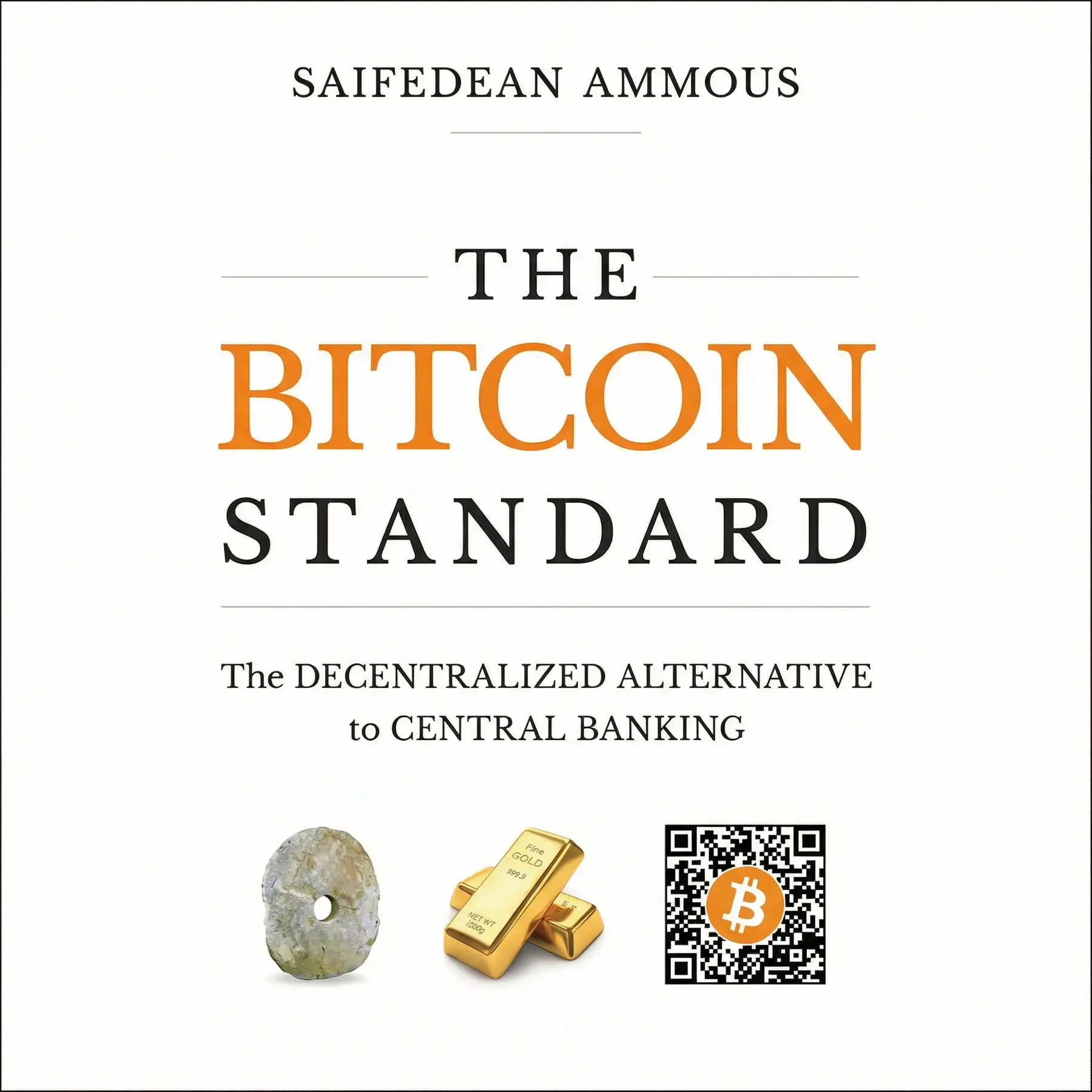
EnglishไทยThe Bitcoin Standard: The Decentralized Alternative to Central Banking
Explains why money keeps its value only when its supply is hard to expand, how governments abandoned gold to print money, and why Saifedean Ammous sees Bitcoin's fixed, secure supply as a digital route back.
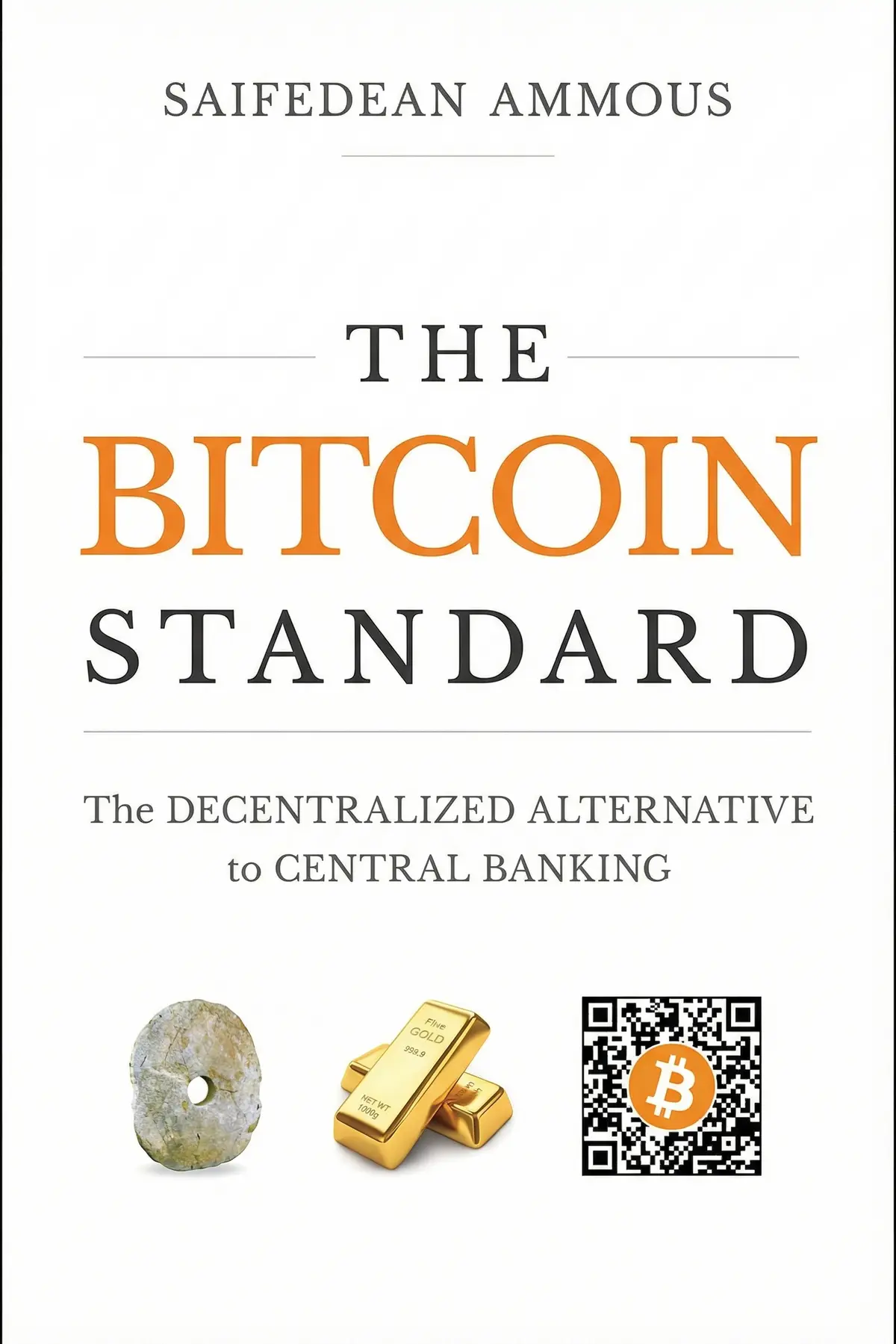
Table of Content
1. Introduction
54 sec
If your savings buy a little less each year, you probably blame prices. In The Bitcoin Standard, economist Saifedean Ammous blames the money itself. His case is that a currency holds its value only when nobody can cheaply create more of it, and that gold enforced that rule for most of modern history. When European governments abandoned gold to pay for the First World War, Ammous argues, they opened a century of printed money, booms followed by busts, and climbing debt.
His way back is Bitcoin, a digital currency whose supply is capped by its code and guarded by its own network. The route runs past four-ton stones on a Pacific island, Roman coins shaved thin, and a president who cut the dollar loose from gold in one announcement. What you get is a simple test for judging any money and a frank look at what still blocks Bitcoin from the job.
2. Spot the quality that makes money last
1 min 36 sec
Four-ton stones on a Pacific island served as money for generations, until a shipwrecked sailor showed up with modern tools. What he did reveals the single property every currency needs to survive.
3. Learn how gold earned the trust of markets
1 min 35 sec
Many metals could have become money, yet one kept winning for more than two thousand years. Its physical quirks, and a decision by Isaac Newton, built an era Ammous holds up as a model.
4. Trace how war spending broke the gold standard
1 min 55 sec
From Rome to 1914, rulers short of money kept reaching for the same tool. Ammous follows that habit to a single announcement in 1971 that changed what stands behind every currency.
5. Honest money rewards saving and sharpens prices
1 min 39 sec
A businesswoman in Malaysia can make the right call about copper without knowing anything about Chile. Ammous explains what lets her do it, and what takes that ability away.
6. See how easy money ends in boom, bust and debt
1 min 40 sec
Governments respond to slumps with the same remedy decade after decade. Ammous argues the remedy is part of the disease, and he traces how it leaves households and states deeper in debt.
7. A money no one can print more of
1 min 37 sec
Oil feels scarce, yet proven reserves keep growing. Ammous makes the case that one asset breaks that pattern entirely, and explains the design choices meant to keep its supply out of human hands.
8. Cheating Bitcoin costs more than it pays
1 min 29 sec
Every digital system invites attackers, and money invites them most. Ammous argues Bitcoin turns the usual odds around, so that even a successful attack leaves the attacker with surprisingly little.
9. Weigh the two problems Bitcoin still faces
1 min 49 sec
A price that rose by hundreds of millions of percent is hard to call stable. Ammous names the two obstacles between Bitcoin and a world standard, and one echoes gold’s old weakness.
10. Conclusion
1 min 03 sec
The Bitcoin Standard treats money as a question of who controls the supply. On Yap, in Rome and across Europe in 1914, the story ran the same way: once new money became cheap to create, it stopped doing its job of rewarding patience, carrying honest prices and holding value over time. Gold, in Ammous’s account, resisted that pull for two centuries until governments found a way around it. Bitcoin is his attempt to put the limit beyond anyone’s reach, in code no government can rewrite.
You do not need to share his verdict on Keynes or his faith in Bitcoin to use his test. Look at the money you rely on and ask how easily someone could make more of it, and who decides. Notice when a boom rests on cheap credit, not on real savings. And if you follow Bitcoin, keep watching the two questions Ammous himself leaves open.
O’Keefe’s boats turned money back into rock. Every currency faces the same question: can anyone send the boats?
About this book
What is this book about?
Most people treat the money in their account as a fixed measuring stick. Saifedean Ammous argues it is nothing of the kind. In his view, a currency holds value only when nobody can cheaply create more of it. History shows what happens when that rule breaks, from the Rai stones of Yap to the clipped coins of Rome. Ammous holds up the gold standard as an age of sound money. Britain launched it in 1717, and about 50 countries had adopted it by 1900. He traces its end to 1914, when European governments printed money to fund the First World War, and follows the slide through fiat currencies, the Bretton Woods system and Nixon's 1971 break with gold. Unsound money, he argues, discourages saving, distorts prices and feeds cycles of boom, bust and debt. His proposed remedy is Bitcoin. Its supply is capped at 21 million coins, and a public blockchain makes cheating costlier than honesty. He also sets out the volatility and scaling limits that could stop it from becoming a new standard. Readers get a clear test for judging any money and a sharper view of the debate over central banking.
Book Information
Who it's for
Asking who controls money
Savers and professionals who want to understand why their money loses value and who controls it.
Bitcoin-curious investors and founders
Investors and founders curious about Bitcoin who want the economic case for it beyond the price chart.
Economics students
Students of economics looking for the Austrian school's critique of central banking and Keynesian policy.
About the Author
Saifedean Ammous
Saifedean Ammous is an economist, born in 1980, who writes from the Austrian school of economics. From 2009 to 2019 he was an economics lecturer at the Lebanese American University. He earned a doctorate from Columbia University in sustainable development and a master's in development management at the London School of Economics, and he studied mechanical engineering at the American University of Beirut. After The Bitcoin Standard he published The Fiat Standard in 2021 and Principles of Economics in 2023. He runs courses on Bitcoin and Austrian economics on an online platform of his own and hosts The Bitcoin Standard Podcast.
Ratings & Reviews
Ratings at a glance
What people think
Listeners view this title as an essential read that brilliantly breaks down the mechanics of Bitcoin and the evolution of currency, highlighting the significance of gold standards. Additionally, the work functions as a primary resource on Bitcoin and delivers a straightforward, reachable guide to monetary theory. Listeners value the book’s deep, challenging insights and often describe it as a life-changing experience.
Top reviews
On
Picked this up thinking it was just another crypto hype manual, but I was dead wrong. The author spends a massive amount of time on the history of gold and why humans naturally gravitate toward hard money. His explanation of the stock-to-flow ratio makes the concept of scarcity very easy to grasp for a beginner. While the tone gets a bit preachy near the end, the core message about sound money is undeniable. You will never look at your bank account the same way after finishing the first few chapters. It is a foundational text that perfectly connects ancient history to the digital age we are entering. Even if you do not buy any Bitcoin, the education on inflation is worth the price.
Show moreKiattisak
This book should be mandatory reading for every high school student before they enter the real world and start earning. It provides a life-changing perspective on how governments have historically manipulated currency to fund wars and expand their own power. Ammous explains the technical aspects of the blockchain without getting bogged down in confusing jargon that usually scares people away. I found the comparison between the Byzantine Generals Problem and the security of the network to be particularly enlightening. The writing is sharp and punchy, making a potentially dry subject feel like a gripping historical narrative. Some might find his libertarian views a bit extreme, but the economic logic he presents is very difficult to ignore once you see it. It is easily the best introduction to the space.
Show moreSangduan
Wow, I never realized how much our current financial system relies on constant inflation just to keep the wheels from falling off. This book opened my eyes to the importance of having a monetary system that is not controlled by a central authority. The historical context regarding the Roman Empire and the debasement of their currency was a perfect parallel to what we see today. Ammous writes with a level of passion that makes you want to immediately move your savings into a hardware wallet. While the technical details on running a node were a bit simplified, the economic theory behind the 21 million cap is presented brilliantly. It is a powerful argument for why we need a separation of money and state in the modern era. Truly a life-changing piece of literature for me.
Show morePong
Finally got around to reading this and it completely reframed how I view the concept of time preference and long-term saving. The writing is incredibly clear and manages to make the history of money feel like a vital part of our personal lives. I loved the way the author contrasted the stability of the 19th century with the volatility of the modern financial era. It is a bold, uncompromising look at why Bitcoin is a necessary invention for the survival of a free society. Even though some of the criticisms of modern art felt like a stretch, the core economic arguments are incredibly robust. I have recommended this to several friends who were skeptical about crypto and it has changed many of their minds. This is easily one of the most important books of the decade.
Show moreHassan
Ever wonder why your savings seem to lose value every year while prices at the grocery store keep climbing? This book answers that question by diving deep into the history of monetary policy and the gold standard. Saifedean’s breakdown of hard money versus easy money is probably the most clear-headed explanation I have ever encountered. I particularly enjoyed the sections on how sound money encourages people to have a lower time preference and think long-term. To be fair, he goes on some weird tangents about modern art being a result of fiat currency which felt quite unconvincing. However, the central thesis regarding Bitcoin as a successor to gold is incredibly compelling and well-argued throughout. It is a must-read for anyone seeking financial sovereignty.
Show moreWoramet
After hearing about this title for years in the crypto space, I finally sat down to see if it lived up to the massive reputation. The research into the rai stones of Yap and the history of silver was fascinating and well-structured. It does a fantastic job of explaining why Bitcoin is often referred to as digital gold by its most ardent supporters. My only real gripe is that the author is a bit of a maximalist who completely ignores the utility of any other blockchain. He presents Bitcoin as the only possible solution to our current financial mess without much room for nuance or alternative views. Despite that, the chapter on Bitcoin FAQs is incredibly helpful for answering common criticisms about energy consumption and security. It is a solid, thought-provoking read for any curious investor.
Show moreDarius
The chapter on the stock-to-flow ratio is worth the price of the book alone for anyone trying to understand digital scarcity. I appreciated how the author broke down the differences between various forms of money based on their durability and portability. It is a very accessible guide for people who know absolutely nothing about the inner workings of the global banking system. I do think he oversimplifies the causes of major wars by pinning them solely on the lack of a gold standard. That kind of reductionist thinking takes away from the otherwise very strong economic points he makes throughout the text. Still, the final chapters on why Bitcoin is the ultimate form of money are very persuasive and well worth your time. It is a great foundational text for any newcomer.
Show moreCamila
Look, you do not have to be a hardcore libertarian to appreciate the sheer depth of research Ammous put into the evolution of currency. He takes a very complex topic and makes it understandable for the average person who just wants to protect their wealth. The way he describes the transition from the gold standard to the current fiat system is both educational and terrifying. I would have liked to see a bit more technical depth regarding the Lightning Network and how Bitcoin scales in practice. He tends to gloss over the difficulties of adoption in favor of theoretical arguments about the superiority of the system. However, the book succeeds in its primary goal of making a rock-solid case for the long-term value of Bitcoin. It is a very informative and necessary read for today's economy.
Show moreRoo
To be fair, the first half of the book is an absolute masterclass in monetary history and the properties of hard money. The way he describes the coincidence of wants and the evolution of salt and beads into gold is excellent. However, the author eventually loses a lot of credibility when he starts launching personal attacks against Keynes. He blames every societal ill from the decline of family values to bad music on the abandonment of the gold standard. This dogmatic approach makes it hard to recommend the book to anyone who prefers a balanced or academic discussion. The sections on Bitcoin scaling are also quite biased and ignore many of the legitimate technical challenges the network faces today. It is a decent starting point but requires a very skeptical mind to navigate.
Show moreMattanee
As someone who appreciates Austrian economics, I found myself nodding along for two hundred pages before the tone became a bit insufferable. The initial chapters on the history of money are five-star material and offer a very clear introduction to monetary theory. Unfortunately, the book then devolves into a series of circular arguments and juvenile insults toward anyone who disagrees with the author's worldview. He makes several easily falsifiable claims about historical investors and seems to have a very limited understanding of how nodes actually process transactions. The irony of suggesting people use third-party custodians while preaching about financial independence was also quite a glaring contradiction. It is worth reading for the history, but you should probably skip the middle section where he rants about modern society. It is a bit of a mixed bag.
Show moreQuestions about this book
What is the main idea of The Bitcoin Standard?
Saifedean Ammous argues that good money must be hard to produce more of, so it holds value over time. Gold played that role under the gold standard, which he credits with an era of prosperity. Governments abandoned it to fund the First World War and later moved to fiat money, which he blames for booms, busts and rising debt. He presents Bitcoin, with its fixed supply of 21 million coins, as a digital form of sound money.
Why does Ammous compare Bitcoin to gold?
Both are mined, and both get harder to produce over time. Gold lies ever deeper underground, while Bitcoin’s puzzles grow more difficult as more computers join and its issuance halves every four years until 2140. Ammous goes further than the comparison, though: Bitcoin’s supply is capped at 21 million coins, which makes it, in his view, the only good defined by absolute scarcity.
What is sound money according to Saifedean Ammous?
In Ammous’s usage, sound money is money the market chooses freely because its supply cannot easily be expanded, as with gold. He argues it encourages saving and investment, because people expect it to hold or gain value, and it keeps prices honest so they carry real information. His example is a businesswoman in Malaysia who can react to a jump in copper prices without knowing an earthquake in Chile caused it.
What problems does Bitcoin face in The Bitcoin Standard?
Ammous names two. The first is price volatility: a coin worth $0.000994 in May 2010 reached $4,200 by October 2017, and in 2017 alone rose from $750 to $20,000, which weakens it as a store of value, though he expects this to calm. The second is scale. Daily transaction limits and rising fees push trade off the blockchain toward central institutions, the very middlemen Bitcoin was designed to avoid.
Who should read The Bitcoin Standard?
It suits readers who want the economic argument behind Bitcoin instead of trading tips, savers puzzled by inflation, and students who want the Austrian school’s critique of central banking and Keynesian spending. Its history runs from Rai stones on Yap and Roman coin clipping to the Bretton Woods system and the 1971 end of dollar convertibility, so it also works as a short history of money.
Readers also enjoyed


Adults in The Room: My Battle With Europe’s Deep Establishment
Yanis Varoufakis


1929: Inside the Greatest Crash in Wall Street History--and How It
Andrew Ross Sorkin

23 Things They Don’t Tell You About Capitalism
Ha-Joon Chang
A Little History of Economics
Niall Kishtainy


A Splendid Exchange: How Trade Shaped the World
William J. Bernstein
AUDIO SUMMARY AVAILABLE
Listen to The Bitcoin Standard in 15 minutes
Get the key ideas from The Bitcoin Standard by Saifedean Ammous, plus 5,000+ more nonfiction titles.
- 5,000+ titles
- Listen as much as you want
- 7-day free trial
- Cancel anytime









