

15 min 14 sec
Available in: English
The Automatic Customer: Creating a Subscription Business in Any Industry
Shows how businesses in almost any industry can move from one-off sales to recurring revenue by choosing the right subscription model, then tracking the right numbers and persuading hesitant customers to sign up and stay.
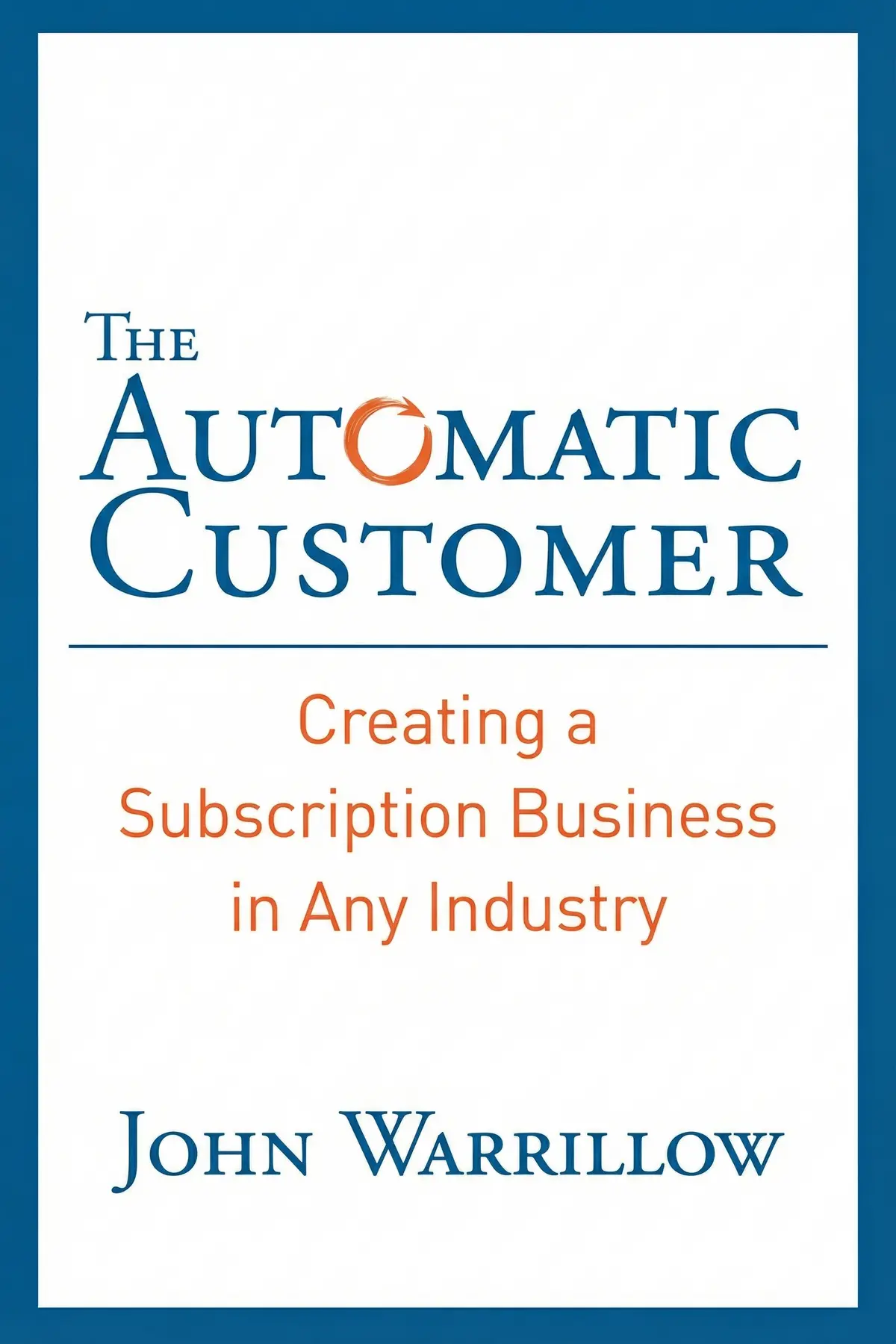
Table of Content
1. Introduction
58 sec
If most of your revenue disappears the day a sale closes, every month starts from zero. In The Automatic Customer, John Warrillow, who started and sold four companies, argues that nearly any business can escape that trap by selling a subscription. His clearest example is WhatsApp, which gathered 450 million users without any advertising, partly because after the first year it cost just $1 a year, so friends signed up friends by the millions.
Warrillow’s case is that recurring revenue no longer belongs only to newspapers and magazines. Whatever you sell, there is a subscription model that fits it, and the right one makes a company steadier, easier to run and worth more. Ahead are the reasons customers now prefer access, nine models matched to different trades, the numbers that replace the usual profit line, and the tactics that get hesitant buyers to sign up and stay.
2. Read the shift that brought subscriptions back
1 min 35 sec
Apple, Microsoft and Amazon have all made more use of subscriptions to charge their customers. Three changes in buyer behavior explain why, and they put pressure on every business that still sells one transaction at a time.
3. A steadier company that buyers value more
1 min 32 sec
A small monthly fee can be worth more than a sale ten times its size. Investors know it, and so do owners who have stopped losing sleep over next month’s demand.
4. Keep products arriving without a reorder
1 min 41 sec
A razor company that does not make razors and a box of dog toys show two ways to sell goods on a schedule. One hides a supplier on purpose; the other hides a bigger sale.
5. Let members recruit members, then guard against backlash
1 min 43 sec
Some communities charge a fortune to keep people out, while others need every new member they can get. Both can work, and one popular online game shows how fast an army of fans can switch sides.
6. Relief from chores and worries is a product
1 min 28 sec
A monthly visit to change light bulbs and an alert when the dog wanders off both sell the same thing. Pricing them is where many providers go wrong.
7. Charge for what you know and shorter waits
1 min 54 sec
A website for dance studio owners was bought by an industry giant within four years. Expertise, a deep library and a place at the front of the queue can all be sold by the month.
8. Measure a subscription with the right numbers
1 min 32 sec
A healthy subscription company can look like it is losing money on paper. The standard report misleads, and the cash gap it hides can cost a founder the whole company.
9. Win hesitant buyers and keep them subscribed
1 min 36 sec
A ski club asks $57,000 a year and still finds members. The tactics that ease people into a commitment, and the habits that stop them canceling, apply far beyond luxury clubs.
10. Conclusion
1 min 15 sec
What Warrillow adds up to is a different way of seeing a customer. A one-time buyer is a sale you must win again next month. An automatic customer is an asset: predictable revenue, a closer relationship and a company someone will pay more to own. The range of his examples, from dog toys to a $25,000 network of entrepreneurs, suggests that almost every trade has a model waiting for it.
The work starts with matching. Ask whether your customers use something up, love a theme, want status, want to reach each other, want a chore or a worry removed, want expertise, want endless choice or want to skip a queue. Then let go of habits that no longer fit, judging the business by what each customer brings in against what it cost to win them, and watching cancellations as closely as sales. When you invite people in, give them a striking comparison, a trial or a reason to pay ahead.
WhatsApp asked for a dollar a year after the first year and let its users do the rest. The fee was tiny. The habit it built was enormous.
About this book
What is this book about?
Most businesses start every month from zero, chasing new sales to replace the ones that just closed. John Warrillow argues they no longer have to. Subscriptions used to belong mostly to newspapers and magazines. Now a generation that prefers access to ownership, growing trust in online payments and the rising value of customer data have opened the model to almost every trade, from razors and dog toys to home repairs and counseling. Warrillow's angle is practical. He sorts subscription businesses into distinct models, each suited to a different kind of company: products people use up, curated surprise boxes, exclusive clubs, growing networks, services that remove chores or worries, paid expertise, unlimited content libraries and priority access. Each comes with real companies, from Dollar Shave Club and Zipcar to Salesforce and Thriveworks, and with the traps they ran into. Readers also learn why the usual profit-and-loss view misleads a subscription company, how to fund the gap while recurring revenue builds, and which tactics win reluctant buyers and keep them from canceling. The promise is a steadier business that is easier to run and worth more to anyone who might buy it.
Book Information
Who it's for
Founders and business owners
Founders and small business owners tired of starting every month from zero sales.
Wondering if subscriptions fit
Service providers, consultants and online sellers wondering how a subscription could fit their trade.
Managers weighing recurring revenue
Managers planning recurring revenue who need the right numbers to judge it.
About the Author
John Warrillow
John Warrillow founded The Value Builder System, practice management software for business advisors. Before that he started and exited four companies, and one of them was bought by a public company. He also wrote Built to Sell, which Fortune and Inc. named among the best business books of 2011 and which has been translated into 12 languages. He hosts the podcast Built to Sell Radio and lives in Toronto with his family.
Ratings & Reviews
Ratings at a glance

What people think
Listeners find this book to be an essential read that delivers comprehensive insights through real-world case studies and actionable advice. They also value the way it analyzes the subscription business model, which helps them feel more capable of launching such ventures. Moreover, the material is highly accessible, and listeners consider it a top-tier resource for established companies, with one listener highlighting its specific utility in grasping the nuances of the rising subscription economy.
Top reviews
Satit
Finally got around to reading Warrillow’s follow-up to Built to Sell, and it’s a game-changer for anyone tired of the constant "eat what you kill" sales cycle. The book provides a crystal-clear roadmap for transforming a traditional business into a recurring revenue machine. I particularly loved the detailed breakdown of the nine different subscription models; it's not just about software or Netflix anymore. The case studies are incredibly practical and gave me the confidence to experiment with a "peace-of-mind" model for my own service company. It’s an easy, engaging read that demystifies complex metrics like LTV and churn. If you want to increase the value of your business, this is the blueprint you've been searching for. It’s rare to find a business book that is both visionary and immediately applicable.
Show moreGame
The chapter on the "Cash Suck vs. Cash Spigot" alone is worth the price of admission for this book. Warrillow brilliantly explains why subscription businesses often feel like they’re failing right before they explode into massive success. I’ve been struggling to explain to my partners why our initial acquisition costs are so high, and this book gave me the vocabulary and the data to back it up. The focus on the first 90 days of the customer journey—the onboarding period—changed how we approach our client relations entirely. Frankly, the writing style is so accessible that I finished the whole thing in two sittings. It's packed with insights that give you the confidence to stop chasing one-off sales and start building a real community of subscribers.
Show moreDao
Wow. This book completely shifted my perspective on what makes a company truly valuable. Before reading this, I was focused on top-line revenue, but Warrillow shows why that’s a vanity metric compared to the "Automatic Customer." The shift from a transaction-based mindset to a relationship-based one is explained with such conviction. I loved the section on "The Psychology of Selling a Subscription" because it addresses the main hurdle: how do you get people to say yes to a recurring fee? The advice to focus on a "10x value" rather than a small discount is a game-changer. Sentence by sentence, the book builds a compelling case that is hard to argue with. It's a quick read but one that I know I will be coming back to.
Show moreGung
Ever wonder why some companies sell for 10x earnings while others struggle to find a buyer at all? This book holds the answer. John Warrillow has a talent for taking complex financial concepts and making them feel like a casual conversation over coffee. The way he breaks down the math of the "Cash Spigot" changed the way I look at my bank balance every month. I particularly appreciated the advice on "spontaneous gifts" to reduce churn; it’s such a simple, human way to keep subscribers happy. This isn't just a book for tech startups; it’s for the plumber, the florist, and the consultant. It gives you the confidence to stop begging for the next sale and start building a predictable future.
Show moreMingkwan
As someone who operates a small consulting firm in Europe, I found the strategies here enlightening, even if the examples lean heavily toward the American market. Warrillow explains the "Automatic Customer" concept with such clarity that it makes you wonder why you haven't switched to recurring billing already. The math section toward the end—specifically the 3:1 LTV to CAC ratio—was a reality check that I desperately needed. Truth be told, I felt some of the anecdotes were a bit repetitive, and a few models seemed a bit forced. However, the overarching message about the "subscription economy" is impossible to ignore. It’s a solid 4-star read because it provides a structural framework that most business books lack. You’ll walk away with at least three or four "aha!" moments.
Show moreCharlotte
Picked this up on a whim, and it turned out to be a fantastic overview of how the subscription model is eating the world. Warrillow does a great job of categorizing different approaches, like the "Simplifier Model" and the "Front-of-the-Line" model, which opened my eyes to possibilities beyond just software. To be fair, some of the references to companies like Amazon Prime feel a bit dated now because we’ve seen them discussed a million times. Still, the way he connects these models to the actual valuation of a company is brilliant. I appreciated the warnings about "churn" and how it can quietly kill a growing business if you aren't paying attention. It’s a very practical guide that avoids unnecessary jargon.
Show moreNuk
My favorite takeaway from Warrillow’s work here is the idea that you shouldn't just offer a subscription as an option, but often as the only way to do business. That’s a bold move that requires a lot of guts, but the book provides the case studies to show why it works. It’s an insightful look at how to create "sticky" services that people can't imagine living without. I did find the sections on math and metrics like MRR and COGS to be a bit dry, but they are absolutely necessary if you want to take this seriously. The tone is professional yet encouraging, which I appreciated. My business is currently 100% project-based, and after finishing this, I’m already drawing up plans for a membership component to stabilize our cash flow.
Show moreChamnong
After hearing so much hype about this title, I have to say I’m a bit underwhelmed, especially compared to the author's previous work. While Built to Sell felt tight and punchy, this one feels slightly bloated with long-winded stories that illustrate very simple concepts. Do we really need an entire chapter to understand why convenience sells? The taxonomy of subscription types is helpful, but I found myself skimming through the middle sections just to get to the actionable data. It’s a decent primer for a novice who has never thought about recurring revenue, but if you’re already familiar with SaaS metrics, you might find the information a bit basic. Personally, I was hoping for more deep-dives into the psychological barriers of getting customers to commit. It's okay, but not the masterpiece everyone claims it is.
Show moreJoshua
To be fair, this is a solid introduction to the subscription economy, but it didn't quite live up to the "must-read" status for me. The 9 models are a useful way to brainstorm, but many of the categories overlap so much that the distinctions feel arbitrary. I also felt that the book was a bit too "American-centric," as many of the service-based examples wouldn't really translate well to other markets where labor costs or consumer habits are different. Not gonna lie, I was expecting more advanced tactics on reducing churn. Instead, it’s a bit more of a high-level strategic overview. It’s perfect for someone just starting their entrepreneurial journey or an old-school business owner looking to modernize.
Show moreApichat
Is this just an elaborate way to tell us that getting paid every month is better than getting paid once? I found the premise of this book to be quite predatory from a consumer standpoint, even if it is "good for business." The author spends a lot of time gushing over how Microsoft and other giants have "hooked" their customers, but he rarely touches on the frustration this causes for people who just want to own their products. The examples provided are purely anecdotal and don't provide enough raw data on net profits compared to traditional competitors. Look, I get it—recurring revenue is the holy grail for founders—but this book feels like a manual on how to chain your customers to your brand financially. If you’re looking for deep innovation or ethical marketing, you won't find much here.
Show moreQuestions about this book
What is the main idea of The Automatic Customer?
John Warrillow argues that nearly any business can turn one-time buyers into recurring subscribers. Changes such as a preference for access over ownership, trust in online payments and the value of data have made subscriptions practical far beyond newspapers. He describes models for goods, communities, services, content and priority access, and shows how recurring revenue makes a company steadier, easier to run and more valuable to investors.
What subscription models does John Warrillow describe?
He covers consumables, such as Dollar Shave Club’s razor blades; surprise boxes, such as Bark Box; private clubs like the Genius Network; networks like WhatsApp and Zipcar; simplifier services like Hassle Free Home Service; peace-of-mind services like the pet tracker Tagg; membership websites; all-you-can-eat libraries like Spotify; and front-of-the-line access, as offered by Salesforce.com and Thriveworks.
How do you measure a subscription business?
Warrillow warns that the profit-and-loss statement misleads, because monthly payments arrive in small pieces while costs land in full. Instead he cites a venture capital rule of thumb: the value of a customer ought to be triple the cost of winning that customer. To fund the gap while revenue builds, he suggests reinvesting profits, raising outside money carefully or billing a full year in advance.
How do you get customers to sign up for a subscription and stay?
Warrillow recommends three persuasion tactics: a striking comparison, such as a $29 monthly art course versus $600 to $800 for private lessons; an ultimatum that removes the old way of buying; and a trial, like a ski club’s $2,500 trial membership. To reduce cancellations, make the product part of daily use and encourage prepayment, which led Wild Apricot’s customers to use its software more.
Who should read The Automatic Customer?
It suits business owners and founders who want steadier income than one-off sales provide, in any industry from retail and home services to consulting and online content. Its examples range from razors and dog treats to counseling and private clubs, so readers can find a model close to their own business and the pitfalls others met along the way.
Readers also enjoyed


Alibaba: The House That Jack Ma Built
Duncan Clark



7 Powers: The Foundations of Business Strategy
Hamilton Helmer

Bad Blood: Secrets and Lies in a Silicon Valley Startup
John Carreyrou
AUDIO SUMMARY AVAILABLE
Listen to The Automatic Customer in 15 minutes
Get the key ideas from The Automatic Customer by John Warrillow, plus 5,000+ more nonfiction titles.
- 5,000+ titles
- Listen as much as you want
- 7-day free trial
- Cancel anytime









