
14 min 57 sec
Available in: English
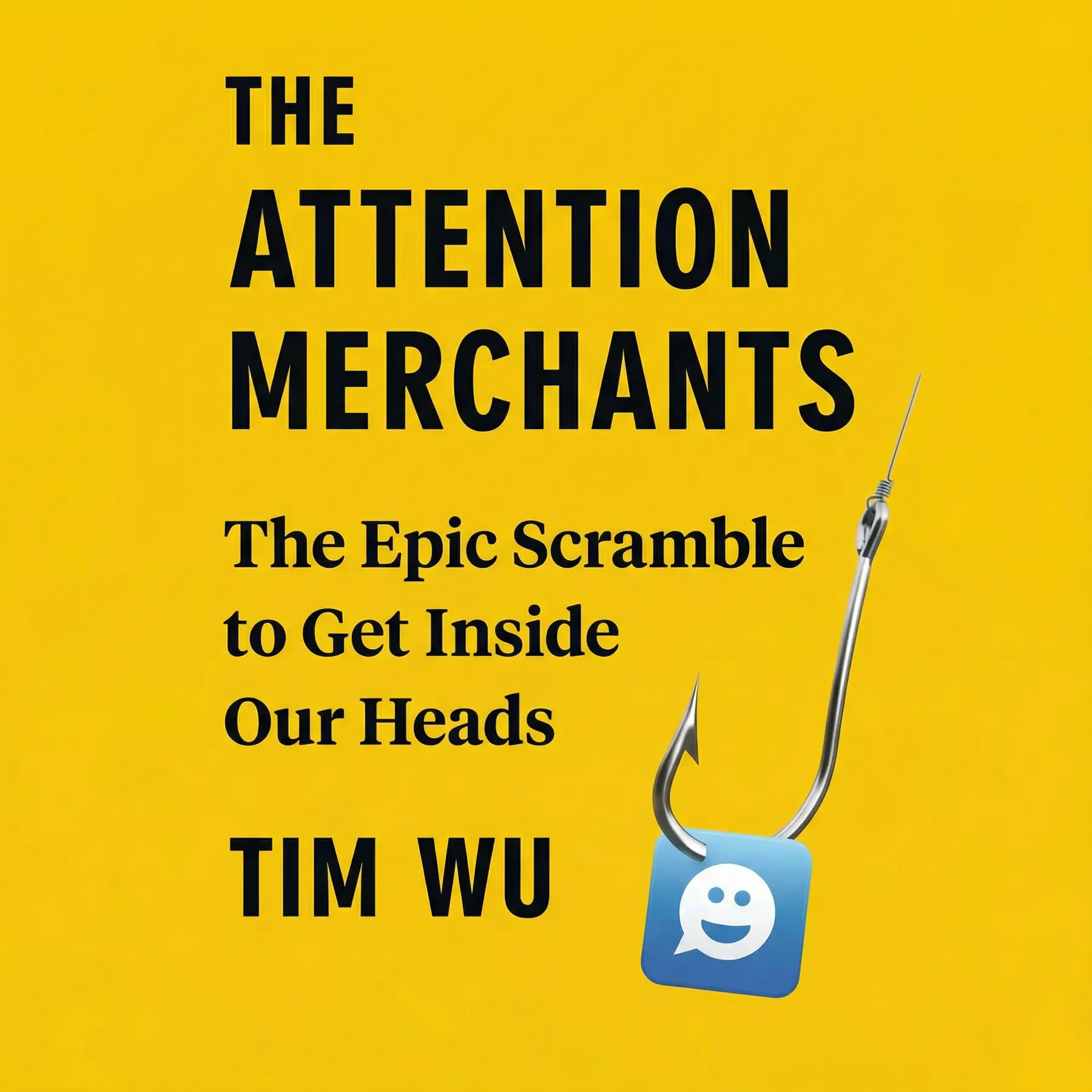
The Attention Merchants: The Epic Scramble to Get Inside Our Heads
By Tim Wu
Tim Wu traces how media learned to capture attention and sell it to advertisers, from a penny newspaper in 1833 to email and Google. It shows the methods still used on you today.
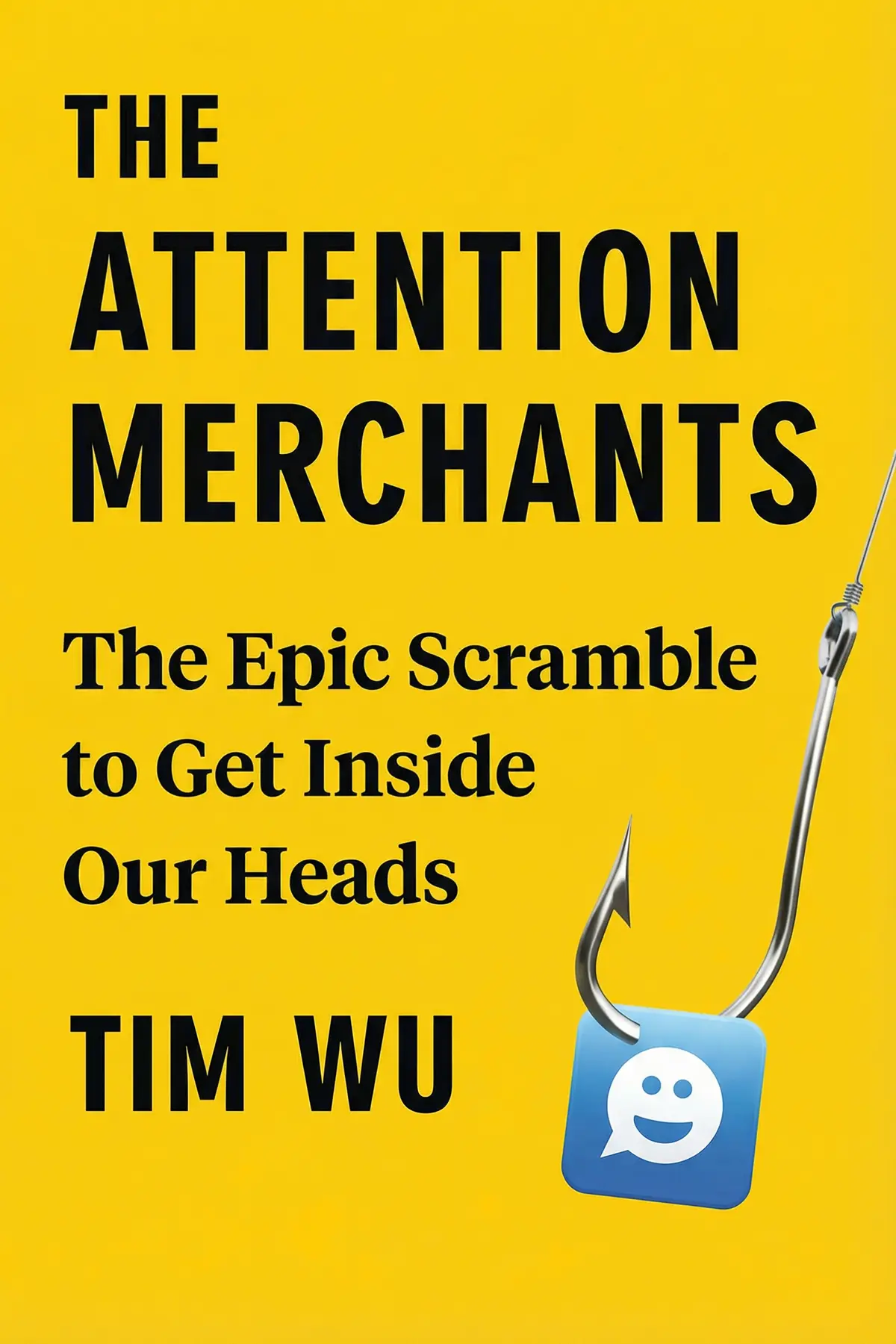
Table of Content
1. Introduction
59 sec
If your phone, your inbox and every screen around you seem to be fighting for your eyes, you are seeing an old story clearly. In The Attention Merchants, Columbia law professor Tim Wu traces that fight back to 1833. That year a New York newspaper began selling its readers’ attention to advertisers and found that this paid better than the news did.
Wu’s history shows one trade repeating for two centuries: give people something they want for little or nothing, then sell their attention to whoever will pay for it. Penny papers did it. So did miracle tonics, war posters, radio soap operas, television, email, Google and celebrity magazines.
Once you see the pattern, you can spot the deal behind each free thing you use. You can also catch the invented problems built to sell you cures, and the small rewards that keep you checking. That awareness is where taking back control of your own attention begins.
2. Spot the moment your attention became the product
1 min 42 sec
A new newspaper sold its copies for a single penny and, on sales alone, should have lost money. Instead it was the top paper in its city within two years, and the trick it found still pays for most of what you read.
3. Recognize the old playbook of free samples and posters
2 min 00 sec
One copywriter made a fortune selling a tonic that cured nothing. A few years later, the same kind of campaign helped a nation at war find millions of soldiers, and none of them were forced to sign up.
4. Catch a problem invented just to sell you a cure
1 min 57 sec
Bad breath was nothing new, until an advertiser gave it a medical-sounding name and turned it into a social danger. The campaign multiplied one company’s earnings many times over, and the method is still in use.
5. See what the free show is really charging you
1 min 48 sec
A toothpaste caught with no cleaning agents in it should have disappeared. Instead its manager found a way into millions of homes every single night, and he changed how entertainment gets paid for.
6. Understand the reward trick behind your inbox habit
1 min 56 sec
Within two years of its invention, one simple tool took over most of the traffic on the early network. A theory holding that human behaviour, like that of animals, is shaped by rewards explains why it still has such a hold on your day.
7. Know why some ads show up only when you search
1 min 41 sec
Two founders had the internet’s most popular search engine and no idea how to make money from it. They refused the usual flood of ads, and the system they built instead changed what an ad could be.
8. Understand the pull of famous faces on your attention
1 min 44 sec
A magazine about famous people became the most profitable in the world, and a single page in it sells for a small fortune. Yet decades of study still cannot fully explain why those faces hold us.
9. Conclusion
1 min 10 sec
On the surface, The Attention Merchants is a history of advertising. Its lasting lesson, though, is about your own mind. Over almost two centuries, Wu shows the same bargain in new forms. Benjamin Day sold the news for a penny. Pepsodent offered an evening with Amos ‘n’ Andy. Google offered search. Each time, the offer drew an audience, and the audience’s attention was the thing being sold. The methods kept getting sharper: free samples, invented conditions with medical names, brands made by broadcasting, small rewards that keep an inbox refreshing, and famous faces whose hold no scholar can fully explain.
Knowing about the bargain helps in everyday ways. When something is free, ask who is paying for your time with it. When an ad opens by naming a problem, check whether you had that problem yesterday. When you catch yourself refreshing a screen for no reason, recognize the reward loop Skinner described, and pick a set time to check instead.
People have been buying and selling your attention since 1833. You still get to decide how much of it to hand over.
About this book
What is this book about?
Ads now reach us on trains, on television, on the radio and on our phones, and it is hard to picture a day without them. Tim Wu goes back to where that started and shows one business model at work across nearly two centuries: attract an audience with something it wants, then sell that audience's attention to whoever will pay. The story starts in 1833 with Benjamin Day's penny newspaper. It moves on to Claude Hopkins selling useless tonics, Britain's poster campaign that brought in millions of volunteers for World War I, and the 1920s invention of problems such as halitosis so products could cure them. Radio, television, email and Google each take the same trade into more of daily life, and celebrities hold our gaze in ways scholars still cannot explain. Readers come away with a short history of advertising and a set of practical questions to ask when something is free, when an ad names a new worry, or when a screen keeps pulling them back.
Book Information
Who it's for
Professionals always checking email
Professionals who check email and feeds all day and want to know why it is so hard to stop.
Founders and marketers
Marketers and founders curious how advertising's core methods were invented.
Curious about media's money
Readers who want a short history of how media from newspapers to Google paid for itself.
About the Author
Tim Wu
Tim Wu is an American legal scholar and professor at Columbia Law School whose work covers antitrust, copyright and telecommunications law. He coined the phrase network neutrality in a 2003 law journal article. He has advised the Federal Trade Commission, worked at the New York Office of the Attorney General and, from 2021 to 2023, advised the President on technology and competition policy at the White House. He also writes opinion pieces for The New York Times and wrote The Curse of Bigness.
Ratings & Reviews
Ratings at a glance
What people think
Listeners find the book engaging and well-written throughout, offering a cohesive history of the advertising industry packed with stimulating historical parallels and stories. Additionally, they value how it fosters a deeper grasp of the attention economy. However, opinions on readability are divided, with several listeners finding it difficult to digest. The pacing and length also see varying feedback; one listener considers it well-paced while another feels it is too long.
Top reviews
Chanpen
Ever wonder why we’ve collectively agreed to trade our privacy for 'free' email and social media? This book provides a chilling answer by detailing the long game played by advertisers over the last century. Wu captures the essence of Tim Cook’s famous warning: if you aren't paying, you are the product. I was especially captivated by the history of Clark Stanley and how the 'snake oil' ethos never really died; it just evolved into pop-up ads and clickbait. The writing is sharp, though the sheer volume of historical anecdotes can feel overwhelming if you’re looking for a quick summary. It’s a deep dive into the 'manufactured consent' of our modern era. By the time I hit the chapters on AOL and the rise of the smartphone, I felt a genuine sense of loss for the private spheres we used to inhabit. Truly a thought-provoking read.
Show moreAdam
Wu is a master at weaving together disparate threads of media history into a cohesive narrative. From the 1960s counterculture being co-opted by advertisers to the 'walled garden' of America Online, he shows how every rebellion against the merchants is eventually absorbed. The book is dense but incredibly rewarding if you’re willing to put in the time. I was struck by the comparison between modern social media and the evangelical zeal of early churches—it’s a provocative take that actually makes a lot of sense when you look at how we worship influencers today. My only gripe is that the book occasionally ignores the class divide; not everyone can afford to 'opt-out' or pay for premium, ad-free content. Despite that, the analysis of how our 'prime time' was conquered is nothing short of masterful.
Show morePetch
Wow, what a comprehensive look at the industry that literally owns our brains. I had no idea that the first laws regarding false advertising were only developed in the 1930s or how 'Amos ‘n’ Andy' essentially invented prime time. Wu’s writing is exceptionally well-put-together, balancing historical facts with sharp social commentary. He doesn't just bash the market; he explains why we find these distractions so alluring. The perspective on binge-watching as an 'ad-free immersion' was particularly refreshing—it’s rare to find a book in this genre that isn't just a total downer. It’s a large book, and the readability varies by chapter, but the overall impact is profound. It’s one of those titles that actually changes how you interact with your phone on a daily basis. I’m definitely more conscious of my 'attention' now.
Show moreMalee
Finally got around to reading this, and it’s a fascinating, if sometimes terrifying, look at how our focus has been monetized. Tim Wu does an incredible job tracing the arc from 19th-century snake oil salesmen to the algorithmic giants of Silicon Valley. While some parts of the history might feel familiar if you've followed tech trends, the way he frames everything as a 'harvesting' of our internal lives is brilliant. I particularly enjoyed the sections on the penny press and the early days of radio. However, the book does get a bit dense in the middle, and the prose can feel a little academic at times. It’s not a beach read, but it’s essential for anyone trying to understand why our digital world feels so exhausting. You start to see every notification as a tiny hook designed to reel you in. Definitely makes you want to go on a digital detox immediately.
Show moreRoo
The chapter on the advent of the remote control was a personal highlight for me. It’s amazing to realize how a simple device completely disrupted the 'captured' audience model of early television. Tim Wu’s work is a sprawling, ambitious history that manages to be both engaging and deeply cynical. He connects the dots between 1920s radio sponsors and today’s 'monetized' YouTube channels in a way that feels inevitable. The book is well-paced, but I can see why some might find it a bit long-winded in its descriptions of mid-century advertising agencies. Still, the core message about the 'Faustian bargain' we make for free media is powerful. It’s changed how I view my subscription services—I’d much rather pay for Netflix than be the product for a 'free' alternative. Highly recommended for the historically curious.
Show moreGoy
As someone who grew up during the transition from broadcast TV to the wild west of the early internet, this was a trip down memory lane. I vividly remember those AOL CDs arriving in the mail, but I never considered them 'attention harvesting' tools at the time. Wu’s ability to recontextualize our shared technological history is his greatest strength. He turns the 'obvious' into something sinister and calculated. The sentence structures vary from punchy insights to long, flowing historical descriptions, which kept me engaged even when the subject matter got a bit technical. Some might say it's too long, but I felt the depth was necessary to show just how deep the roots of this industry go. It really makes you question the 'bargain' you're making every time you open an app. A very sobering, necessary piece of work.
Show moreCamila
Not what I expected initially; it felt a bit more like a history textbook than a quick-hitting social critique. However, I eventually appreciated the research that went into detailing the rise of the penny press and the biography of snake oil salesmen. While I was hoping for more actionable insights on how to reclaim my attention, the historical context is invaluable. The writing is technically superb, even if the pacing feels glacial during the mid-section. There are some truly interesting nuggets about the Nazi co-opting of propaganda, but they are sometimes buried under mountains of detail about radio serials. It’s a long commitment for the points it’s trying to make, but the deeper understanding you gain about the attention economy makes the effort worthwhile. It's a solid, if demanding, read.
Show moreGame
Look, if you've ever felt like your brain is being pulled in a dozen directions at once, you need to read this. Wu explains the 'epic scramble to get inside our heads' with such clarity that it's almost uncomfortable. The book connects the dots between the first billboards and the 'microfame' of modern YouTube creators. I was particularly struck by the idea that we’ve traded our private spheres for the convenience of 'free' media—it’s a Faustian bargain we didn't even know we were signing. The history of the remote control as a tool of rebellion was a brilliant touch. While the book can be a bit dense and requires focus, the historical analogs are spot on. It’s a well-written, thought-provoking journey through the commercialization of the human mind. Essential reading for the 21st century.
Show moreVimolwan
To be fair, I felt like the first half was much stronger than the second. The exploration of early propaganda and the 'Amos ‘n’ Andy' radio era was genuinely eye-opening, showing how mass attention was first harnessed. But once the book transitions into the modern internet era, it starts to feel like a retread of every think-piece I’ve read in the last decade. Yes, we know Google tracks us, and yes, we know social media is addictive. Wu is a great writer, but he leans a bit too heavily on obvious observations toward the end. I also found his analysis of Oprah and the 'church' of personality to be a bit of a reach. It’s a solid history, but don’t expect a ground-breaking solution to our current attention crisis. Worth a read if you want the backstory, but maybe skim the later chapters.
Show moreNarong
Frankly, the pacing was all over the place for me, making it a bit of a slog to get through. While the anecdotes about Walter Lippmann and the manufacture of consent were fascinating, the book often felt like a series of disconnected essays rather than a fluid narrative. I found myself checking how many pages were left more often than I’d like to admit. It’s a well-researched history, certainly, but the readability suffers from a somewhat dry, academic tone. There’s a lot of 'what' happened but not quite enough 'why' it matters in a way that feels fresh. If you’ve already read a lot about the attention economy or the history of Silicon Valley, you might find yourself nodding along but not necessarily learning anything new. It’s an okay reference book, but I wouldn't call it a page-turner.
Show moreQuestions about this book
What is The Attention Merchants by Tim Wu about?
It is a history of how media learned to capture people’s attention and sell it to advertisers. Wu starts with Benjamin Day’s penny newspaper, the New York Sun, in 1833. He then follows the same trade through patent medicine ads, British wartime posters, 1920s branding, radio and television sponsorship, email, Google’s Adwords and celebrity magazines such as People.
What is demand engineering in The Attention Merchants?
Demand engineering was a 1920s method that advertised a problem rather than a product. The problem was often one people had never noticed, and the product was then sold as the cure. Listerine’s campaign gave bad breath the clinical name halitosis and hinted that it made people unpopular. Its yearly earnings grew from $115,000 in 1922 to $8 million in 1929.
Why is email so hard to stop checking, according to Tim Wu?
Wu draws on B. F. Skinner’s theory of operant conditioning, in which behavior is reinforced by rewards. The scientist Tom Stafford argues that a pleasant email works as a small reward. Because it feels good, we keep refreshing our inbox hoping for another. That habit makes the inbox an attractive place for advertisers to reach us.
How did Google make money from search without selling top results?
Sergey Brin and Larry Page wanted search results set by the algorithm and free of bias, so companies could not buy their way to the top. With the mathematician Erik Veach, they created Adwords, which shows ads only when they match what a user is searching for. If a search reveals no clear need or interest, no ads appear.
How can I use the ideas in The Attention Merchants?
Ask three things. When a service is free, who is paying for your attention? When an ad names a worry, especially with a medical-sounding label, did you have that worry before? When you keep refreshing a screen, is a reward loop driving you? Checking messages at set times and judging a product apart from its famous spokesperson both follow from Wu’s history.
Readers also enjoyed



AI 2041: Ten Visions for Our Future
Kai-Fu Lee

A Splendid Exchange: How Trade Shaped the World
William J. Bernstein


A Spy Among Friends: Philby and the Great Betrayal
Ben Macintyre




AUDIO SUMMARY AVAILABLE
Listen to The Attention Merchants in 15 minutes
Get the key ideas from The Attention Merchants by Tim Wu, plus 5,000+ more nonfiction titles.
- 5,000+ titles
- Listen as much as you want
- 7-day free trial
- Cancel anytime









