Same as Ever: A Guide to What Never Changes
Morgan Housel
 English
Shows how to spend so money actually improves your life: match purchases to your own values, keep luxuries rare enough to enjoy, test what brings you joy and let good fortune make you kinder.
1 min 00 sec
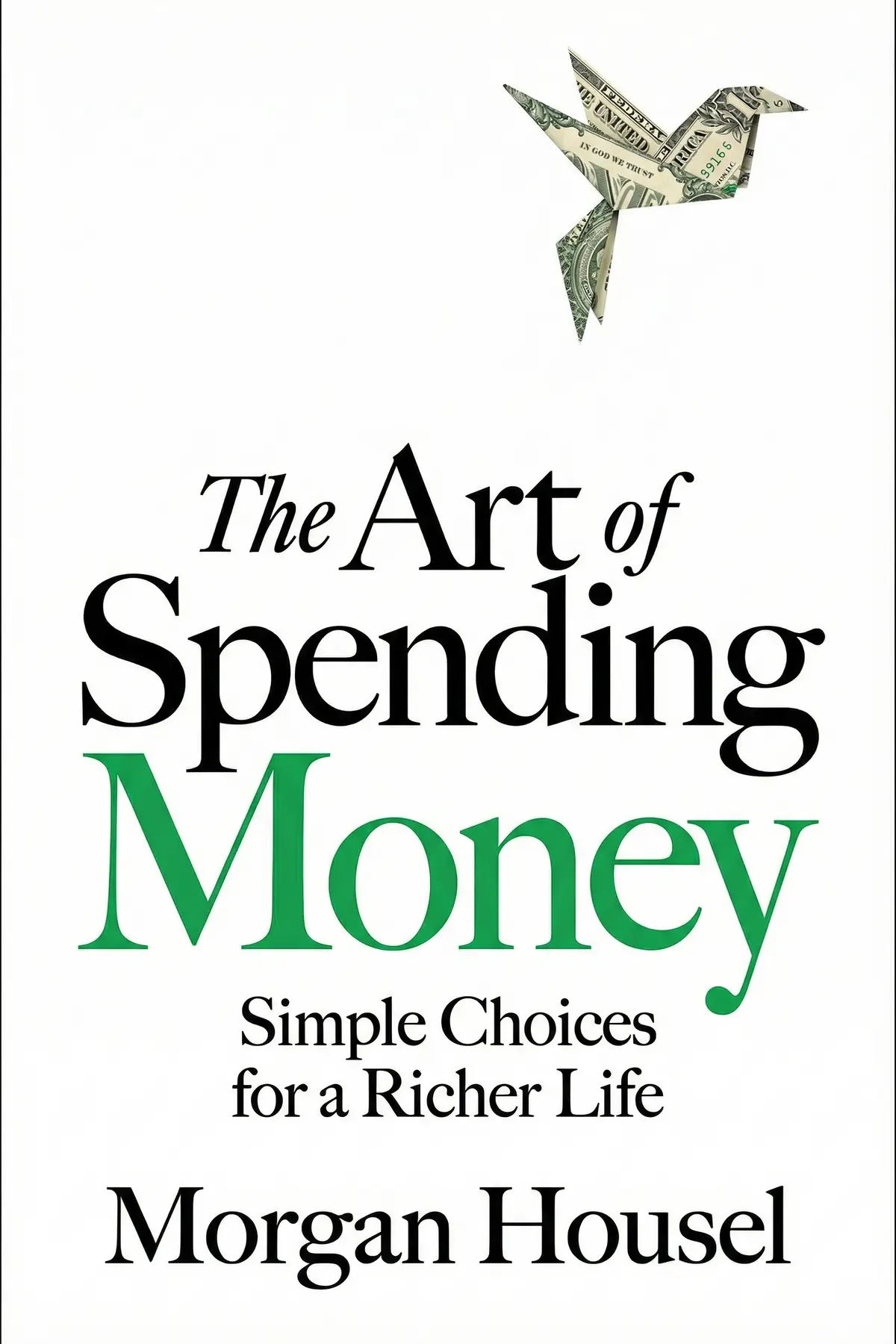
Many people earn steadily, buy what they are supposed to buy and still feel behind. In The Art of Spending Money, financial journalist and investor Morgan Housel argues that the trouble usually lies in how money is used, and that the fix is self-knowledge instead of a stricter budget. A good purchase fits what you truly value, and no one else can define that for you.
The dream kitchen becomes the place where leftovers get reheated, and the new car is just the way to work. Money makes life richer when spending follows your own values, keeps pleasures rare enough to feel and is learned by testing, all held with gratitude for the luck behind it. Along the way come shipwrecked explorers who called their first safe, warm night the happiest of their lives, and a film star who nearly ignored the script that made him. The book offers a way to judge which purchases earn their keep, and permission to drop the rest without guilt.
2 min 28 sec
A young man buys a car to impress his friends. A careful saver reaches retirement and cannot spend a cent. Housel argues that neither has a money problem, and his diagnosis applies to far more people than these two.
2 min 11 sec
Twenty-eight men survived nineteen months of Antarctic ice and hunger. What several of them later called the best night of their lives involved nothing anyone would call luxury, and it explains why your comforts stopped thrilling you.
2 min 09 sec
Say a friend gets a new car, and all at once yours seems old. Someone calls renting a waste and you sign for a house you never wanted. Housel explains how other people’s rules slip into your wallet, and what to ask instead.
2 min 06 sec
Some people think first-class seats are a con, others cannot picture flying any other way. Since nobody can predict their own joy from a chair, Housel offers a simple two-step method for finding out what is worth paying for.
2 min 07 sec
A struggling writer slept in Kevin Costner’s guest room and begged him daily to read his pages. Costner kept saying no. What happened next shows why treating everyone well is both decent and smart.
1 min 16 sec
For a writer on money, Housel ends up somewhere unexpected. The richest spending he describes is personal, a little sparse and generous toward others. A purchase earns its place when it fits who you are, when it is rare enough to still feel like a treat and when it has survived an honest test. And whatever comfort money brings comes with a debt of gratitude to the luck that made it possible.
That points to a few things worth trying this week. Before the next large purchase, ask whose approval it is really for. Choose one luxury you have stopped noticing and make it occasional again, so the contrast can return. Try something new on a small budget and judge it by how you feel afterward, then keep it or let it go. And the next time someone else’s spending looks foolish, imagine the story that would make it sensible.
Shackleton’s men had lost their ship, their supplies and nearly their lives when they reached South Georgia. A bath, a meal and a clean bed gave them the best night they ever had. Enough, for them, was a feeling they recognized the moment it arrived, and Housel’s case is that the rest of us can learn to recognize it too.
Earning money is hard. Spending it well may be harder. Comfort wears off fast, comparison never stops, and many people save out of fear or buy to impress, then wonder why a growing balance feels empty. Morgan Housel argues that this is a psychological problem, not a mathematical one, and that spending is closer to an art than a science. His answer starts with self-knowledge. A purchase works when it fits your personality and priorities, not when it follows someone else's idea of being sensible. He uses Ernest Shackleton's stranded Antarctic crew to show that joy depends on contrast, so luxuries feel best when they stay occasional. His advice is to cast a broad net and then judge harshly: sample many kinds of spending, and drop anything that doesn't deliver real satisfaction. And through a story about Kevin Costner and an ignored script, he argues that the luckier you are, the kinder you should be. Readers get a simple way to judge which purchases earn their place, permission to stop spending on what they do not care about, and a calmer definition of enough.
Professionals whose income has grown while their satisfaction has stayed flat.
Savers who feel guilty spending anything, and spenders who keep buying to keep up with friends.
Anyone who read The Psychology of Money and wants the spending side of Housel's thinking.
Morgan Housel is a financial journalist, investor and advisor, and a partner at the Collaborative Fund. He also wrote The Psychology of Money and Same as Ever. His writing has twice won the Best in Business Award from the Society of American Business Editors and Writers, earned a New York Times Sidney Award, and twice made him a finalist for the Gerald Loeb Award for Distinguished Business and Financial Journalism.
Listeners find this work insightful and thought-provoking, with many noting it serves as the second installment in the Psychology of Money series. The book is well-crafted and easy to digest, featuring relatable daily anecdotes regarding financial situations. They value the straightforward perspective on spending and feel it is worth their time, as one listener compares it favorably to "The Psychology of Money."
Wow. This book hit me harder than I anticipated, especially the sections on how we use money to perform for others. Housel has this incredible knack for taking complex financial behaviors and stripping them down to their core emotional roots. I’ve always viewed saving as the ultimate goal, but he reframes spending as a skill that requires just as much intentionality and practice. To be fair, I never realized how much of my budget was dedicated to 'social debt' until I read the chapter on status. It’s a refreshing, honest look at why we buy what we do and how to break free from the hedonic treadmill. If you loved The Psychology of Money, this is the essential second act that completes the narrative. The writing is tight and the stories are genuinely memorable.
Show moreFinally got around to reading this and I’m kicking myself for waiting so long. Housel manages to explain the 'why' behind our bank statements in a way that feels like a conversation with a wise friend over coffee. Not gonna lie, the chapter on why low-income families make certain spending choices was incredibly eye-opening and handled with significant empathy. Most finance books are dry and clinical, but this one is human, focusing on independence rather than just a number on a screen. It’s a quick read that packs a psychological punch, making you question if you’re buying things for yourself or for the admiration of strangers. Every chapter challenges your assumptions about what it means to be 'wealthy' in a consumer-driven society. Definitely a must-read for 2025.
Show moreThe chapter on 'social debt' alone makes this entire book worth the price of admission. It perfectly articulates that hollow feeling we get when we buy things just to keep up with neighbors we don’t even like. Morgan Housel has a gift for making you feel seen without feeling judged, which is a difficult balance to strike in financial writing. I’ve been stuck in a cycle of scarcity and anxiety for years, and this book gave me the permission I needed to spend on what actually brings me joy. It’s a profound shift in perspective that prioritizes time and independence over material markers of success. This isn't just a book about money; it’s a manual for living a more contented, intentional life. I'll be gifting this to my younger self.
Show moreAfter hearing so many people compare this to The Psychology of Money, I was worried it wouldn't live up to the legacy. I was wrong. This book is a masterpiece of financial philosophy that focuses on the often-ignored 'spending' side of the equation. Housel’s ability to weave together stories of historical figures with modern psychological traps is simply unmatched in the genre. He doesn't tell you how to budget; he tells you how to think, which is far more valuable in the long run. In my experience, most financial advice is too prescriptive, but Housel respects the reader's autonomy. I found myself highlighting almost every other page because the insights were so sharp and relevant. It’s a beautifully written reminder that money is just a tool.
Show moreStop what you are doing and pick up this book if you’ve ever felt like you’re running in place despite earning more every year. Housel masterfully deconstructs the 'status trap' and explains why our desire for admiration often leads to financial ruin. Personally, I think most money books are about restriction, but this one is about the liberation that comes from knowing what you actually value. The prose is lean and efficient, making it a very quick read that stays with you long after you close the cover. It’s rare to find a book that is both intellectually stimulating and practically useful for your daily life. This is easily one of the best books on personal finance I’ve read in the last decade. Truly an eye-opener.
Show morePicked this up because Housel’s previous work changed my entire outlook on investing, and this follow-up is nearly as good. The writing is punchy and accessible, filled with those trademark anecdotes about historical figures that make the concepts stick. Personally, I found the discussion on the 'wide funnel and strict filter' for experiences to be the highlight of the entire text. However, there were moments where it felt like he was retreading ground from his blog posts, which might frustrate long-time followers. Frankly, it’s less about hard data and more about the philosophy of utility, so don't expect spreadsheets or tax hacks. It’s a solid 4-star read that will make you rethink your last three big purchases and why you actually made them.
Show moreThe Art of Spending Money is a rare finance book that focuses on the exit strategy rather than just the accumulation phase. Housel argues convincingly that the hardest financial skill isn't making money, but actually using it to improve your quality of life. I loved the distinction between using money as a tool for freedom versus using it as a yardstick for status. Truth is, some chapters felt a little repetitive, echoing themes of contentment that we’ve heard before from the minimalism movement. Still, his storytelling is top-tier, and the relatable everyday stories make the advice feel attainable rather than elitist. It’s a great companion piece to his earlier work that provides a necessary reality check on our modern consumer habits and insecurities.
Show moreEver wonder why your bank account grows but your happiness stays exactly the same? This book tackles that specific paradox with grace and a healthy dose of psychological insight. Housel examines how our upbringing influences our adult spending patterns, which forced me to reckon with my own history of financial insecurity. Frankly, the advice about having no FOMO being a vital financial skill is something I plan to internalize immediately. My only minor gripe is that the book avoids some of the harder questions regarding systemic economic pressures, focusing almost entirely on individual behavior. Despite that, it’s a thought-provoking read that will likely result in me purging several unnecessary subscriptions and focusing more on high-utility experiences. Well written and very accessible for anyone.
Show moreAs someone who has followed Morgan’s column for years, I had incredibly high expectations for this release. While the prose is as elegant and smooth as ever, I couldn't help but feel that the core message could have been delivered in a long-form essay. The anecdotes are charming, yet they occasionally felt like a distraction from the lack of a rigorous framework or systemic analysis. Look, it’s a pleasant read and definitely worth a borrow from the library, but it doesn't quite reach the heights of his first book. I appreciated the insight into how our backgrounds shape our spending fears, but I wanted more depth on the macro forces at play. It’s good, just not groundbreaking or particularly thought-provoking for seasoned finance readers.
Show moreNot what I expected at all given the massive hype surrounding this author. While Housel is undeniably a talented storyteller, this book felt like a collection of agreeable truisms that lacked any real intellectual bite or fresh data. I was hoping for a more critical framework for evaluating the return on life investments, but instead, I got a series of anecdotes about famous people. To be fair, the writing style is very clean and easy to get through, but the content felt thin and repetitive after the first fifty pages. If you’ve already mastered basic frugality and understand the concept of the hedonic treadmill, you won't find much new information here. It’s a self-help sermon for the comfortable that avoids the hard questions.
Show moreMorgan Housel argues that spending well is a matter of self-knowledge rather than rules. Money improves life when purchases match your own values instead of social pressure, when luxuries stay rare enough to feel special, and when you learn what you enjoy by experimenting. He also argues that people who have been lucky should respond with humility, gratitude and kindness.
Shackleton’s crew spent 19 months stranded in Antarctic ice, and all 28 men survived. When they reached a whaling station on South Georgia Island, a bath, a meal and twelve hours of sleep felt so good that several called it the happiest night of their lives. Housel uses the story to show that joy comes from contrast, which is why constant comfort stops feeling special.
It is Housel’s method for finding which spending makes you happy. The wide funnel means trying many things, such as travel, clothes, food, concerts or a new hobby. The tight filter means quickly dropping, without guilt, anything that fails to bring real or lasting satisfaction. What remains is a small set of indulgences that fit you, which makes cutting everything else feel easy.
Check whether big purchases serve your own values or someone else’s approval. Make one luxury you have stopped noticing occasional again so it feels like a treat. Test new kinds of spending in small amounts and keep only what brings joy. When other people’s choices look foolish, picture the background that would explain them, which turns judgment into empathy.



Julien Saunders
Tren Griffin
Michael Batnick
AUDIO SUMMARY AVAILABLE
Get the key ideas from The Art of Spending Money by Morgan Housel, plus 5,000+ more nonfiction titles.