

13 min 37 sec
Available in: English
Charlie Munger: The Complete Investor
By Tren Griffin
Shows how Charlie Munger built his investing record from habits anyone can learn: constant reading, staying within your competence, buying businesses at a discount, patience, courage against the crowd and borrowing ideas from many fields.
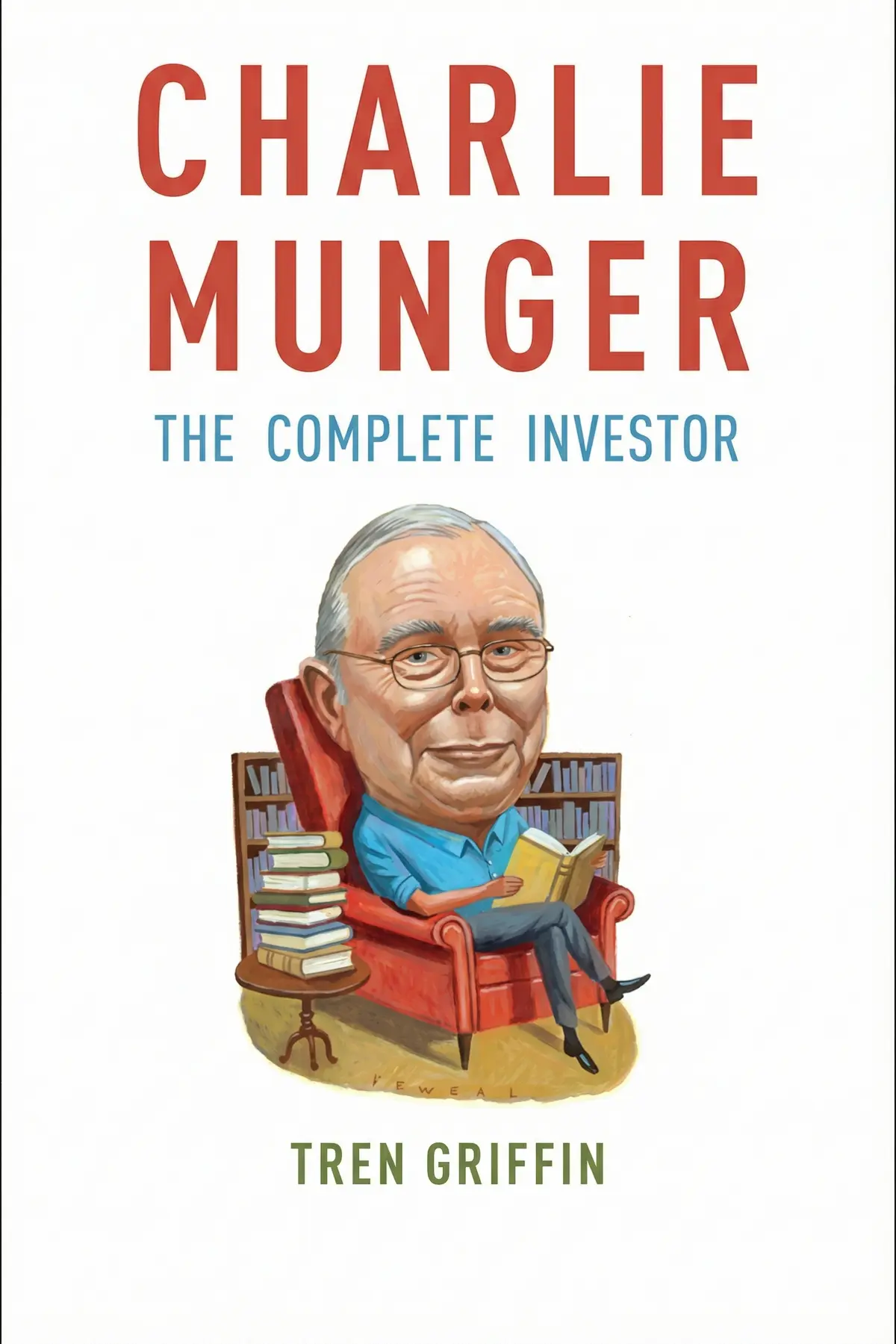
Table of Content
1. Introduction
1 min 03 sec
Many people invest the way they shop on a busy day: on impulse, following the crowd, trading whenever the news makes them nervous. In Charlie Munger: The Complete Investor, Tren Griffin shows that one of today’s most successful investors works almost the opposite way, and that his first habit is simply reading for most of his working day.
Munger, vice-president of Berkshire Hathaway and Warren Buffett’s longtime partner, does not claim any gift for business. Griffin’s case is that his record rests on a short set of habits anyone can learn: keep learning, stay inside what you understand, buy businesses for less than they are worth, wait with patience, act with courage when others panic, and think with ideas borrowed from many fields.
Each habit answers a mistake ordinary investors make every week. By the end, you will have a simple filter for any stock tip, a picture of the market as a moody partner, and a good reason to feel calm doing nothing for months.
2. Read your way to better investment decisions
1 min 55 sec
Two of the most successful investors alive spend most of their working day doing something that looks, from the outside, like no work at all. Their results suggest it may be the most productive habit they have.
3. Sort every opportunity into three baskets
1 min 51 sec
The most exciting deals are often the ones that quietly ruin investors. Berkshire Hathaway keeps a special place for opportunities that look wonderful, and the reason it rarely touches them is the heart of its method.
4. Buy a business, with room for error
1 min 38 sec
Most people look at a share price and ask where it will go next. Munger asks a different question first, and a simple picture from everyday driving explains why it protects him when he turns out to be wrong.
5. Turn Mr. Market's mood swings into bargains
1 min 54 sec
Imagine a business partner who some days begs you to take his assets cheaply and other days overpays for everything. Value investors deal with him constantly, and the real danger is catching his moods yourself.
6. Wait calmly, then act when others panic
2 min 03 sec
Busy people hate standing still, and markets punish them for it. A bus stop with no timetable and a baseball game without strikeouts show why the hardest skill in investing is doing nothing until the moment that counts.
7. Borrow ideas from many fields to see further
1 min 57 sec
A product gets more expensive and somehow sells better. An investor trained only in economics sees a warning sign and runs. One who has read more widely sees something else entirely, and keeps the money working.
8. Conclusion
1 min 16 sec
Griffin’s portrait takes the mystery out of Munger’s record. Behind Berkshire Hathaway’s $200 billion in yearly revenue there is no hidden formula, only a handful of habits held for decades: read constantly, stay inside what you understand, buy businesses at a discount, keep emotion out of the decision, wait without fidgeting and act when others are afraid. The striking thing is how ordinary each habit is, and how rarely people keep all of them at once.
That is good news for anyone with modest savings and no special talent. The habits cost time and temper, which anyone can spend. You can begin by guarding an hour a day for reading, and by sorting your next investment idea honestly into In, Out or Too Tough. Before you buy, run a short checklist that asks what the business is worth and how wide your margin of safety is. And when prices fall and the headlines turn dark, remember Klarman’s bus stop, and the fact that no one is ever called out for letting a pitch go by.
Mr. Market will keep swinging between gloom and joy. The investor who has done the reading only has to wait for him to offer a bargain.
About this book
What is this book about?
Many investors trade on impulse. They chase tips, follow the crowd and sell whenever the news turns dark. Charlie Munger, vice-president of Berkshire Hathaway and Warren Buffett's longtime partner, works in almost the opposite way, and Tren Griffin sets out to show how. Griffin's angle is that Munger's success is not a mystery. It rests on Benjamin Graham's value investing system, which Munger applies through four plain principles: treat a share as part ownership of a business, buy at a discount for a margin of safety, profit from the mood swings of Mr. Market, and stay rational with the help of a checklist. Around that system Munger adds a habit of reading for most of the working day, the patience to wait for bargains, the courage to buy when others are afraid, and worldly wisdom, a set of mental models drawn from psychology, history, mathematics, physics, philosophy and biology. Readers get a short, usable framework: sort ideas into In, Out and Too Tough, keep a safe distance between price and value, and treat market panic as an opening.
Book Information
Who it's for
New to investing
New investors who trade on tips and headlines and want a calm, simple system instead.
Long-term savers
Professionals building long-term savings who want to understand how Munger and Buffett think.
Wanting better decision habits
Founders and managers looking for better decision habits, from checklists to mental models.
About the Author
Tren Griffin
Tren Griffin has held a senior role at Microsoft. Before that he was a partner at Eagle River, a private equity firm that invested in telecommunications, software and other technology businesses. He has also worked as a consultant in Australia and Korea. He is the author of The Global Negotiator, a guide to negotiating across borders, and he runs the 25iq blog, in addition to his earlier consulting work in Australia and Korea.
Ratings & Reviews
Ratings at a glance

What people think
Listeners find the work stimulating and essential for investors, valuing the dense concentration of wisdom it provides. Furthermore, it earns praise for its helpful insights, and one listener observes that it functions as a good refresher course in Buffett/Munger methodology. The high frequency of quotes also enhances its status as a beneficial resource. On the other hand, the prose and ease of reading spark varied reactions, as some consider it clear and fast-paced while others disagree. Likewise, views on the author’s skill are divided, with some admiring the effort and others criticizing the writing style.
Top reviews
May
Finally finished this over the weekend and I’m genuinely surprised by how much I enjoyed the section on the psychology of human misjudgment. Most investing books focus purely on the numbers, but Munger and Griffin remind us that temperament and character are the real drivers of long-term success. The book outlines a recipe for a life well-lived: read constantly, learn from your mistakes, and don’t let envy dictate your financial decisions. I appreciated the emphasis on how compounding applies to knowledge just as much as it does to money. My only gripe is that the writing style feels a bit stiff, almost clinical at times, which contrasts sharply with Munger’s own blunt wit. Nevertheless, the wisdom here is undeniable and serves as a great reminder to keep things simple.
Show moreBun
As an investor who prefers the Graham-style approach, I found this to be an incredibly helpful refresher course on the basic tenets of the craft. Griffin captures the essence of why Munger is so mythical: he doesn’t just invest; he thinks in systems and probabilities. The book highlights how critical it is to buy at a significant discount to intrinsic value, a rule many modern traders have seemingly forgotten. Personally, I didn’t mind the high volume of quotes because Munger’s voice is so distinct and authoritative. The author serves more as a curator than a narrator here, which works if you’re looking for a reference guide. It’s not going to replace the 'Almanack,' but it’s a worthy companion for your bookshelf. It definitely makes you want to go out and read more, which is the highest praise.
Show moreChiw
Don't expect a fast-paced thriller, but if you want a serious concentration of wisdom, this is a must-read for any disciplined investor. The book focuses on the importance of building a latticework of mental models to avoid the standard traps of human psychology. I particularly liked the discussion on how envy, not greed, is what truly drives the world into financial bubbles. Griffin's tone can be a bit condescending in certain sections, as if he's the sole arbiter of what Munger intended, but the quotes speak for themselves. In my experience, the best way to read this is in small bursts so you can actually digest the logic behind the valuation techniques. It’s a dry read, certainly, but the lessons on discipline and stupidity avoidance are timeless. It will definitely help you refine your temperament for the next market crash.
Show moreCharlotte
Tren Griffin has essentially compiled a highlight reel of Charlie Munger’s most potent wisdom, focusing heavily on the Graham value investing philosophy. While some might find the sheer volume of quotes overwhelming, I found it to be a concentrated shot of financial discipline. It serves as an excellent refresher on concepts like the margin of safety and the importance of being objective when others are panicking. The structure is a bit disjointed, jumping from one insight to another, but the core message about temperament remains clear. Frankly, I think this works better as a desk reference than a cover-to-cover narrative. It’s not a biography, so don't go in expecting a life story; instead, expect a masterclass in how to think about capital and risk.
Show moreSam
Is this a biography? Not exactly, and that seems to be where a lot of readers get tripped up when they pick up this volume. If you are looking for a deep dive into Munger’s personal history, you should probably stick with 'Damn Right' or 'Poor Charlie’s Almanack.' Griffin’s approach is much more academic, focusing on the mental models and the 'latticework' of theory that Munger uses to evaluate businesses. To be fair, the author’s commentary can sometimes feel like a redundant echo of the quotes he just presented. I found the constant repetition of the term 'Graham value investors' to be a bit grating after the third chapter. Still, the underlying principles of avoiding stupidity and practicing extreme patience are worth the price of admission for any serious market participant.
Show moreArthit
The chapter on moats was worth the entire cost of the book for me, even though it was tucked away in the appendix. Griffin does a solid job of breaking down the Munger-Buffett methodology into digestible chunks, especially regarding the 'servant' role of Mr. Market. I’ve read a lot of value investing literature, and while this isn't the most original, it’s a very efficient way to internalize the core principles. Truth is, you could probably find most of this online, but having it all in one place makes for a great study guide. The focus on 'patient aggressiveness' is a concept I’ll be thinking about for a long time. It’s a short read, which is a blessing because it allows you to circle back and re-read the dense parts without feeling exhausted.
Show morePrapaiwan
What a concentrated dose of investment philosophy! I picked this up hoping for a quick overview of Munger's style and that is exactly what Tren Griffin delivered. The book is really about how to develop a model for life, emphasizing reading, health, and avoiding major catastrophes like excessive leverage. I loved the quote about Munger’s kids seeing him as a book with legs—it’s a perfect image for the lifelong learning he advocates. Not gonna lie, the writing style can be a bit robotic and the author repeats himself quite a bit throughout the chapters. However, the core principles of treating a share as a piece of a business are presented very clearly. It’s a high-value resource for anyone trying to stand on the shoulders of giants.
Show moreChatri
If you want to understand the difference between Fama & French factor investing and the classic Graham approach, this book provides a great starting point. It isn’t just about stock picking; it’s about the virtues of patience and the courage to act aggressively when the right opportunity finally appears. The formatting is a bit strange with the heavy reliance on external quotes, but the aggregate effect is a very powerful argument for a specific way of living. I’ve been following Griffin’s blog for a while, and you can see that same analytical DNA in these pages. Some people might find it too short, but I think the brevity helps keep the focus on the most important 'rules' of the game. It’s a solid effort that offers plenty of food for thought for the objective mind.
Show moreStella
Picked this up at the airport and it served as a decent way to kill a few hours during my layover. The content is essentially a 'Best Of' collection of Mungerisms, which is great, but the author's commentary doesn't add much value to the original quotes. Honestly, it feels like it could have been a long-form essay rather than a full book. To be fair, the section on the 'Psychology of Human Misjudgment' is well-handled and provides a good introduction to the concept of mental models. I just wish there was more original analysis or perhaps some fresh interviews to spice up the narrative. If you’ve already read the standard value investing classics, you might find this a bit redundant. It’s a fine entry point for beginners, but seasoned investors might find it a bit too thin on new insights.
Show moreGoy
Look, the writing here is pretty much what you'd expect from a specialized blog post stretched into a full-length book. I struggled with the formatting because it feels like a never-ending loop of quotes followed by a summary of that exact same quote. It’s a bit like watching a movie with a narrator who insists on describing every single action you see on the screen. While the content itself is top-tier—because Munger’s insights are always 5 stars—the delivery is clunky and lacks a cohesive narrative flow. The appendix on moats was actually more engaging than several of the main chapters, which felt repetitive. It’s fine for a quick skim if you want to refresh your memory on Ben Graham’s rules, but it’s not exactly a literary masterpiece.
Show moreQuestions about this book
What is the main idea of Charlie Munger: The Complete Investor?
Tren Griffin argues that Munger’s success comes from learnable habits, not investing magic. Munger follows Benjamin Graham’s value investing system, reads for most of his working day, stays within his competence, buys businesses below their worth, keeps emotion out of decisions, waits patiently and acts bravely when the crowd panics. He also uses worldly wisdom, a set of mental models drawn from many fields.
What are Charlie Munger's four investing principles?
Griffin describes four. First, treat a share as part ownership of a business and value the business first. Second, buy at a discount to create a margin of safety between price and intrinsic value. Third, stay on the right side of Mr. Market, the moody crowd that sometimes sells too cheaply and sometimes pays too much. Fourth, stay rational, using a checklist to catch emotional errors.
What does In, Out and Too Tough mean in investing?
It is how Berkshire Hathaway sorts possible investments under the Graham system. The In basket, always the smallest, holds opportunities worth pursuing. The Out basket holds uninteresting ones. The Too Tough basket holds deals that may look great but lie outside what Berkshire currently understands, so they are set aside. The method keeps investors inside their competence.
What is worldly wisdom according to Charlie Munger?
Worldly wisdom is Munger’s habit of thinking with mental models from many disciplines, including psychology, history, mathematics, physics, philosophy and biology. Griffin suggests learning each field’s core ideas and then connecting them. His example is a Giffen good: a product that sells more as its price rises because it feels exclusive, which a narrowly trained investor might misread as a reason to sell.
How can I apply Munger's ideas to my own investing?
Set aside daily time to read. Sort each idea into In, Out or Too Tough and only act on what you understand. Value the business before the share, and buy only with a clear margin of safety. Write a short checklist to keep mood out of the decision. Then be patient, avoid frequent trading that adds taxes and fees, and be ready to buy when others are fearful.
Featured in
Readers also enjoyed






AUDIO SUMMARY AVAILABLE
Listen to Charlie Munger in 15 minutes
Get the key ideas from Charlie Munger by Tren Griffin, plus 5,000+ more nonfiction titles.
- 5,000+ titles
- Listen as much as you want
- 7-day free trial
- Cancel anytime









