

14 min 25 sec
Available in: English
The All-or-Nothing Marriage: How the Best Marriages Work
Explains why modern marriages tend to be either deeply fulfilling or disappointing, and shows how time, attention, support for each other's growth and a protected sense of self push a relationship toward fulfilling.
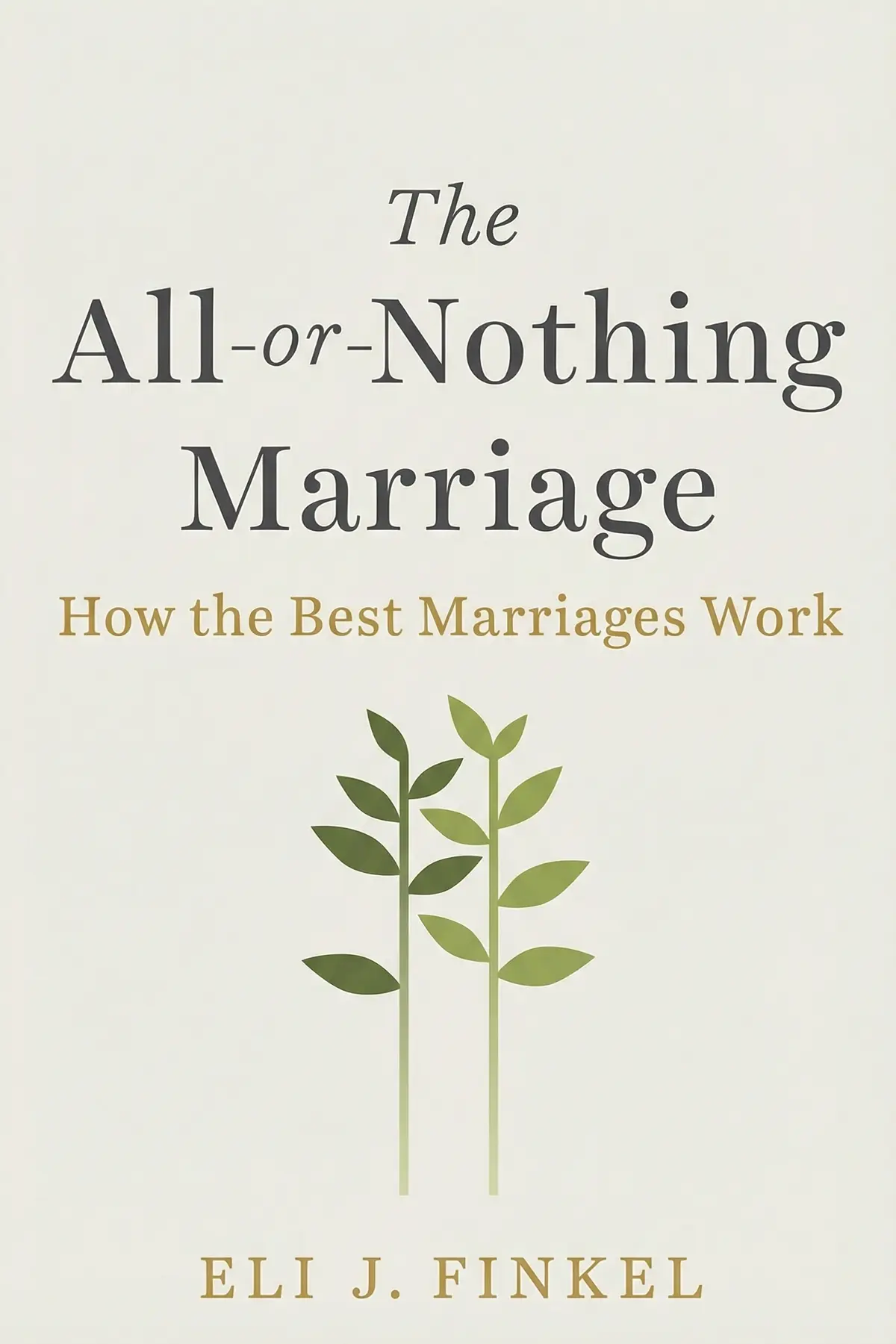
Table of Content
1. Introduction
58 sec
If your marriage feels like it should give you more than your grandparents ever asked of theirs, you are right, and that is both its promise and its danger. In The All-or-Nothing Marriage, Northwestern University psychologist Eli J. Finkel argues that couples now expect a spouse to be lover, closest friend and partner in personal growth. Marriages therefore land at the extremes: happier than ever when those needs are met, unhappier than in the past when they are not.
Finkel draws on a large body of relationship research to show that the difference comes down to effort. The strongest marriages today work like teams. They protect time together, pay real attention, back each other’s dreams and keep two distinct people inside one partnership. Along the way come a handful of tested exercises, from letting a compliment land to counting the hours a screen takes from you, that can move a relationship toward the all end of the scale.
2. Learn what makes modern marriages thrive or fail
1 min 45 sec
Your grandparents may not have seemed very fond of each other, and their marriage may have worked anyway. The reason reveals why modern couples can be happier than any before them, and why so many end up worse off.
3. Growth and commitment can share one marriage
1 min 59 sec
Many people fear that a wedding ring means giving up on themselves. The research says otherwise, with one odd twist: the most committed partners seem to see the rest of the world in a slightly distorted way.
4. Build compatibility instead of searching for it
1 min 42 sec
Dating sites match people on shared hobbies and tastes, yet that may be the wrong test entirely. Finkel points to a habit of mind, practiced early, that predicted which couples were still happiest years later.
5. Two short exercises that lift a doubting partner
1 min 37 sec
A jealous partner can accuse you of wandering even when you are fully devoted. One psychologist found a way to change what happens after a simple compliment, and another found a two-step way to feel more grateful.
6. Find the hours your marriage is missing
1 min 47 sec
Most couples say they have no time for each other. The numbers on how people estimate their working hours, and on how many hours vanish into screens, tell a very different story.
7. Keep a self that survives the relationship
1 min 40 sec
Some people in close couples cannot say whether they are introverts or extroverts. That small confusion explains why breakups can feel so devastating, and why millions of married people choose to keep separate homes.
8. Weigh an open marriage with clear eyes
1 min 49 sec
One couple’s experiment with an open marriage ended in divorce within a short time. Yet a survey of over 2,000 people found something few would predict about trust and jealousy in non-monogamous relationships.
9. Conclusion
1 min 08 sec
The All-or-Nothing Marriage leaves a hopeful but demanding message. Marriage has not become obsolete. It has climbed. Couples who once teamed up to survive now ask each other for love, self-expression and growth, and that higher aim pays off only for those who put time, attention and dedication behind it.
Finkel’s closing example is John Lennon. His first marriage, to Cynthia Powell, did not last as he moved deeper into a life of art and self-expression. With Yoko Ono, an artist in her own right who encouraged that side of him, he found a strong partnership. The point is less about fame than about fit: the best partner helps you become more fully yourself.
That suggests where to begin. Ask your partner what they hope to achieve in the coming years, and find one practical way to support it. Take back an hour a screen would otherwise claim, and spend it fully present with each other. When praise comes your way, let it land instead of brushing it aside. A modern marriage will not run on its own, but with that care it can be better than earlier generations could have hoped for.
About this book
What is this book about?
A few generations ago, people married mainly to survive: to run a farm, raise food and keep a household going. Today a single person can get by alone, so couples expect something else from marriage. They want a lover, a closest friend and a partner who supports their dreams. Psychologist Eli J. Finkel argues that these higher hopes make marriage all or nothing. Couples who meet them are happier than couples in any earlier era, and couples who fall short are unhappier than they would once have been. Finkel builds his case on relationship research, from studies of how committed partners rate strangers to data on how much time people lose to television. He shows that compatibility is built through sacrifice and generous admiration, that short exercises can lift a partner's self-esteem and gratitude, and that couples have more time for each other than they think. Readers also get his view on keeping an identity of their own, including why some married couples live apart, and what the data says about open relationships. The result is a practical guide for anyone who wants their marriage at the all end of the scale.
Book Information
Who it's for
Couples wanting more
Married or long-term couples who feel their relationship should give them more than it does.
Worried about partner time
Busy professionals who suspect work and screens are crowding out their partner.
Weighing big relationship choices
Anyone weighing big choices about independence, living apart or open relationships who wants research rather than opinion.
About the Author
Eli J. Finkel
Eli J. Finkel is a professor at Northwestern University, with posts in both the psychology department and the Kellogg School of Management. He has been described as an award-winning researcher of social relationships, has directed the university's Relationships and Motivation Lab and has published more than 100 scientific papers. He has also written often for the Op-Ed page of The New York Times.
Ratings & Reviews
Ratings at a glance
What people think
Listeners find the writing to be both articulate and intellectually stimulating, featuring research-backed insights and actionable advice for building successful relationships. They consider it an essential resource on marriage, with one listener highlighting the discussion on how personal self-esteem strengthens a union. While the historical context is widely praised as fascinating, views remain divided on the text's overall readability and accessibility.
Top reviews
Wararat
Finkel’s research-backed approach is a breath of fresh air in a genre usually filled with vague platitudes and anecdotal nonsense. This isn't just a list of 'do this, not that' tips; it's a profound examination of how healthy self-esteem and mutual growth nurture the modern bond. I loved the concept of the 'All-or-Nothing' marriage, which explains why the best marriages today are better than ever, while the average ones feel more precarious. The 'love hacks' are surprisingly effective because they are grounded in psychological data rather than just opinion. Not gonna lie, it changed how I perceive my own role in supporting my wife’s personal goals. This is easily one of the most important books on marriage I’ve read in the last decade. It’s thoughtful, provocative, and ultimately very hopeful about what a committed partnership can achieve.
Show moreApichat
As someone who appreciates a marriage book that treats the reader like an adult, I found this incredibly empowering. The concept that we can 'recalibrate' our expectations during difficult seasons instead of just giving up is a vital perspective for anyone in a long-term commitment. Finkel writes with a charismatic tone that makes the scientific data feel accessible and relevant to everyday life. I especially enjoyed the part about how we can help our spouses become their best selves; it framed marriage as a partnership in personal growth rather than just a legal contract. The historical context actually helped me feel less guilty about the high demands I place on my relationship. It turns out we are all just trying to navigate a new era of intimacy. Highly recommended for anyone who wants a smarter approach to love.
Show moreChloe
Ever wonder why modern marriages feel so much more high-stakes than those of our grandparents? Eli Finkel provides a fascinating deep dive into how we've climbed Maslow’s hierarchy of needs within our domestic lives. He argues that we used to marry for survival or economic stability, but now we seek self-actualization through our partners. It’s a compelling thesis, though the first 75% of the text feels more like a sociological history lesson than a guide. While the academic tone might be a bit much for some, the insights into how cultural shifts changed our expectations are eye-opening. The latter part of the book provides some solid, research-backed strategies that felt more grounded than your average self-help fluff. It’s a dense read, but worth it if you want to understand the 'why' behind the 'how' of modern relationships.
Show moreOrawan
Finally got around to reading this and I appreciate how Finkel doesn't sugarcoat the effort required to reach the 'summit' of a modern marriage. The data he presents suggests that while we ask more of our partners than ever before, the payoff for those who put in the work is unparalleled. I found the concept of the 'supply-and-demand' model of marriage very helpful for understanding why some seasons of life feel so draining. Sometimes you just have to descend the mountain and lower your expectations when resources are low. The book is heavily focused on the American experience, which is worth noting if you're looking for a more global perspective. Still, the strategies for 'investing additional resources' were practical and easy to implement. It’s a thought-provoking read that balances theory with a few actionable takeaways.
Show moreDao
The chapter on 'love hacks' actually provided some of the most practical, low-effort strategies I’ve seen in recent years. By focusing on how we attribute motives to our spouse's behavior, Finkel offers a way to shift the entire dynamic of a relationship without needing a three-hour therapy session. I liked the analytical approach to 'supply and demand' within a marriage; it takes the emotion out of it for a second so you can look at the logistics of your life together. The book is definitely a bit top-heavy with the history, and some might find the Maslow's mountain metaphor a bit tired. However, the core message about the potential of modern marriage is inspiring. It’s a well-researched, thought-provoking piece of work that offers a unique perspective on why we struggle the way we do.
Show moreSupachai
The truth is, this book feels like two different projects stitched together with varying degrees of success. While the academic exploration of the 'self-expressive' era of marriage is intellectually stimulating, the actual practical application felt somewhat thin. I appreciated the section on recalibrating expectations, but I found myself wanting more depth in the strategy department. To be fair, Finkel is an academic, so the writing style reflects that—it’s very well-written but can be quite dense and slow-moving at times. It’s a good overview for someone interested in the history of the institution, but it lacks the emotional resonance of something like Esther Perel’s work. I’d recommend it for the history, but don’t expect a total relationship transformation just from the few tips at the end. It's a solid 3-star read for the curious mind.
Show moreKanokwan
To be fair, if you aren't living in the United States, a lot of the cultural context here might feel a bit alien or irrelevant. Finkel focuses heavily on the American shift from pragmatic to romantic unions, which is interesting, but it ignores the global diversity of the institution. I read this as someone from a non-Western background and found the 'self-actualization' goals to be very individualistic. The writing is clear and the research is obviously top-tier, yet I struggled to connect with the 'love hacks' because they felt like small patches for much larger structural issues. It’s a well-constructed argument, but the 'all-or-nothing' premise seems to apply to a very specific socioeconomic class. I’d say it’s worth a skim for the data, but it didn't quite hit the mark for me personally.
Show moreAstrid
Not what I expected given the title, as I was looking for something more immediate and actionable for my own relationship struggles. It’s well-written and Finkel is clearly a brilliant guy, but I found myself constantly wishing he’d spend less time on the 1800s and more on the present. The middle section drags quite a bit with all the talk about Maslow’s hierarchy, which felt a little repetitive after the third chapter. When he finally gets to the 'love hacks,' they are actually quite good—especially the advice about seeing your partner’s actions through a positive lens. However, those gems are buried under a lot of academic scaffolding. It’s more of a sociological study than a self-help manual. If you have the patience for a slow build, you'll find some value here.
Show morePloy
Frankly, if you’ve already read Gottman or Sue Johnson, you’ve heard a lot of these insights before. Finkel does a decent job of synthesizing the current state of relationship science, but I didn't find much here that felt truly revolutionary. The 'love hacks' are essentially just reminders to be kind and attentive, which is useful but not exactly groundbreaking. The historical analysis is the strongest part of the book, but it takes up so much space that the actual 'how-to' feels like an afterthought. It's a bit of a kitchen-sink approach where he throws in every study he's ever conducted or read. It’s not a bad book by any means, but it’s definitely more for people who like to understand the theory behind things rather than those looking for quick fixes.
Show moreJoy
Look, I really wanted to like this, but the first three-quarters of the book is a dry history lesson that feels more like a sociology textbook than a guide for couples. The author spends way too much time on the evolution of marriage from the colonial era through the industrial revolution. I was looking for practical advice on how to fix my relationship, not a lecture on agrarian society and cultural shifts. By the time I finally reached the 'love hacks' in the last section, I was already checked out. Frankly, the advice provided—like giving your spouse the benefit of the doubt—felt incredibly basic and pedestrian compared to the work of John Gottman or Sue Johnson. If you want an academic history of marriage in America, buy this. If you want to actually improve your marriage, look elsewhere.
Show moreQuestions about this book
What is the main idea of The All-or-Nothing Marriage?
Eli J. Finkel argues that marriage has shifted from a survival partnership to a relationship expected to meet higher needs such as love, friendship and personal growth. Because those expectations are so high, marriages tend toward extremes. Couples who meet each other’s needs are happier than couples in earlier eras, while those who fall short are unhappier than they would once have been.
What does Eli Finkel mean by an all-or-nothing marriage?
He means that modern marriages rarely settle in the middle. Generations ago, couples on farms married mainly to secure food, clothing and shelter. Now a single person can manage alone, so spouses expect romance, close friendship, a fulfilling sex life and support for their dreams. Meeting those demands produces the best marriages ever seen; failing them produces worse ones than before.
How can couples apply the ideas in The All-or-Nothing Marriage?
Finkel suggests counting how many days you spend more than a couple of hours together and reclaiming time from television and phones. He recommends idealizing a broad quality in your partner, like kindness, and two short exercises: reflecting on compliments instead of dismissing them, and recalling meaningful things your partner has done to build gratitude. The book closes by urging you to support your partner’s dreams.
What does the book say about open relationships?
Finkel treats them as risky and in need of careful discussion. He describes a couple, Lana and David, whose open arrangement ended in divorce after David became anxious and depressed. Yet a 2012 study by Terri Conley of over 2,000 people found non-monogamous partners just as satisfied, loyal and passionate as monogamous ones, with slightly more trust and less jealousy.
Why do some married couples live apart, according to Finkel?
US Census Bureau figures from 2014 show three percent of married couples, about 3.5 million people, kept separate homes. Some do it for work, but many choose it to protect their individuality. Psychologist Birk Hagemeyer supports this for people with independent or avoidant personalities who are very sensitive to criticism, since they tend to do better living apart.
Readers also enjoyed

59 Seconds: Change Your Life in Under a Minute
Richard Wiseman




A Liberated Mind: How to Pivot Toward What Matters
Steven C. Hayes


Acting with Power: Why We Are More Powerful Than We Believe
Deborah Gruenfeld


All About Love: New Visions
bell hooks
AUDIO SUMMARY AVAILABLE
Listen to The All-or-Nothing Marriage in 15 minutes
Get the key ideas from The All-or-Nothing Marriage by Eli J. Finkel, plus 5,000+ more nonfiction titles.
- 5,000+ titles
- Listen as much as you want
- 7-day free trial
- Cancel anytime









