
11 min 18 sec
Available in: English
The 5 Choices: The Path to Extraordinary Productivity
A practical guide to doing important work without burning out. It covers how to tell urgent from important, give each of your roles a goal, plan the week and protect your energy.
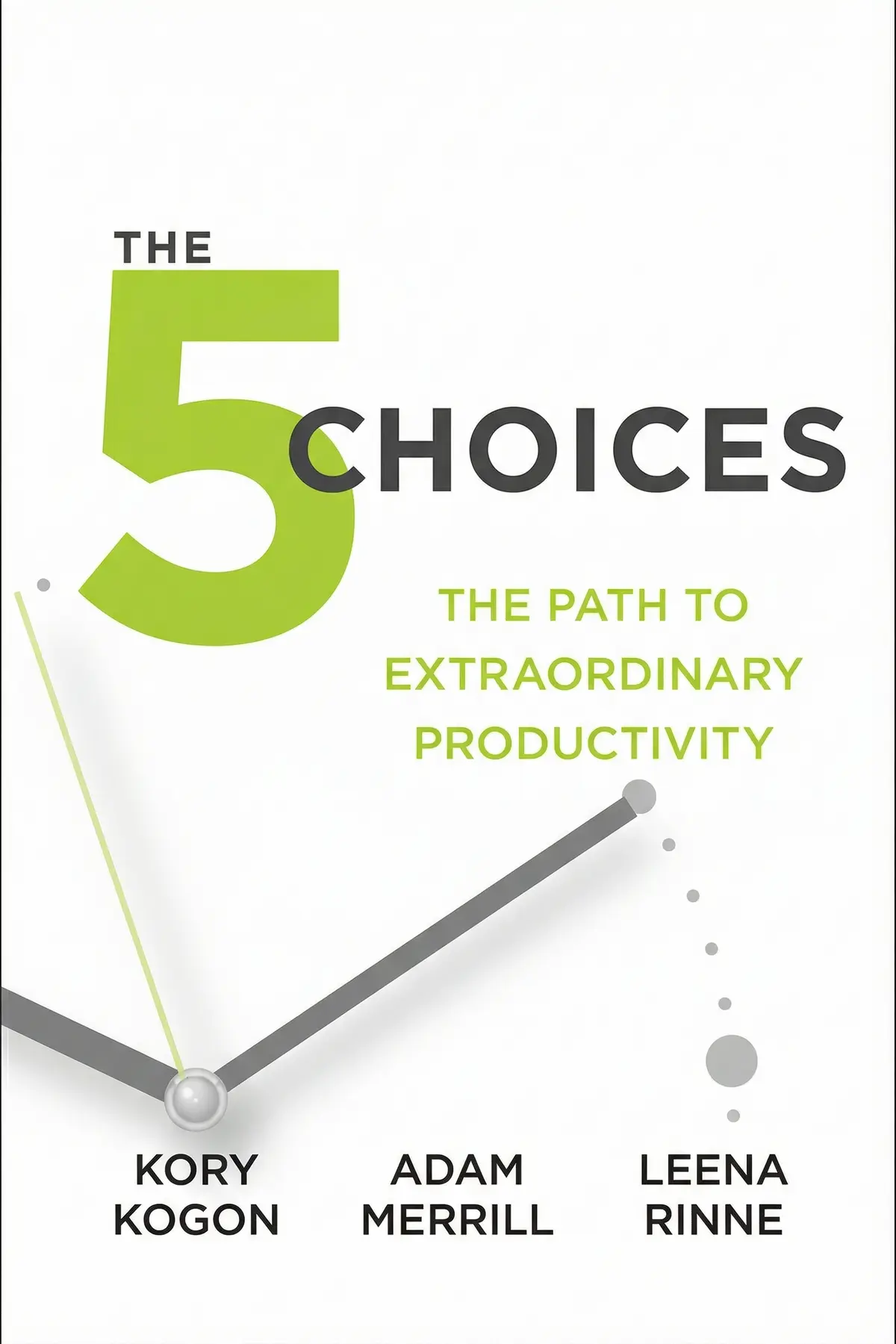
Table of Content
1. Introduction
1 min 01 sec
If your phone holds three productivity apps and your to-do list is still winning, the software may not be the problem. In The 5 Choices, FranklinCovey’s Kory Kogon, Adam Merrill and Leena Rinne argue that apps and gadgets make little difference for most people, because the real engine of productivity is the human brain. They define the goal as extraordinary productivity: getting important things done without burning out.
Their case is that this comes from a handful of deliberate choices. These cover what deserves your attention, what you plan for, how you handle the flood of information and how you look after the body that does the thinking. Tools come last, as servants of those choices.
Along the way you get a simple four-part map of your working hours and a weekly planning routine that fits into half an hour. You also get a way to stop the inbox from deciding your day, and a reminder that a tired brain undoes every system you build.
2. Spend your best hours on important, unhurried work
1 min 57 sec
Answering emails and putting out fires can make a day feel full and useful. The authors argue that this busy feeling is misleading, and they offer a three-step pause that keeps you on work that counts.
3. Give each role you play a clear goal
1 min 41 sec
Being told to focus on what matters is useless when your job is really three jobs pulling in different directions. A simple naming exercise turns that tug of war into a choice you can make each morning.
4. Move the big rocks before the gravel
1 min 53 sec
Even with a perfect plan, most people end the day having done the small, easy things. A landslide blocking a main road explains why, and points to a weekly routine that takes about half an hour.
5. Sort every input so tools carry the load
1 min 48 sec
Nobody would let a computer choose their career, yet many let their devices decide what they look at next. The authors show how to turn that around, starting with a simple way of sorting what comes in.
6. Feed the brain that does the work
1 min 52 sec
A flawless plan and a spotless inbox can still produce a wasted week. The authors trace the reason to a small organ with a large appetite, and to three sources of energy most busy people neglect.
7. Conclusion
1 min 06 sec
The 5 Choices turns productivity into a matter of judgment. The phone full of apps was never the missing piece. What was missing was a clear view of what matters, a plan that protects it, a system that keeps trivia out of the way and enough energy to think. The authors do not ask anyone to work longer or harder. They ask for better work aimed at the right things, and they hold that anyone willing to change can get there.
The landslide is the image worth keeping. Every week starts with boulders and gravel, and the gravel will always be easier to lift. Begin by booking 30 minutes this week to put your big rocks into the calendar, then set aside 10 minutes each day to adjust the plan. Before the next email pulls you away, pause long enough to ask whether it truly needs you now. And when the week gets heavy, keep the exercise and the decent meals, because a tired brain drifts toward the gravel no matter how good the plan is.
Clear the big stones first, and keep enough strength to lift them.
About this book
What is this book about?
Many professionals have tried app after app to get more done and noticed little change. Kory Kogon, Adam Merrill and Leena Rinne of FranklinCovey argue that the missing piece was never technology. Extraordinary productivity, which they define as accomplishment without burnout, comes from the human brain and from the choices it makes about time, attention and energy. The authors start with a four-part time matrix that separates urgent work from important work, and they argue that most of your hours belong to important tasks that are not yet urgent. From there they show how to give each role you play a title, a statement and a goal, how to plan the week around your biggest tasks, how to sort the information that floods in, and how to let filters and software take over the small decisions. They finish with the body. The brain burns a fifth of your energy, so purpose, movement and relationships decide whether any system works. Readers get a weekly planning routine, a quick test to use before opening an email, and a clear case for protecting their health on busy days.
Book Information
Who it's for
Inbox-heavy desk workers
Office workers who spend half the day in email and end it with the important work untouched.
Multi-role managers and specialists
Managers and specialists juggling several roles who need a way to choose between them.
Professionals stretched by deadlines
Busy professionals who drop sleep, food and exercise whenever deadlines pile up.
About the Author
Kory Kogon
Kory Kogon, Adam Merrill and Leena Rinne all work on productivity at FranklinCovey. Merrill, vice president of innovation, has spent more than twenty-five years studying time management worldwide, with a focus on technology and on how health shapes decisions. Kogon has led the firm's global productivity practice and brings long project management experience. Rinne is a senior consultant who helps organizations from Fortune 100 companies to small local businesses grow more productive and develop their leaders.
Ratings & Reviews
Ratings at a glance

What people think
Listeners find the writing accessible and appreciate its hands-on advice, with one listener noting it offers tips for instant progress. Additionally, the book helps increase efficiency, with one listener mentioning that it secures more time for significant priorities. Listeners also find it deeply influential, specifically for decision-making, and value its directness; one listener points out how it distills Covey methodology into brief, manageable chapters. They also prize the provided organizational resources and find the work to be a valuable investment.
Top reviews
Bella
This book provides a masterclass in prioritizing what actually moves the needle in your professional life. While much of the philosophy stems from the classic "Big Rocks" analogy, the authors modernize it for an era where we are drowning in digital noise. I found the distinction between the urgent and the truly important to be incredibly sharp. To be fair, some people might find the "Decision Management" section a bit basic, but for me, the clarity was exactly what I needed to stop sorting gravel and start focusing on extraordinary outcomes. It's a quick, punchy read that transforms abstract productivity concepts into a concrete roadmap for daily action. If you’re feeling buried by your inbox, this is the investment you need to make right now.
Show moreBunyarit
Finally got around to reading this, and the timing couldn't have been better for my career. The way Kogon and the team break down "Energy Management" changed how I view my afternoon slumps. Instead of just pushing through, I'm learning how to fuel my fire so I don't hit that wall of total burnout. The book is remarkably easy to navigate, with clear chapters that allow you to jump straight to the advice you need most. I’ve already implemented the email protocols they suggested, and I’ve regained at least an hour of my day. It's rare to find a business book that offers such immediate, tangible ROI for your personal time.
Show moreTantipat
After hearing my boss rave about this for months, I finally dived in and I’m so glad I did. The clarity with which they explain the "5 Choices" makes it easy to remember the principles even when you’re in the middle of a high-stress day. It has significantly improved my decision-making process, helping me distinguish between what needs a response now and what can wait. I’ve noticed a huge shift in my productivity levels since I started using their organization tools. Personally, it’s worth the investment just for the perspective shift on how we let technology rule our lives. Five stars for being practical, impactful, and genuinely helpful.
Show moreNum
Ever wonder why your to-do list never seems to get shorter despite working ten-hour days? "The 5 Choices" tackles this head-on by forcing you to evaluate your attention management. I particularly appreciated the section on ruling your technology instead of letting it rule you, which feels more relevant now than ever. The writing style is very accessible, though I will say it occasionally feels a bit like a corporate seminar in print form. Still, the practical tools for scheduling and the focus on "Fueling Your Fire" to avoid burnout are worth the price of admission. It’s a solid 4-star guide for anyone needing a structured system to regain control of their calendar.
Show moreWyatt
The chapter on "Decision Management" really hit home for me during a particularly chaotic month at work. It’s so easy to get sucked into the "Urgent" quadrant and lose sight of the "Important" goals that actually define our success. I love how the book provides specific organization tools to help you filter out the noise. Gotta say, the layout is beautiful and makes the information very easy to digest during a commute. My only minor gripe is that the section on technology feels a bit dated in the age of Slack and Teams, but the underlying principles still hold up. It’s a practical, high-yield read for the modern professional.
Show moreRatchanee
As someone who has always struggled with saying "no" to trivial requests, Choice 1 was a total wake-up call. The authors do a fantastic job of explaining why we feel the need to react to every ping and buzz on our phones. This isn't just about time management; it’s about taking ownership of your mental bandwidth. I found the advice on "Scheduling the Big Rocks" to be a helpful reminder to protect my deep-work blocks. In my experience, the book is a bit wordy in the middle, but the overall framework is incredibly robust. It’s a great jumping-off point for anyone looking to transition from being "busy" to being truly productive.
Show moreChiw
Truth is, I wasn't looking forward to another productivity book, but this one actually managed to surprise me. The authors move beyond simple list-making and dive into the psychology of how we make choices under pressure. I especially liked the emphasis on going for the "Extraordinary" rather than just checking boxes to stay afloat. The writing is clear and the steps are actionable, making it feel less like a lecture and more like a coaching session. While some of the email tips are a bit basic, the overall structure of the book provides a solid foundation for anyone feeling overwhelmed by their current workload.
Show moreSavannah
Picked this up as a mandatory read for a management retreat, and it’s essentially FranklinCovey 2.0. If you’ve never encountered the four-quadrant approach or the "rocks and sand" story, you will likely find this life-changing. However, for those of us who have lived through several cycles of productivity training, there isn’t much "new" substance here to chew on. The authors do a great job of condensing complex time management theories into five digestible choices, but the fluff level is high. Frankly, it could have been a long-form article rather than a full book. It's a decent refresher, but don't expect a revolutionary breakthrough if you're already a productivity geek.
Show moreMalee
Look, "The 5 Choices" is a perfectly fine introductory text for someone new to the workforce. It condenses the famous Covey methodology into something more modern and bite-sized, which I appreciate. That said, if you’ve read The 7 Habits of Highly Effective People, you’ve already seen about 80% of this material before. The "Gravel vs. Rocks" metaphor is a bit played out at this point, isn't it? I did enjoy the focus on physical and mental energy, which is often overlooked in these kinds of books. It’s a quick read, but I’m not sure it deserves all the "game-changer" hype it gets on LinkedIn.
Show moreChai
Not what I expected at all, especially given the high praise it often receives in corporate circles. To be blunt, the tone of the writing is incredibly patronizing, often treating the reader like a child who has never seen a calendar before. While the core message of "don't settle for ordinary" is fine, the book is bloated with repetitive anecdotes and corporate speak that adds very little value. It feels like a 200-page advertisement for a consulting firm rather than a genuine self-help tool. If you want real depth on organization, you are much better off reading David Allen’s Getting Things Done. This one is just too surface-level for my taste.
Show moreQuestions about this book
What is the main idea of The 5 Choices?
Kory Kogon, Adam Merrill and Leena Rinne argue that productivity apps rarely make much difference, and that extraordinary productivity, meaning accomplishment without burnout, comes from the brain’s choices. Those choices cover focusing on important but non-urgent work, defining roles and goals, planning the week around the biggest tasks, organizing incoming information so tools can handle trivia, and managing your energy through purpose, movement and relationships.
What are the four quadrants in The 5 Choices?
The time matrix splits work by importance and urgency. Quadrant one is important and urgent, like emergencies. Quadrant two is important but not urgent, like preparing next week’s strategy report. Quadrant three is urgent but unimportant, like constant inbox checking. Quadrant four is waste, such as phone games. The authors say most of your time should go to quadrant two, where focused thinking happens.
What is the Pause, Clarify, Decide method?
It is a quick check that keeps you on important work. Before opening a new email or reacting to a request, you stop for a moment and ask who it is from, what it concerns and whether it needs immediate action. If it does not, you leave it and return to the important task you had planned instead of letting the message take over.
How do you apply The 5 Choices to weekly planning?
Keep a Master Task List for the coming week. Schedule your biggest, most important tasks first as blocks of time, then leave space each day for the smaller urgent items that always appear. The authors recommend 30 minutes of planning each week and 10 minutes each day, so the list stays current and you keep your appointments with yourself.
What does The 5 Choices say about energy and health?
The authors note that the brain uses 20 percent of the body’s energy while making up two percent of its mass, so no system works without energy management. They name three sources: a strong sense of purpose, a body that moves instead of sitting all day, and healthy relationships. They advise keeping exercise and good eating going even in busy weeks.
Readers also enjoyed



AUDIO SUMMARY AVAILABLE
Listen to The 5 Choices in 15 minutes
Get the key ideas from The 5 Choices by Kory Kogon, plus 5,000+ more nonfiction titles.
- 5,000+ titles
- Listen as much as you want
- 7-day free trial
- Cancel anytime









