

15 min 11 sec
Available in: English
 ไทย
EnglishไทยThe 12 Week Year: Get More Done in 12 Weeks than Others Do in 12 months
Shows how to replace the annual plan with a 12-week cycle. Deadlines start to feel close, each week is built around the actions that matter, and a weekly score tells you early whether your goal is on track.
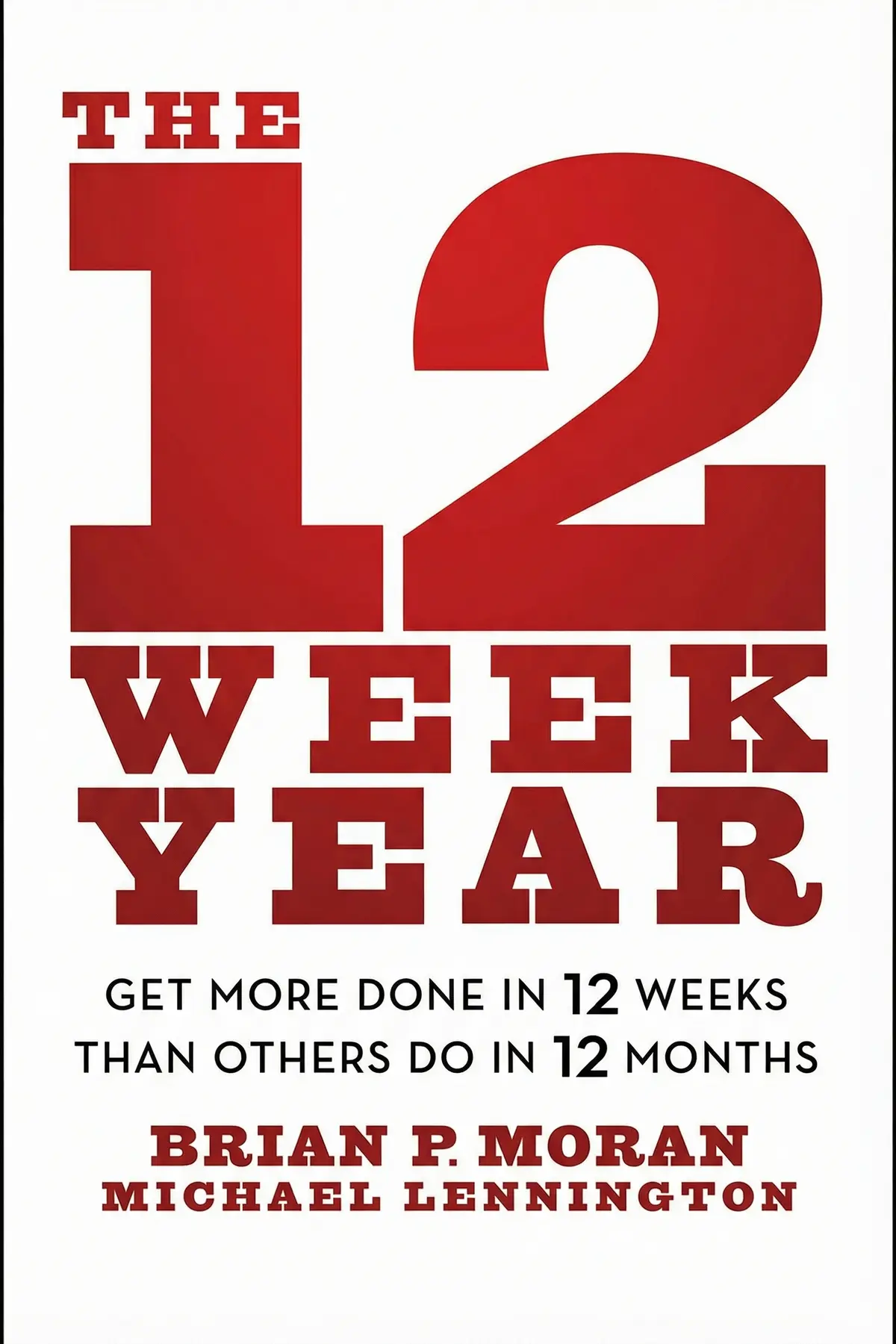
Table of Content
1. Introduction
1 min 06 sec
Most people who fall short of their goals already know what to do. What they lack is the habit of doing it week after week. In The 12 Week Year, executive and coach Brian P. Moran and his co-author Michael Lennington argue that the fix starts with the calendar. A year is too long to feel urgent, so we coast for months and scramble at the end. Shrink the year to 12 weeks, and the deadline is always close enough to feel.
The case they build is that results improve when a short cycle replaces the annual plan, and when that cycle runs on a clear vision, a simple plan, protected time, a weekly score and honest ownership. Each piece removes one reason good intentions stall. The examples range from a Houston financial advisor who raised her output by 400 percent to heart patients who were far more likely to change their habits with a group behind them. The method ends with a way to turn next quarter’s goal into this week’s calendar, and a number that shows each week whether it is working.
2. Turn what you already know into results
1 min 42 sec
Thousands of diet books, a giant fitness industry, and most people still struggle with their weight. The same puzzle shows up at work, and one financial advisor solved it without changing her strategy at all.
3. Bring the year-end rush into every week
1 min 39 sec
Sales teams often do their best work in the final weeks of the year. That burst of effort reveals something uncomfortable about the other eleven months, and about the calendar most of us plan by.
4. Draw a ten-year picture that pulls you forward
1 min 34 sec
After key staff walked out with clients and revenue, one business owner found his way back in an unlikely place. What he saw there changed the question he was asking about his company.
5. Write a plan you can follow day by day
1 min 39 sec
Many capable people skip planning because they already know what they should do. The authors think that confidence is exactly what lets the day slip away, one small demand at a time.
6. Protect three hours for the work that counts
1 min 29 sec
Inbox, voicemails and that unpaid invoice always seem to come first, and the important proposal waits. Research on office interruptions puts a weekly price on that habit, and it is larger than most people guess.
7. Stay on course after the first hard hit
1 min 35 sec
Even an Olympic champion has mornings when training is the last thing he wants. What gets him to the pool anyway is something ordinary people can copy, and a study of heart patients shows how much it matters.
8. Score your actions to predict your results
1 min 34 sec
Most people track the outcome they want and wait to see what happens. The authors track something else, and they say one percentage tells you early whether your 12-week goal will land.
9. Own your results instead of blaming circumstances
1 min 39 sec
Busy months and stressful exams make perfect excuses, and most of them are partly true. A young wrestler’s story shows why the excuse still costs more than the circumstance does.
10. Conclusion
1 min 14 sec
The 12 Week Year is finally a book about the length of a deadline. Most people already have enough ideas. What they lack is a structure that makes an ordinary Tuesday in March feel as pressing as the last week of December. Moran and Lennington build that structure by shrinking the horizon, then filling it with parts that each remove an excuse: a picture worth aiming at, a plan short enough to trust, hours that interruptions cannot reach, a weekly score, people who will ask about it, and the habit of owning whatever the score says.
The authors insist the system works only if you commit to it, and the first step fits into today. Write your ten-year and three-year picture, pick a goal for the next 12 weeks, and list the few actions that drive it. If an action looks too big, break it into smaller steps. The authors cite research that people who see a goal as manageable are more likely to reach it, and visible progress keeps you moving. Then book one strategic block this week and score yourself when it ends.
Durso’s fireweed grew out of ashes. Your next twelve weeks can start from wherever this year has left you.
About this book
What is this book about?
Most people have more good ideas than they will ever use. What holds them back is acting on those ideas consistently, week after week, long after the January enthusiasm fades. Brian P. Moran and Michael Lennington argue that the annual calendar itself is part of the problem. With December far away, nobody feels urgency until the final push. Their answer is to treat every 12 weeks as a complete year. The method starts with a long-range vision and a 12-week plan made of a few specific, measurable actions. Those actions go into weekly plans, protected blocks of time and a weekly meeting with peers. A simple score tracks how many of your planned actions you actually finished. Readers get a working system for turning a goal into this week's calendar. The book explains why interruptions cost professionals more than ten hours a week, and why completing 85 percent of planned actions predicts success. It also shows how owning your results, instead of blaming circumstances, turns every bad week into useful feedback.
Book Information
Who it's for
Sales and consulting professionals
Salespeople, advisors and consultants whose numbers swing between slow months and frantic year-end pushes.
Leaders with drifting goals
Founders and managers with big annual goals that drift by spring.
Losing hours to interruptions
Professionals who lose their best hours to email and interruptions and want a weekly system to measure real progress.
About the Author
Brian P. Moran
Brian P. Moran has 30 years of experience as a corporate executive, entrepreneur, consultant and coach, including management and executive roles at UPS, PepsiCo and Northern Automotive. He noticed that people rarely lack ideas but struggle to carry them out, and he built the 12 Week Year method to close that gap. He founded and led the 12 Week Year company and has consulted for dozens of firms. Michael Lennington has spent nearly four decades on the same problem and has written four books, including Uncommon Accountability.
Ratings & Reviews
Ratings at a glance

What people think
Listeners find this title to be a high-quality, brief listen that delivers fantastic techniques and is extremely beneficial for building doable roadmaps. Furthermore, the content transforms their perspective on reaching milestones and assists with both professional and private objectives. They also value the direct style, which keeps the material simple to grasp, and its capability to make success much more probable.
Top reviews
Nuk
Finally got around to reading this productivity classic, and it completely reframed how I view my calendar. The core idea is that 12 months is far too long to maintain focus; by the time October rolls around, you’ve already forgotten your January resolutions. Moran shifts the horizon to 12 weeks, which creates a permanent sense of urgency without being overwhelming. To be fair, some sections feel repetitive, but the 'model week' and the emphasis on measuring execution over results are game-changers. I’ve started implementing the strategic blocks—three-hour chunks of uninterrupted work—and my output has already spiked. If you are tired of the 'New Year, New Me' cycle that never delivers, this is the tactical manual you need. It’s a straightforward approach that makes success feel like a series of small, winnable battles rather than a marathon with no finish line in sight.
Show moreElise
Ever wonder why you're more productive in December than any other month? This book captures that 'year-end' energy and bottles it into a repeatable system. I love the focus on 'intentionality.' We often spend our days reacting to emails and notifications, but Moran argues for a 'model week' where you guard your time like a hawk. The distinction between 'lead indicators' and 'lag indicators' is a crucial mindset shift for anyone in sales or management. Not gonna lie, I was skeptical about the 12-week timeframe at first, but it forces you to confront your lack of execution immediately. You can't hide behind a nine-month buffer anymore. This is a must-read for high achievers who want to stop dreaming and start doing.
Show moreSuthinee
Wow, I didn’t expect a business book to resonate so deeply with my personal fitness goals. While the authors primarily target professional performance, the logic applies to everything from marathons to learning a new language. Gotta say, the focus on 'counting the cost' before you commit is a refreshing take on discipline. It isn't just about 'RA-RA' motivation; it’s about the tactical 'how-to' that many other self-help books miss. The writing style is direct and no-nonsense, which I appreciate. By the time I reached the chapter on 'Process Control,' I was already mapping out my first 12-week cycle. It’s an awesome strategy for anyone who wants to see tangible results quickly. This book definitely changed my mindset about what is possible in a short period of time.
Show moreArjun
The chapter on accountability changed my entire perspective on what it means to take ownership. In my experience, most people view accountability as a punishment, but Moran explains that it is actually a mindset of personal responsibility. I’ve been using the 12-week cycle for two months now, and I’m already hitting benchmarks I thought would take me until next year. The book is very helpful for developing manageable plans that don't just sit on a shelf gathering dust. It forces you to be honest about your 'keystone actions'—those few tasks that actually drive 80% of your results. If you are serious about your personal growth, this provides a clear, actionable roadmap. It’s not just a book; it’s a system for continuous improvement.
Show moreMoon
The concept is undeniably brilliant, even if the execution of the writing feels a bit padded at times. I appreciate how the authors break down the 'execution gap'—the space between what we know we should do and what we actually do. Instead of just 'working harder,' the 12 Week Year asks you to score yourself every week. Truth is, striving for that 85% completion rate on plan tactics is much more motivating than chasing a distant end-of-year revenue goal. The book uses several weight loss analogies which help simplify the complex planning phases, though I wish there were more diverse business case studies. Success is more likely when you have a feedback loop. You could probably get the gist in 50 pages, but the repetition helps cement the habit in your mind. It’s a solid 4-star read for anyone needing a structured system to stay on track.
Show moreOrm
As someone who has always struggled with long-term goal setting, this book provided a much-needed framework that actually feels attainable. Personally, I think the 12 Week Year isn't just a marketing gimmick; it’s a psychological hack. When you treat every week like a month, your focus sharpens, and low-value activities naturally fall away because you simply don't have the luxury of wasting time. I found the 'Breakout Blocks' especially helpful—intentional free time to prevent burnout. My only gripe is that it occasionally feels like a sales pitch for their online services, but the core methodology is strong enough to stand on its own. It turns the daunting task of annual planning into a manageable, 12-week sprint. It’s straightforward, effective, and highly recommended for entrepreneurs who feel stuck.
Show moreLena
Picked this up on a recommendation from my manager, and while some parts felt like a repeat of Grant Cardone’s ideas, the tactical side is far superior. Where other books tell you to 'think big,' this one tells you exactly how to schedule your Tuesday morning to ensure you actually reach that 'big' goal. In all fairness, the scoring system is a bit rigorous, but it provides the feedback loop necessary to adjust your plan before it's too late. To be fair, the weight loss examples are a bit dated, and the tone can be somewhat dry. However, the effectiveness of the 12-week 'year' is undeniable for both business and personal life. It makes success feel less like luck and more like a deliberate process of execution.
Show moreGor
Frankly, this could have been a long-form blog post or a pamphlet. I don't mean that the advice is bad—it’s actually quite effective—but the authors repeat the same three or four points for nearly 200 pages. It felt a bit like a middle school book report where the student is trying to hit a word count. However, the section on 'Accountability' was surprisingly profound; it’s not about external consequences but about taking personal ownership of your choices. If you can move past the repetitive nature of the text, there are real gems here regarding time use and 'buffer blocks' to handle low-value tasks. I’d recommend skimming the middle sections or finding a summary if you’re short on time. It’s a useful tool, but be prepared for a bit of a slog through the fluff.
Show moreFon
Look, the core advice here is gold, but you have to dig through a lot of fluff to find it. I gave it three stars because while the 12-week structure is a fantastic way to boost urgency, the book is incredibly repetitious. It feels like the authors were trying to justify the price tag by adding unnecessary pages. That said, the 'strategic blocks' concept is worth the price of admission alone. I also liked the part about moving from 'informed pessimism' to 'informed optimism'—it’s a realistic look at the emotional cycle of change. If you are the type of person who needs constant reinforcement to stay on track, you might enjoy the repetitive style. For me, a more condensed version would have been much more effective for my business planning.
Show moreLincoln
Not what I expected at all given the hype. I found the book to be incredibly oversimplified and, quite honestly, a bit of a bore to read. The authors take a single, decent idea—shortening your goal-setting cycle—and stretch it out until the original point is almost lost in the wordiness. I felt like I was being pitched a subscription service for their website every other chapter. If you've read standard productivity blogs from the last decade, you've already heard 90% of what's in here. I struggled to finish it because the narrator on the audio version was so dry and monotonous. Save your money and just read a summary online; you'll get the same value in five minutes that I got in five hours of listening to this repetitious sales pitch.
Show moreQuestions about this book
What is the main idea of The 12 Week Year?
Brian P. Moran and Michael Lennington argue that people fall short through weak execution, not a lack of ideas. Annual planning makes the deadline feel far away, so urgency only appears at year’s end. Treating every 12 weeks as a full year keeps the deadline close. The cycle then runs on a long-term vision, a short plan of measurable actions, protected time, weekly scoring, peer meetings and a sense of ownership over results.
How do you create a 12-week plan?
Start from a vision written for ten years and for three years ahead. Then choose goals for the next 12 weeks that move you toward it, such as bringing in $110,000 of new business on the way to selling your company. List a small number of specific, measurable actions, like calling ten prospects a week, and avoid overthinking the plan. Each week, pull the actions due into a weekly plan.
What are lead and lag indicators in The 12 Week Year?
A lag indicator is the end result you want, such as weekly weight loss when the goal is to lose ten pounds. Lead indicators are the actions that produce it, such as miles run or calories eaten. The authors stress lead indicators: in their experience, completing 85 percent or more of your planned weekly actions makes reaching your 12-week goal very likely.
What are strategic, buffer and breakout blocks?
They are three kinds of protected time. A strategic block is three uninterrupted hours for the work that moves your goals, such as sales calls or proposals. A buffer block, an hour once or twice a day, handles emails, voicemails and colleagues in one go. A breakout block is three hours a week, during working hours but away from the business, to stay fresh. The authors suggest scheduling these first.
Who should read The 12 Week Year?
It suits professionals who have plenty of goals but struggle to follow through, especially those in sales, financial advice or running a business, where results can be counted. It also helps anyone who loses large parts of the week to interruptions, or who tends to abandon goals after a few hard weeks. The method is built around plans and weekly scores, so it rewards readers willing to measure themselves honestly.
Readers also enjoyed



AUDIO SUMMARY AVAILABLE
Listen to The 12 Week Year in 15 minutes
Get the key ideas from The 12 Week Year by Brian P. Moran, plus 5,000+ more nonfiction titles.
- 5,000+ titles
- Listen as much as you want
- 7-day free trial
- Cancel anytime









