
13 min 46 sec
Available in: English
Testing Business Ideas: A Field Guide for Rapid Experimentation
Shows how to turn a business idea into testable hypotheses, run quick and cheap experiments, and weigh customer evidence by what people do and pay, so you learn what works before investing heavily.
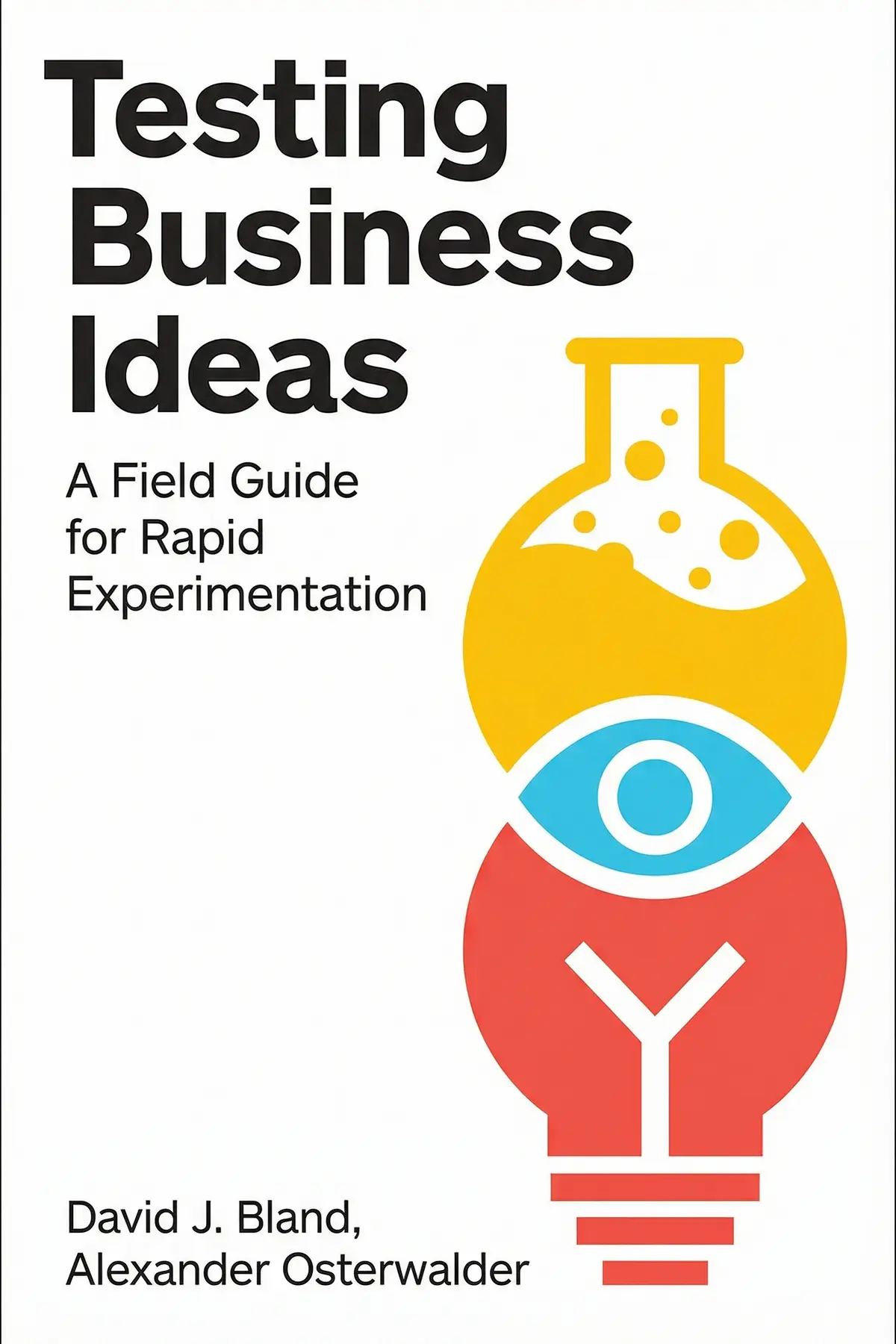
Table of Content
1. Introduction
1 min 02 sec
Most new ventures go wrong long before launch day, at the moment someone mistakes a hunch for a fact. In Testing Business Ideas, startup advisor David J. Bland and Business Model Canvas co-inventor Alexander Osterwalder argue that a bright idea is really a bundle of assumptions. Each of those assumptions can be checked quickly and cheaply before anyone bets serious money on it. Fortune may favor the bold, they suggest, but it favors people who test even more.
Their method turns guessing into a routine. You map the idea, rewrite its riskiest beliefs as statements that could be proven false, run small experiments and judge the evidence by what it cost people to give it. A customer’s praise counts for little. A customer’s money counts for a lot.
The chapters ahead show how to write a hypothesis sharp enough to fail, which experiments to run first, how to separate strong data from weak, and which team habits keep the testing honest.
2. Sketch your whole business on one page
1 min 37 sec
Most founders fall for their first idea and start building. Two simple worksheets show where that idea is weakest, before a single dollar is spent finding out the hard way.
3. Turn hunches into claims you can prove wrong
1 min 44 sec
A belief like customers will love this feels solid until you try to check it. The authors show why most business beliefs cannot be tested as written, and the small rewrite that changes that.
4. Trust what customers do over what they say
1 min 46 sec
Ask people whether they like your idea and most will say yes. The authors explain why that yes tells you so little, and which kind of answer deserves your trust.
5. Learn the most from the cheapest tests first
1 min 35 sec
In the earliest stage, even shaky evidence can be worth collecting. Two inexpensive methods tell you where your idea fits customers and where they quietly walk away.
6. Confirm your direction is right before you scale
1 min 40 sec
Picking a concept feels like the finish line, so many teams stop testing exactly there. The authors argue a second, harder round begins, and it asks customers for more than their opinion.
7. Build a team that tests without ego
1 min 40 sec
The same experiment can give honest or misleading results depending on who designs it. The authors describe the mix of skills, backgrounds and habits that keeps a team from fooling itself.
8. Escape the traps that stall experiments
1 min 38 sec
Some teams test too little, others debate endlessly and never test at all. A four-word phrase from a technology forecaster captures the attitude that avoids both mistakes.
9. Conclusion
1 min 04 sec
What Bland and Osterwalder offer is a new relationship between a person and their idea. The idea stops being a bet to defend and becomes a list of guesses to check, each small enough to test this month. In their view one good idea is never enough. You need many, a careful choice among them, and experiments cheap enough that being wrong costs little.
The habits are concrete. Take your riskiest belief and write it as a We think that statement with a number in it, then tag it as a matter of desirability, feasibility or viability. Decide what success looks like before you see any result. When people praise a concept, find out what they have paid for or done, and give that answer more weight than the praise. And protect a few hours every week for testing, so learning never waits for a free afternoon.
None of this makes a founder less bold. It means their boldness finally rests on something solid: evidence that customers chose to give, often with their own money.
About this book
What is this book about?
Plenty of entrepreneurs rush a product to market on the strength of one exciting idea and a few encouraging conversations. David J. Bland and Alexander Osterwalder argue that this is gambling. Until it has been tested, an idea is only a set of assumptions about customers, costs and capabilities, and any of them could be wrong. Their field guide replaces the gamble with a routine. First, map the idea on the Business Model Canvas and the Value Proposition Canvas. Then rewrite your riskiest beliefs as precise hypotheses that a test could prove false, and run small experiments to check them. Early discovery tests such as customer interviews and web traffic analysis show you which way to go. Later validation tests such as a single feature MVP or a crowdfunding campaign tell you whether that direction holds. Running through all of it is one rule about evidence: facts beat opinions, and behavior in the real world beats anything said in a focus group. The authors also cover the team behind the tests and the mindsets that stall them. Readers come out with a repeatable way to find out whether an idea is desirable, feasible and viable before they spend serious time and money on it.
Book Information
Who it's for
Entrepreneurs wanting proof first
Founders and solo entrepreneurs who want proof that customers will pay before they build or launch.
Innovators and product teams
Corporate innovators and product teams who need a repeatable way to test new products and services.
Team leads wanting experiments
Team leads who want their meetings to settle arguments with experiments instead of opinions.
About the Author
David J. Bland
David J. Bland is a founder, author and advisor in Northern California. In 2015 he created Precoil, which helps companies test new products and services, and he has worked with GE, Adobe, Toyota, HP and Behr after more than 10 years scaling technology startups. Alexander Osterwalder holds a doctorate from HEC Lausanne. With Yves Pigneur he invented the Business Model Canvas and the Value Proposition Canvas, and in 2010 he co-founded the strategy company Strategyzer.
High-Impact Tools for Teams: 5 Tools to Align Team Members, Build Trust, and Get
Stefano Mastrogiacomo
Ratings & Reviews
Ratings at a glance

What people think
Listeners find the book to be an excellent resource for validating concepts, praising its clear and practical descriptions. Furthermore, the material is top-notch, with one listener mentioning it functions as a superb supplement to The Strategyzer Series. The text is also accessible and stimulating; one review points out that it assists in concentrating on urgent problems. Conversely, several listeners describe problems with the physical construction, noting that the binding fails and pages detach after just a single reading.
Top reviews
Yongyut
Finally got around to reading this, and it is easily one of the most practical business books I own. Most 'startup' literature is just 300 pages of anecdotes, but this is a legitimate field guide. It provides a structured way to move from a vague concept to a validated business model without wasting thousands of dollars. The toolkit of experiments is vast, covering everything from simple landing pages to complex concierge tests. To be fair, you won't become an expert in every method overnight, but having this roadmap is a total game changer for my current project.
Show moreLeah
The chapter on experiments alone is worth every penny. For years, our team struggled to move beyond basic user interviews, but Bland and Osterwalder provide a literal menu of options like card sorting and boomerang tests. It is incredibly thought-provoking and helped us pivot away from a feature that would have been a total dud. I love the way the authors break down the cost and strength of evidence for each test type. It’s simple, visual, and highly effective for teams that need to stop arguing and start testing.
Show moreMattanee
As a product manager working in a massive corporate environment, I often find 'lean' books to be totally disconnected from my reality. This one is different. It provides a clear, step-by-step path for testing ideas even when you're dealing with internal stakeholders and high levels of risk. The graphs and tables are not just window dressing; they are functional tools that I’ve already started using in my weekly strategy meetings. It’s easy to read but manages to stay intellectually stimulating throughout the entire 300+ pages.
Show moreNum
Stop guessing what your customers want and just buy this book. It’s remarkably rare to find a guide that is this simple to digest while remaining so useful for actual product development. The way it helps you map out uncertainty and then choose the right experiment to mitigate that risk is brilliant. We used the storyboard techniques last week, and the clarity it brought to our team was immediate. It’s a must-read for anyone who is serious about bringing a new product to market successfully.
Show moreOoi
I picked this up during a particularly frustrating phase of my startup journey and it provided the exact framework I was missing. The diversity of testing methods—from low-fidelity mockups to high-fidelity pilot programs—is impressive. Frankly, I wish I had discovered this two years ago before I wasted time on features nobody wanted. It's become my go-to reference book. The physical design is gorgeous, though I do worry about the binding holding up over time given how often I'm flipping through it.
Show moreFelix
Everything about this guide screams 'practicality.' It doesn't just suggest that you should test your ideas; it shows you exactly how to do it with clear pros and cons for every single method. It’s a fantastic addition to the Strategyzer series that bridges the gap between strategy and execution perfectly. I love how it forces you to think about evidence rather than just opinions. Whether you’re a solo founder or leading a large innovation team, there is something in here that will improve your process immediately.
Show morePrapaiwan
If you’re already a fan of the Strategyzer series, this is an essential addition to your library. It maintains that iconic visual style that makes complex frameworks feel accessible and immediate. I found the section on assumptions mapping particularly enlightening because it forced me to confront my own biases. However, the breadth-over-depth approach means you might need to look elsewhere for the 'how-to' on specific technical implementations. It’s a fantastic starting point for any team, though the physical landscape format makes it a bit awkward to read unless you have a desk.
Show moreLillian
Wow, this is such a refreshing change from the usual text-heavy business guides that put me to sleep. The authors clearly understand that entrepreneurs are busy people who need quick, actionable insights. I especially appreciated the 'Speed Boat' and 'Product Box' methods for gathering feedback. My only real gripe is that the book spends a significant amount of time cross-promoting other titles in the series, which feels a bit salesy after a while. Still, the core content is outstanding and will definitely help you focus on the most pressing issues in your business model.
Show moreOwen
Is this a comprehensive manual or just a very well-designed summary of existing techniques? I’m torn. On one hand, the visual layout is stunning and it’s a great 'cheat sheet' to keep on your desk for inspiration during brainstorming sessions. On the other hand, the actual experimentation techniques don't appear until nearly a hundred pages in, and much of the earlier content feels like a repeat of previous Strategyzer books. It’s a decent primer for beginners, but experienced entrepreneurs might find the level of detail a bit lacking for real-world execution.
Show moreAlejandra
Beware of the physical construction of this book because the binding is absolutely terrible. Within a week of light reading, the glue failed and pages began falling out, which is frustrating for a book at this price point. Content-wise, I found it a bit superficial. It feels like a beautiful catalog of ideas rather than a deep dive into the 'why' or 'how.' If you need specific instructions on running a customer interview, you’re better off sticking with something like The Mom Test. It’s pretty to look at, but ultimately lacked the substance I needed for my day-to-day work.
Show moreQuestions about this book
What is the main idea of Testing Business Ideas?
David J. Bland and Alexander Osterwalder argue that a new business idea is a set of assumptions that may be wrong. Instead of rushing to market, you list your riskiest assumptions, turn them into testable hypotheses and run quick, cheap experiments to check them. Discovery experiments set a direction, validation experiments confirm it, and decisions rest on evidence rather than opinion.
How do you write a good business hypothesis?
The authors suggest starting with the words We think that, then making the statement testable, precise and discrete. Testable means data could prove it true or false. Precise means using numbers, such as parents paying $20 a month rather than spending a lot. Discrete means testing one thing at a time, so a claim about buying and distributing products profitably becomes two separate hypotheses.
What counts as strong evidence when testing a business idea?
Facts beat opinions. A customer saying they like something is weak evidence, while a customer describing what they paid last week is much stronger. Behavior in real-world conditions also beats behavior in artificial settings such as focus groups, where people know they are being watched. Tests in which customers actually use a product and pay for it, such as a single feature MVP, give the strongest evidence.
What experiments does the book recommend for early-stage ideas?
For discovery, the authors recommend customer interviews of around 15 to 20 people, using a script and noting body language, plus web traffic analysis to find where people drop out before signing up or buying. For validation, they suggest a single feature MVP that customers pay to use, and crowdfunding, which shows who wants the product and how much they will pledge.
Who should read Testing Business Ideas?
The book is aimed at corporate innovators, startup entrepreneurs and solopreneurs. It suits anyone with a product idea who wants to know whether it is desirable, feasible and viable before investing heavily. Team leaders will also find practical advice on building diverse, cross-functional teams and avoiding traps such as analysis paralysis and testing only to prove themselves right.
Readers also enjoyed



Alibaba: The House That Jack Ma Built
Duncan Clark



7 Powers: The Foundations of Business Strategy
Hamilton Helmer

Bad Blood: Secrets and Lies in a Silicon Valley Startup
John Carreyrou
AUDIO SUMMARY AVAILABLE
Listen to Testing Business Ideas in 15 minutes
Get the key ideas from Testing Business Ideas by David J. Bland, plus 5,000+ more nonfiction titles.
- 5,000+ titles
- Listen as much as you want
- 7-day free trial
- Cancel anytime









