
14 min 55 sec
Available in: English
Surprise: Embrace the Unpredictable and Engineer the Unexpected
Explains surprise as the brain's response to a failed prediction, then shows how to recover from unwelcome shocks, open up to people and design small delights that friends, partners and customers remember and share.
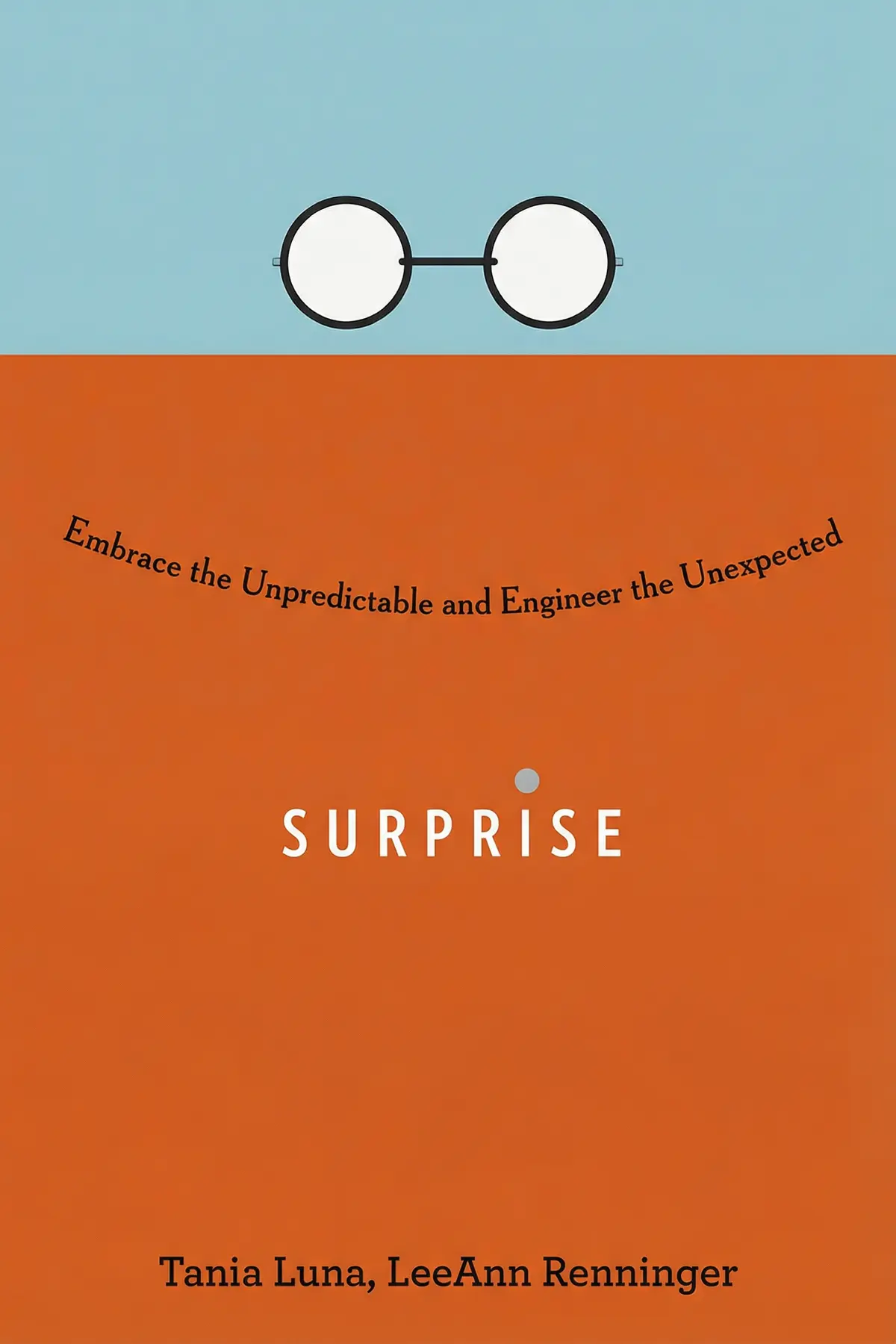
Table of Content
1. Introduction
1 min 06 sec
A plan that collapses at the last minute can sour a whole day, and most people respond by holding on to control even harder. In Surprise, psychology researchers Tania Luna and LeeAnn Renninger argue that this instinct costs more than it saves, because welcoming the unpredictable is linked to happiness, growth and closer ties with others. Their starting point is plain: a surprise is the jolt you feel when your brain’s running guess about the next moment turns out to be wrong.
Once surprise is understood as a process, it can be handled and even designed. That is the case the authors make, and every idea below supports it. There is a way to recover faster from bad shocks, a reason to let people see your doubts, and a method for building small delights into a friendship, a marriage or a business. Along the way come a ballet dancer who reinvented herself with a saw, an artist who won over a crowd after meeting cold fellow speakers, and a hotel basket of sweets that got guests talking.
2. Know the four steps your mind takes when startled
1 min 43 sec
That blank look on your face when something catches you off guard is only the beginning. Your brain runs through a fixed sequence every time, and knowing it changes how a shock feels.
3. Balance routine and novelty to avoid anxiety and boredom
1 min 50 sec
Uncertainty makes people anxious, yet total control makes them restless. A striking survey about psychics hints at how far people will go for certainty, and why getting it never quite satisfies.
4. Turn an unwelcome surprise into a new direction
1 min 48 sec
A serious injury ended one woman’s dance career overnight. What she did next made her famous in a field almost nobody has heard of, and it shows a skill anyone can practice.
5. Let people see your doubts and earn their warmth
1 min 53 sec
Backstage, an artist found the other speakers cold and unwelcoming. After his talk, the same room responded to him in a way he never expected, and he knew exactly why.
6. Surprise yourself with new experiences and moments of awe
1 min 49 sec
You do not have to wait for life to catch you off guard. The brain has a strong preference that makes self-made surprise surprisingly easy, and a rarer feeling worth going out to find.
7. Design small delights that people want to share
1 min 45 sec
A hotel manager made one tiny change to her rooms, and guests started doing her marketing for her. A study of online reviews suggests her result was no fluke.
8. Keep closeness and mystery alive in one relationship
1 min 49 sec
Knowing everything about a partner sounds like the goal of a good relationship. One psychologist suggests it can also be the moment desire starts to fade.
9. Conclusion
1 min 12 sec
What Luna and Renninger offer is a different relationship with the unexpected. A surprise is only a prediction that failed, followed by four stages your brain already knows how to run. Seen that way, the sting of a cancelled plan and the joy of a crowded surprise party come from the same machinery, and both can be worked with. The bad ones can become openings, the way a dancer’s ruined foot led to a career playing the saw. The good ones can be made on purpose, for yourself through novelty and awe, and for others through a basket of sweets or a theme that changes how people mix.
The authors’ final piece of advice asks the most: stop trying to be cool. If being cool means having everything figured out, nobody can reach it, because a world this uncertain keeps everyone learning. So the next time you want to sing or dance and worry about looking foolish, do it anyway. Tell one honest story about a mistake. Leave a gap in your week that you cannot plan.
Control will always feel safer. The fuller life this book describes begins in the moment your brain guesses wrong, and you let it.
About this book
What is this book about?
Most people like their days to go to plan, and a sudden change can leave them anxious or annoyed. Yet a life built entirely around control tends to turn dull, and it shuts out the pleasant surprises along with the painful ones. Tania Luna and LeeAnn Renninger argue that learning to welcome the unpredictable is linked to happiness, growth and stronger relationships. They start with the mechanics. Surprise, in their account, runs through four stages: a freeze, a search for an explanation, a shift in how you see things and an urge to share. From there they explain why people need both stability and novelty, how to build resilience to bad surprises, and why openness wins more warmth than armor. The second half turns from coping to creating. Readers learn how a hotel manager's basket of sweets and a party designer's themes produce delight, how to keep both closeness and mystery in a relationship, and how novelty and awe let you surprise yourself. The result is a practical way to stop fearing the unexpected and start using it.
Book Information
Who it's for
Thrown by sudden change
People who feel thrown by sudden changes and want to recover from setbacks faster.
Leaders and service teams
Managers, founders and service teams looking for small, low-cost ways to delight customers and colleagues.
Partners and longtime friends
Partners and friends who sense a long relationship going flat and want to bring back some spark.
About the Author
Tania Luna
Tania Luna is a psychology researcher, writer and educator who has started several companies, including the leadership development firm LifeLabs Learning and Scarlet Spark, a nonprofit for organizations working for animals. She has spoken at TED and co-hosts the podcast Talk Psych to Me. LeeAnn Renninger is a cognitive psychologist with a PhD who helped start LifeLabs Learning, which trains managers and executives worldwide. Her specialty is rapid skill acquisition, and her TED talk covers a science-based method for giving useful feedback.
Ratings & Reviews
Ratings at a glance

What people think
Listeners find the book highly engaging and easy to digest, with one listener remarking on how it encourages thinking through more open pathways. They also enjoy the witty tone and practical impact, as one listener emphasizes the useful methods for professional life. Furthermore, the book earns praise for its insightful nature; one review characterizes it as an accessible guide to the psychology of surprise, while another highlights its value for life. However, reactions to the scientific content are mixed.
Top reviews
Caleb
Wow, this book totally flipped the script on how I view my daily routine and the 'unexpected' interruptions I usually hate. I listened to the audio version, and the authors' enthusiasm is infectious, even if they are clearly pitching their business at times. The 'Burying a Cookie' concept is a game-changer for someone like me who tends to be overly scheduled and rigid. Personally, I think the most stimulating part was realizing that surprise isn't just an emotion, but an intensifier for everything else we feel. It’s humor-filled. It's quirky. It's surprisingly effective. A high recommendation for anyone feeling stuck in a rut. I’ve already started planning small surprises for my partner and the results are instant.
Show moreBam
Finally got around to reading this, and it’s arguably one of the most stimulating books on psychology I’ve picked up this year. It’s rare to find a book that manages to be both incredibly funny and deeply practical for your work life. The authors describe surprise as a 'story intensifier,' and that framing has completely changed how I plan my team meetings. I don't care if it's partly an advertisement for their firm—the ideas are worth the price of admission alone. The bite-sized summaries at the end of each chapter are perfect for someone with a short attention span. If you want to feel more alive and engaged with the world, read this. It’s a short read that packs a major punch.
Show moreTaw
As a project manager who handles high-stress speakers, I found the 'cheat sheets' at the end of each section to be incredibly valuable for quick reference. The authors have a very whimsical, cheerful tone that makes the content feel like a conversation rather than a lecture. I especially appreciated the strategies for work life, specifically the idea of 'living in the fog' when things don't go as planned. Truth is, I started nodding my head during the relationship sections because the advice on novelty is so practical. It’s not the most rigorous scientific text out there, but as an accessible guide to psychology, it hits the mark. It definitely helped me open up some new channels in my thinking. It’s a solid addition to my professional development shelf.
Show moreVimolwan
The distinction between a 'fake' surprise face and the actual deer-in-the-headlights look was a total lightbulb moment for me. I enjoyed the science of surprise, even if it was a bit vague in the latter half of the book. To be fair, the authors are clearly experts in their niche, and the 'Red Thread' idea is a great framework for resilience. I did find it a bit frustrating that they wouldn't reveal the details of the 'fear of heights' surprise they organized for their client. Why mention it if you can't show us the 'how-to'? Still, the book serves as a stimulating guide that helps you think in more open channels. It’s an easy four-star read for the psychology buffs. It makes life feel a bit more like an adventure.
Show moreNam
After hearing the authors talk about their 'surprise company' on a podcast, I was skeptical but curious about how this would translate to a book. I’m happy to report that it’s actually quite insightful, especially regarding how surprise can boost resilience and gratitude. The writing style is very whimsical, which matches the subject matter perfectly. I loved the idea of the 'Red Thread' and found myself implementing some of the relationship advice immediately. Look, it’s not going to win any awards for scientific breakthroughs, but it’s a practical and humor-filled manual for living a more interesting life. It made me realize how much I’ve been avoiding 'the fog' lately. It is a refreshing, accessible guide for the average reader.
Show moreBig
The concept of 'burying a cookie' is something I immediately started implementing in my office environment to keep things fresh. I think many people miss the point of this book by focusing too much on the 'secretive' client stories. In my experience, the value lies in the mindset shift rather than a step-by-step instruction manual. It’s an accessible guide that encourages you to step outside your comfort zone and embrace the unknown. While I agree that some examples like the 'fear of heights' story were a bit of a letdown because they lacked a payoff, the overall message is powerful. It’s a solid 4-star read for anyone looking to add a spark back into their daily existence. It encourages open-mindedness.
Show moreFelix
Ever wonder why some experiences stick while others just fade into the background noise of life? This book answers that question by breaking down the mechanics of the unexpected in a way that is both lighthearted and thought-provoking. I found the section on 'living in the fog' particularly relevant to my current career transition. It’s a quick read, but the impact lasts. Some might call it a wishy-washy mess, but I found it to be a refreshing change of pace from denser, more clinical texts. It’s about the philosophy of adventure as much as it is about the psychology of the brain. It makes you think in more open channels. Definitely worth the afternoon it takes to finish.
Show moreManop
Coming off the back of reading 'The Power of Moments,' I had high expectations for this, though I’ll admit it didn't quite reach those heights. It functions as a decent companion piece that expands on why novelty matters, but it feels a bit repetitive in the middle. The 'dog dog dog cat' example felt a bit juvenile for a book positioned as a psychology resource. However, I’ve gotta say that the sections on the 5 Love Languages through a surprise lens were a fresh take. It’s a sweet, quick read that reminds you to be intentional with your gestures. Not every book needs to be a heavy academic tome to be useful. Three stars for the good vibes and occasional flashes of brilliance, even if it feels like a long blog post.
Show moreRin
I really wanted to enjoy this one, but it felt less like a book and more like an extended brochure for the authors' consulting firm. While the writing is undeniably breezy and accessible, the lack of actual neurological data makes it feel a bit like 'science-lite.' It is a fast read. I found the page 7 stunt—where they leave it blank to 'surprise' you—to be more gimmicky than insightful. Frankly, I was looking for actionable steps to create surprise, yet they keep their specific client techniques a secret. It borrows heavily from the work of Brene Brown and other pop-psych giants without adding enough of its own substance. If you want a quick hit of inspiration, it’s fine, but don't expect a deep dive into brain chemistry. Ultimately, it lacks the depth required to be a truly transformative manual.
Show moreMeen
To be fair, this reads more like a series of blog posts than a cohesive scientific text. I was expecting more hard data on neurology. Instead, I got a lot of 'maybe you should try this' advice that felt a bit fluffy. The dog/cat sentence was supposed to be a clever example of pattern-breaking, but I just found myself skimming past it entirely. It’s a very quick read. The 'The End' page joke on page 7 made me roll my eyes rather than laugh. It’s not a bad book, just a very basic one that repackages work from people like Gottman and Chapman. If you’re new to pop psychology, you might find it interesting. If you’re a veteran, it’s a total pass. Skip this and read something with more meat on the bones.
Show moreQuestions about this book
What is the main idea of Surprise by Tania Luna and LeeAnn Renninger?
The authors argue that surprise is the brain’s response when its prediction of the next moment fails, and that welcoming the unpredictable is linked to happiness, growth and better relationships. They explain the four stages of surprise, show how to build resilience to bad surprises, and describe ways to create good surprises for yourself, your partner and the people you serve.
What are the four stages of surprise?
The authors call them freeze, find, shift and share. In the freeze, your attention locks onto the unexpected event and your face goes blank. In the find stage, your brain searches for an explanation. In the shift, your view of the situation changes. Finally, you share the experience with others, which lightens the mental work of processing it.
How does the book suggest building resilience?
Luna and Renninger describe four steps: set a stable foundation, such as trusting relationships with neighbors; look for the advantages in a bad surprise; treat struggle as part of reaching a goal; and see setbacks as a chance to change direction. Natalia Paruz, a ballet dancer pushed out of dance by a foot injury, went on to be counted among the most famous saw players anywhere.
How can a business use the ideas in Surprise?
The book shows that delighted people share their experience. A hotel manager named Eva placed sweets in every room, and guests spread the word to friends and family. A study of TripAdvisor reviews found guests who had a delightful surprise were 58 percent more likely to return or recommend the hotel. Creating sensory experiences, such as themed events, is another route.
Who should read Surprise?
It suits people who feel anxious when plans change, professionals who want to recover from setbacks and connect more openly, and anyone in a business or team looking for low-cost ways to delight others. Couples and friends will also find the authors’ ideas on balancing closeness and mystery useful for keeping long relationships fresh.
Readers also enjoyed



A Liberated Mind: How to Pivot Toward What Matters
Steven C. Hayes


Acting with Power: Why We Are More Powerful Than We Believe
Deborah Gruenfeld


Age of Propaganda: The Everyday Use and Abuse of Persuasion
Anthony Pratkanis



AUDIO SUMMARY AVAILABLE
Listen to Surprise in 15 minutes
Get the key ideas from Surprise by Tania Luna, plus 5,000+ more nonfiction titles.
- 5,000+ titles
- Listen as much as you want
- 7-day free trial
- Cancel anytime









