

14 min 44 sec
Available in: English
Surfaces and Essences: Analogy as the Fuel and Fire of Thinking
Shows that analogy drives every word, memory and idea you have. It also explains how looking past surface likenesses to deeper ones makes you a better learner, teacher and problem solver.
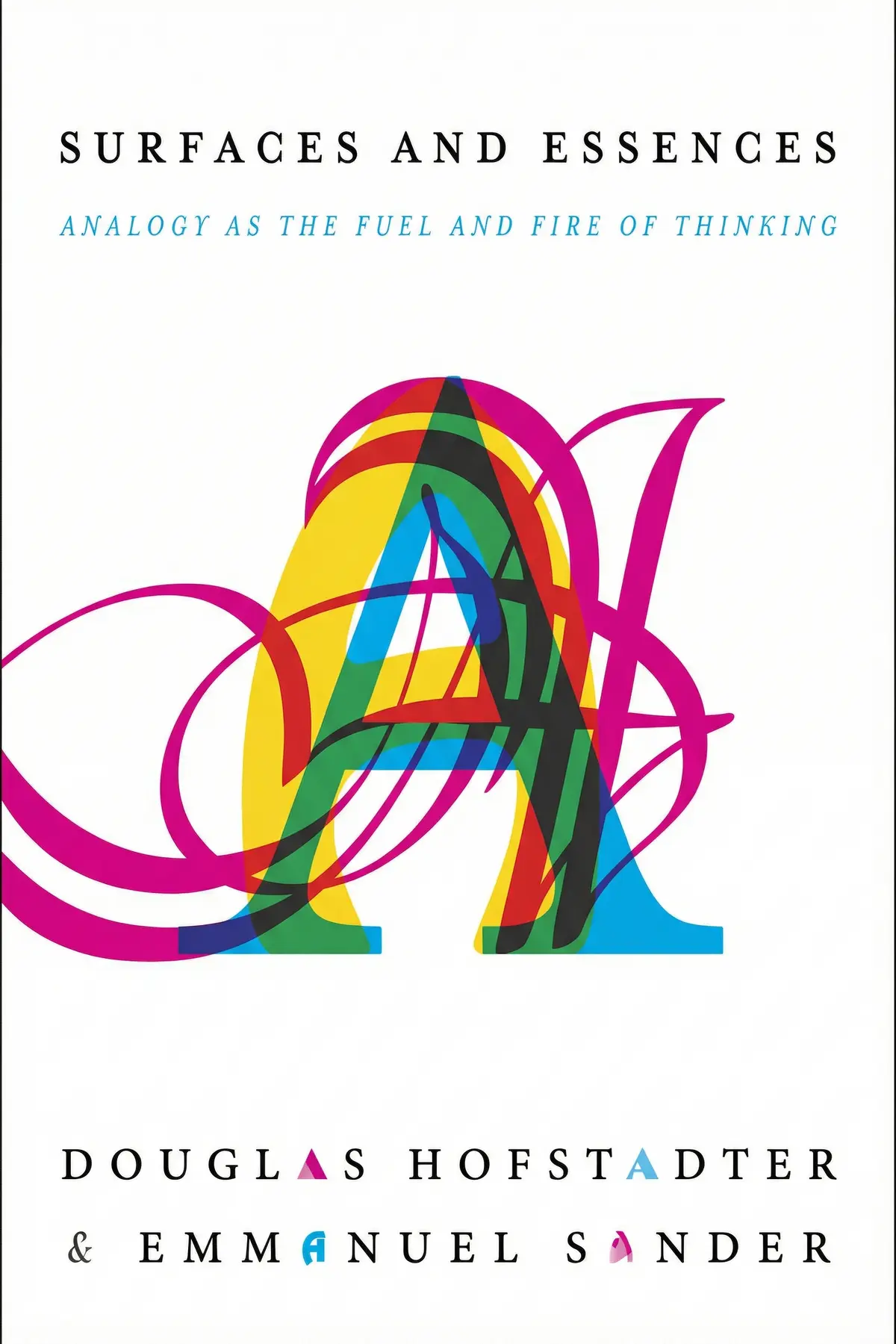
Table of Content
1. Introduction
1 min 10 sec
If you think of analogy as a classroom device or a poet’s decoration, you are underrating something your mind does all day. In Surfaces and Essences, cognitive scientist Douglas Hofstadter and psychologist Emmanuel Sander argue that without analogies there are no concepts, and without concepts there is no thought. Recognizing a chair, answering a friend’s story with one of your own and learning a new app all rest on the same move: matching something new to something you already know.
That claim is the spine of the book. Words, idioms, memories, expert judgment and even Einstein’s physics all run on one engine, which maps the unfamiliar onto familiar categories and keeps refining the match. For the authors, intelligence means the speed and accuracy with which someone gets to the core of a situation, past what shows on the surface. Along the way you will hear why a toddler calls every woman mommy, why students freeze when asked to divide and get a bigger number, and how comparing a box of radiation to a gas changed physics.
2. Treat every word as a stretchy category
2 min 00 sec
A word as ordinary as chair turns out to have no clean definition, and a toddler calling every woman mommy shows why. The fuzziness looks like a flaw until you see what it makes possible.
3. Use idioms and proverbs as ready-made lenses
2 min 04 sec
Two well-known proverbs give opposite advice, and a French idiom about a duck has no English twin. Both point to what phrases really do inside the mind, and to how they can steer you without your noticing.
4. Spot the tiny comparisons behind every reply
1 min 59 sec
The shortest replies in any conversation hide a constant mental habit. A child at the Grand Canyon who preferred an anthill shows how memory keeps experiences that have no name at all.
5. What experts really see that beginners miss
2 min 02 sec
Experts are usually admired for how much they know, yet the authors place their real skill somewhere else. A judo class and a flute lesson sitting in the same category hint at where.
6. Spot when your first analogy leads you astray
1 min 56 sec
Asking a friend who is moving for their new email address sounds harmless until you hear yourself. The same kind of slip leaves university students stuck on a simple division question about a grandmother’s baking.
7. See Einstein turn a strange comparison into physics
2 min 17 sec
Most physicists thought comparing a box of radiation to a gas made about as much sense as comparing a pool to a pool table. Einstein followed the likeness anyway, and it carried him to some of his best-known ideas.
8. Conclusion
1 min 16 sec
The title carries the argument. Every situation arrives with a surface, the features that strike a beginner, and an essence, the structure an expert learns to see. Analogy is how a mind gets from one to the other. A toddler does it with the word mommy, a student does it when division stops meaning sharing, and Einstein did it when a box of radiation began to look like a gas. In the authors’ view, intelligence comes down to how quickly and how accurately a person makes that crossing.
That turns thinking into something you can watch yourself doing. When you meet something new, name the comparison your mind has already reached for, then hunt for the spot where it breaks, the way an email address broke the postal one. When a problem refuses to move, describe it at a higher level of abstraction and look at what else shares that category. And when a proverb or a this-is-just-like-last-time feeling steers a decision, remember that its opposite exists too.
None of this needs new knowledge. It needs a closer look at the comparisons you already make, every minute, in every conversation. Sometimes the likeness that sounds strangest is the one pointing straight at the essence.
About this book
What is this book about?
Most people think of analogy as a teaching aid or a literary flourish. Douglas Hofstadter and Emmanuel Sander make a far larger claim: analogy is the mechanism behind all thinking. Without analogies there are no concepts, they argue, and without concepts there is no thought. The authors build the case from the ground up. They show how simple words like band and chair are fluid categories that grow by comparison. Idioms and proverbs package ready-made perspectives, and tiny everyday matches, which the authors call banalogies, shape memory, empathy and prediction. They then turn to expertise and creativity, and to the naive analogies that make division confusing and email feel like ordinary mail. Last comes Albert Einstein, whose leaps from a gas to radiation and from mechanics to electromagnetism they trace to analogy. Readers come out able to watch their own minds at work. They can notice which comparisons they reach for, test where those comparisons break and climb to more abstract categories when a problem will not move.
Book Information
Who it's for
Professionals and students
Knowledge workers and students who want to understand how ideas and insights actually form.
Educators and managers
Teachers, trainers and managers who explain new things and want to know where their comparisons mislead.
Language and creativity buffs
Curious readers drawn to language, creativity and how Einstein actually thought.
About the Author
Douglas Hofstadter
Douglas Hofstadter is Distinguished Professor of Cognitive Science at Indiana University in Bloomington, where he directs the Fluid Analogies Research Group, and he built the analogy-making computer model Copycat with Melanie Mitchell. His Gödel, Escher, Bach won the Pulitzer Prize for general nonfiction. Emmanuel Sander is a professor at the University of Paris (Saint-Denis), working in cognitive and developmental psychology.
Ratings & Reviews
Ratings at a glance
What people think
Listeners consider the text both deep and enlightening, highlighting its clearly defined concepts and exceptionally inventive analogies. Additionally, they enjoy the smooth prose and general style, with one listener noting its dual language format. The storytelling is also regarded as highly effective, with listeners reporting that it follows a convincing arc. However, opinions on the total length are varied, with several listeners suggesting the work is too long.
Top reviews
Tanyaporn
Few authors can transform the mundane act of categorization into a cosmic dance of cognition like Hofstadter and Sander. This book is a profound exploration of how we actually navigate the world through mental links. While I adore 'Gödel, Escher, Bach', this feels like a more grounded, though equally ambitious, successor. The section on Einstein’s thought experiments was genuinely breathtaking; it made me feel as if I were witnessing the birth of relativity myself. Some might complain about the sheer volume of examples, but the richness of these analogies is precisely the point. Truth is, we don't realize how much we rely on these patterns until they are laid bare in such an exhaustive, beautiful manner. It’s a dense read, yet the narrative quality keeps it remarkably engaging for such a hefty tome. It convinces you that your brain is a miracle of mapping.
Show moreKom
Picked this up on a whim and was immediately sucked into the authors' vision of a world built entirely on analogies. The way they break down the 'zeugma' and other linguistic quirks makes you realize that every word we speak is a tiny miracle of categorization. It’s rare to find a book that manages to be both scientifically rigorous and beautifully written. I was particularly struck by the extraordinary creative analogies used to explain the evolution of light quanta; it felt less like a textbook and more like a narrative history of human genius. To be fair, it is a long read, but I never felt it was 'bloated.' Instead, the repetition served to anchor these complex concepts into my long-term memory. If you enjoy thinking about how you think, this is an essential addition to your library. It is a masterpiece of cognitive science literature.
Show moreSamuel
Ever wonder why we say 'turn off the window' when we’re tired? Hofstadter and Sander dive into these linguistic slips to show that our brains are constantly mapping categories in ways we barely notice. This book is an intellectual feast, though perhaps one where the chef keeps bringing out the same course in slightly different bowls. I loved the deep dives into how math is taught, specifically the limits of the 'multiplication as repeated addition' analogy. It totally changed how I look at my own learning process. While the length is undeniably intimidating, the writing remains accessible and the creative spirit is palpable on every page. Personally, I found the dual perspective from a French and English linguistic background added a layer of depth that many pop-science books lack. It’s a commitment, but one that pays off in sparks of genuine clarity and wonder.
Show moreDivya
Does every great idea require five hundred pages of justification? In the case of Hofstadter and Sander, the answer seems to be a resounding yes. I’ve read 'The Mind’s I' and loved the collaboration with Dennett, so I had high expectations. This book delivers on the 'big idea' front—convincing me that analogy is indeed the core of all human intelligence. However, the path there is paved with more examples than any person could possibly need. The section on how AI might eventually handle these 'conceptual hooks' was fascinating, providing a much-needed bridge to modern technology. Not gonna lie, I did some aggressive skimming through the middle sections, but the final chapters on Einstein and mathematical theory were absolute gold. It’s a brilliant, slightly bloated work that requires a bit of patience to fully appreciate. Stick with it for the ending alone; it's spectacular.
Show moreJoy
After hearing about this book for years, I finally finished it, and my brain feels like it’s been through a marathon. There is something truly profound about the way the authors link the simplest slip of the tongue to the greatest scientific breakthroughs. The dual-language perspective adds a unique flavor, showing how different cultures categorize the world. I found the discussion on how children and adults struggle with division particularly illuminating. It explains so much about our innate cognitive biases. Look, it’s not a breezy beach read, but the prose is clear and often humorous in a dry, academic sort of way. Even if the sheer volume of examples feels like overkill at times, the cumulative effect is a total shift in perspective. It makes the invisible architecture of thought visible. I’m glad I pushed through the slower parts to reach the conclusion.
Show moreKek
Wow. This is a monumental work that demands your full attention. Hofstadter and Sander have crafted a compelling narrative about the very essence of human thought. The way they connect mathematical principles to everyday language is nothing short of brilliant. I particularly enjoyed the segments on how we use physical terms to describe abstract concepts. It’s a very readable book, despite its size, thanks to the authors' ability to tell a story through their examples. Some might find the level of detail excessive, but I felt it was necessary to dismantle our habitual ways of looking at the world. It’s a profound meditation on the 'fire' of thinking. To be fair, I could have done without the final dialogue section, which felt a bit meta for its own sake, but it didn't ruin the overall experience. Highly recommended for any science buff.
Show moreConnor
Finally reaching the technical climax of this book felt like a massive reward for my persistence. The chapter on physics was a splash of cold water after a long hike through linguistic examples. Seeing how Einstein used analogy to bridge the gap between seemingly unrelated phenomena was worth the entire read. Hofstadter and Sander are masters at explaining complex ideas through creative comparisons. While the book is undeniably long—perhaps even too long—the insights are so sharp that you forgive the redundancy. It convinced me that our education system needs to rethink how we teach math, moving away from rigid rules toward a more analogical approach. The writing is smooth, though the tone can get a bit argumentative when the authors defend their thesis against imagined critics. Still, the quality of the narrative and the depth of the research make it a standout.
Show moreAhmed
I wanted to love this, but the pacing made it a bit of a struggle. I’ve always appreciated Hofstadter’s playful style, yet here the 'pun-y' headers and self-referential dialogues felt more like distractions than enhancements. There’s a fantastic 200-page book trapped inside this 500-page monster. The analysis of how division is misunderstood in schools was eye-opening for me as an educator. On the other hand, the endless lists of synonyms and airport hub metaphors became mind-numbing after a while. Gotta say, I expected something as transformative as GEB, and while the ideas are solid, the delivery is far too indulgent. It's a useful resource if you’re willing to skim the fluff and focus on the technical gems regarding physics and mathematics toward the end. Not exactly a page-turner, but the core argument is undeniably robust and stays with you long after you close the cover.
Show moreChamlong
Not what I expected from the author of GEB, but it certainly offers a unique perspective on cognitive science. The central thesis—that analogy and categorization are effectively the same thing—is fascinating and well-argued. Unfortunately, the writing style can be quite exhausting. The authors spend pages dissecting analogies that most people understand intuitively within seconds. Why spend so much time on airport hubs? I found myself wishing for a more disciplined editor who could have trimmed the fat without losing the meat. That said, the technical sections near the end regarding Einstein's thought processes are masterful. In my experience, this book is best taken in small doses over several months rather than binged. It’s a treasure trove of insights buried under a heap of repetition. It’s insightful, yes, but also very tiring for a general reader.
Show moreSam
As a long-time fan who keeps 'Le Ton Beau de Marot' on my bedside table, I found this work deeply frustrating. What could have been a sharp, 50-page essay on the mechanics of metaphor has been bloated into a 500-page slog that feels twice that length. Do we really need twenty pages explaining the subtle difference between 'and' and 'but'? I think not. The authors treat the reader like a student who hasn’t quite grasped the basics, resulting in a patronizing tone that saps the joy out of the subject. It’s a shame because the core thesis—that analogy is the fuel of thought—is a strong one. However, the execution is so repetitive that the essential insights are buried under mountains of padding. Frankly, it’s a missed opportunity from a brilliant mind. I expected a rapier, but I got a mallet.
Show moreQuestions about this book
What is the main idea of Surfaces and Essences?
Douglas Hofstadter and Emmanuel Sander argue that analogy is the mechanism behind all thinking. Without analogies there are no concepts, and without concepts there is no thought. Words, idioms, proverbs, memories, expertise and scientific discoveries all work by matching something new to familiar categories. As they see it, intelligence is the speed and accuracy with which someone grasps what a situation is really about, beneath its surface features.
What is a naive analogy in Surfaces and Essences?
A naive analogy is a comparison that feels natural but rests on surface likeness. Asking a friend who is moving for their new email address treats email like postal mail. Learning division as sharing is another: it makes students think dividing always gives a smaller number. The deeper concept, the authors argue, is measurement, as in counting how many cookies one pound of flour can make.
What are banalogies?
Banalogies is the authors’ word for the tiny, automatic analogies people make constantly without noticing. Replying me too to a friend’s story, or saying there you go again, means framing the present against past experience. The authors argue these small matches are essential to thinking, letting people draw conclusions, empathize and predict without working everything out from scratch.
How can I apply the ideas in Surfaces and Essences?
Notice the analogy you are using when you meet something new, and look for the case where it breaks, the way sharing breaks for division. When stuck, describe your problem at a higher level of abstraction, as the authors move from rocking chair to chair, and see what else fits that category. When a proverb steers a decision, recall that an opposite proverb usually exists.
Who should read Surfaces and Essences?
It suits readers curious about how thinking works: students, teachers and trainers who explain new ideas, professionals who want to solve problems more creatively, and anyone interested in language and science. The book moves from everyday words like band and chair to idioms across English and French, and on to the analogies behind Einstein’s work on light quanta and relativity.
Readers also enjoyed

Acting with Power: Why We Are More Powerful Than We Believe
Deborah Gruenfeld


Age of Propaganda: The Everyday Use and Abuse of Persuasion
Anthony Pratkanis




59 Seconds: Change Your Life in Under a Minute
Richard Wiseman


AUDIO SUMMARY AVAILABLE
Listen to Surfaces and Essences in 15 minutes
Get the key ideas from Surfaces and Essences by Douglas Hofstadter, plus 5,000+ more nonfiction titles.
- 5,000+ titles
- Listen as much as you want
- 7-day free trial
- Cancel anytime









