
15 min 24 sec
Available in: English
 ไทย
EnglishไทยSuperFreakonomics: Global Cooling, Patriotic Prostitutes and Why Suicide Bombers Should Buy Life Insurance
Levitt and Dubner show how counting what people actually do, instead of trusting stories about them, explains odd behavior, exposes the side effects of incentives and turns up cheap fixes for problems from disease to climate change.
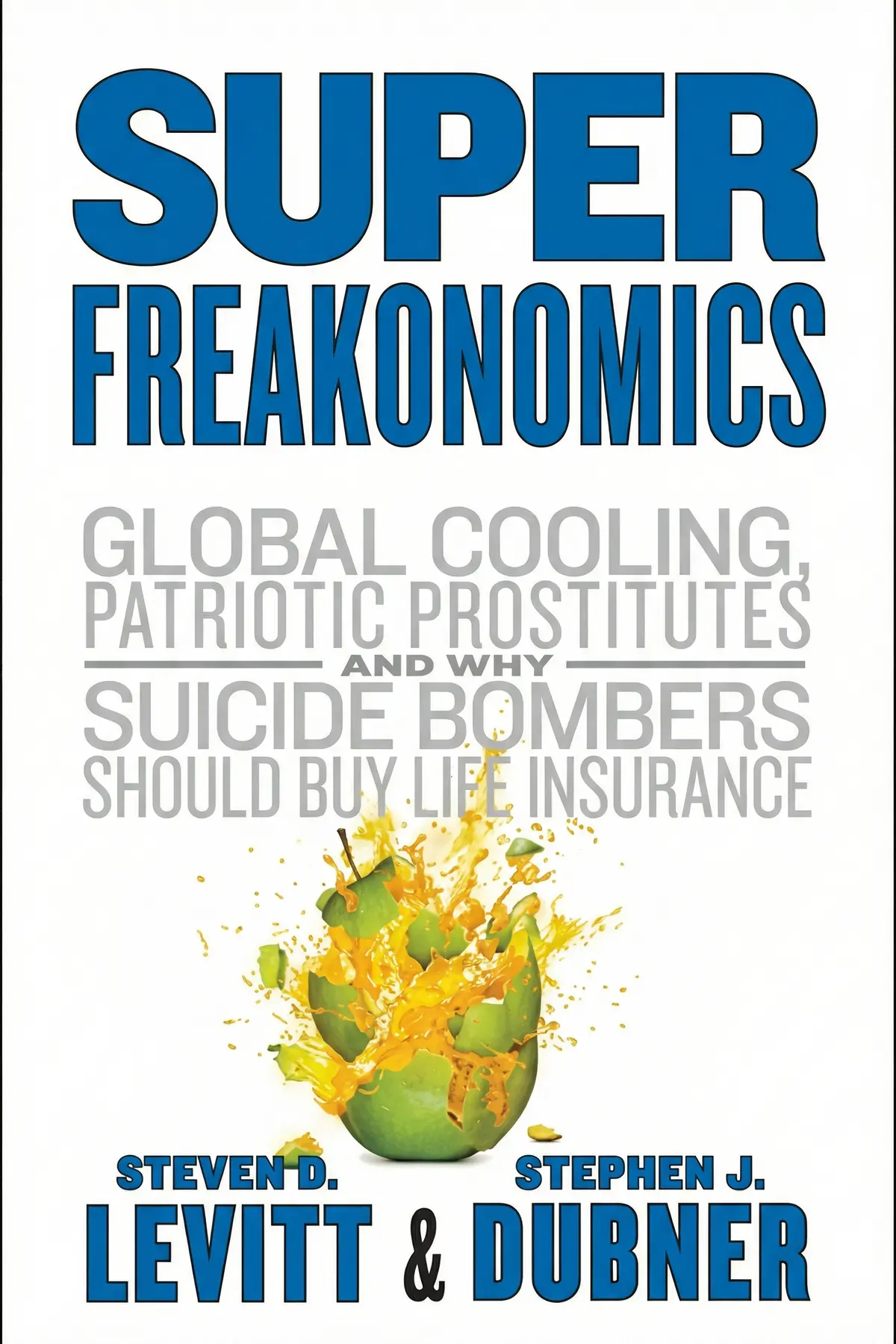
Table of Content
1. Introduction
1 min 01 sec
Most of us judge big problems by the stories that reach us, and those stories often point the wrong way. In SuperFreakonomics, economist Steven D. Levitt and journalist Stephen J. Dubner describe what happened when trash collection in Germany was priced by volume: many households began flushing leftover food down the toilet, and the rat population grew. The fee assumed people would throw away less. The data showed what they actually did.
That gap between assumption and behavior runs through the whole book. Set aside the memorable anecdote, count how people really respond to incentives, and problems that look stuck often turn out to have simple, cheap answers. The cases range from a Chicago brothel around 1900 to a Vienna maternity ward, a banking algorithm that hunts terrorists and a plan to cool the planet through a hose. The habit worth taking from them is checking the numbers before the story, and spotting the fix everyone else walked past.
2. Tell a real trend from a loud headline
1 min 24 sec
One terrible attack on a child convinced a nation that the ocean had turned more dangerous. When someone finally counted, the picture changed completely, and the lesson applies to every alarming report that lands on your desk.
3. Predict how people will dodge your rules
1 min 18 sec
A sensible fee meant to cut household waste ended up feeding an animal nobody wanted more of. The story shows why well-meant rewards and penalties so often misfire, and how to see the misfire coming.
4. Read prices as signals of risk and demand
1 min 40 sec
Sex workers in Chicago a century ago earned sums their modern counterparts could hardly imagine. Explaining the collapse takes only a few economic forces, and the same forces shape the price of almost any kind of work.
5. Trust what people do over what they say
1 min 43 sec
One famous murder convinced the world that people are coldly indifferent. A famous experiment later convinced it of the opposite. An economist who tweaked a few rules showed that both camps had misread human nature.
6. Spot hidden patterns in everyday records
1 min 47 sec
The usual picture of a terrorist turns out to be wrong, and one of the strongest clues to a suicide bomber hides in a product most families buy without a second thought.
7. Fix the cause with the simplest tool
1 min 51 sec
Doctors in a Vienna hospital were killing mothers without knowing it, and car designers spent years solving the wrong problem. In both cases, a careful look at the facts produced an answer almost embarrassingly cheap.
8. Understand what makes climate change so hard to tackle
1 min 42 sec
Nearly everyone agrees warming is dangerous, yet behavior barely shifts. The authors trace the stall to a few stubborn obstacles, one of which also explains why shared problems at work never seem to get fixed.
9. Judge an odd idea by its data and cost
1 min 50 sec
A volcanic eruption in 1991 briefly cooled the planet and made forests flourish. A former technology executive asked whether people could copy the effect on purpose, for less than one foundation spends on publicity each year.
10. Conclusion
1 min 08 sec
From rats in German sewers to holiday prices, stamp-sticking volunteers and a hose pointed at the sky, Levitt and Dubner keep finding the same thing. The beliefs we carry about people, that they are hopelessly selfish, that terrorists are poor, that sharks are on the rise, tend to crumble once someone counts. What survives the count is usually more useful than the belief, and often cheaper to act on: a basin of water, a strap across the chest, a gas pumped higher.
The authors’ own advice for a stubborn problem is to free yourself from assumptions about it first. They picture a cat that keeps peeing on the floor on Wednesdays. Rather than blaming the day, note what you and the cat do on Wednesdays and what it eats. Perhaps you work long hours that day, and the cat is lonely and wants your attention.
The same steps fit a team that keeps missing deadlines. Collect more data than feels necessary, look for the indicator that moves with the problem, and try a fix you can reverse. Semmelweis did not need a new theory of medicine. He needed to notice where the doctors were walking from.
About this book
What is this book about?
Big problems such as disease, terrorism and global warming seem to defeat clever people again and again. Steven D. Levitt and Stephen J. Dubner argue that one reason is where the experts look. Too many rely on memorable anecdotes and personal impressions, while the clearest answers sit in plain data about how people behave. The authors apply that economist's habit to an unusual range of cases. They explain why sex workers around 1900 earned far more than today's, why a trash fee in Germany fed the rats, how a bank algorithm might flag terrorists and why a famous experiment on generosity fell apart once it looked more like real life. They also revisit simple cures, from handwashing in a Vienna hospital to the seat belt, and end with a provocative proposal to cool the planet with more pollution. Readers get a way of thinking they can use at work and at home: check the numbers before the story, predict how people will react to a rule, and look for the cheap fix that removes a problem at its cause.
Book Information
Who it's for
Leaders whose incentives backfire
Managers and policy makers whose rules, targets or bonuses keep producing strange side effects.
Hoping to test assumptions
Founders and analysts who want to test assumptions with data before spending money on a fix.
Curious about surprising economics
Curious readers who enjoy counterintuitive economics about crime, health, sex work and climate change.
About the Author
Steven D. Levitt
Steven D. Levitt is an American economist who has taught at the University of Chicago. He won the John Bates Clark Medal in 2003 for his work on crime, co-edited the Journal of Political Economy until 2007, and was named one of Time's 100 People Who Shape Our World in 2006. Stephen J. Dubner is an American journalist and author whose work has appeared in The New York Times, The New Yorker and Time. He hosts Freakonomics Radio, and the pair co-wrote the Freakonomics series.
Ratings & Reviews
Ratings at a glance
What people think
Listeners find this work exceptionally engaging and easy to follow, packed with remarkable data and informative perspectives. They value how it challenges conventional wisdom regarding common problems and forces people to reconsider their routine experiences. The prose is straightforward and clear, ensuring a broad appeal, while the witty delivery and captivating narratives ensure the audience remains amused throughout.
Top reviews
Yaowares
Few books manage to make data feel this much like a late-night conversation with a genius friend. I loved how the authors took the global financial crisis and ignored it in favor of much more interesting, granular topics like the perils of walking drunk. The writing is incredibly accessible, stripping away the dense jargon usually associated with microeconomics. Truth is, the storytelling is so engaging that you almost forget you are learning about incentives and human behavior. The section on how cable television actually improved the autonomy of women in rural India was particularly eye-opening. While some people might find their take on global warming controversial, it certainly makes you question the 'standard' solutions we see in the media. This is a must-read for anyone who wants to see the hidden side of how the world functions through a humorous lens.
Show moreSuwit
The chapter revisiting the Kitty Genovese story is worth the price of admission alone. It serves as a brilliant reminder that when a story seems too simple, there is almost always more to the data. I found the authors' exploration of altruism—both pure and impure—to be a deep dive into what actually motivates us to be good people. Frankly, it’s refreshing to read an economics book that focuses on the human element rather than just dry spreadsheets and market forecasts. From the 'dirty rotten truth' about donors to the way monkeys learn to use money, the variety of topics keeps things moving at a breakneck pace. Even when I didn't agree with every conclusion, I appreciated the way it forced me to re-examine my own assumptions about daily life. It is highly readable and perfect for a long flight.
Show moreElias
Wait, did they really teach monkeys how to use money just to see if they would gamble and hire prostitutes? That experiment alone makes this book a classic in my eyes. I love how the authors are willing to look at the 'repugnant' or the bizarre to find truths about human nature. The section on the 'great Iranian kidney experiment' was a powerful look at how market incentives can solve organ shortages in ways that pure altruism cannot. It’s a provocative read that isn't afraid to challenge the status quo on everything from chemotherapy to hurricanes. The humor is dry and the pace is fast, making it nearly impossible to put down once you start. If you enjoyed the first one, you will find this to be a fantastic expansion of their 'rogue economist' philosophy.
Show moreFort
Finally got around to reading this sequel and it's every bit as eye-opening as the original was years ago. The authors have a gift for making you look at your own life and the world around you with a much more critical, data-driven eye. I found the story of Ignatz Semmelweis and the history of hand-washing in hospitals to be a tragic but vital lesson in how hard it is to change human behavior. In my experience, most books that try to be this 'clever' end up being boring, but the storytelling here is top-notch. Whether they are talking about the decline of whale oil or the effectiveness of car seats, they keep the reader engaged with humor and surprising statistics. It’s a refreshing take on the world that reminds us that incentives are the true engine of society.
Show moreJavier
Picked this up on a whim and found myself surprisingly glued to the chapter on how to get doctors to wash their hands. The authors have this uncanny ability to find simple, low-cost solutions to seemingly intractable problems. Personally, I think their greatest strength is taking data that we all assume we understand and flipping it on its head. For instance, the analysis of the 1960s crime explosion and its roots was fascinating, even if it makes you a bit uncomfortable. My only real gripe is that some of the logic regarding global warming feels like it ignores potential negative externalities in favor of a 'tech will save us' narrative. Still, the prose is snappy and the anecdotes about street prostitutes and pimps versus realtors are undeniably entertaining. It is a solid follow-up that keeps the 'freak' in economics alive.
Show moreNatnicha
Ever wonder why suicide bombers should buy life insurance or why oral sex got so cheap in Chicago? This book asks the weird questions that most economists would never dream of touching. I found the comparison between pimps and real estate agents to be a hilarious but actually very insightful look at how middlemen function. To be honest, I preferred this to the first book because it felt a bit more daring in its subject matter, even if it was a bit more scattered. The discussion on how car seats are no more effective than seatbelts for older kids is exactly the kind of counter-intuitive insight I love. It makes you realize that so much of what we do is driven by fear or tradition rather than actual data. It’s a fun, thought-provoking journey that is well worth your time.
Show moreUraiwan
As someone who isn't a math whiz, I appreciated how Levitt and Dubner broke down complex societal shifts into digestible, punchy stories. The way they linked the introduction of cable TV in India to a decrease in the preference for male children was absolutely fascinating. Not gonna lie, some of the chapters feel a bit like they were written under a tight deadline, especially the parts about Congress and the estate tax. However, the overarching theme that people respond to incentives in unpredictable ways remains strong throughout the text. The writing style is simple without being condescending, which makes it a great entry point for people who want to understand behavioral psychology. It’s not perfect, but it is certainly one of the more entertaining books on my shelf this year.
Show moreAlice
Is this a worthy successor or just a collection of leftovers that didn't make the first cut? To be fair, some chapters feel like a Shepherd's Pie made from the scraps of the original Freakonomics. I found the section on climate change to be particularly problematic because it ventures far beyond the authors' expertise in behavioral economics. They offer a 'garden hose to the sky' solution that feels a bit too simplistic for such a massive, complex system. However, the book isn't without its charms; the data on car seats versus seatbelts was genuinely shocking and well-argued. It is still a very fast and entertaining read, but it lacks the consistent 'wow' factor that made the first book a global phenomenon. It’s interesting enough to finish, but don't expect it to change your life as much as the first one did.
Show moreLillian
Gotta say, the writing is still sharp, but some of the conclusions felt a bit more forced this time around. While the first book felt like it was discovering hidden patterns, this one sometimes feels like it is trying too hard to be 'edgy' just for the sake of it. For example, comparing Al Gore to Mount Pinatubo in the global warming chapter felt more like a provocation than a nuanced economic argument. To be fair, the research on the 'birthdate bulge' and how it affects talent in sports was quite compelling. It’s a bit of a mixed bag; you get some genuinely brilliant insights alongside some fairly questionable 'simple solutions' to massive problems. It’s a good 'toilet book' because you can dip in and out of the short sections easily, but it lacks a cohesive soul.
Show morePim
Look, I wanted to like this, but it often feels like pop-science overreaching into areas where the authors lack actual expertise. Right up front, they declare that global warming fears are overblown because we'll just innovate our way out of it, citing horse manure in 19th-century New York as proof. That is some of the most glaringly flawed logic I have encountered in a serious non-fiction book lately. They seem to suffer from a massive case of survivorship bias and an assumption that human ingenuity is completely unbounded. While the bits about prostitution and the male-female wage gap were somewhat interesting, the rest felt like a collection of anecdotes looking for a theme. It’s catchy and fast-paced, sure, but the lack of academic rigor in the more 'hard science' chapters really hurt their credibility for me.
Show moreQuestions about this book
What is the main idea of SuperFreakonomics?
Levitt and Dubner argue that data on how people actually behave explains far more than anecdotes or personal impressions. Collect numbers, ask good questions and stay objective, and you can learn how people react to incentives, sidestep unintended consequences and discover simple fixes. Their examples include handwashing in a Vienna hospital, the seat belt, a banking algorithm that flags terrorists and a plan to cool the planet with sulfur dioxide.
Why do the authors say a trash fee increased the rat population?
Charging households by the volume of trash was meant to make them produce less waste. In Germany, many people avoided the fee by flushing uneaten food down the toilet instead, and the rat population grew. The authors use the case to show the law of unintended consequences, and to argue that studying past behavior helps predict how people will react to a new incentive.
What does SuperFreakonomics say about global warming?
The authors say action is slow because the science is uncertain, experiments on the climate are impossible, myths distort debate and those causing harm rarely bear its cost. They report that cows and other ruminants produce 50 percent more greenhouse gas than transportation. They also describe Budyko’s Blanket, a plan to pump sulfur dioxide into the stratosphere for about $250 million, inspired by the cooling after Mount Pinatubo’s 1991 eruption.
How can I apply the ideas in SuperFreakonomics?
Start by dropping your assumptions about a stubborn problem and collecting as much data as you can. Look for the indicators that change along with it, then influence those. The authors’ example is a cat that pees on the floor on Wednesdays, perhaps because its owner works late that day. Before launching a rule or reward, also list the easiest ways people could game it.
Who should read SuperFreakonomics?
It suits readers who make decisions about other people’s behavior, such as managers designing incentives, founders testing ideas or anyone working on public policy. It also appeals to curious readers who like surprising findings, from why sex workers earned far more around 1900 to why an experiment on generosity reversed once it became more realistic.
Readers also enjoyed



Adults in The Room: My Battle With Europe’s Deep Establishment
Yanis Varoufakis


1929: Inside the Greatest Crash in Wall Street History--and How It
Andrew Ross Sorkin

23 Things They Don’t Tell You About Capitalism
Ha-Joon Chang

A Little History of Economics
Niall Kishtainy


A Splendid Exchange: How Trade Shaped the World
William J. Bernstein
AUDIO SUMMARY AVAILABLE
Listen to SuperFreakonomics in 15 minutes
Get the key ideas from SuperFreakonomics by Steven D. Levitt, plus 5,000+ more nonfiction titles.
- 5,000+ titles
- Listen as much as you want
- 7-day free trial
- Cancel anytime









