

14 min 09 sec
Available in: English
Super Founders: What Data Reveals About Billion-Dollar Startups
By Ali Tamaseb
Uses data on billion-dollar startups to separate founder myths from the real predictors of success. Experience, differentiation, timing and the right level of funding turn out to matter more than age, degrees or having a cofounder.
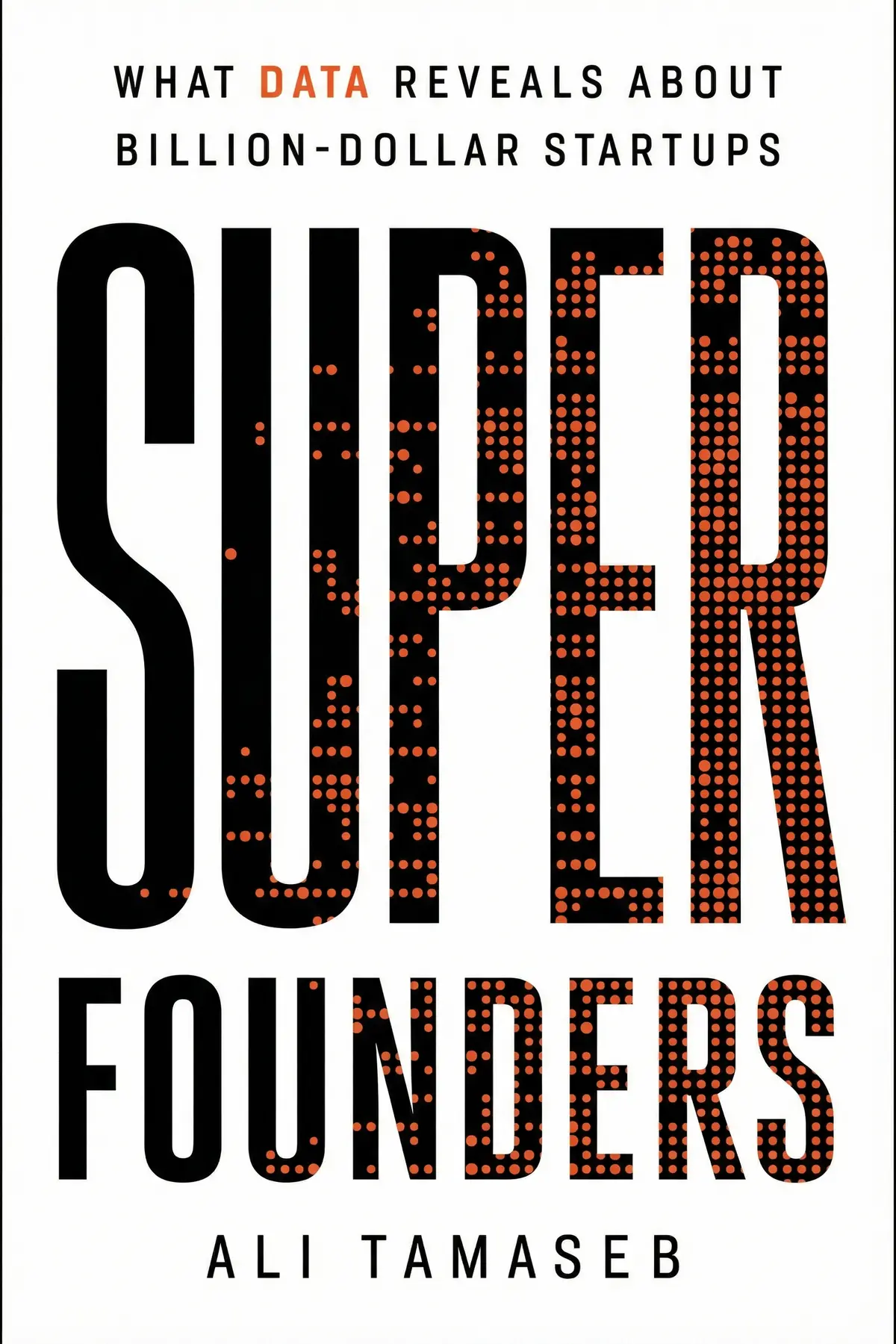
Table of Content
1. Introduction
1 min 03 sec
Perhaps you have ruled yourself out of building a big company because you never went to Harvard, never dropped out, or turned 30 without a hit. If so, the numbers say you ruled yourself out by mistake. In Super Founders, Silicon Valley venture capitalist Ali Tamaseb checks the popular founder myths against roughly 30,000 data points gathered since 2017, and many of them fall apart. Unicorn founders with PhDs outnumbered dropouts. Only 15 percent of these billion-dollar companies went through an accelerator program, and many were built on ideas that had already failed once.
Tamaseb’s case is that the traits people treat as an entry ticket hardly matter. A few less glamorous ones do: founders who have built before, ideas that are clearly different and relieve real pain, good timing, and funding that fits the idea. By the end, you will know which questions about yourself to stop asking, and which questions about your idea deserve your attention instead.
2. Stop ruling yourself out over age or degrees
1 min 46 sec
The dorm-room dropout is the founder everyone pictures, and that picture keeps many capable people from ever starting. Tamaseb checked three common disqualifiers against his data, and none of them survived the test.
3. Treat your past attempts as your best credential
1 min 47 sec
One trait showed up in about six out of ten unicorn founders, and it is something many people treat as a weakness. A music player built by two high school students hints at why it matters so much.
4. Hunt for an idea you can carry for years
2 min 01 sec
Billion-dollar ideas rarely arrive in a flash. A gaming company that never caught on, then turned into a photo site, shows what founders need beyond a good idea, and what investors look at first.
5. Build a painkiller customers can tell apart
2 min 03 sec
Creating a brand-new market sounds like the smarter bet, yet the valuations tell a different story. Two other qualities clearly separated unicorns from ordinary startups, and one of them undid many fun, popular apps.
6. Test whether the timing is finally right
2 min 04 sec
A smartphone was built in 1995 and flopped. A small eyewear startup took on two giants holding a large share of the world market. Both stories turn on the same question about timing.
7. Raise only the money your idea needs
2 min 13 sec
One video startup raised over a billion dollars and closed within months. Another founder began with her own savings and kept the entire company. Tamaseb explains when venture money fits and when it hurts.
8. Conclusion
1 min 12 sec
Super Founders swaps the founder legend for a plainer and more hopeful picture. A billion-dollar company does not belong to a type of person. It belongs to people who keep building, who pick a problem that hurts, make their answer clearly different, and check that the world is ready for it. Zoom’s founder was 41. One unicorn in five had a single founder. The smartphone failed once before it changed daily life.
Tamaseb names the real predictors as dreaming big, knowing the market well and having started a company before. That last one is the least glamorous and the easiest to act on. If you want to found something large, your next small project counts toward it. When you weigh an idea, score it on pain and on difference before you score it on novelty, and spell out what has changed to make this the right year. When money comes up, match the amount to what the idea really demands, the way Blakely and Lake did.
The dorm room and the garage make good stories. The data points somewhere less romantic: a founder’s second or third try, with a sharper idea and better timing.
About this book
What is this book about?
Many would-be founders compare themselves with Mark Zuckerberg in his dorm room or Steve Jobs in his garage, then decide they are too old, too ordinary or too alone to try. Venture capitalist Ali Tamaseb decided to test those stories. He gathered some 30,000 data points on billion-dollar startups and compared them with a random set of companies. What he found overturns much of the folklore. Founders with PhDs outnumbered dropouts. The median founder was 34, one unicorn in five had a single founder, and few went through accelerators. Being first to market gave no clear edge. The signals that did stand out were prior startup experience, products sharply different from rivals, ideas that relieve real pain and a clear answer to why the timing is right. The book also covers money: why venture capital and unicorns suit each other, and why Spanx and Stitch Fix show how much a lean company can achieve. Readers come away with evidence-based tests they can run on themselves and on their ideas.
Book Information
Who it's for
Would-be founders with doubts
Aspiring founders who fear they are too old, too unqualified or too alone to start something big.
Founders facing early decisions
Early-stage founders deciding what to build, when to launch and how much money to raise.
Investors and startup operators
Operators and investors who want evidence in place of Silicon Valley folklore.
About the Author
Ali Tamaseb
Ali Tamaseb is a partner at DCVC, a Silicon Valley venture capital firm that has backed more than ten companies valued above one billion dollars. He also holds leadership and board roles at companies in the US and elsewhere. He received the British Council's 2018 British Alumni Award and Imperial College's President's Medal for Outstanding Achievement. His work has been featured by the BBC, TED, the Guardian and Forbes.
Ratings & Reviews
Ratings at a glance
What people think
Listeners consider the work highly perceptive, and one review points out its deep research and the diverse viewpoints shared by both venture capitalists and entrepreneurs. It earns praise for being an easy read, with one listener describing it as essential reading for the startup community. However, listeners have differing opinions regarding the overall quality of the writing.
Top reviews
A
Ever wonder why some startups hit the billion-dollar mark while others crumble into obscurity? Tamaseb moves away from the typical "eureka moment" stories to provide a rigorous, data-driven analysis of what actually correlates with success. It's refreshing to see someone look at thirty thousand data points rather than just retelling the same three anecdotes about Steve Jobs. I found the breakdown of founder education and previous work experience particularly enlightening, as it dispels several Silicon Valley myths. While the prose can be a bit dry in the data-heavy sections, the interviews at the end of each chapter provide a necessary human element. It is a massive undertaking that serves as a reality check for anyone dreaming of unicorn status. If you prefer hard numbers over vague inspirational quotes, this is the startup book you need to buy.
Show moreTuck
Wow. This completely changed how I look at the "dropout" narrative that has dominated tech circles for decades. It turns out that most successful founders are actually more experienced and better educated than the media leads us to believe. Tamaseb has created a massive database to prove his points, and the result is a fascinating bird's-eye view of the entire ecosystem. I loved the "missionary" concept and the emphasis on the fact that the market often wins regardless of team quality. The book is incredibly readable despite the heavy amount of statistics involved. I’ve already recommended this to three of my colleagues who are thinking about pitching VCs this year. It's an essential reality check for the modern entrepreneur.
Show moreSirichai
As a first-time founder currently in the weeds of fundraising, I found this book to be an absolute goldmine. It helps you understand the "math" that VCs are playing, which is often a mystery to those on the outside. The author’s decision to donate the proceeds to charity is a class act and makes me feel even better about the purchase. I particularly enjoyed the sections debunking the idea that you need to be a "techie" to found a successful software company. The writing is clear, concise, and backed by a staggering amount of data that provides a sense of confidence. It’s a refreshing departure from the usual anecdotal fluff found in the business section. This is easily the most insightful book on startups I have read.
Show morePrim
Ali Tamaseb has done the heavy lifting that most business authors are too lazy to do. By analyzing such a massive dataset, he provides a zoom-out approach that is sorely lacking in a world obsessed with individual founder biographies. The book tackles misconceptions about industry experience and age with precision and clarity. I found the discussion on "high capex" startups particularly interesting, as it challenges the "software is eating the world" mantra. Even if you aren't planning to build a billion-dollar company, the insights on market-fit and team dynamics are universally applicable. It's a must-read for anyone who wants to understand the actual mechanics of the startup world. Purely for the research alone, this deserves a full five stars. Well done.
Show morePiyanart
Picked this up on a whim after seeing it on several "must-read" lists for tech entrepreneurs. The structure is quite predictable, with a data thesis followed by a supporting interview, but that consistency actually makes it a great reference tool. I especially appreciated the sections on capital efficiency and the story of Stitch Fix’s early days. It’s not just about raising huge rounds; it’s about how you manage what you have. Some might find the repetition a bit tedious if reading cover-to-cover, yet the insights from VCs like Peter Thiel are worth the price alone. It’s a solid, well-researched guide that balances quantitative research with qualitative storytelling. Definitely a helpful addition to my shelf, even if some of the advice feels a bit out of reach for the average person.
Show moreIngrid
The chapter on pivoting was worth the entire read for me personally. Hearing about the transition from Flickr to Slack through the lens of data rather than just luck provides a whole new perspective on resilience. Tamaseb does a great job of explaining that a pivot isn't just a failure, but a calculated response to market feedback. The book is well-researched and provides a varied perspective by including both founders and the investors who back them. I did think some of the chapters felt a little long-winded, and the "Super Founder" branding is a bit cheesy. Regardless, the core message about dreaming big while staying grounded in market reality is vital. It’s a strong 4-star book that I’ll likely revisit when I start my next venture.
Show morePetch
Finally got around to finishing this, and I have to say, it lived up to the hype. Look, there are a lot of myths in Silicon Valley, and Tamaseb systematically dismantles them one by one using 30,000 observations. The distinction between "mercenaries" and "missionaries" was a major "aha" moment for me. I also liked the focus on capital efficiency—the Sara Blakely/Spanx example was a great reminder that VC money isn't always the only path. The book is a bit heavy on the "top-tier" everything, which can be a bit discouraging, but the data is the data. It's an interesting, pleasant read that provides a much-needed reality check for the "move fast and break things" crowd. Recommended for anyone looking to build something lasting.
Show moreSomkid
Frankly, the title "Super Founders" is a bit much, but the content inside is surprisingly grounded and analytical. I've been involved in the startup scene for a decade, and I still found three or four data points that genuinely surprised me. Most books in this genre are just ego-trips for the authors, but Tamaseb stays focused on the research methodology throughout. The interviews provide great context, though some feel a bit like pre-packaged PR statements from the guests. I appreciated the nuance regarding solo founders versus teams, as the data shows there isn't one "perfect" way to build. It’s a solid 4-star effort that offers a comprehensive presentation of the current market landscape without being overly academic or too simple.
Show moreLena
To be fair, the data in this book confirms something many of us already suspected: privilege plays a massive role in startup success. Tamaseb points out that coming from a top-tier university and working at a "Big Tech" company are huge predictors for becoming a "Super Founder." While the methodology is impressive, the book sometimes struggles to offer proactive advice for those who aren't already starting from third base. The writing quality is a bit hit-or-miss, occasionally feeling like a collection of blog posts stitched together. However, I can't deny the value of the "mercenary vs. missionary" distinction and the hard look at market dynamics. It’s a 3-star read for me because it’s high on observation but somewhat low on actionable steps for the "non-privileged" founder.
Show morePatcharaporn
Not what I expected given the high praise I’ve seen on LinkedIn. The whole thing feels like a Jim Collins book, but without the narrative flow that makes "Good to Great" so compelling. It’s very repetitive; every chapter hits the same notes and ends with an interview that just repeats what was already said in the data section. Also, much of the data points to things you can’t change, like where you went to college twenty years ago. If you want a slightly entertaining read for general interest, it’s fine, but don't expect a "cheat code" for success. It’s more of an academic aggregation than a helpful manual for the average entrepreneur. I found myself skimming the latter half because the structure became so monotonous.
Show moreQuestions about this book
What is the main idea of Super Founders?
Ali Tamaseb tests popular beliefs about billion-dollar startups against roughly 30,000 data points gathered since 2017. He finds that age, education and the number of cofounders do not predict success. What does stand out is prior startup experience, a highly differentiated product that relieves a real pain, good timing, and funding that matches what the idea actually needs.
Do you need a cofounder to build a unicorn?
Not according to Tamaseb’s data. About 20 percent of unicorns had a single founder, even though some venture firms avoid backing solo founders. He notes that power struggles and disagreements about vision, common problems at young companies, cannot arise when one person leads. The median founder was 34 and most held degrees, so the dropout-genius profile is far from required.
What is the difference between painkillers and vitamin pills for startups?
A painkiller relieves an urgent need, as Tinder did for single people, so customers go looking for it. A vitamin pill adds fun or extra value, like BuzzFeed, Snapchat or TikTok. Tamaseb found that about a third of unicorns made vitamins, compared with over half of a random group of startups. Vitamins face closer competition, and their novelty can wear off.
Should a startup raise venture capital?
It depends on the idea. Ninety percent of the unicorns Tamaseb studied had venture backing, and costly, risky ideas like Tesla need it. But Quibi raised over $1 billion and closed six months after launch, while Sara Blakely built Spanx from $5,000 of savings and kept full ownership. Tamaseb argues that capital efficiency helps founders and investors by limiting dilution.
How can I apply Super Founders to my own startup idea?
Treat earlier projects, even failed ones, as experience that builds contacts and lessons. Test your idea for pain and difference: what urgent need it relieves and why customers would switch. Ask why now, checking whether the technology and customers are ready and what past attempts got wrong. Then raise only the money the idea truly requires, as Stitch Fix and Spanx did.
Readers also enjoyed


7 Powers: The Foundations of Business Strategy
Hamilton Helmer



Alibaba: The House That Jack Ma Built
Duncan Clark

Bad Blood: Secrets and Lies in a Silicon Valley Startup
John Carreyrou
AUDIO SUMMARY AVAILABLE
Listen to Super Founders in 15 minutes
Get the key ideas from Super Founders by Ali Tamaseb, plus 5,000+ more nonfiction titles.
- 5,000+ titles
- Listen as much as you want
- 7-day free trial
- Cancel anytime









