

AI 2041: Ten Visions for Our Future
Kai-Fu Lee
 English
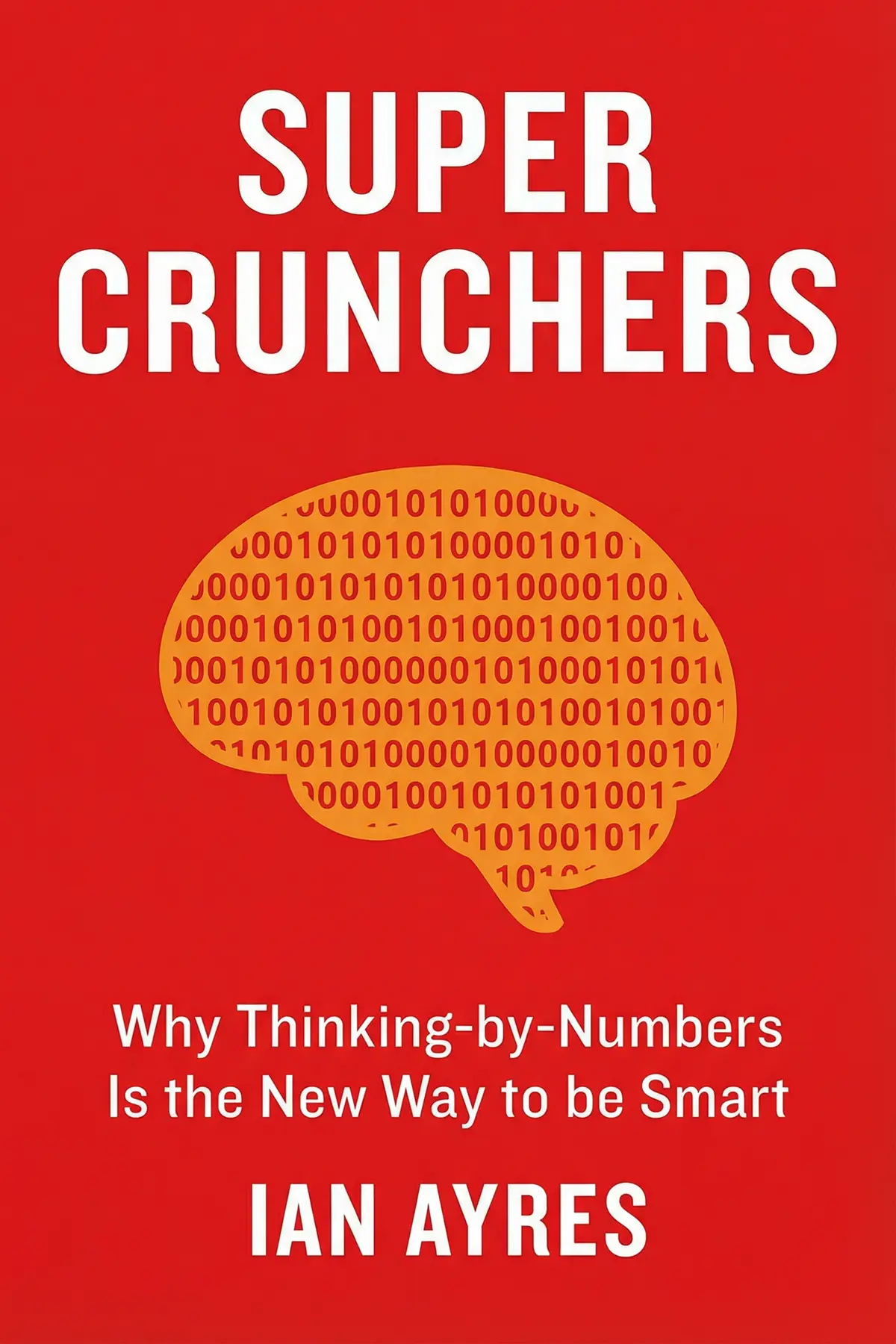
Shows how statistical analysis of large data sets, through regression and randomized testing, outpredicts expert intuition in wine, baseball, medicine, business and policy, and how experts can work with the numbers.
1 min 07 sec
If you make important calls on gut feel, a fairly simple equation may already be outperforming you. In Super Crunchers, lawyer, economist and Yale professor Ian Ayres reports that when one psychologist surveyed 136 contests between experts and statistical models, the experts clearly won only eight. Ayres calls the statistical analysis of large data sets super crunching, and he finds it at work in wine cellars, baseball clubs, dating sites, hospitals and government programs.
His argument is that numbers crunched at scale forecast the future and expose the past better than intuition, because intuition carries biases that a good data set does not. Experts still have a role, but it moves: they propose the ideas, and the numbers test them. Along the way you meet an economist who prices wine from rainfall, a bidding fraud caught in auction records and a webpage that runs its own experiment. By the end you will know the two tools behind most of these wins, regression and the randomized test, and how to run a small randomized test of your own this week.
1 min 53 sec
A young red wine is a bet on what it will taste like years from now. An economist found a way to place that bet without opening a single bottle, and a baseball writer did the same with players.
1 min 48 sec
The same statistical technique can tell a dating site who belongs together and tell an investigator who has been rigging public contracts. One tool, pointed in two opposite directions in time.
1 min 42 sec
Comparing two cancer treatments or two web pages sounds simple until hidden differences between the groups start faking the result. The fix Ayres describes is to stop choosing who goes where.
1 min 44 sec
Governments usually commit to a program first and learn whether it works later. Ayres describes researchers who flip that order, following families for a decade and testing anti-poverty ideas on a small scale first.
1 min 39 sec
Years of training and experience ought to beat a basic equation. A psychologist spent half a century checking, and his tally, along with one startling fact about children’s safety, shows where expert judgment goes wrong.
1 min 41 sec
Some well-paid professionals have already been replaced by algorithms. Others are doing better work than ever. The difference lies in one task no equation can do for itself.
1 min 14 sec
Ayres’s book is finally about who gets the last word on a decision. For a long time it went to whoever had the most experience: the taster, the scout, the loan officer, the clinician. His evidence suggests it should now go to the record of outcomes, analyzed at scale, because a record does not overweight a dramatic story or warm to a friendly face. People keep the earlier and harder job of deciding what deserves testing.
The most usable part of his case is also the cheapest. Ayres urges readers to produce their own data through randomized tests. A business unsure which of two advertising slogans catches attention can show them at random to website visitors, then compare click-throughs and the time people stay on the page. The same habit suits a team trying out a new process or a manager choosing between two ways of running a meeting.
Before the next decision you would normally settle by instinct, look for the history of outcomes you already hold, or set up a small, fair test to create one. An economist found the price of a wine in last winter’s rain. The evidence for your next decision is probably sitting just as close.
Doctors, scouts, bankers and policymakers have long trusted experience and instinct. Ian Ayres argues that a different method now beats them at their own game: the statistical analysis of large data sets, which he calls super crunching. Ayres shows the method at work in surprising places. An economist predicts the price of wine from rainfall records. A baseball writer spots a player the scouts dismissed. A dating site matches couples with an equation, and auction data exposes a bribery scheme. He explains the two tools behind these results, regression and the randomized test, and shows randomized trials shaping medicine, website design and public policy, from housing vouchers in American cities to anti-poverty pilots in developing countries. At the center is a hard finding for experts: across 136 studies comparing people with formulas, people clearly won only eight times. Ayres traces the gap to human bias. He does not write experts off. He gives them a new job, proposing the ideas the numbers then test, and he urges readers to run randomized tests of their own.
Managers and analysts who still make big calls on instinct and want a fairer way to decide.
Founders and marketers choosing between two designs, slogans or offers who want proof before committing.
Experts in medicine, finance or policy wondering how their role changes when data outpredicts them.
Ian Ayres, born in 1959, is an American lawyer and economist who holds professorships at both Yale Law School and the Yale School of Management. He cofounded StickK.com, a site built around commitment contracts, and his articles have appeared in the New York Times, the Wall Street Journal and the Financial Times. Super Crunchers became a bestseller.

Listeners find the work educational and articulate, with one listener characterizing it as a superb entry-level book regarding data mining. They value how easy it is to read, with one listener remarking that it is especially appropriate for individuals with a big data background. This title motivates audiences to pursue further knowledge, and one listener emphasizes its ability to enhance decision-making via computational creativity. Listeners view it as an empowering guide and enjoy the subject matter, although views on the material quality are varied.
As someone with a background in data science, I found this to be an incredibly inspirational look at the early days of the big data movement. Ayres perfectly captures the friction between 'old world' experts and the new wave of statistical profiling. The discussion on the 100,000 lives campaign was particularly moving; the slogan 'Some is not a number, soon is not a time' should be required reading for every corporate manager. I also loved the quiz on page 113—it really exposes how overconfident we are in our own biased estimates. The truth is, we are all prone to cognitive errors, and this book provides the framework for why we need to let the data do the talking. It’s a pellucid, well-researched argument for computational creativity that has aged surprisingly well despite the rapid changes in technology since its publication.
Show moreEver wonder why a computer can predict a winning Greyhound better than a seasoned track expert? Ayres dives into these types of 'super crunching' scenarios with a style that is both informative and highly readable for non-mathematicians. The Greyhound racing example is particularly mind-blowing because it shows how a simple computer model can yield a 25% profit while human experts consistently fail to keep up with the cold, hard numbers. I found the exploration of how casinos calculate a player's 'pain point' to be both fascinating and slightly terrifying. It’s a wake-up call about how corporations use our own data to manipulate our behavior. Personally, I think the most useful takeaway is that we should always be skeptical of 'expert' intuition when a randomized trial could provide a much clearer answer. This is an excellent, thought-provoking read that encourages you to seek out the data in your own life.
Show moreFinally got around to reading this classic, and the discussion on evidence-based medicine alone made it worth the price of admission. The way Ayres explains how Google is transforming medical culture—allowing patients and young doctors to bypass the 'wisdom' of older peers—is still incredibly relevant today. He does a fantastic job of explaining complex concepts like heteroskedasticity and regression without making your head spin. I loved the insight into how T-Rex was reimagined as a scavenger through data; it's a perfect example of why we shouldn't get too attached to our 'intuitions.' This is an inspirational read for anyone who prefers the 'pure truth' of an algorithm over the biased guesses of a human. It’s a bit of a 'money machine' of information. Highly recommended for those who want to understand the shift toward a more quantified society.
Show morePicked this up after reading Freakonomics, and it functions as a solid companion piece for anyone interested in how algorithms are quietly reshaping our everyday lives. Ayres focuses on the shift from expert intuition to data-driven decision-making, using the famous wine vintage prediction formula as a primary example. It’s fascinating to see how simple variables like rainfall and temperature can outperform the palates of world-renowned critics. While the book was written in 2007, the core message about the power of regression remains incredibly relevant today. Some sections feel slightly repetitive, and the author definitely likes to pat himself on the back, but the insights into evidence-based medicine and the '100,000 lives campaign' make it a worthwhile read. To be fair, if you already work in big data, some of this will feel like an introductory text, but for the general public, it's an eye-opener.
Show moreAfter hearing so much about 'computational creativity,' I decided to give this a go and wasn't disappointed by the breadth of real-world examples provided. Ayres makes a compelling case for why we should be wary when corporations start being 'nice' to us; it usually means they've crunched the numbers and realized we're overpaying. The section on car dealership discrimination was a gut-punch, showing how statistical profiling can be used to exploit certain demographics. It's an analytical look at the shift of power from the periphery to the 'Super Crunching' center. The writing is accessible, though the author's tone can be a bit self-congratulatory at times. Still, the explanation of neural networks versus traditional regression was one of the clearest I've ever read. It’s a great reference for anyone who wants to understand the logic behind the algorithms that run our world.
Show moreIn my experience, books about math are either too dense or too shallow, but Ayres finds a decent middle ground here. He highlights how randomization and large sample sizes are the only real ways to determine what actually works in government and medicine. The bit about how annual physical exams are largely obsolete according to data was shocking but well-supported. It really opens your eyes to the predictability of the world. While the 2007 publication date makes some of the technology talk feel like ancient history, the underlying logic of data-driven decision-making is timeless. I particularly appreciated the discussion on how the internet is disrupting the traditional 'sage' status of doctors. It's a well-written, informative text that will definitely make you rethink your own decision-making process. I’m glad I didn't shove it back on the shelf.
Show moreLook, the book is a bit dated now, especially when Ayres discusses the 'novelty' of internet data mining which is now just standard corporate practice for almost every company on earth. I found the chapter on regression to the mean interesting, particularly the bit about how tall fathers often have shorter sons, but I wish he had snuck those statistical foundations in much earlier. The Greyhound racing study mentioned in the beginning felt like a missed opportunity; if a computer model is a 'money machine' with 25% profit, why isn't everyone doing it? Something felt a little fishy there. It’s a decent introductory text if you’ve never thought about A/B testing or randomization before. However, if you’ve read anything published in the last five years on big data, you can probably just skim this one. It's okay, but not groundbreaking anymore.
Show moreThis book attempts to bridge the gap between human intuition and mathematical algorithms, though it sometimes leans too far into the 'formula is always right' camp. I struggled with the idea that 'direct instruction' for teachers—literally reading from a script—is the best way to educate children just because the numbers look good on a chart. Statistics are powerful, but they don't always capture the nuance of the human experience. The wine vintage discussion was the highlight for me, as it perfectly illustrated the outrage experts feel when their 'wisdom' is challenged by a simple equation. It's a bit of a mixed bag. Some chapters are brilliant and others feel like filler seasoned with dabs of fun. It’s worth reading for the parts on standard deviation, but be prepared for some 'blah' stretches in the middle.
Show moreThe word 'supercrunch' appears so many times in these 270 pages that it starts to lose all meaning. Dr. Ayres clearly wanted to write the next big pop-economics hit, but he missed the mark by being overly repetitive and a bit too self-promotional regarding his ties to Steven Levitt. It’s just grating. The book focuses heavily on anecdotes rather than teaching the reader the actual statistical techniques he champions. I was looking for a deeper dive into how to apply these methods, yet I walked away only knowing that regression was discovered by Darwin’s cousin. Frankly, it feels like a collection of research descriptions fleshed out with too much filler. If you want to know that computers are better than people, this book tells you that a billion times. It doesn't really show you how to join the revolution yourself.
Show moreNot gonna lie, I expected a lot more 'how-to' and a lot less 'wow, look at me.' Ayres spends so much time using the prefix 'nano-' and the word 'supercrunch' as every possible part of speech that the actual message gets buried. He stresses the need for the public to understand statistics but then fails to go over any actual techniques in a meaningful way. It feels very much like a Freakonomics wannabe that lacks the charm and tight editing of the original. The anecdotes vacillate between being creepy and overly exuberant. For example, the way he describes data mining in dating and medicine feels a bit paranoid at times. It’s a short enough book that it doesn't completely waste your time, but it certainly didn't leave me feeling like I learned anything I couldn't have found in a long-form magazine article. Very repetitive.
Show moreAyres argues that statistical analysis of large data sets, which he calls super crunching, predicts the future and uncovers the past better than human judgment, because people are swayed by bias. He shows it in wine pricing, baseball scouting, online dating, fraud detection, medicine, web design and public policy, and argues that experts must learn to work with the numbers instead of against them.
Regression is a technique that studies historical data to measure how different factors affect one outcome. Ayres shows it working forward and backward. eHarmony uses it to estimate which users will be compatible, based on trait combinations that paired well in the past. Ayres himself used it on auction data to expose a bribery scheme in New York construction bidding during the 1990s.
According to the work Ayres cites, almost always. Psychologist Paul Meehl compared expert forecasts with simple statistical models, first in around 20 studies from 1954 and later in 136 studies. In the larger survey, experts were clearly more accurate in only eight. Ayres blames bias: people overweight vivid events, so they fear guns more than swimming pools, though pools are almost 100 times deadlier for children.
No. Ayres says some roles, like the bank loan officer, have been replaced by algorithms, but most experts gain a new job. Numbers can test a hypothesis, yet a person has to propose it and choose which variables to analyze. Studies he cites suggest experts decide better when given statistical results, and that expert opinion should support the statistics rather than override them.
Run your own randomized tests. Ayres suggests showing two advertising slogans to website visitors at random and comparing click-throughs or time spent on the page. The same logic works for page designs, as Offermatica’s software does, or for piloting a new process with a random part of a team, as the Poverty Action Lab pilots programs before scaling them up.
Kai-Fu Lee




Andrew Ross Sorkin

Ha-Joon Chang

Niall Kishtainy
AUDIO SUMMARY AVAILABLE
Get the key ideas from Super Crunchers by Ian Ayres, plus 5,000+ more nonfiction titles.









