

13 min 38 sec
Available in: English
 ไทย
EnglishไทยStumbling on Happiness
Gilbert shows why our predictions about what will make us happy go wrong, from mood-tinted forecasts to flattering memories. He also explains why asking people who have lived an experience, and acting boldly, leads to better choices.
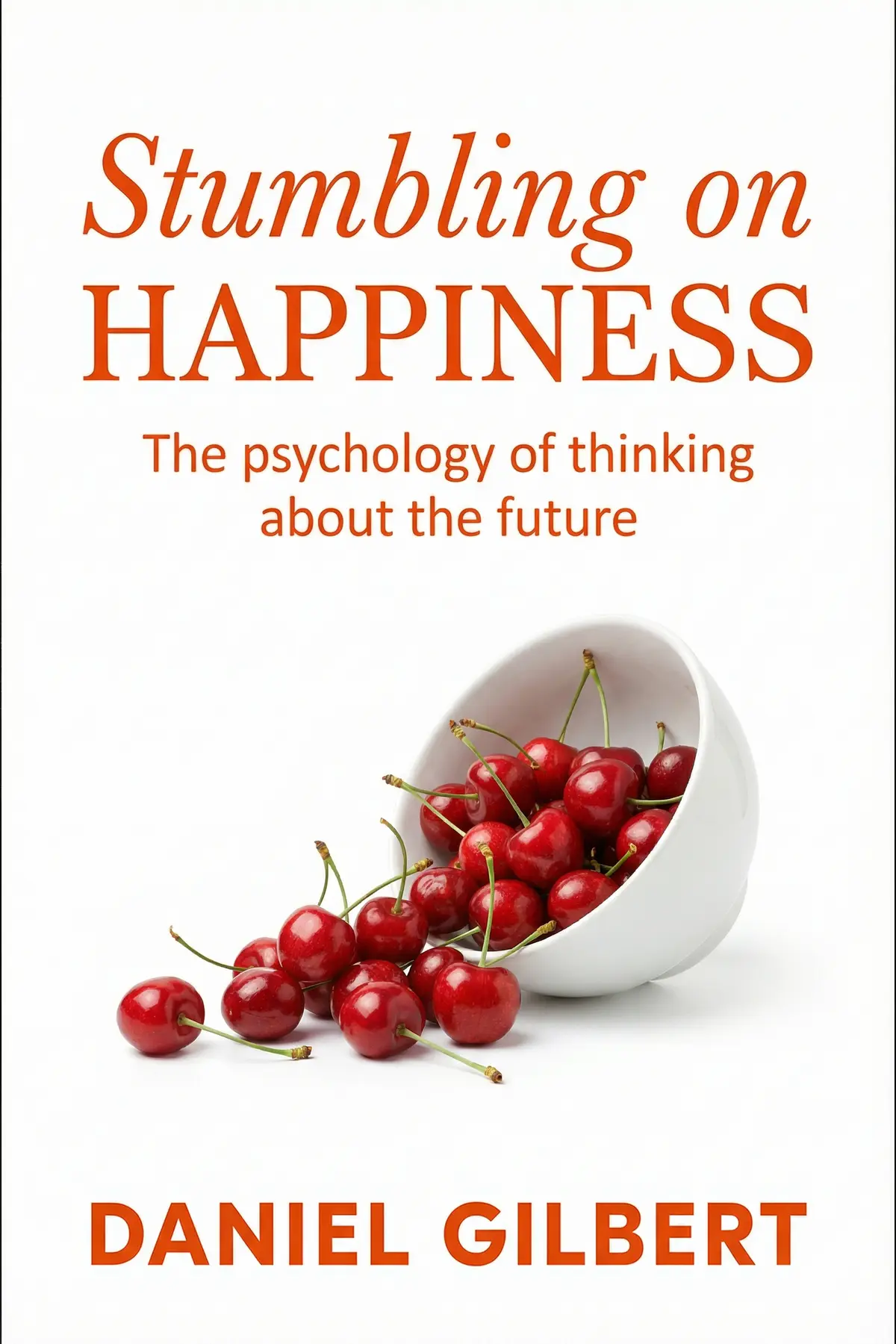
Table of Content
1. Introduction
1 min 04 sec
Most people feel sure they know what will make them happy, and most get it wrong in the same predictable ways. In Stumbling on Happiness, Harvard psychologist Daniel Gilbert traces those errors to a habit the brain keeps hidden: it fills in missing details and hands us the result as fact. It does this with the blind spot in every eye, with our memories and, most costly of all, with the futures we imagine.
Because we cannot see the filling in, Gilbert argues, we pick plans, purchases and risks that leave us less happy than we expected. The errors follow patterns, though, and patterns can be caught. Learn them and you can spot a mood bending a forecast, judge a price by what else the money buys, discount the one bright moment of a dull trip, and find the person whose experience is a better guide to your future feelings than your own imagination. Gilbert’s advice is simple: be bold, and ask others.
2. Spot the details your mind invents
1 min 32 sec
Part of what you see right now is made up, and you have no idea which part. The same hidden editing shapes your memories and your plans, and it makes imagined futures feel far more certain than they are.
3. Keep today's mood out of tomorrow's plans
1 min 29 sec
A week of groceries bought at the wrong moment can run out by Wednesday. The reason reaches far beyond food, and it can talk you out of a presentation that would have gone perfectly well.
4. Rate past experiences by their ordinary hours
1 min 29 sec
A week of insect bites and stony ground should put anyone off camping for life. One small surprise can reverse that verdict, and the way it does so explains why people keep repeating experiences they did not enjoy.
5. Judge a price by what else money buys
1 min 51 sec
Offered two identical holidays, most people pick the more expensive one and feel clever about it. The same faulty yardstick explains why a belief about wealth keeps spreading even though it is mostly false.
6. Small annoyances outlast big disasters, and here is the reason
1 min 47 sec
A chipped nail and a burned-down house should not compete for your misery, yet the smaller one can win. Gilbert explains the defense behind this, and why solving a pleasant mystery can drain the pleasure out of it.
7. Commit fully and let your mind make peace
1 min 39 sec
Keeping your options open feels like the safe move, and avoiding risky choices feels like protection from regret. Gilbert finds that both instincts point the wrong way, and a birthday watch shows why.
8. Ask someone who has already lived it
1 min 38 sec
Your situation feels too personal for anyone else’s story to apply. Gilbert argues the opposite, with one warning: the people you would naturally ask are often the worst ones to tell you the truth.
9. Conclusion
1 min 09 sec
Gilbert’s book leaves a humbling picture of the mind as a skilled editor that never shows its edits. It patches the blind spot, adds a grin to a waiter who never smiled, turns a week of mosquitoes into a fond memory because of $100 under a rock, and paints a pizzeria you have never seen in confident detail. Because the edits feel like facts, we steer our lives by them, and the choices often leave us unhappier than we hoped.
His remedy is modest and practical. When the only evidence is your own imagination, borrow someone else’s experience, ideally from a person who has lived what you are weighing and has no reason to flatter you. When a decision to act scares you, remember that the mind can find value in a mistake but has nothing to work with in a chance you passed up. Smaller checks help too: avoid shopping on a full stomach, set a price against what else the money could buy, and recall the ordinary hours of a trip before booking it again.
Happiness is hard to aim at. It gets easier to stumble into once you stop trusting the picture your mind painted and go ask someone who has seen the real thing.
About this book
What is this book about?
We make our biggest decisions by imagining how they will feel: a new job, a move, a purchase, a trip. Daniel Gilbert, a Harvard psychologist, argues that this imagining is far less reliable than it feels. The brain fills in missing details everywhere, from the blind spot in each eye to the memory of a bad dinner, and it never tells us which parts it made up. Gilbert follows that habit into the errors it causes. A full stomach shortens a shopping list. One lucky find rewrites a miserable camping trip. A rising price hides a good deal, and a chipped nail can bother us longer than a house fire. He also explains why we regret what we never tried, why gifts we cannot return please us more, and why friends make poor advisers. Readers get a clear map of the ways their minds mislead them about the future, and two practical habits that follow from it: ask people who have already been through what you are weighing, and when in doubt, act.
Book Information
Who it's for
Professionals weighing big decisions
Professionals weighing a job change, a move or a big purchase who want to know how it will really feel.
Afraid of regret
People who keep hesitating over risky choices and fear regret.
Curious why we misjudge
Curious readers who want a clear, story-driven tour of why the mind misjudges memory, prices and the future.
About the Author
Daniel Gilbert
Daniel Gilbert is an American social psychologist and a professor of psychology at Harvard University. With Timothy Wilson he is known for research on affective forecasting, the study of how well people predict the emotional impact of future events. The American Psychological Association gave him its early career award for distinguished scientific contribution. Stumbling on Happiness has appeared in more than 30 languages and won the 2007 Royal Society Prize for Science Books. He has also presented a nonfiction series on PBS and given three TED talks.
Ratings & Reviews
Ratings at a glance
What people think
Listeners find the book to be thought-provoking, with one review observing how it interlaces psychological facts and theories. The writing is approachable and captivating, and listeners enjoy the humor, with one mentioning how it educates while staying entertaining. Listeners characterize it as an excellent volume on the science of happiness, and one review emphasizes how it causes readers to reflect on their own thinking. Although some listeners find it simple to follow and absorbing, others claim it is a difficult read and can be tedious.
Top reviews
Kek
Finally got around to reading this after seeing Daniel Gilbert’s TED talk, and the book is even better. It is definitely not a 'how-to' guide for finding joy; instead, it is a fascinating exploration of why we are so terrible at predicting what will make us happy in the future. Gilbert uses a lightness of touch and a sharp wit that makes complex psychological research feel like a conversation over a beer. I found myself laughing out loud at his analogies while simultaneously reconsidering every major life decision I’ve ever made. The way he explains our 'blind spots' and how we fill in details of the future that don't exist is genuinely eye-opening. While some might find his humor a bit much, I thought it kept the dense information from feeling like a textbook. If you want to understand the machinery of your own mind, this is essential reading.
Show moreMai
Picked this up on a whim and was absolutely captivated by the unique perspective on human decision-making. Gilbert explains that our brains are 'filling-in' machines that create a future based on our biased pasts and our present moods. This isn't your typical self-help fluff; it’s a rigorous look at the mechanics of the mind. The humor is sharp and frequent, making the data on risk aversion and habituation easy to digest. I found the section on conjoined twins particularly moving and thought-provoking, as it challenged my own assumptions about what constitutes a 'good' life. It makes you reflect on your own choices and why you chase things that don't actually bring lasting satisfaction. It's a superb tome that is both intellectually stimulating and genuinely entertaining to read.
Show moreJoy
Truth is, I didn't think a book about psychology could be this funny. Gilbert has a way of explaining the most complex theories of the mind with analogies that are both hilarious and perfectly accurate. This book really makes you reflect on your own thoughts and the ways you've lied to yourself about what you want. The idea that we are much more like everyone else than we care to admit was a tough pill to swallow, but he presents it with such charm that you can't help but agree. It’s a brilliant exploration of the human condition and why we are consistently surprised by our own feelings. I've already recommended it to several friends who are interested in why humans behave the way they do.
Show moreSupaporn
As a person who usually avoids pop-science, I was surprised by how much I enjoyed this. Gilbert manages to weave together neuroscience, philosophy, and behavioral economics without ever making the reader feel overwhelmed or bored. The book focuses on the 'prospection' errors we make, essentially showing how our brains are wired to fail at imagining our future selves correctly. I particularly liked his point about how we treat our future selves like strangers. Frankly, it’s a bit humbling to realize that our imaginations are so flawed. My only real gripe is that the book stops right when it gets to the 'so what?' part of the equation. He explains the problem beautifully but offers very little in the way of solutions, which might frustrate some readers looking for more practical application.
Show moreLily
After hearing about this book for years, I finally dove in and found it incredibly thought-provoking. Gilbert is a smooth and entertaining writer who knows how to keep a narrative moving even when discussing complex neurological processes. The central premise—that we 'stumble' on happiness rather than finding it through careful planning—is backed by some really fascinating experiments. I especially appreciated the discussion on how variety is the key to beating habituation, even if we naturally resist it. Sometimes the jokes felt a bit forced, but they did help break up the more academic sections of the text. It’s a great book for anyone interested in why they make the same mistakes over and over again. It’s definitely more of a science book than a self-help one, which was a welcome change of pace for me.
Show moreWilliam
Ever wonder why we work so hard for things that don't end up making us happy? Gilbert answers this by looking at the blind spots in our predictive abilities, specifically how we fail to account for absences. The writing is accessible and engaging, making it one of the better pop-science books I’ve read in recent years. He does a great job of explaining why we trust our own imaginations more than the testimony of others, even though the latter is more accurate. While the tone is a bit academic at times, the insights into 'prefeeling' and the 'psychological immune system' are worth the effort. I walked away feeling like I understood my own brain a little better, even if I’m still just as likely to make the same errors tomorrow.
Show moreArm
Not what I expected based on the title alone. If you’re looking for a roadmap to bliss, you should probably look elsewhere because this is strictly a cognitive psychology book. Truth is, I found the middle sections quite monotonous as the author listed experiment after experiment to prove a point that felt a bit obvious after the first few chapters. Gilbert is undeniably smart, but his tone can occasionally drift into being a bit patronizing, as if he's the only one who has figured out that our memories are biased. I appreciated the sections on how our current emotions color our view of the future, but the lack of a strong cohesive thesis made it feel like a collection of essays rather than a unified book. It's an interesting read for a rainy weekend, but it didn't stay in my memory as much as I hoped it would.
Show moreMuk
The chapter on how we perceive the future through the lens of the present was the highlight for me, but the rest felt a bit hit-or-miss. Personally, I found the author’s wit to be a double-edged sword; sometimes it was genuinely funny, but other times it felt like he was trying too hard to be the 'cool professor.' The book does a great job of outlining our cognitive fallacies, like how we overestimate how bad we will feel after a tragedy. However, it felt like a bit of a laundry list of psychological quirks without a strong ending to tie them all together. It's a decent introduction to the field if you're new to it, but seasoned readers of behavioral science might find it a bit repetitive. It's fine for what it is, but it didn't leave a lasting impact on my life.
Show morePhu
In my experience, books with titles like this are usually a letdown, and while this wasn't bad, it wasn't life-changing either. The book is essentially about how we suck at predicting our future emotions because our present state influences us so much. It’s a solid premise, but the author takes a very long time to get to the point in several chapters. There is a lot of 'academic fluff' that could have been trimmed down to make for a more punchy read. It’s well-researched, sure, but I found myself skimming through some of the longer descriptions of old psych experiments. It’s a good choice if you want a light introduction to cognitive psychology, but don't expect it to actually help you find happiness in any practical way.
Show moreChatri
Look, I know this is a bestseller and highly recommended by everyone, but I couldn't get past the author's cocky writing style. Gilbert treats the reader like an idiotic student, reiterating basic concepts as if they are revolutionary discoveries that he personally unearthed. It felt like he was talking down to me for the entire duration of the book. He acknowledges in the beginning that he wrote it 'all by himself' and then spends the rest of the time citing his students' hard work, which felt incredibly arrogant. While the science behind our predictive failures is sound, the delivery was so infuriating that I struggled to finish it. If you have any background in psychology, you already know 90% of what is in here anyway. Save your time and read a more humble researcher's work instead.
Show moreQuestions about this book
What is the main idea of Stumbling on Happiness?
Daniel Gilbert argues that we choose our futures using memory and imagination, both of which the brain quietly fills in with invented details. Because we cannot see this happening, we trust forecasts that are only one guess among many, colored by our current mood and by memorable but rare moments. The result is choices that often leave us unhappier than we expected.
Why are people bad at predicting what will make them happy?
Gilbert describes several causes. Imagination supplies details we do not actually know. Present feelings, like being full or angry, distort how we picture later events. Memory favors unusual moments, so a dull trip with one lucky find seems great. We also underestimate how fast we recover from major setbacks, and we overrate the value of keeping our options open.
Does Stumbling on Happiness say money makes you happier?
Only up to a point. Gilbert writes that money boosts happiness when it moves people from poverty into the middle class, and Americans who make $50,000 annually report far more happiness than people who make $10,000. Beyond that level, extra money adds little. He argues the opposite belief persists because an economy needs people who keep striving to earn and spend.
How can I apply the ideas from Stumbling on Happiness?
Gilbert’s two main lessons are to ask people who have already been through what you are considering, since their feelings predict yours well, and to act when you are unsure, because the mind finds value in mistakes but not in missed chances. Smaller habits also follow: plan when your mood is neutral, and compare prices with other uses of the same money.
Readers also enjoyed

Acting with Power: Why We Are More Powerful Than We Believe
Deborah Gruenfeld


Age of Propaganda: The Everyday Use and Abuse of Persuasion
Anthony Pratkanis




59 Seconds: Change Your Life in Under a Minute
Richard Wiseman


AUDIO SUMMARY AVAILABLE
Listen to Stumbling on Happiness in 15 minutes
Get the key ideas from Stumbling on Happiness by Daniel Gilbert, plus 5,000+ more nonfiction titles.
- 5,000+ titles
- Listen as much as you want
- 7-day free trial
- Cancel anytime









