
14 min 54 sec
Available in: English
 ไทย
EnglishไทยStolen Focus: Why You Can’t Pay Attention – and How to Think Deeply Again
By Johann Hari
Shows why staying focused feels harder every year, how apps and modern work are built to break your attention, and which changes in technology, workplaces and daily habits can help you think deeply again.
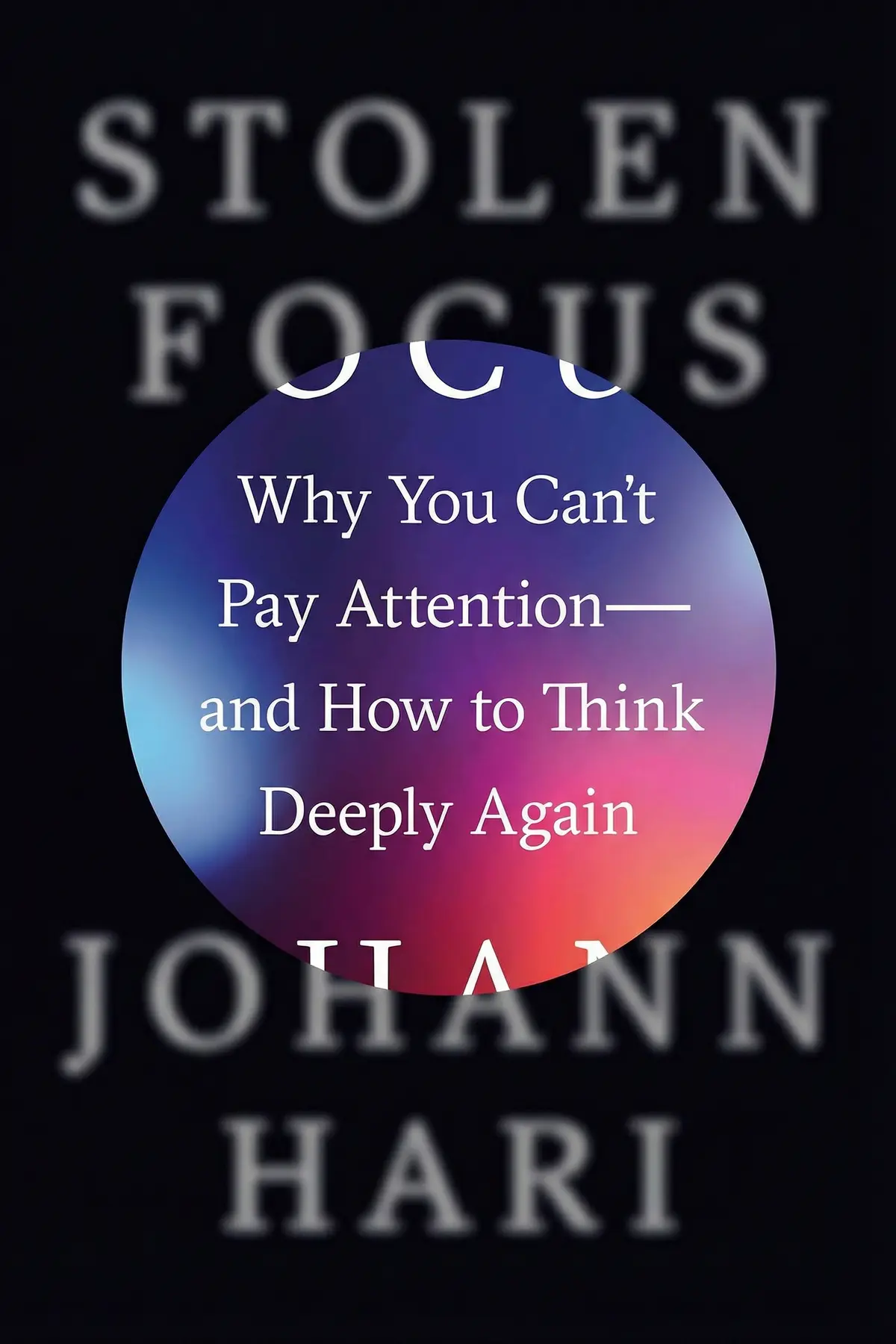
Table of Content
1. Introduction
1 min 02 sec
If you sit down to work and surface an hour later from a chain of texts, alerts and photos, the problem may not be your willpower. In Stolen Focus, British journalist Johann Hari argues that our attention is being taken from us, by a rising flood of information and by apps engineered to hold us. One Danish study found that topics stayed popular on Twitter for 17.5 hours in 2013 and only 11.6 hours by 2016, a loss of about six hours in three years.
Hari’s case is that this is a shared crisis with designed causes, so the cure has to reach technology and work as well as personal habits. Along the way you meet a rat pressing a button for food, the engineer who regrets the endless feed, and a car factory that earned more by working less. What you gain is a clear view of who profits from your distraction, and several places to start taking your focus back.
2. Stop blaming yourself for a scattered mind
2 min 08 sec
A professor who felt his concentration slipping decided to measure it, and found the slide began long before smartphones. His data points to a cause that no amount of personal discipline can fully fix.
3. Spot the reward loop behind every like
2 min 07 sec
A rat ignored a pointless button until one small change made it press again and again. That same change now sits on the screen in your pocket, and it explains why closing an app feels so hard.
4. See how your feed rewards anger over calm
1 min 48 sec
Facebook ran its own internal study on what its algorithms promote, and the conclusion was blunt. What it found about the human brain helps explain why scrolling so often leaves you tense.
5. What a society loses when it cannot focus
2 min 14 sec
In the 1970s, scientists spotted an invisible threat in the sky, and the world eventually acted on it. Hari asks what made that possible, and why the same feat looks so much harder now.
6. Find flow by doing one thing at a time
2 min 12 sec
Interrupted workers in one study briefly performed as if they had lost ten IQ points. Yet many offices still treat juggling tasks as a badge of effort, and a psychologist’s alternative points the other way.
7. A shorter workweek that gets more done
2 min 08 sec
A car factory cut two hours from every workday, and its output went up rather than down. The numbers moved in a direction few managers would predict, and other places are now rewriting the rules of work.
8. Conclusion
1 min 15 sec
Stolen Focus adds up to a shift of blame. The scattered mind you fight every day is the predictable result of faster information, apps tuned to hold you and workplaces that reward juggling. That is why Hari insists the response must be shared: designers rethinking their products, employers rethinking the week, and citizens guarding the attention they need to act together, as they once did over a hole in the sky.
None of that excuses you from your own part. You can notice when a feed is paying you in hearts, step away when a post is built to anger you, and give one meaningful task an unbroken stretch where flow can begin. If you shape anyone’s working day, you can test fewer hours with fewer interruptions.
Hari closes on advice that runs against instinct. When you feel stuck, stop forcing concentration and let your mind wander. Drifting thoughts form unexpected links, and creativity grows from those links. Doing nothing is a kind of focus too.
Your attention was taken a little at a time. You can win it back the same way, starting with a few minutes when nothing is asking for it.
About this book
What is this book about?
Many people end the day busy but with little done, pulled from one ping to the next. Johann Hari argues that this is not a private failure of willpower. Our attention is being taken from us by a steady speeding up of information and by technology designed to keep us hooked. Hari follows the problem from a Danish professor's study of shrinking public interest to the Stanford lab where behavioral psychology met software. He looks at the engineer who now regrets inventing the infinite scroll and at algorithms that reward outrage. He shows what that does to a society's ability to focus on shared dangers, then explains why multitasking fails and how the state psychologists call flow restores deep concentration. The book ends with signs of change: designers rethinking social media, a New Zealand firm on a four-day week, a car factory that earned more with shorter days and a French law that limits after-hours work. Readers get a clear account of who profits from their distraction and practical ways to win some of their focus back.
Book Information
Who it's for
Phone-wary office workers
Office workers who end busy days with little finished and suspect their phone is part of the reason.
Team leaders weighing changes
Managers and team leads weighing shorter hours, fewer interruptions and less multitasking.
Uneasy about social media
Anyone uneasy about how social media shapes their mood, their politics and their ability to think deeply.
About the Author
Johann Hari
Johann Hari, born in 1979, is a British writer and journalist. His journalism has run in The Guardian, The New Republic, the Los Angeles Times and The New York Times. He left The Independent in 2011, resigning after he admitted plagiarism and fabrication in his work there. He then turned to books on topics ranging from depression to drug policy, including Lost Connections and Chasing the Scream, a New York Times best seller about the war on drugs.
Ratings & Reviews
Ratings at a glance
What people think
Listeners find the book engaging and thoroughly investigated, valuing its academic citations and the way it blends scientific depth with approachable prose. They characterize it as stimulating and revelatory, with one listener highlighting how individual narratives are integrated throughout. The prose earns favorable reviews, and listeners view the work as significant, with one mentioning it should be mandatory reading for high school students. Responses to the book's central theme are varied; while some celebrate its capacity to boost attention spans, others observe that the writer's own focus drifts mid-way. Additionally, the political perspectives included face pushback for being biased.
Top reviews
Vimolwan
This book felt like a bucket of cold water to the face. Hari masterfully articulates why we feel so fragmented, arguing that our loss of focus isn't a personal failing but a systemic theft. Truth is, I always blamed my own lack of willpower for my late-night scrolling habits. However, after reading about "surveillance capitalism" and the way algorithms are literally designed to hijack our dopamine loops, my perspective has shifted entirely. The writing is incredibly propulsive and readable, making complex sociological concepts feel urgent and personal. While he does lean into his own political leanings at times, the core message about reclaiming our collective attention is too important to ignore. It’s a sobering look at how Big Tech treats our minds as natural resources to be mined for profit. I found the chapters on the importance of "flow states" particularly life-changing. Every person with a smartphone needs to grapple with these ideas before our ability to think deeply vanishes for good.
Show moreThitima
After hearing so much buzz about this, I finally dove in and wasn't disappointed. Hari's journey to a tech-free beach town serves as a poignant backdrop for a much larger investigation into the twelve forces ruining our concentration. Not gonna lie, I was skeptical at first, but the interviews with former Silicon Valley engineers are chilling. They confirm our worst fears about how these platforms are engineered for addiction. I particularly appreciated the distinction between "cruel optimism"—the idea that we can just buy a "phone jail" to fix ourselves—and the need for actual political regulation. The book is well-researched, though some might find the narrative style a bit meandering in the middle sections. Still, the way he connects sleep deprivation and poor nutrition to our cognitive decline is fascinating. It’s a call to arms for anyone who misses the feeling of being fully immersed in a long book or a deep conversation.
Show moreEye
Wow, I didn't realize how much my 'mind-wandering' time had been replaced by the orange glow of social media algorithms. This book is a hauntingly beautiful exploration of what it means to be human in an age of digital distraction. Hari’s writing is poetic and evocative, especially when he describes the simple joy of sinking into a long novel without the itch to check a notification. I was captivated by the stories of the engineers who regret their creations; it felt like a modern Frankenstein tale. The book argues that we are losing our ability to solve big problems because we can’t even focus on small ones anymore. Some critics say he’s too pessimistic, but I found his call for a "pro-attention" movement to be incredibly inspiring. It’s not just about being more productive at work—it’s about having a soul and a life that belongs to you, not a billionaire in California.
Show moreKru
Ever wonder why you can't even sit through a movie without checking your phone three times? This book explains exactly why that is, and the answer is terrifying. Hari takes us on a global tour to meet the people who are fighting to save our focus, from activists in France to scientists in the UK. The most powerful takeaway for me was the idea that our attention hasn't collapsed—it was stolen. That shift in language is so important because it moves us from guilt to anger and, hopefully, to action. The book is well-paced and balances heavy data with human stories effectively. I especially loved the section on how "multi-tasking" is actually just our brains rapidly switching and losing IQ points in the process. It’s a wake-up call that should be mandatory reading for anyone who feels like their life is slipping away one scroll at a time.
Show moreChamnong
Picked this up during a particularly bad bout of burnout and it was exactly the medicine I needed. The book is an urgent, deeply researched plea for us to reclaim our lives from the "outrage economy." Hari argues that our inability to focus is why we can't solve major societal issues, and that connection alone makes the book worth reading. I was particularly struck by the research on sleep; it turns out we are all essentially walking around in a permanent state of "attention hangovers." The prose is engaging and never feels dry, even when he's diving into the nitty-gritty of algorithmic design. Frankly, it’s one of those rare books that changes the way you see the world the moment you step outside. It’s not just about "digital detoxing"—it’s about demanding a world that is built for human beings instead of for profit. A truly essential read for the modern age.
Show moreWatchara
As a high school teacher, I found myself nodding along to almost every page regarding our students' dwindling attention spans. Hari makes a compelling case that we are living through a massive ecological crisis of the mind. The chapters regarding the "confinement of children" and the lack of free play were especially resonant for me. Frankly, it explains so much of the anxiety and lack of focus I see in the classroom every single day. I do have to mention that the author's political bias is quite prominent, which might alienate some readers who aren't on board with his critique of capitalism. Also, his writing style is very journalistic—it's a breeze to read, but sometimes it feels like he simplifies complex scientific debates to fit a neat story. Regardless of those minor gripes, the central thesis is undeniable. We are losing something precious, and we need to fight to get it back.
Show moreChon
Johann Hari has this unique ability to weave personal anecdotes with high-level sociological research. Picked this up hoping for some productivity hacks, but I got something much deeper instead. The book shifts the blame away from the individual and places it squarely on the corporations that profit from our distraction. Look, it’s refreshing to hear someone say that it’s not just your fault that you can’t stop checking Instagram. The concept of "flow" and how it is being systematically destroyed by constant interruptions was a huge "aha" moment for me. However, I did find that the book loses a bit of steam toward the end when it tries to link everything to climate change. It felt like a bit of a reach, even if the underlying sentiment was well-intentioned. Overall, it’s an eye-opening read that will make you want to toss your phone into the nearest body of water.
Show moreNit
Gotta say, I'm a huge fan of Lost Connections, so I had very high expectations for this one. While it didn't quite hit the same emotional heights for me, it’s still a fantastic piece of investigative journalism. Hari has a knack for finding the right people to interview, and his conversation with the "flow" expert Mihaly Csikszentmihalyi was a highlight. He covers a lot of ground—from the impact of lead in our air to the way our offices are designed. My only real complaint is that some of the solutions felt a bit vague or overly idealistic. Is a "grassroots movement" against Big Tech really feasible when we are all so addicted to the tools we’d need to organize? It’s a bit of a catch-22. Regardless, the book is incredibly thought-provoking and has definitely changed the way I interact with my devices. I’ve already started implementing his "phone jail" suggestion for a few hours every evening.
Show moreSam
Wait, did we just ignore the biological reality of neurodivergence for the sake of a narrative? While I found the first half of the book about Big Tech and surveillance capitalism to be absolutely brilliant, the section on ADHD was incredibly frustrating. In my experience, suggesting that ADHD is primarily an environmental byproduct of a fast-paced world feels dangerously close to ableism. He minimizes the role of executive function and dopamine regulation, which are very real struggles for those of us who are neurodivergent. It felt like he was cherry-picking certain scientists to support a "nature vs. nurture" argument that has already caused so much stigma. That said, his points about the "outrage economy" and the death of sustained reading are spot on. It’s a frustratingly uneven read; half of it is a five-star masterpiece on modern technology, while the other half feels like a poorly researched opinion piece on mental health. Proceed with caution.
Show morePete
Personally, I find it hard to separate the message from the messenger given Hari's history of journalistic issues. I went into this wanting to like it because the topic is so relevant, but the "confirmation bias" is just too loud to ignore. He presents complex scientific theories as settled facts when they are actually highly disputed in the academic community. To be fair, he is a gifted storyteller, and the prose flows smoothly, but I kept asking myself: "Is this the whole truth?" The way he dismisses the biological basis of ADHD to suit his environmental narrative is particularly egregious and feels quite dated. He seems to prioritize a compelling "aha!" moment over nuanced scientific accuracy. If you want a fun, breezy read about why the internet is bad, this is fine. But if you’re looking for a rigorous, trustworthy analysis of human attention, I’d suggest looking elsewhere. It felt more like an elongated magazine article than a serious non-fiction book.
Show moreQuestions about this book
What is the main idea of Stolen Focus by Johann Hari?
Hari argues that our shrinking attention is mainly caused by forces around us, not by personal weakness. Information has been speeding up for over a century, and modern apps are deliberately designed to keep us engaged so platforms can sell more ads. Workplaces that praise multitasking add to the damage. Because the causes are built into systems, he says the solutions must include changes to technology and work, alongside personal habits.
Why does Stolen Focus say social media is addictive by design?
Hari traces the design to Stanford’s Persuasive Technologies Lab, which applied behavioral psychology to software. Like buttons echo B. F. Skinner’s rats, which kept pressing a button once it delivered food. The infinite scroll, invented by Aza Raskin, removed the natural pause at the bottom of a page, and Raskin estimates it makes people stay about 50 percent longer. Platforms measure success in minutes of engagement, which become ad revenue.
What does Stolen Focus say about multitasking?
Humans cannot truly multitask, Hari explains. We switch rapidly between tasks, and each switch forces the brain to reset and lowers performance. In a study commissioned by Hewlett Packard, people distracted during a task lost about ten IQ points while doing it. The alternative is flow, a state described by Mihaly Csikszentmihalyi, which needs a task that is rewarding in itself, challenging but achievable, and done on its own.
How can I apply the ideas in Stolen Focus?
Notice which rewards, such as likes, keep you on an app, and which posts hold you through anger. Give one meaningful task an unbroken block of time to give flow a chance. If you manage people, consider shorter hours with fewer interruptions, like the four-day week at Perpetual Guardian or the shorter days at a Toyota factory in Gothenburg. When stuck, Hari suggests letting your mind wander to spark creative connections.
Readers also enjoyed

AI 2041: Ten Visions for Our Future
Kai-Fu Lee





168 Hours: You Have More Time Than You Think
Laura Vanderkam

AUDIO SUMMARY AVAILABLE
Listen to Stolen Focus in 15 minutes
Get the key ideas from Stolen Focus by Johann Hari, plus 5,000+ more nonfiction titles.
- 5,000+ titles
- Listen as much as you want
- 7-day free trial
- Cancel anytime









