
13 min 37 sec
Available in: English
Start Finishing: How to Go from Idea to Done
Shows how to pick the idea that matters most, turn it into a project with a clear goal and supporters, protect weekly time for it, get unstuck when it stalls and finish well.
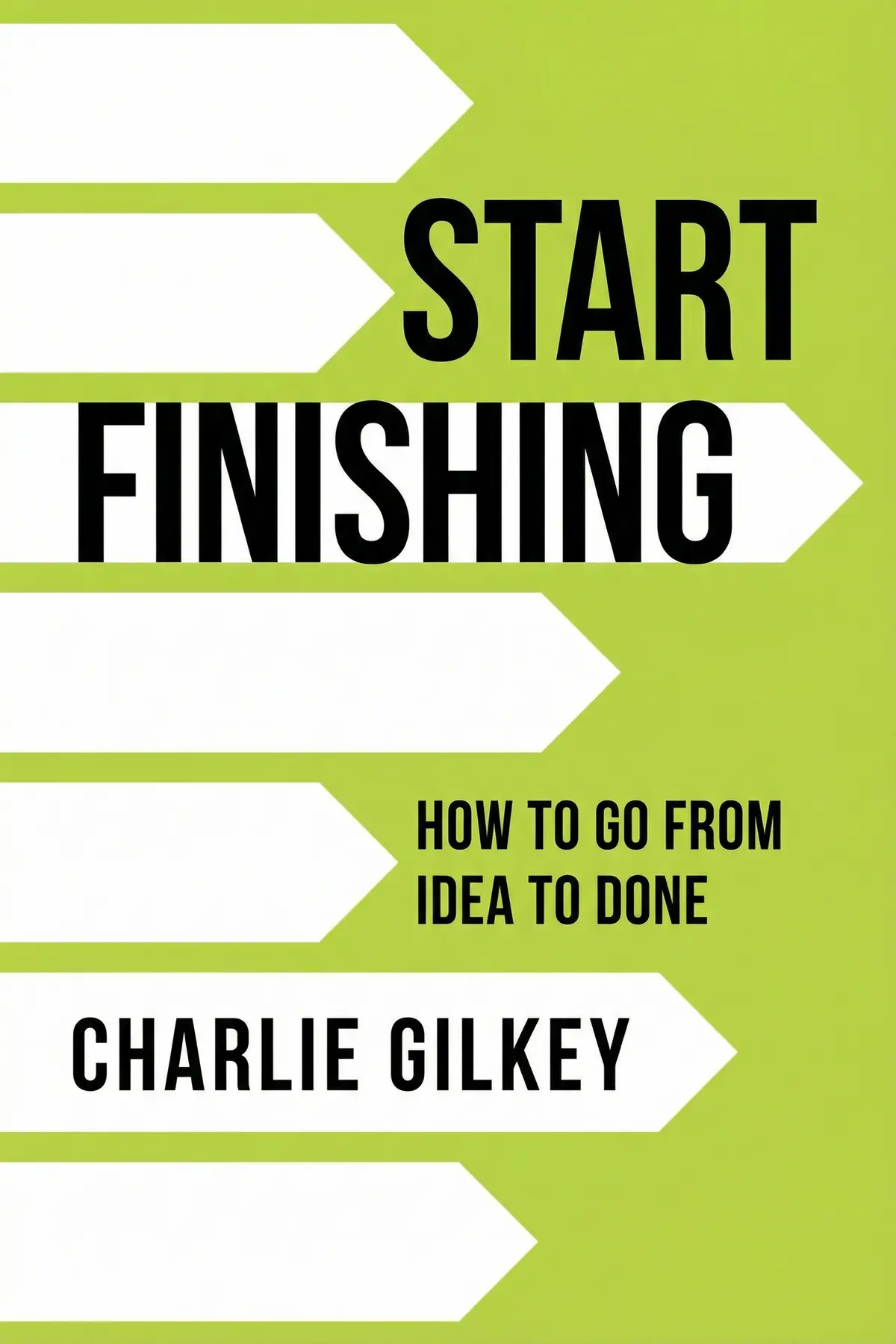
Table of Content
1. Introduction
56 sec
Most people keep a mental drawer of ideas that never get finished. Some wait for the perfect day, and others drop the idea at the first hurdle. In Start Finishing, Charlie Gilkey, founder of Productive Flourishing, argues that the ideas that keep nagging at you point to your best work, and they only become real once you treat them as projects. In his sense, a project is anything that takes time, attention and effort to finish, from moving to a new city to clearing out the garage.
His case is that finishing comes down to design. You choose one idea, plan it with the right people and make protected time for it. You expect the traps that stall it, and you close it properly when it’s done. Each step is concrete. You’ll learn how to find the idea you would hate to abandon, how many hours a week it really needs, and what to leave on your desk tonight so tomorrow starts easily.
2. Choose the one idea worth finishing first
1 min 26 sec
A long list of exciting ideas can be the very thing that keeps you from finishing any of them. A short exercise with a few searching questions shows which idea deserves your evenings.
3. Build the five qualities that carry projects home
1 min 37 sec
Projects rarely die from one big disaster. They die from a mix of distractions, doubt and people who don’t get it. Gilkey matches each kind of trouble to a quality you can build on purpose.
4. Turn a vague wish into a trackable plan
1 min 41 sec
Ending child hunger and feeding a precise number of children by a set year sound like the same goal. Only one of them can actually be finished, and the difference changes how every working session feels.
5. Make time for your project instead of hunting for it
1 min 41 sec
Waiting for free time is how good projects quietly expire. A five-level pyramid and four kinds of calendar blocks turn a big ambition into a week you can actually live with.
6. Spot the traps that stall projects and escape them
1 min 43 sec
A phone call from a parent, too many open projects, a task untouched for weeks: each slows you in a different way. Naming the trap tells you which way out to take.
7. Keep momentum with frogs, batches and crumb trails
1 min 40 sec
Great days followed by empty ones never add up to a finished project. A piece of advice credited to Mark Twain and a small habit at the end of each work session help you keep moving.
8. Finish well so the next project starts easier
1 min 41 sec
The moment a project ends, most people either collapse or rush into the next one. Gilkey borrows a ritual from the US Army that makes each finished project easier than the last.
9. Conclusion
1 min 12 sec
Gilkey’s book starts from a simple observation: the ideas you keep failing to make time for show you where your best work lies. The rest of the book shows how to take those ideas seriously. A wish becomes a project with an end you can see. The project gets people around it and hours on the calendar. The forces that stall it get names, such as cascades, logjams and tarpits, which makes them easier to deal with. And finishing gets its own ritual, so the next start is lighter.
The actions are small enough to begin today. Write down your ideas, cross out the ones that don’t move you, and keep the one you would hate to abandon. Book three focus blocks next week, with one recovery block for every two. When you sit down to work, do the task you dread first. When you stop, leave yourself a crumb. Gilkey adds one more piece of advice: before any project, ask which of your strengths could make it easier. That means your expertise, what you enjoy and what comes naturally to you.
The idea that keeps nagging at you doesn’t need a perfect day. It needs a next step, written down where you’ll see it.
About this book
What is this book about?
Plenty of people have more ideas than finished projects. Some wait for a day when their mood, energy and circumstances feel right. Others start with enthusiasm and lose steam at the first obstacle. Charlie Gilkey argues that both habits waste the ideas most worth pursuing, because the ones that keep nagging at you point toward your best work, the work your own experience and knowledge prepare you for. His method treats finishing as a matter of design. You narrow a long list of ideas to one, build the qualities that carry projects through, and plan with a SMART goal and a success pack of guides, peers, supporters and beneficiaries. You split the work into chunks, schedule focus, admin, social and recovery blocks, and learn to spot the cascades, logjams and tarpits that stall progress. Readers get concrete tools for every stage: an exercise for choosing what to work on, rules for how many focus blocks a week a project needs, ways to deal with dreaded tasks, crumb trails that make restarting easy and an after-action review borrowed from the US Army.
Book Information
Who it's for
Creators and founders
Creatives and entrepreneurs with plenty of ideas and few finished projects.
Professionals with side projects
Busy professionals whose side projects keep losing out to everyone else's priorities.
Owners of stalled projects
Anyone with a project stuck for weeks who wants a practical way to restart it.
About the Author
Charlie Gilkey
Charlie Gilkey is the founder of Productive Flourishing, a company that supports creatives, leaders and entrepreneurs in their work and personal lives, and he hosts the Productive Flourishing podcast. Before starting the company, he worked as a Joint Force Military Logistics Coordinator while studying for a PhD in Philosophy. His earlier book, The Small Business Life Cycle, helps small business owners understand the stages their business moves through.
Ratings & Reviews
Ratings at a glance

What people think
Listeners find this productivity guide thorough and accessible, offering realistic advice for turning concepts into concrete projects. By providing straightforward methods for completing tasks, the work assists listeners in concentrating on their objectives; notably, one listener points out how it utilizes peak daily hours. Listeners value the book’s insights, with one review emphasizing its ability to generate the drive necessary for consistent advancement.
Top reviews
Audrey
Picked this up because I am the absolute queen of starting exciting new projects but never seeing them through to the actual finish line. Charlie Gilkey offers a refreshing perspective on productivity that feels much more human and less robotic than the standard advice I usually find. The concept of the Success Pack really resonated with me because I often try to white-knuckle my way through big goals alone. By building a team for accountability, I have finally managed to sustain progress on my novel after months of stalling. The book provides simple steps to transform those vague creative sparks into concrete, actionable plans that actually fit into a busy life. I especially appreciated the focus on leveraging your best hours of the day for deep work instead of just answering emails. This is easily the most practical guidance I have encountered in years for turning big dreams into finished reality.
Show moreRosa
Wow, the concept of 'thrashing' alone was worth the price of admission for me. Gilkey explains that procrastination is often just an emotional response to our most important work, which helped me stop feeling so defective. I stopped treating my creative writing like a hobby and started scheduling it as my primary focus during my peak energy windows. The writing style is approachable and funny at times, yet he remains dead-on serious about the importance of finishing what we start. I have already recruited my own support pack to keep me accountable for my quarterly goals, and the difference is night and day. This book helps you stop selling out your potential by giving you the tools to bust through mental blocks. If you struggle with the 'shiny object syndrome,' you definitely need to read the chapters on project roadmaps and time blocking.
Show moreArjun
After years of struggling with a never-ending to-do list, the Project Pyramid finally gave me a way to visualize my goals. I finally understand how my daily tasks actually connect to the big yearly milestones I want to achieve. Charlie Gilkey provides a brilliant framework for modern work that is both practical and deeply encouraging. I love the idea of 'air sandwiches' as a way to describe those projects that lack the necessary middle-level planning. By following the simple steps outlined in the book, I have been able to sustain progress on a project I’ve ignored for years. The advice on building a support pack changed how I view my professional relationships and my own accountability. This book is a must-read for any creative professional who feels like they are constantly spinning their wheels. It helps you focus on what matters most and ignore the distractions that steal your time.
Show moreThawee
Let’s talk about the 'Success Pack' because that was the missing ingredient for my latest business venture. I used to think that finishing was just about willpower, but this book proved me completely wrong. It is about systems, energy management, and having the right people in your corner to push you through the 'thrashing' phase. The pages are filled with actionable advice that you can put into practice the very same day you read it. I’ve already recommended it to all my colleagues who are struggling with their own creative logjams. The book is well-engineered for busy people who need to grasp the deeper content quickly without reading every single word. The commentary from other authors like James Clear and Seth Godin adds even more value to the overall message. If you want to finally finish that big project by next year, buy this book and follow the steps.
Show moreTantipat
Charlie Gilkey’s approach in this book feels more like a coaching session than a standard self-help guide. I have used his Momentum Planner resources online for a while, so I was excited to see the full framework expanded into a hardback. The book is engineered for recall with helpful green highlighted boxes and summaries that make it very easy to skim for key points later. I particularly liked the section on handling constraints and figuring out why my projects always seem to hit a logjam. While some of the information is similar to other productivity titles, the focus on the emotional side of finishing is unique. One minor gripe is that the five-project rule still feels a bit vague regarding specific timescales for each category. Overall, it is a solid resource for anyone looking to build momentum and finish their best work without burning out.
Show moreSudarat
The visual layout of this book is the first thing you will notice when you hold it in your hands. It features an attractive grass-green color scheme and wide margins that offer plenty of space for writing your own notes. I appreciate the production qualities, from the smooth paper to the way the book lies flat when you are working through the exercises. The content itself is quite comprehensive, offering simple steps to accomplish tasks that once felt completely insurmountable. I am currently using the 2-hour focus blocks to chip away at a massive backlog of administrative work for my nonprofit. The chapter on 'other people's priorities' helped me realize how much time I was wasting on things that don't actually matter. It is a bit jargon-heavy, but once you translate the terms into your own words, the system is quite effective. It is definitely going on my shelf as a permanent reference.
Show morePridi
I’ve read a lot of time-management books over the years, but few address the reality of creative work like this one. Gilkey understands that we are not robots and that our energy levels fluctuate throughout the day. Instead of a rigid schedule, he teaches you how to build a flexible plan that can change as your life does. I have started using verbs in my daily planning as suggested, which makes my to-do list feel much more actionable. The book reminds us that doing our best work requires scheduled recovery time, not just constant grinding toward a deadline. I found the sections on 'momentum planning' to be particularly helpful for staying on track when life gets chaotic. While the 'college textbook' look was a bit distracting, the actual wisdom inside is very high quality. It is a great guide for anyone who wants to stop dreaming and start doing.
Show moreBee
Does anyone else feel like productivity books are getting more complicated and academic lately? While I appreciate the sentiment that celebrations are for your community, I struggled with the sheer volume of specialist jargon scattered throughout the chapters. Terms like CAT time, air sandwiches, and various acronyms made it feel like I was studying for a college entrance exam rather than planning my week. To be fair, the Project Pyramid is a compelling way to visualize how daily tasks build toward yearly goals, but the delivery was a bit dry. The physical book is a non-standard square format that looks great on a desk but won't fit neatly into a standard narrow-sized bookshelf. I found some interesting gems in the thicket of overwriting, but I had to work way too hard to find them. It is decent advice if you are in a rut, but be prepared for a dense read.
Show moreWeera
To be fair, there is some absolute gold buried in these chapters if you can get past the terminology. I really liked the idea that we should only focus on three to five main projects at a single time. Most of us try to do way too much, leading to that inevitable feeling of being stuck in a tarpit. However, the author’s tendency to coin new words for every single concept made the reading experience feel quite clunky. I had to keep flipping back to find out what certain acronyms meant since there is no glossary included. The Project Pyramid diagram is a great visual, but the explanation of how weeks break down into tasks was a bit convoluted. It took me a few tries to figure out how to fit his 'blocks' into my actual calendar. It is a useful book for planning, but the delivery could have been much more succinct and straightforward.
Show moreTom
Honestly, I had high hopes for this one given how much I enjoy the author's podcasts. Unfortunately, the information was not delivered in an appealing way and lacked enough real-life examples to keep me engaged. Most of these ideas are things I have encountered in a dozen other books, just rebranded with new, confusing names. I found the definition of a project to be frustratingly broad, making it difficult to implement the system into my existing workflow. The prose felt a bit roundabout and over-explained simple concepts that could have been summarized in half the page count. Even the paper is thick and high-quality, but that does not make up for the fact that I couldn't get into the content. It might be helpful for someone totally new to the genre, but seasoned productivity nerds will likely find it repetitive. I ended up finishing my project using a different strategy entirely.
Show moreQuestions about this book
What is the main idea of Start Finishing by Charlie Gilkey?
Gilkey argues that the ideas that keep nagging at you point toward your best work, the work your own experience and knowledge prepare you for. To do it, you turn one idea into a project with a SMART goal and a success pack of supporters. Then you make protected time for it in weekly blocks, deal with the traps that stall it, and finish with recovery, cleanup and a review.
How do I choose which idea to work on first?
Gilkey suggests listing every idea you are considering, then crossing out the ones that don’t move you deeply and the ones you could drop without regret. Test what remains: which one you would most like to celebrate finishing, which will matter most in five years, which would get you up early or keep you up late, and which you would be heartbroken to give up. The idea that meets most of these tests goes first.
How many focus blocks does a project need each week?
Gilkey recommends at least three focus blocks a week to build momentum and keep it. Each lasts 90 minutes to two hours and is for solo work that moves the project forward. Around those, plan admin blocks of 30 to 60 minutes for calls and planning, social blocks for collaborating with others, and a recovery block for each pair of focus or social blocks, which helps you avoid burnout.
What is a tarpit and how do I get out of one?
A tarpit is Gilkey’s name for a project that not only gets stuck but stays stuck, and it becomes harder to restart the longer it sits. His remedy is to start moving and keep moving. Divide the project’s chunks into smaller tasks still, promise yourself to complete one inside three days, and after that put in work on the project at least two times a week.
What is a crumb trail in Start Finishing?
A crumb trail is something you leave for yourself at the end of each work session: a note about your next step, or an easy task to begin with. It makes the next session easier to start, so you don’t lose time or feel lost when you sit down again. Gilkey suggests making it a habit, along with doing dreaded tasks early and working during your most alert hours.
Readers also enjoyed



AUDIO SUMMARY AVAILABLE
Listen to Start Finishing in 15 minutes
Get the key ideas from Start Finishing by Charlie Gilkey, plus 5,000+ more nonfiction titles.
- 5,000+ titles
- Listen as much as you want
- 7-day free trial
- Cancel anytime









