

14 min 24 sec
Available in: English
Start at the End: How to Build Products That Create Change
Shows how to design products and campaigns by starting with the behavior you want, mapping what drives and blocks it, checking the ethics and testing cheap pilots before you scale anything up.
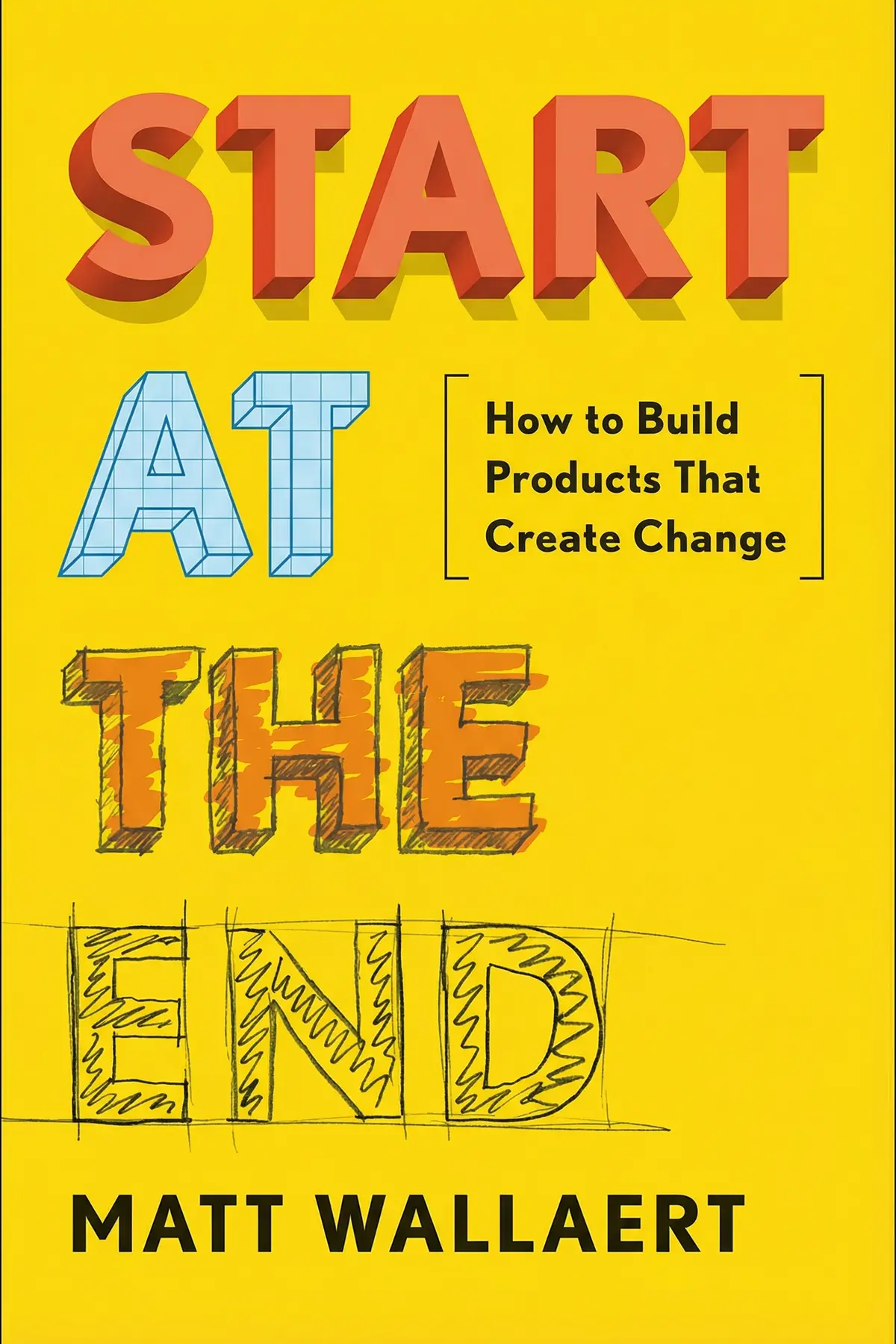
Table of Content
1. Introduction
1 min 03 sec
Most products are built by asking what will sell, and then teams wonder why nobody changes how they act. In Start at the End, behavioral scientist Matt Wallaert flips the order. He argues that every successful product, from the iPhone onward, is really a change in behavior, so you should begin by naming the behavior you want and work backward from there. Wallaert, who has applied behavioral science at Microsoft and at the insurer Clover Health, calls his method the Intervention Design Process.
His case runs like this: decide precisely how you want people to act, find out with evidence what pushes them toward that behavior and what holds them back, then change those forces honestly and test small before you scale. Along the way come children who barely used search engines, the first rides in San Francisco, a bowl of M&Ms and a flu shot plan built around church leaders. By the end, you can turn a vague product idea into one sentence, a map of forces and a cheap first experiment.
2. Prove the gap before you build anything
1 min 45 sec
Microsoft suspected that schoolchildren, full of questions, were hardly touching search engines. Before spending a cent on the problem, the team had to find out whether the gap they sensed was real or imagined.
3. Turn a vague goal into one exact sentence
1 min 30 sec
Uber’s first goal could be written as a single sentence, and one small detail in it, a city, explains a great deal. Five parts turn a fuzzy ambition into something a team can actually measure.
4. See what pushes people toward and away
1 min 33 sec
A bowl of candy within reach and the same candy twenty blocks away are very different temptations. The forces that decide whether people act are often stranger and smaller than any product team expects.
5. Map the pressures that drive customer behavior without trusting instinct
1 min 44 sec
Sugar can drive one person away and pull another closer, and a high price can attract buyers instead of scaring them off. That puzzle explains why guessing about customers so often goes wrong.
6. Win by easing the strongest reason to say no
1 min 58 sec
A health insurer saw a sensible message lose against a deep, historical distrust. The team’s response did not argue harder for the facts. It went looking for the people the community already believed.
7. Three questions that keep your influence honest
1 min 48 sec
A good goal can still be pursued with tactics that harm people. A short ethical test, applied twice, catches both the bad goal and the bad method, including the clever excuses in between.
8. Test small and messy, then scale the winners
1 min 50 sec
Launching your best idea nationwide sounds bold and can waste everything. A deliberately messy first trial, and a surprisingly relaxed standard of proof, may be the faster route to something that works.
9. Conclusion
1 min 13 sec
The iPhone, in Wallaert’s telling, mattered because it changed what people did with their phones every day, and his whole process follows from that observation. If a product is really a change in behavior, the work starts with the behavior: proven to be missing, written down precisely, explained by the forces around it. Only then come ideas, and only ideas that pass an honest ethical check reach real people.
What makes the method useful is its humility. At every stage it assumes you might be wrong about the gap, about why people act as they do, about which idea will work. The Bing team watched children in classrooms instead of trusting a hunch. At Clover Health, the deciding force behind flu shots was trust, not health.
Start with a project you care about and write its behavioral statement, preconditions and measure included. Draw the map, with the irrational and counter-rational pressures you would prefer to ignore. Then choose the cheapest pilot that could change your mind, and accept 80 percent confidence instead of waiting for certainty.
Begin with the world you want people to live in, and build backward until the first step is small enough to try tomorrow.
About this book
What is this book about?
Most teams design a product, then hope people will use it. Matt Wallaert argues the order should be reversed. A successful product, in his view, changes how people behave, so the first job is to decide which behavior you want to create and then work backward toward the product that makes it happen. His method, the Intervention Design Process, moves through clear stages. You confirm with data and observation that a gap really exists between how people act and how you want them to act. You capture the ideal in a one-sentence behavioral statement. You map the pressures that push people toward the behavior and hold them back, design interventions that shift the balance, run an ethical check, and test small before scaling. Readers follow the process through cases from Wallaert's own work on Microsoft's Bing and at the insurer Clover Health, along with Uber's first launch and a close look at what makes people eat M&Ms. The result is a practical way to turn hunches into tested changes, without manipulating the people you want to help.
Book Information
Who it's for
PMs and founders
Product managers and founders who want people to actually use what they build.
Influencing without manipulating
Marketers and designers trying to change customer behavior without manipulating anyone.
Team leads
Team leads who need a shared, evidence-based process for testing ideas before spending big.
About the Author
Matt Wallaert
Matt Wallaert has spent more than fifteen years applying behavioral science to practical problems. He was one of the first behavioral scientists to leave academia for industry, and he has spoken hundreds of times about behavior change, at venues including the UN and SXSW. He has worked at Microsoft and at the insurer Clover Health, where he led a large behavioral science team. His side projects include GetRaised.com, a site that has helped women who were underpaid request raises. Start at the End, published in 2019, is his first book.
Ratings & Reviews
Ratings at a glance
What people think
Listeners find the writing makes behavioral science accessible and enjoy the well-timed humor throughout. Additionally, the book is commended for its clarity and depth, with one listener highlighting that it offers a fresh perspective on product development.
Top reviews
Art
As a product manager who has been struggling to get my team to think beyond features, this was exactly the wake-up call we needed. Wallaert makes complex psychological concepts feel totally approachable and even funny, which is rare for this genre. We’ve already started drafting our first "behavioral statements" to define exactly what change we want to see in the real world. I love how he emphasizes the ethical check before moving to the intervention phase, as that is so often ignored in tech. It’s a fresh, human-centric perspective on development that actually provides a concrete framework to follow. I’ve already bought several copies for my colleagues.
Show moreKob
The Intervention Design Process (IDP) described here is a game-changer for anyone in marketing or engineering. It provides a specific, repeatable methodology for creating real-world impact by starting with the "endgame" in mind. I found the distinction between the "ideal world" and the "real world" to be a simple but powerful way to frame our goals. Not gonna lie, I was skeptical about the informal writing style at first, but it grew on me. The examples provided are excellent and help ground the theories in reality. This is a must-read if you want a structured way to think about nudging consumers toward better outcomes.
Show morePun
Finally finished Wallaert’s take on behavioral design, and I’m mostly impressed by how he strips away the academic jargon. The core idea is the Intervention Design Process (IDP), which forces you to look at the "pressures" affecting your users before you even sketch a single UI component. To be fair, the writing is extremely chatty—almost like reading a long series of blog posts—but the humor keeps it from feeling like a dry lecture. I found the section on "promoting pressures" particularly insightful for my current project. While some might find the autobiographical anecdotes a bit much, they do humanize the science. It’s a solid blueprint for anyone trying to nudge user behavior effectively.
Show moreYok
Ever wonder why users drop off right before the finish line? This book tackles that head-on by teaching you how to identify the "inhibiting pressures" that prevent people from reaching the desired state. I appreciated the shift from "what should we build" to "what behavior do we want to see." The humor is well-placed and makes the behavioral science feel much less intimidating for a non-expert. In my experience, most business books are far too dry, so Wallaert’s energetic voice was a welcome change of pace. It's a practical guide for anyone who actually wants to change the world through their products.
Show moreJong
If you are tired of building products that nobody actually uses, you need to read this immediately. Matt Wallaert does a fantastic job of explaining how to design for behavioral change without making it feel like a chore. The book is incredibly easy to read, and I finished it in just two sittings because the pacing is so quick. The focus on "pressures" is a really useful mental model that I’ve already started applying to my own design work. I’ll admit the writing gets a little too self-aware at times, but the practical utility of the framework makes it worth it. It’s a very fresh take on product management.
Show moreNora
Look, I wanted to love this book more than I actually did. The central framework of mapping out promoting and inhibiting pressures is undeniably brilliant and useful for any designer. However, the author's writing style is a major hurdle; it’s aggressively casual and sometimes feels like he's trying too hard to be the "cool" social scientist. To be fair, the insights into how to modify user behavior are backed by solid research, which saves the book from being a total miss. It’s a strange mix of high-level strategy and low-brow humor. If you can stomach the self-aware tone, there is definitely value here.
Show morePick
Not gonna lie, the tone of this book is a bit of a polarizing mess. One minute you’re learning about serious ethical implications and behavioral research, and the next you're reading a jokey tangent about snacks. Personally, I think the "Intervention Design Process" is a stellar framework, but the delivery is needlessly rambly and self-centered. It feels like it was written for a very specific type of tech bro who needs their science served with a side of edge. That said, the actual advice on identifying pressures and trialing interventions is quite sound. It's a good book hidden inside a somewhat annoying one.
Show moreSavannah
After hearing a lot of hype about this book, I found it to be a bit of a mixed bag. The core premise—that we should design by starting with the behavioral outcome—is fantastic and should be standard practice. However, the prose is so "chatty" that it often feels like the author is just talking to hear himself speak. In my experience, a more thorough and serious treatment of the IDP would have been more effective. Still, the techniques for influencing user behavior are backed by good science and are worth considering. It’s a helpful resource if you can filter out the fluff.
Show moreChanpen
Frankly, this felt more like a 300-page LinkedIn post than a cohesive business book. The "Start at the End" premise is simple enough—focus on the outcome behavior rather than the product features—but it gets buried under layers of self-indulgent prose. I was looking for a rigorous exploration of behavioral science, yet I got a lot of stories about the author’s life and Flaming Hot Cheetos. The formulaic nature of the Intervention Design Process is helpful, but the delivery is just too rambling for my taste. It could have been half as long and twice as impactful. I struggled to finish it because the tone felt unnecessarily coarse at points.
Show moreRoongsak
Picked this up expecting a textbook on behavioral economics, but it felt much more like a casual memoir with some business advice sprinkled in. The constant self-references and autobiographical fluff made it difficult for me to stay focused on the actual methodology. Truth is, the IDP framework is interesting, but it doesn't need 200+ pages of "chatty" prose to explain. I found the "formulaic" approach to be a bit repetitive after the first few chapters. If you prefer your professional development books to be streamlined and serious, you might want to skip this one. It lacks the depth I was hoping for.
Show moreQuestions about this book
What is the main idea of Start at the End?
Matt Wallaert argues that successful products change behavior, so design should start with the behavior you want and work backward. His Intervention Design Process moves from a validated insight about a gap between real and ideal behavior, to a one-sentence behavioral statement, to a map of the pressures pushing people toward or away from that behavior. Then come interventions, an ethical check, small pilots and larger tests before anything is scaled.
What is a behavioral statement in Start at the End?
It is one sentence describing the world you want to create, built from five parts: the behavior, the population, the motivation, the preconditions and the measure. Wallaert’s Uber example covers people in San Francisco with a connected smartphone and electronic payment who want to get somewhere, taking an Uber, measured by the number of rides. The preconditions keep the goal realistic, and the measure tells you whether it is happening.
What are promoting and inhibiting pressures?
Promoting pressures push people toward a behavior and inhibiting pressures hold them back. For M&Ms, taste and bright colors promote eating them, while distance from the candy inhibits it. Wallaert stresses that pressures depend on context: sugar deters a health-conscious person but tempts a hungry one, and a high price can even attract buyers of jewelry. That is why he insists pressure maps be built on data and interviews.
How does Wallaert suggest testing an idea before scaling it?
Start with pilots: small trials run in an operationally dirty way, doing by hand what a finished product might automate. Wallaert argues products can accept a p-value below 0.20, which still means an 80 percent chance the result is right. Ideas that pass move to a formal test with a larger sample and a cleaner operation, checking feasibility as well as effect. A cost-benefit comparison then decides what to scale.
Who should read Start at the End?
It suits product managers, founders, marketers and designers who want people to change what they do, and not only to buy. Team leads get a shared, step-by-step process for testing ideas. Anyone uneasy about manipulation gets a clear ethical test: does the behavior match people’s goals, do the benefits outweigh the costs, and are you transparent about your motives and methods?
Readers also enjoyed

Age of Propaganda: The Everyday Use and Abuse of Persuasion
Anthony Pratkanis



59 Seconds: Change Your Life in Under a Minute
Richard Wiseman




A Liberated Mind: How to Pivot Toward What Matters
Steven C. Hayes
AUDIO SUMMARY AVAILABLE
Listen to Start at the End in 15 minutes
Get the key ideas from Start at the End by Matt Wallaert, plus 5,000+ more nonfiction titles.
- 5,000+ titles
- Listen as much as you want
- 7-day free trial
- Cancel anytime









