

15 min 25 sec
Available in: English
Smarter: 10 Lessons for a More Productive and Less-Stressed Life
By Emily Austen
Shows ambitious, overstretched people how to get more done with less strain by tracking their energy, planning in minutes, focusing on one task at a time and measuring success by their own definitions.
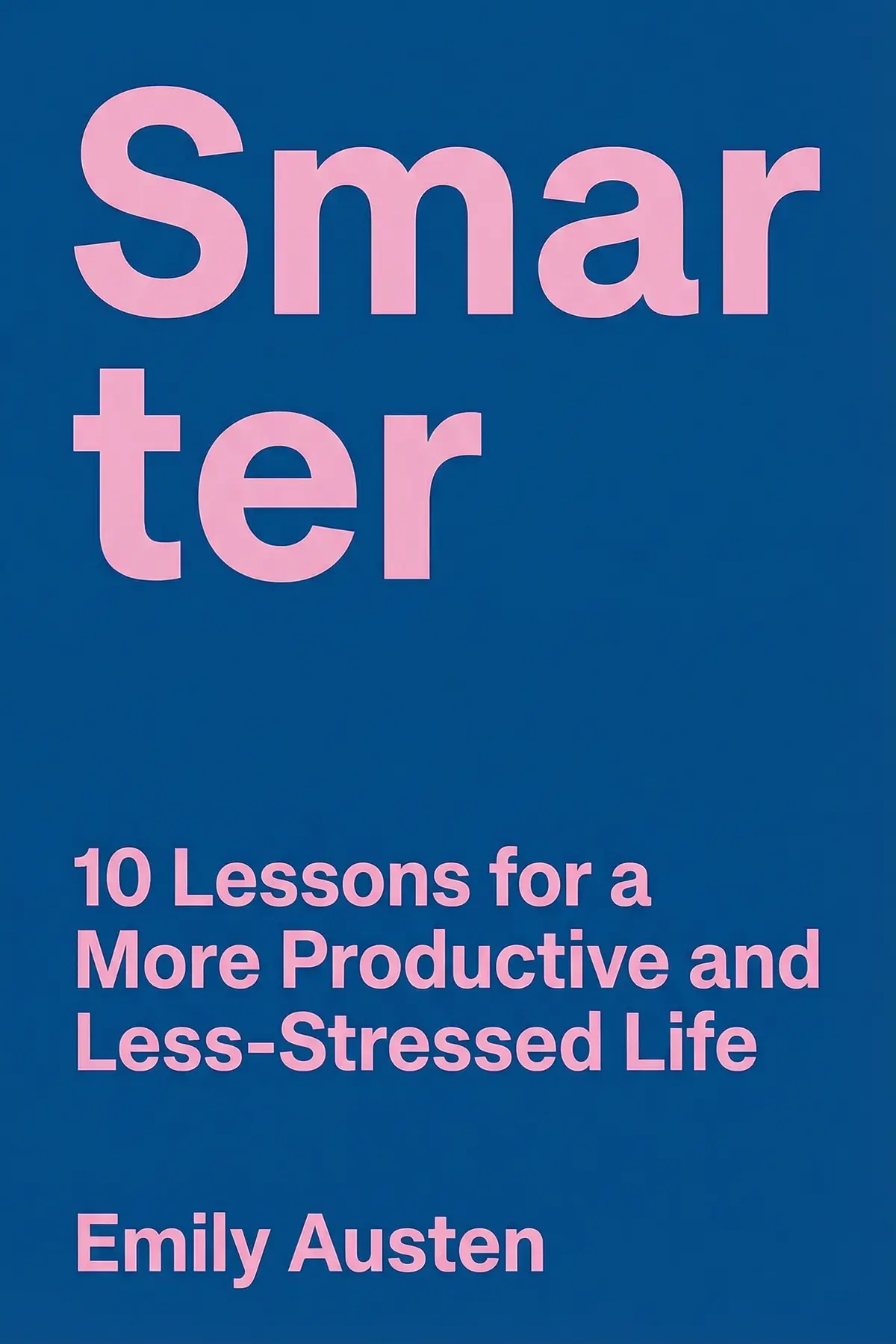
Table of Content
1. Introduction
1 min 08 sec
If your days are full and your progress still feels slow, the fullness itself may be the problem. In Smarter, Emily Austen, who founded a London PR agency at 22 and spent over a decade growing it into a multimillion-dollar business, argues that most of our busyness is self-made. It works like an addiction, she says, a stream of small dopamine hits that keeps us occupied and away from the work that counts.
Her response keeps the ambition and moves the effort: toward the hours when your energy is high, toward one task at a time, toward minutes you can count, and toward goals you have defined for yourself. The whole book rests on one claim. A full, successful life comes from guarding your energy and attention, and piling on more hours usually makes things worse.
Along the way come tools you can try tomorrow morning: a four-level energy map, a day budgeted in 480 minutes, a pie chart that settles hard decisions, and a list of things you will stop doing.
2. Stop mistaking a full calendar for progress
2 min 02 sec
Plenty of high achievers feel proud of how tired they are. Austen thinks that pride hides a trap, and she borrows a single question from Olympic rowers to get out of it.
3. Schedule hard work for your high-energy hours
1 min 55 sec
Eight hours of sleep, a strict morning routine, and you are still drained before ten. Austen argues the usual productivity advice has the problem upside down, and she offers a week-long test to prove it.
4. Budget every workday as 480 minutes
1 min 44 sec
A report planned for an hour gets done in forty minutes, and the rest disappears into a screen. Austen thinks the hour itself is to blame, and her fix involves a cheap object on your desk.
5. Do one task at a time to get more done
1 min 55 sec
Answering email on a call while planning dinner feels like the height of efficiency. The research Austen cites tells a very different story, and the cost of a single interruption is larger than most people guess.
6. Talk to yourself the way a friend would
1 min 55 sec
Smokers who managed to quit used one sentence about themselves that the others did not. Austen builds a whole method on that difference, and it starts with the words you already use every day.
7. Give each factor in a decision its true weight
1 min 57 sec
A dream job wins on paper five to one, and something still feels wrong. Austen shows why counting pros and cons misleads, and how a simple drawing can make the right answer obvious.
8. A daily life built on your own definitions
1 min 45 sec
A vision board full of mansions can leave you doing less, not more. Austen explains why big dreams sometimes stall people, and what to pin up in their place, along with a list most people never write.
9. Conclusion
1 min 04 sec
Austen’s book is a case against hustle as a measure of worth. The octopus trying to hold eight things, the worker keeping a laptop awake to look present, the hour that leaks away after forty minutes: each shows effort spent on the appearance of progress. What she offers in its place is a calmer kind of ambition, one that respects real limits on energy, attention and time and still aims high.
The changes she supports are small enough to start this week. Track your energy as Silence, Hum, Sing or Shout for seven days, then move your hardest work into the Shout hours. Plan tomorrow in minutes, cap the total at 480, and set a timer on your desk. When a new request arrives, run it past the rowers’ question and your five values before you say yes. And before you sleep, write three things on a to-don’t list.
None of this asks you to want less from life. It asks you to stop paying for success with exhaustion you never needed to spend.
About this book
What is this book about?
Many ambitious people wear exhaustion as proof that they matter. Their calendars are full, their phones never stop, and real progress still feels slow. Emily Austen, who built a PR agency into a multimillion-dollar business over more than a decade, argues that much of this busyness is self-made. It feels like work, she says, but it keeps people away from the work that counts. Her answer keeps the ambition and changes where the effort goes. She asks readers to manage energy before time, mapping their daily highs and lows on a four-level scale. She replaces vague hourly blocks with a workday counted in 480 minutes, swaps multitasking for single-tasking, and offers simple tools for kinder self-talk, clearer decisions and boundaries grounded in personal values. The result is a practical set of exercises for professionals, founders and anyone juggling several roles: an energy map, the 4Ds for sorting tasks, a pros and cons pie for hard choices, a personal balance circle, and a to-don't list for the habits that drain you.
Book Information
Who it's for
Busy without real progress
Ambitious professionals who feel busy all day yet see little real progress.
Juggling several roles
Founders and people juggling several roles who want simple systems for energy, focus and boundaries.
Heading toward burnout
Anyone heading toward burnout who wants to keep their goals without the constant strain.
About the Author
Emily Austen
Emily Austen founded EMERGE, an award-winning PR agency in London, in 2012 when she was 22, just after studying Criminology and Criminal Law at Manchester University. The agency has worked with global brands including Huel, Red Bull and Spanx. Austen has guest lectured at Harvard University and served as Strategic PR Advisor to UN Women UK. She also hosts The Busi-Ness Podcast, interviewing CEOs and founders about running a business. Smarter, her first book, collects what she has learned about productivity, balance and boundaries.
Ratings & Reviews
Ratings at a glance
What people think
Listeners consider Smarter an invigorating and useful remedy for burnout culture, specifically highlighting the author's focus on natural biological rhythms and energy management. Although some feel the advice might seem basic to those already familiar with productivity books, most find practical systems like the "Four Ds" for prioritizing tasks to be highly effective. Furthermore, listeners emphasize the work's compassionate tone and straightforward guidance, with one listener mentioning that the "thinking in minutes" principle enabled them to successfully reconfigure their daily habits to decrease friction. They also suggest that the focus on "to-don’t" lists and self-understanding offers a significant viewpoint for high-performers aiming to stay successful without burning out.
Top reviews
Monthon
Wow. I didn't realize how much 'productivity theater' I was performing just to feel important until I sat down with this book. Emily Austen hits the nail on the head regarding the 'busy trap'—we wear exhaustion like a badge of honor, but we aren't actually moving the needle. The chapter on energy management, rather than time management, was a total lightbulb moment for me. I’ve stopped trying to force myself into the '5 AM Club' because, frankly, my brain doesn't 'Sing' until at least 10 AM. Following her four-level energy system (Silence, Hum, Sing, Shout) has made my workdays feel almost effortless. It’s a refreshing, practical roadmap that prioritizes well-being over raw output. I’ve already bought copies for my entire management team. This isn't just about doing more; it’s about being more intentional with the limited energy we have. Absolutely essential reading for any woman in leadership.
Show moreMoon
Ever wonder why you're completely drained by 3 PM despite only answering emails? Austen explains exactly why in 'Smarter.' Her analogy of the human energy battery really clicked for me. I’ve spent years fighting against my natural rhythm, trying to be a morning person when my peak creativity hits in the late afternoon. This book gave me the permission—and the data—to finally stop doing that. The 'busyness detox' she suggests was a total game-changer. I turned off my notifications and stopped the reflexive 'I'm so busy' response to everyone. It turns out, most of my stress was self-imposed and performative. The writing style is engaging, conversational, and completely devoid of the usual 'bro-science' that plagues this category. If you’re an ambitious person on the verge of a breakdown, please read this. It’s the compassionate, smart guide we’ve all been waiting for.
Show moreSuwit
As a freelance designer constantly juggling client revisions, Austen’s concept of 'thinking in minutes' felt like a genuine lifeline. Instead of staring at an eight-hour block of impending doom, I started breaking tasks into 20-minute sprints based on my focus levels. The results were immediate. I’m actually getting through my backlog without that suffocating feeling of being perpetually behind. Truth is, I’ve tried every productivity app under the sun, but the psychological shift here is what actually stuck. My only gripe is that the middle section drags a bit when she discusses her own agency growth. It felt a little 'look at me' in places, which might alienate someone just starting out. Still, the core frameworks—especially the Four Ds—are incredibly solid. If you are tired of the hustle-porn version of success, this offers a much more sustainable alternative. It’s practical, grounded, and actually respects the fact that we have lives outside of our laptops.
Show moreAna
After hearing so much buzz about Austen’s agency on social media, I wanted to see if her 'Smarter' method actually translated to the page. It does. The 'Will it make the boat go faster?' filter is a deceptively simple tool that has saved me hours of pointless meetings this week. I love how she frames rest as a strategy rather than a weakness. It's a much-needed antidote to the 'hustle culture' that dominates LinkedIn. My only minor complaint is that the 'Personal Balance Circle' felt a bit like filler content you’d find in a basic self-help blog. Despite that, the actionable frameworks like the Four Ds for task prioritization are gold. It's a quick, punchy read that left me feeling motivated but—crucially—not overwhelmed. She writes with a clarity that is rare in this genre, making complex neurological concepts like multitasking fatigue easy to grasp and even easier to fix.
Show moreFelix
The chapter on energy management—specifically the Silence, Hum, Sing, and Shout levels—completely changed how I schedule my deep work blocks this month. I used to save my hardest tasks for the end of the day, which I now realize was absolute madness. Frankly, Austen’s advice on ditching the '5 AM club' was a huge relief. I’ve felt guilty for years about not being an early riser, and seeing a successful entrepreneur debunk that myth was incredibly validating. The book is full of these little moments of permission to just be a human. I did find some of the stuff about 'vibrations' a bit woo-woo for my tastes, and I wasn't a huge fan of the harsh comments about personal trainers. Still, the core message about consistency over intensity is one I really needed to hear. It’s a very practical guide for the modern, over-stressed worker.
Show moreJib
Finally got around to reading this after a month of near-burnout, and the timing couldn't have been better. Austen’s writing is like a cool glass of water for a frantic brain. She understands the pressure to perform but offers a way out that doesn't involve quitting your job or moving to a commune. The 'Thinking in Minutes' concept helped me refactor my daily workflow to actually include gaps for rest, which I used to view as 'wasted' time. Now I see it as a strategic necessity. I appreciated the emphasis on identity-based language, too; saying 'I don't do meetings before 10' feels a lot more powerful than 'I’m trying to keep my mornings free.' It’s a very female-centric perspective on ambition that feels both honest and empowering. Some parts are definitely more geared toward business owners with teams, but the general principles of focus and boundaries apply to everyone.
Show moreWan
Look, if you’ve already read James Clear or Cal Newport, a good 70% of this will feel like a retread of very familiar ground. I went in hoping for a total revolution in my workflow, but found myself skimming through chapters on habits and single-tasking that I’ve seen elsewhere. To be fair, Austen writes with a much more empathetic tone than your average 'alpha' productivity guru. I particularly liked the 'To-Don't' list idea—it’s a clever way to acknowledge how much time we waste on performative busyness. However, some of the advice felt a little half-baked, like the brief mentions of 'higher vibrational frequencies' that didn't really fit the logic of the rest of the text. It’s a decent primer for someone new to the genre, but seasoned high achievers might find it a bit rudimentary. A solid three stars for the clean presentation and the '8 and 2' principle, which I’ve actually started using.
Show moreYaowaluk
Is it groundbreaking? Not exactly. The 'Four Ds' and time-blocking are staples of almost every productivity book written in the last decade. That said, the way Austen connects these tactics to our biological rhythms (the Silence/Shout energy states) is a nice touch that adds some much-needed nuance. I found the first half of the book incredibly insightful, but the latter 40% felt a bit surface-level, especially the sections on identity-based language. It felt like she was trying to cover too much ground rather than diving deep into the psychology of work. Personally, I would have liked more detail on how to implement these systems in a corporate environment where you don't have total control over your schedule. It seems geared more toward entrepreneurs and sole traders. It's a good reminder of things we should be doing, but don't expect it to change your life if you're already a productivity nerd.
Show moreSomporn
To be fair, the frameworks provided are quite useful, especially the 'Pros and Cons Pie' for making big decisions. It’s a lot better than a standard list. However, I couldn't help but feel like I was reading a very long blog post at times. The information is clear and well-presented, but much of it is common sense if you’ve spent any time on self-improvement. The 'eight and two' principle is a good takeaway, though. It helped me realize that most of my 'urgent' tasks are just distractions. I gave it three stars because while it’s a solid book, it didn't offer that 'aha!' moment I was looking for. It’s a safe bet for a gift for a new grad, but seasoned professionals might find it a bit light on new theory. It’s a quick read, at least, and the tone is very encouraging without being overly preachy.
Show moreNoah
Not what I expected from a book that claims to move away from typical high-achiever rhetoric. While Austen talks a big game about avoiding burnout, she still seems obsessed with being 'more productive' and optimizing every single second of existence. The constant digressions into her personal success as a multimillion-dollar agency owner felt more like a humble brag than a helpful case study. I also struggled with the parts where she complained about the unique struggles of women in business; it felt like it diverged too much from the actual productivity lessons I paid for. In my experience, the 'Smarter' method is just 'Work Harder' with a fresh coat of paint and some talk about energy levels. If you want a book that actually interrogates why we feel the need to achieve so much to be happy, keep looking. This one stays firmly on the surface.
Show moreQuestions about this book
What is the main idea of Smarter by Emily Austen?
Austen argues that constant busyness is often self-made and gets confused with success. She says a full, successful life comes from managing energy before time, focusing on one task at a time, planning in precise minutes and defining success on your own terms. Her tools include a four-level energy map, the 480-minute workday, the 4Ds for sorting tasks and a to-don’t list.
What is the 480-minute day in Smarter?
An eight-hour workday holds 480 minutes, and Austen asks you to plan it at that level. Each morning, list your tasks and give each one a set number of minutes, keeping the total at or below 480. Put demanding work in your most alert hours and use a desk timer, kept separate from your phone, to stay focused. Smaller units make it harder to let time drift.
How does Emily Austen suggest tracking energy?
She uses four levels: Silence when you are completely drained, Hum when energy is low, Sing at moderate capacity and Shout at your peak. For one week, note your level through the day along with when you feel creative, focused or sluggish. The result is a personal energy map you can use to place hard tasks in strong hours and routine work in weaker ones.
What are the 4Ds in Smarter?
The 4Ds are a way to sort every task. Do covers quick items you can finish now, Defer means scheduling something for later, Delegate hands it to someone else, and Delete removes it entirely. Austen pairs this with single-tasking, since the research she cites says multitasking cuts productivity by 40 percent and each interruption costs over 20 minutes of concentration.
Who should read Smarter?
It suits ambitious people who feel permanently busy: employees climbing a career ladder, founders running their own business and anyone juggling several roles. It is especially useful for readers close to burnout who want to keep their goals while dropping performed busyness, using small exercises such as an energy map, a balance circle and personal definitions of success.
Readers also enjoyed



AUDIO SUMMARY AVAILABLE
Listen to Smarter in 15 minutes
Get the key ideas from Smarter by Emily Austen, plus 5,000+ more nonfiction titles.
- 5,000+ titles
- Listen as much as you want
- 7-day free trial
- Cancel anytime









