
15 min 28 sec
Available in: English
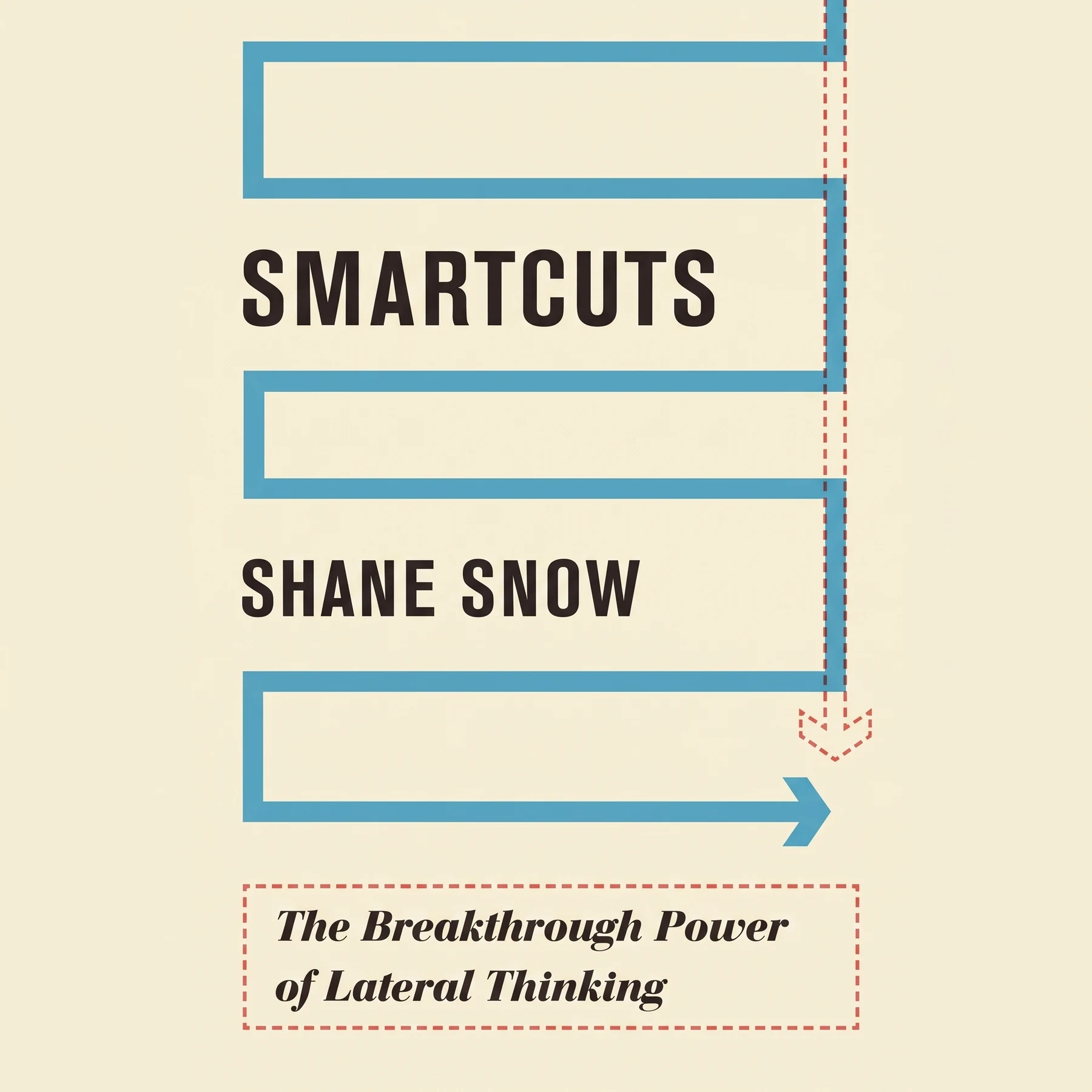
Smartcuts: The Breakthrough Power of Lateral Thinking
By Shane Snow
Shows how fast risers skip the step-by-step climb. They borrow from mentors, criticism, platforms, trends and connectors, then simplify their work and set goals ten times bigger than small, steady improvements.
Table of Content
1. Introduction
1 min 05 sec
If your career feels like a queue, waiting for the people above you to move on, Shane Snow has a striking finding: about a third of American presidents never waited in that line. In Smartcuts, the journalist and entrepreneur notes that many spent only around seven years in elected office before the top job, having built experience elsewhere and switched ladders at the right moment.
Snow calls the skill behind such moves lateral thinking, spotting connections and routes other people miss. The routes themselves he calls smartcuts: the fastest path to a goal that still holds up. His argument is that people who rise quickly rarely climb step by step. They borrow speed from mentors, criticism, existing platforms, trends and well-connected people, then simplify and aim far higher than seems sensible.
Expect heart surgeons coached by a Formula One pit crew, a teenager who became Skrillex and a makeup tutorial that reached thirty million viewers, each with a move you can copy.
2. Switch ladders instead of waiting your turn
1 min 32 sec
A university president and a general who had never stood for election both reached the White House. Their routes suggest that the patient climb most careers are built on may be the slowest option on offer.
3. Find a mentor who is invested in you
1 min 48 sec
Mentoring programs are everywhere, yet the relationships that change careers rarely come from a sign-up form. A London hospital and a racing team show what the strongest kind of guidance looks like.
4. Turn harsh feedback into your fastest teacher
1 min 39 sec
Some well-meant coaching makes people perform worse, while the comments that sting most can help the most. A Chicago comedy school has found a way to make criticism useful instead of crushing.
5. Build on what others have already made
1 min 39 sec
Starting from zero feels honest and original, but it is usually the slow road. A whole country rebuilt its schools by reshaping what it already had, and climbed from average to among the best.
6. Catch a rising trend and keep riding it
1 min 45 sec
A teenage musician read two shifts before almost anyone else, and a makeup artist’s best-known video was no better than her others. Both stories show what separates a lucky break from lasting success.
7. Get influential people to spread your work
1 min 36 sec
A finance startup grew a loyal following with almost no advertising, and a rebel radio broadcast won listeners slowly. Both relied on the same condition before anyone would pass their message on.
8. Simplify your work and your daily choices
1 min 45 sec
A storage device that replaced floppy disks and a wardrobe of identical black shirts share one principle. Research on decision-making explains why it protects both a company’s costs and a person’s creativity.
9. Aim ten times higher to beat small gains
1 min 35 sec
Improving something by ten percent sounds sensible and safe. A lab built for big bets argues that the far larger goal can be easier to reach, and a rocket company shows how.
10. Conclusion
1 min 04 sec
What Snow offers is a different way to read your own position. The staircase in front of you is one route among many, and the fastest people treat other people’s work as a resource: experience built in another field, a pit crew’s precision, a cold audience, a school system worth reworking, a trend already rising, a front page that reaches millions. Each smartcut trades a long solo climb for something already built or already moving, then adds the piece only one person can bring.
The surgeons at Great Ormond Street could have tried to fix their handovers alone. They went looking for the team that did changeovers best.
Start with the ladder you are on. If its next rung depends on someone leaving, look at nearby fields where your skills already count. Put your work in front of people who will name its weakest part. And when something you make suddenly catches on, find out why and give people more of it quickly.
Nobody ever required you to start on the bottom step.
About this book
What is this book about?
Most people assume success means climbing one ladder, rung by rung, and waiting their turn. Shane Snow argues that the people and companies who move fastest rarely do that. They find smartcuts, his word for routes to a goal that are quick and still hold up, and they find them through lateral thinking: spotting connections and paths that others overlook. Snow builds his case from varied examples. Presidents switched into politics near the top. London heart surgeons learned from a Formula One pit crew. Finland reworked its schools, a teenage musician rode two trends before becoming Skrillex, and Michelle Phan turned one well-timed makeup video into a business. Along the way he looks at research on mentoring, feedback and decision fatigue, and at 10x Thinking from Astro Teller of the Google X lab. Readers get a set of practical moves: switch ladders when yours is blocked, choose mentors who are invested in you, use criticism without taking it personally, build on existing platforms, catch trends early, win over well-connected people, simplify relentlessly and dare to aim much higher.
Book Information
Who it's for
Young professionals awaiting promotion
Young professionals stuck waiting for promotions that depend on someone else leaving.
Career switchers
Career switchers wondering how their current skills could carry them into a new field.
Founders wanting faster growth
Founders who want faster growth through mentors, trends and word of mouth rather than big budgets.
About the Author
Shane Snow
Shane Snow is an award-winning journalist and entrepreneur who cofounded Contently, a content technology company. His articles have appeared in Wired, The New Yorker, GQ, Fast Company and The Washington Post, and he sits on the board of The Hatch Institute, a nonprofit for investigative journalism. He studied journalism at Columbia University. Smartcuts became a bestseller, and his later books include The Storytelling Edge and Dream Teams.
Ratings & Reviews
Ratings at a glance
What people think
Listeners find the book both motivating and educational, offering tangible advice for professional and personal growth. Its accessibility is highly valued, as one listener points out it is an excellent light read for staying focused, and it successfully provides practical strategies and hacks. The work features engaging narratives and detailed research, with one review emphasizing the way it blends real-world case studies with storytelling and evaluation. Listeners commend the clear prose, with one specifically mentioning its informal tone, and its emphasis on lateral thinking, with one review noting how it transforms your method of solving problems.
Top reviews
Mai
Shane Snow's deep dive into unconventional success is more than just another productivity manual; it fundamentally challenges the 'pay your dues' mentality that traps many talented professionals. By analyzing how US Presidents and tech innovators bypass traditional hierarchies, Snow provides a compelling argument for lateral thinking that feels both fresh and necessary. The writing is incredibly smooth, whisking the reader through complex concepts like 10x thinking and pattern recognition without ever feeling dense or academic. I found the section on leverage particularly enlightening, especially the way it reframes the use of existing platforms to amplify small efforts into massive results. It’s an essential read for anyone tired of the slow crawl toward their goals and looking for a way to work smarter, not harder. This book doesn't just offer tips; it shifts your entire worldview on what is possible in a short timeframe.
Show moreNook
Picked this up during a career slump and it completely reframed my perspective on growth and momentum. The concept of 'hacking the ladder' by moving laterally to climb faster is a game-changer for anyone feeling stuck in a dead-end industry. I was particularly moved by the story of the 'sleeping bag for babies' as a lesson in radical simplicity and first-principles thinking. Snow manages to weave together disparate histories—from Cuban revolutionaries to EDM artists—to show that success isn't about working harder, but about finding the right waves to ride. This isn't just theory; it’s a toolkit for rethinking how you approach every challenge in your professional life. It's a quick read that packs a serious punch, and I've already started applying the '10x thinking' principle to my current projects with great results. Truly inspirational.
Show moreWichai
Wow, it's rare to find a business book that reads like a page-turning novel, but Snow manages to pull it off with incredible style. The research feels meticulous, yet it’s presented through such beautiful storytelling that you hardly realize you're learning complex strategies for career advancement. I was fascinated by the 'paradox of failure' and how observing others' mistakes can actually be more beneficial than making your own. It changed the way I look at my own small business, specifically regarding how to hunt for patterns and catch the right market waves before they peak. This is the kind of book that gives you a new, actionable idea on every other page. It’s definitely earned a permanent spot on my reference shelf for when I need to rethink my strategy. Truly a masterclass in modern lateral thinking.
Show moreWoravit
Ever wonder how some people just bypass the traditional grind and land right at the top? This book dives into the mechanics of that acceleration, using fascinating examples like Jimmy Fallon’s laser-focused path to Saturday Night Live. While the advice to 'get a mentor' isn't exactly groundbreaking, Snow’s emphasis on the type of mentorship—one that involves frequent, depersonalized feedback—adds a fresh layer of depth. I appreciated the distinction between a shortcut and a 'smartcut,' acknowledging that hard work is still the engine, but the track doesn't have to be a straight line. Some of the storytelling felt a bit like a Malcolm Gladwell imitation, which grew a little repetitive by the end, but the core message remains incredibly motivating. It is a solid choice for entrepreneurs who feel like they are spinning their wheels in the mud.
Show moreBook
Finally got around to finishing this, and the chapter on simplicity really stuck with me as a vital lesson for modern business. Shane Snow has a knack for finding the exact right example to illustrate his points, like using the evolution of heart surgery to explain the paradox of failure. The book moves at a blistering pace, which is fitting given its subject matter of rapid acceleration and efficiency. While I think some of the connections between the stories are a bit of a stretch, the overall framework of the nine principles is quite solid. It’s a refreshing departure from the usual 'hustle harder' mantra, focusing instead on being clever with your resources and leveraging existing platforms. I'd recommend it to anyone looking for a mental spark to change their career trajectory without following the traditional, slow-moving path.
Show moreOscar
As someone who has spent a decade in the corporate world, the concept of lateral thinking resonates deeply with my own observations of who actually gets ahead. Snow’s breakdown of how high-achievers use superconnectors and platforms to amplify their reach is both instructional and highly readable. I loved the section on 10x thinking, which argues that aiming for massive goals can actually be easier than incremental improvements because it forces you to abandon old, broken models. My only real gripe is that some chapters end quite abruptly, leaving you wanting a bit more detail on the actual implementation side of things. Still, the conversational style makes it an easy book to digest in just a few sittings. It provides a great framework for anyone looking to disrupt their own industry or climb a different ladder entirely.
Show morePrinya
After hearing about 'Smartcuts' on a podcast, I decided to see if the hype was justified, and I’m glad I did. The book is an excellent primer on efficiency, focusing on how to achieve outsized results by questioning the standard 'rules' of success. I found the examples of Jimmy Fallon and the Ruby on Rails framework to be particularly effective in illustrating how to use leverage to your advantage. It’s a very encouraging read that emphasizes that you don't necessarily have to 'pay your dues' in the traditional sense if you're smart about your moves. Though some parts feel a bit anecdotal and heavy on the storytelling frills, the writing is so engaging that you’ll find yourself flying through it. It’s a great light read to keep you on course when you're feeling overwhelmed by the daily grind.
Show moreMaria
The truth is, while the stories about heart surgeons and surf patterns are genuinely engaging, the actionable advice felt spread thin throughout the narrative. I enjoyed the quick pace and the conversational tone, but I often found myself waiting for a concrete 'how-to' that never quite materialized in a satisfying way. Snow is a brilliant storyteller, yet many of his conclusions rely heavily on anecdotal evidence that might suffer from survivorship bias. It’s a great 'light' read for a flight or a lazy weekend if you want to feel inspired, but don't expect a rigorous, data-driven framework. If you've read The Lean Startup or similar productivity titles, a lot of the 'rapid feedback' sections will feel like familiar territory you've already covered elsewhere. It’s a fun read, just not necessarily a revolutionary one for seasoned business people.
Show moreBoy
Frankly, the book is a fast, enjoyable read that definitely keeps you entertained with its rapid-fire case studies and slick prose. However, I can't help but feel that many of the 'smartcuts' described are heavily influenced by survivorship bias and unique circumstances that are hard to replicate. The advice to 'ride the wave' or 'hack the ladder' sounds great in theory, but the book lacks the granular data needed to prove these strategies work for the average person. It’s essentially a high-quality collection of stories that might inspire you, but it won't give you a step-by-step roadmap for your specific situation. It's perfect for a quick motivational boost or a gift for a new graduate, but seasoned entrepreneurs might find the content a bit light on substance. It's good, just not as revolutionary as the title suggests.
Show moreJoe
Not what I expected from all the hype surrounding this title, as it mostly feels like a collection of blog posts stitched together. Much of the advice is surprisingly generic, such as the suggestion to find a mentor or to look for patterns in your industry. I found the 'Gladwell-esque' writing style—starting with a teaser anecdote and circling back much later—to be more distracting than helpful, often losing the thread of the actual argument. There’s a lot of 'spin' here that tries to make common sense sound like a revolutionary secret, and the lack of hard data is disappointing for a business book. Honestly, you could probably fit the core takeaways on an index card and save yourself several hours of reading through recycled case studies and questionable connections. It lacks the depth needed to be truly useful for anyone over thirty.
Show moreQuestions about this book
What is the main idea of Smartcuts by Shane Snow?
Snow argues that people and companies who succeed quickly rarely climb step by step. They use lateral thinking to find smartcuts, routes that are fast and still hold up. That means switching ladders, learning from invested mentors, using negative feedback, building on existing platforms, catching trends, winning over well-connected people, simplifying and aiming for goals ten times bigger.
What is the difference between a smartcut and a shortcut?
A shortcut suggests skipping quality to save time. Snow defines a smartcut as the most efficient path to a goal that is also sustainable. He sees nothing wrong with taking the quickest route, since it saves time and resources, as long as the result lasts. Presidents who built experience elsewhere before entering politics near the top are his model.
What does Smartcuts say about mentors?
Snow cites research that entrepreneurs with mentors raise on average 70 percent more capital. Psychologist Christina Underhill found informal mentoring did more for salary, promotions and self-esteem than formal programs. His best example is Great Ormond Street Hospital in London, where help from Ferrari’s pit crew cut errors by 66 percent.
How can I apply Smartcuts to my career?
If your next promotion depends on someone retiring, look sideways for a related role, company or industry where your skills transfer, such as moving from agency sales to sales elsewhere. Seek regular, honest criticism without taking it personally. When something you make catches on, as Michelle Phan’s Lady Gaga tutorial did, study why and build on it quickly.
What is 10x Thinking in Smartcuts?
10x Thinking comes from Astro Teller of the Google X lab. Instead of small linear improvements, you aim to make something ten times better, which forces you to drop old assumptions. Snow says it is riskier but can be easier, partly because people back visionary projects. Elon Musk building his own rockets is his example.
Readers also enjoyed


60 Seconds & You’re Hired!
Robin Ryan



Be A Free Range Human: Escape the 9 to 5, Create a Life You Love,
Marianne Cantwell
Be the Unicorn: 12 Data-Driven Habits That Separate the Best Leaders from the
William Vanderbloemen
AUDIO SUMMARY AVAILABLE
Listen to Smartcuts in 15 minutes
Get the key ideas from Smartcuts by Shane Snow, plus 5,000+ more nonfiction titles.
- 5,000+ titles
- Listen as much as you want
- 7-day free trial
- Cancel anytime









