

13 min 59 sec
Available in: English
Smart Until It’s Dumb: Why Artificial Intelligence Keeps Making Epic Mistakes (and why the AI Bubble Will Burst)
Shows why artificial intelligence can beat champions yet confuse a bus for a bird, and how to judge AI tools, projects and headlines by what the technology really does with data.
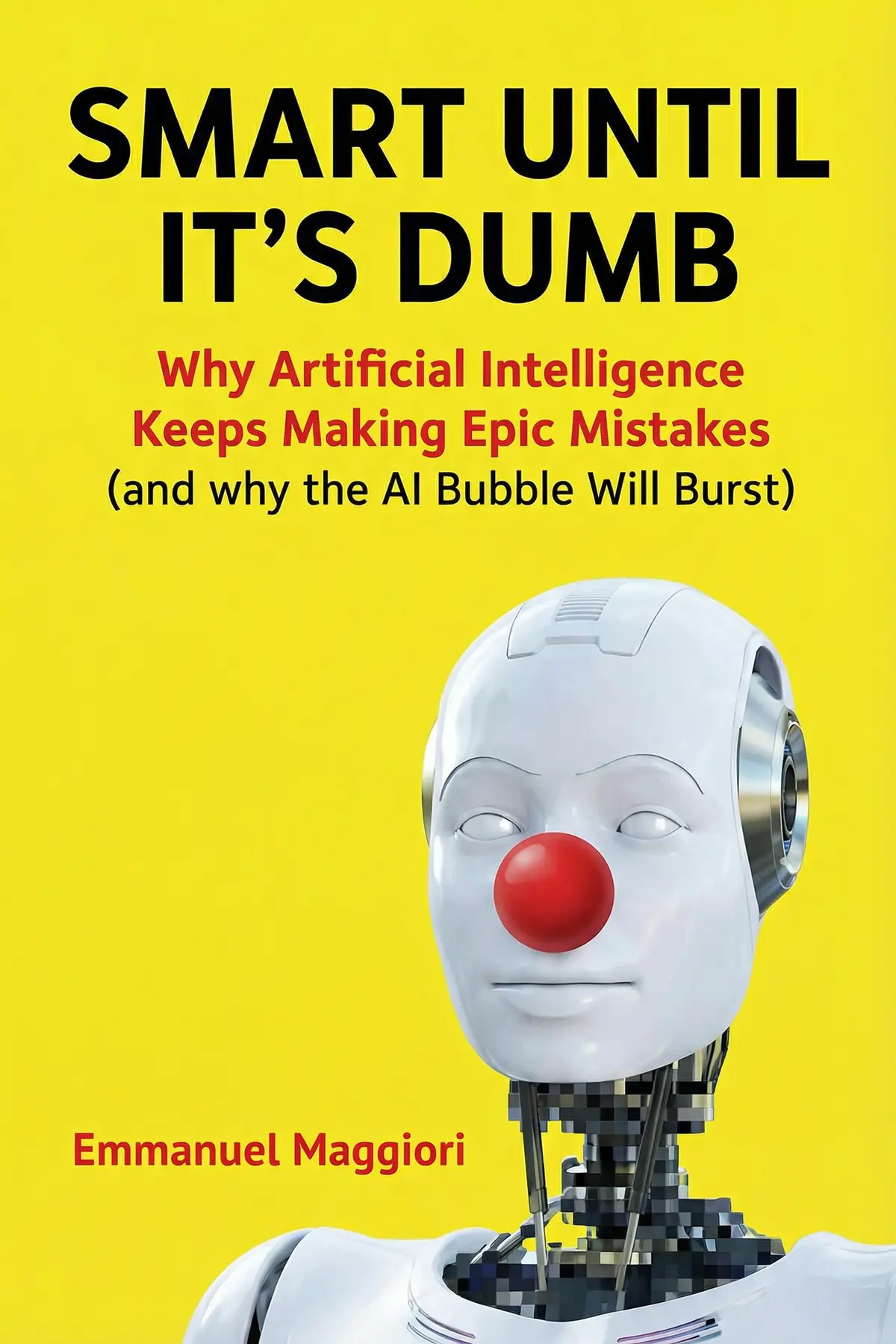
Table of Content
1. Introduction
56 sec
If AI headlines leave you unsure whether to be amazed or alarmed, start with this: the systems that write fluent paragraphs and beat game champions do not understand what they produce. In Smart Until It’s Dumb, machine learning researcher Emmanuel Maggiori argues that today’s AI works by fitting patterns in data, which is why it can be brilliant one moment and absurd the next. A translation app that puts a box inside a writing pen has not malfunctioned. It is doing exactly the job it was built for.
Maggiori’s case is that this gap between performance and understanding is real, that hype, careless testing and business incentives keep it hidden, and that it may never close. Follow his argument and you will be able to tell what AI can safely do for you, test a promising project before it eats your budget, and read the next breakthrough headline with a calm, informed eye.
2. Read today's AI boom through two earlier busts
2 min 09 sec
Twice before, clever programs convinced experts that thinking machines were close, and twice the money vanished. Today’s systems work differently, yet one experiment about pedestrians and phone numbers shows an old weakness has survived the upgrade.
3. See how AI beats Go champions yet misses a bus
1 min 54 sec
A model trained on doodles looked at a drawing of a school bus and confidently decided it was an ostrich. The reason exposes what sits inside the technology behind today’s most impressive headlines.
4. Expect AI to fail where context changes
1 min 54 sec
A toddler learns a word from one example, while a machine needs thousands and still misses a cow on a beach. Fixing each mistake as it appears turns out to solve far less than it seems.
5. Test an AI project before it burns your budget
2 min 06 sec
Most failed AI projects never make the news. They fade away after the hiring spree, and the warning signs were visible from the start, including a website test that flattered the AI by accident.
6. Read an AI breakthrough headline with a sharper eye
1 min 43 sec
AI research seems to announce a leap every week. Look closely at how many of those results are produced, and a familiar classroom trick appears, one that can make even a weak model look excellent.
7. Stay calm when a chatbot sounds alive
2 min 02 sec
An engineer became convinced a chatbot had become conscious and said he had even taught it to meditate. His story rests on an assumption about minds that sounds scientific, yet nobody has ever managed to prove it.
8. Conclusion
1 min 15 sec
Maggiori’s book works like a pair of glasses. Once you see that today’s AI fits patterns without grasping what they mean, its odd behavior stops being mysterious. The ostrich that was really a bus, the cow lost on a beach and the phone number that seemed to predict survival all grow from the same root. So do the larger illusions: projects that look successful because the test was tilted, benchmark scores earned through dozens of retakes, an engineer who taught a chatbot to meditate. The technology has made genuine progress in narrow tasks. Trouble starts when its fluency is mistaken for understanding, by users, by companies and by the people who write the headlines.
That view leads to habits a reader can start this week. Let AI handle work with clear rules, rich data and easy measures of success, and check its output hardest wherever context shifts or a request is ambiguous. Before backing any AI project, insist on a named problem and a fair comparison. When a breakthrough or a sentient machine makes the news, ask what was actually tested.
AI stays smart right up to the moment it turns dumb, and knowing where that moment lies is the whole skill.
About this book
What is this book about?
Artificial intelligence writes, chats, recommends and translates at remarkable speed, and it is often described as something close to magic. Even so, it gets basic sentences wrong in translation, puts the wrong labels on the people in pictures, and fails to notice a cow standing on a beach. Emmanuel Maggiori, who holds a PhD in machine learning, sets out to explain that contradiction. His answer is that modern AI imitates intelligence by matching patterns in huge datasets, without grasping meaning. He traces the field's earlier cycles of hype and collapse, takes apart deep learning's most impressive results, and shows why fixing one error never fixes the system. He then turns to the people around the machines: companies that start AI projects with no problem to solve, tests that make weak systems look strong, and research results polished by repeated retakes and selective reporting. He ends on the largest claim of all, that minds are just code. Readers get a clear sense of where AI is dependable and where it breaks, along with practical questions for evaluating an AI project, a vendor's pitch or the next breakthrough headline.
Book Information
Who it's for
Professionals using AI daily
Professionals who use AI tools daily and want to know when to trust the output.
Weighing AI decisions
Managers and founders weighing an AI project, a vendor pitch or a new AI team.
Tired of AI headlines
Curious readers tired of headlines that swing between miracle and doom.
About the Author
Emmanuel Maggiori
Emmanuel Maggiori holds a PhD in machine learning and has applied artificial intelligence across a range of industries, work that connects advanced research with real business uses. His books take apart fashionable, overhyped subjects in business, technology and economics, and he is known for making complex technical ideas clear to non-specialists. Smart Until It's Dumb draws on that mix of research training and hands-on experience with AI projects.
Ratings & Reviews
Ratings at a glance
What people think
Listeners find the book highly enjoyable and appreciate the value provided, as one listener notes it serves as an excellent primer for how language models work.
Top reviews
Jeeranan
Finally, a book that cuts through the noise of the current AI gold rush. Maggiori manages to explain complex topics like backpropagation and statistical correlation without getting bogged down in jargon, making it a great value for anyone curious about the tech. Frankly, I was impressed by how he balances the genuine achievements of machine learning with the hilarious, and sometimes scary, ways these systems fail. It’s not just a technical manual; it’s a warning about treating correlation as causation. While I wish there was more focus on the very latest generative models, the core message about mimicry versus true understanding remains incredibly relevant today. A must-read for anyone in tech who feels like they’re being sold a bill of goods by marketing departments.
Show moreUraiwan
Maggiori provides an eye-opening look at the 'AI winter' cycles and why we might be headed for another one if we aren't careful. This book is a brilliant historical and technical survey of how we got here. He explains that today’s deep learning is more about brute-force computing power than a conceptual leap in intelligence. I loved the section on how a toddler understands a 'pen' for writing versus a 'pen' for animals, while an AI struggles without massive datasets. It’s a great primer on why scale doesn't necessarily lead to consciousness. Truly, for the price of a couple of coffees, you get a much better education on AI than most online courses will give you. Five stars for clarity alone.
Show moreMuk
Pick this up if you're tired of hearing tech CEOs promise the world while their products still struggle with basic image recognition. Maggiori’s anecdote about the 'gorilla' tag fix—just deleting the label instead of fixing the logic—was a perfect illustration of his point. These systems don’t 'know' anything; they just react to patterns. The book does a stellar job of explaining the human decisions behind the data that actually drive the AI's behavior. It’s refreshing to see someone point out that the emperor has no clothes, or at least that his clothes are made of statistical correlations. It's a quick read but one that sticks with you long after you've put it down. Highly recommended for the tech-curious.
Show moreSamira
Not many tech books manage to be both informative and genuinely fun to read, but this one nails it. The author’s story about being a 'corporate AI spy' was hilarious and provided a rare look at how the sausage is actually made in the industry. It’s one thing to read about AI in a textbook; it’s another to see how companies fudge the numbers to impress investors. The truth is, most of what we call AI is just clever engineering and manual tweaking. This book is an excellent value for money and provides a necessary vocabulary for discussing the limits of automation. I’ve recommended it to several colleagues already. It’s a 5-star debunking of the modern tech mythos.
Show moreMai
As a software developer, I found Maggiori's breakdown of 'statistical pattern matching' incredibly grounding in an era of pure hype. He explains why a self-driving car might handle a highway but fail miserably because of a slightly vandalized stop sign. This book highlights the fragility of these systems and the massive human effort required in data labeling that most people never see. To be fair, some of the analogies feel a bit stretched, but the logic holds up under scrutiny. It’s a sobering reminder that we aren't building minds; we’re building very sophisticated, very fast calculators. If you want to understand why AI is ‘smart’ until it does something incredibly ‘dumb,’ this is the best primer out there. Well worth the price of admission.
Show moreAim
Ever wonder why your smart assistant can't understand a simple joke or basic context? Maggiori dives deep into the 'correlation engines' that power modern technology, revealing how they lack even the basic reasoning of a toddler. The chapter on how researchers cherry-pick data to make their models look better was particularly enlightening. It made me look at every AI-related headline with a much more critical eye. Look, the book isn't perfect—it's definitely leaning toward the pessimistic side—but we need that perspective right now. It provides a much-needed reality check against the 'superintelligence' narratives that dominate the news cycle. The writing is punchy and accessible, which I appreciated.
Show moreBunyarit
After hearing so much buzz about AGI, reading this felt like a cold shower in the best way possible. The author doesn't just dismiss AI; he explains exactly how it works and where the 'magic' ends. I found the discussion on consciousness and the Google engineer who thought a chatbot was sentient to be the highlight of the book. It raises some deep questions about how easily we are fooled by linguistic fluency. Gotta say, the way Maggiori dismantles the idea that the mind is just a computer program is fascinating, even if you don't fully agree with his philosophical stance. It’s a short, dense, and deeply rewarding read that challenges the status quo of the Silicon Valley echo chamber.
Show moreSven
This book is a fantastic primer for anyone who wants to understand how large language models actually function without needing a PhD in mathematics. It's affordable, well-structured, and written in a way that is actually fun to read. My only real gripe is that it occasionally feels like it’s ignoring the very real progress made in the last eighteen months. Still, the underlying critique of 'brute-force' learning remains valid. The explanation of why a model might label a bus as an ostrich based on a few pixels is worth the price of the book alone. It’s a great gift for that one friend who is convinced a robot is going to take their job by next Tuesday. Very informative.
Show moreEmma
The truth is, while the technical explanations are top-tier, the author's writing style felt a bit repetitive at times. He hammers home the 'mimicry vs. understanding' point in almost every chapter, which started to grate by the halfway mark. However, I can't deny the value of his insights into the corporate culture of AI, where projects are launched just to say they have AI. That part felt very real to my own experience in the industry. Personally, I would have liked to see a bit more nuance regarding the successes of AI in fields like protein folding or logistics. Instead, the focus is almost entirely on where the technology breaks. It’s an important read, just a bit one-sided.
Show moreAkira
I’m not convinced the author understands the true potential of recent breakthroughs. This book feels like it was written by someone who is determined to see the glass as half-empty regardless of the evidence. While he makes some okay points about statistical bias, he completely misses the emergent properties of newer, larger models. Comparing AI to cold fusion is frankly ridiculous and shows a lack of depth in his analysis of state-of-the-art research. The writing is also quite dry and the structure feels disjointed in the final third. If you're looking for a balanced view, this isn't it. It’s more of a manifesto for cynics than a serious look at the future of technology.
Show moreQuestions about this book
What is the main idea of Smart Until It's Dumb?
Emmanuel Maggiori argues that modern AI imitates intelligence by matching patterns in large datasets, without understanding meaning. That is why it can beat champions at Go yet label a school bus as an ostrich or mistranslate a simple sentence. He adds that hype, flawed testing and business incentives hide this gap, and that human-level AI may be impossible if minds cannot be computed.
Why does AI make such strange mistakes, according to Maggiori?
Because it learns correlations instead of concepts. A model that recognized cows in grassy fields missed the same cow on a beach, since it only knew where cows tend to appear. A translation app put a box inside a writing pen because word statistics pointed that way. Fixing one such error, Maggiori says, just brings the next flaw into view.
Why do so many AI projects fail?
Maggiori sees a repeated pattern. Companies treat AI as the goal rather than a tool for a defined problem, flawed models look like they work, and unfair tests flatter results, as when an AI website version reached more shoppers in wealthy cities. Teams then grow before anything is proven, and some even rewrite outputs by hand to please decision makers.
How can I apply the ideas in Smart Until It's Dumb?
Use AI where problems are clear, data is plentiful and success is easy to measure, and check it closely when context changes. For any AI project, start from a named problem, demand a fair comparison and question every input. When a headline announces a breakthrough, ask what the model was compared against and whether it was tested on truly unseen data.
Does Maggiori think AI can become conscious?
He treats it as an open and doubtful question. Claims like the Google engineer’s belief that LaMDA was conscious rest on the unproven idea that minds are just code running on any hardware. Science does not yet know how consciousness arises, and some scientists suspect brains use a physical process, perhaps quantum or analog, that computers cannot reproduce.
Readers also enjoyed







AUDIO SUMMARY AVAILABLE
Listen to Smart Until It’s Dumb in 15 minutes
Get the key ideas from Smart Until It’s Dumb by Emmanuel Maggiori, plus 5,000+ more nonfiction titles.
- 5,000+ titles
- Listen as much as you want
- 7-day free trial
- Cancel anytime









