

13 min 56 sec
Available in: English
Science of Evil: On Empathy and the Origins of Cruelty
Treats cruelty as empathy erosion, the moment we start treating people as things, and drops the vague idea of evil. Shows how orders, beliefs, genes, brain damage and early care turn empathy down, and what caregivers can change.
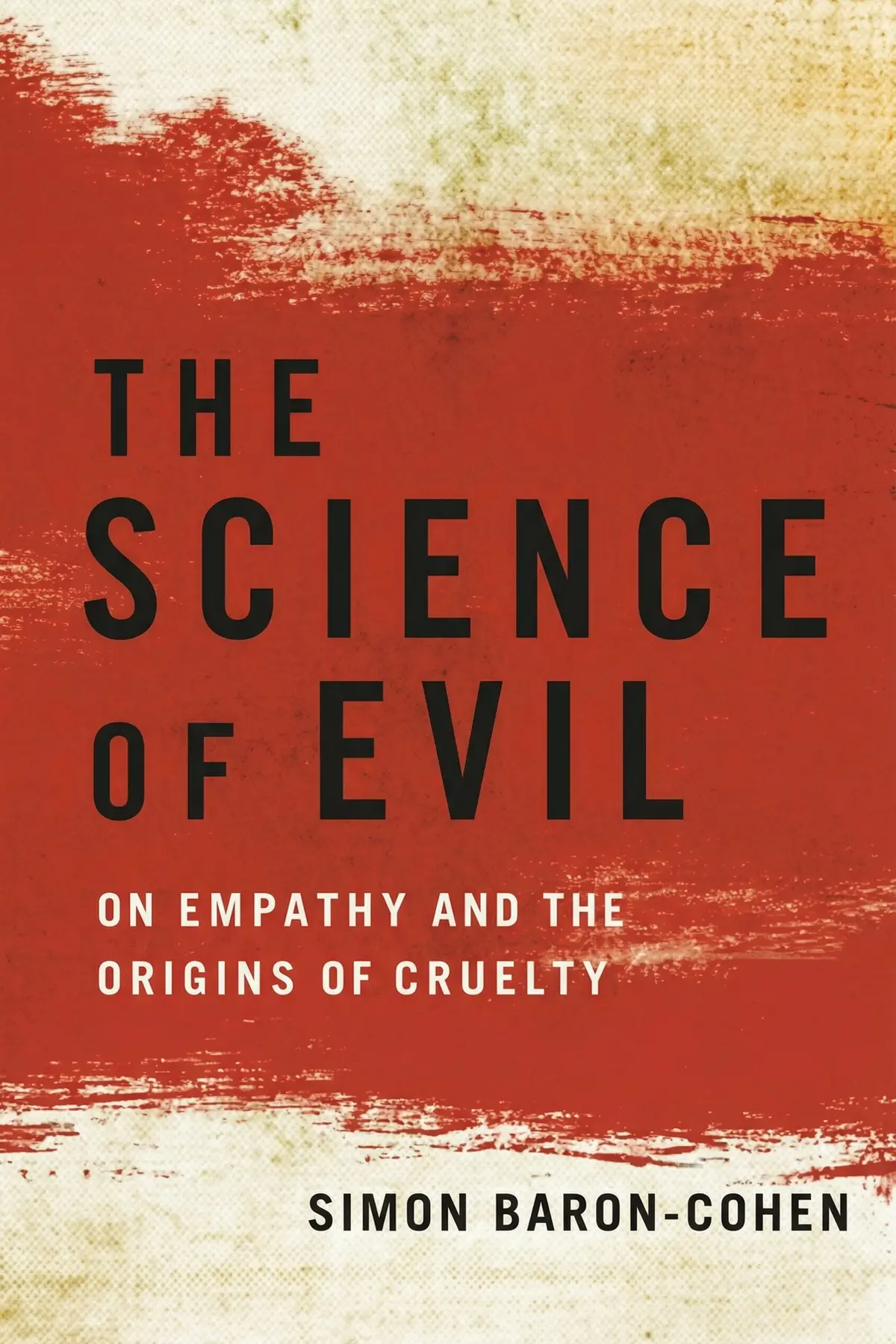
Table of Content
1. Introduction
1 min 00 sec
Most of us explain the worst human acts with a single word, evil, and then stop thinking. In Science of Evil, Cambridge psychologist Simon Baron-Cohen argues that the word explains nothing, and offers something we can actually measure instead: empathy, and what happens when it wears away. Cruelty, in his account, becomes possible the moment we stop seeing another person as a person and start treating them as a thing.
He calls that shift empathy erosion, and it is not reserved for monsters. It works on a scale. Orders, beliefs and propaganda can turn it down, and its roots reach into our genes, our brains and the way we were raised. Follow his argument and the headlines about atrocity look less like mysteries. You also get a clear picture of the everyday moments when your own empathy dims, and of what parents and caregivers can do so that children grow up able to feel for others.
2. Drop the word evil to see cruelty clearly
1 min 50 sec
A Nazi doctor’s research is still taught in universities, and many of his fellow defendants looked like ordinary office workers. The usual label for them turns out to hide more than it reveals.
3. Spot the moment a person becomes a thing
1 min 46 sec
Empathy and sympathy sound like twins, but they work in different ways. The difference explains what goes missing in a mind capable of cruelty, and it can show up in an ordinary meeting.
4. Tell knowing feelings apart from caring about them
1 min 52 sec
Some people read emotions perfectly and still do great harm, while others struggle to read emotions yet feel deeply for anyone suffering. Their mirror-image profiles reveal that empathy has two separate parts.
5. See how orders and slogans dim decent people's empathy
2 min 09 sec
Well-adjusted volunteers kept giving painful shocks to a stranger because a man in a lab coat asked them to. Yet the same forces fail to explain one notorious killer who seemed perfectly normal.
6. Learn what leaves some brains with less empathy
2 min 01 sec
An iron rod through a railroad engineer’s skull, a gene nicknamed after warriors and a hormone measured before birth all point to the body’s role in empathy. But none of them settles anyone’s fate alone.
7. Give children the secure base empathy needs
2 min 02 sec
A child’s drawing, a tumble at the playground and a study of young thieves all lead to the same discovery about where empathy comes from, and about who has the most power to grow it.
8. Conclusion
1 min 16 sec
Baron-Cohen’s case is that the word evil hides more than it shows. Swap it for empathy erosion and cruelty turns into something with parts you can examine: a double focus that shrinks to a single one, a knowing half and a caring half that fail separately, a dimmer that orders and slogans can turn down, and roots in genes, hormones, brain circuits and early care. Rascher at Dachau and Bundy on the helpline stop being mysteries, even if they remain horrors.
His most hopeful point is also his most demanding. Nobody picks their genes or rewrites their own childhood, but we do shape the childhoods of the people we raise and teach. In his view, people who do terrible things are made as well as born.
That leaves a few things worth noticing. When a group is described as less than human, or an instruction presses you to ignore someone’s pain, recognize the dial being turned. When stress narrows your attention to your own problem, treat it as fatigue and look up. And for the children around you, be the secure base they come back to.
Cruelty starts when a person becomes an it. Empathy is the habit of keeping them a thou.
About this book
What is this book about?
After the Nuremberg trials, one question stayed open: how did so many ordinary people, careerists and cultured scientists among them, take part in such cruelty? Calling them evil feels right, but Simon Baron-Cohen argues it explains nothing. The word covers too much, and it runs in a circle: bad people do bad things because they are not good. His alternative is empathy, which can be studied and measured. Cruelty becomes possible, he argues, when empathy erodes and another person stops being a person and becomes a tool or an obstacle. He separates two halves of empathy, reading feelings and caring about them, and uses psychopathy and autism to show how they can fail separately. He describes empathy as a dimmer that authority, ideology and propaganda can turn down, drawing on Stanley Milgram's shock experiments, the September 11 hijackers and the case of Ted Bundy. Then he traces the roots: the MAOA gene, testosterone in the womb, the brain injury of Phineas Gage, and the attachment research of John Bowlby and Peter Fonagy. Readers get a clearer way to think about atrocity and everyday coldness alike, and a hopeful conclusion about the part that care in childhood plays.
Book Information
Who it's for
Troubled by atrocities
Readers troubled by atrocities in the news who want an explanation better than evil.
Managers and team members
Managers and team members wary of how orders and group pressure can dull decent people.
Curious how empathy forms
Parents, teachers and caregivers who want to know how empathy forms in children.
About the Author
Simon Baron-Cohen
Sir Simon Baron-Cohen is professor of developmental psychopathology at Cambridge University, where he directs the Autism Research Centre, and a Fellow of Trinity College. He began researching autism in 1982, proposed the mindblindness theory in 1985 and the empathising-systemising theory in 2003, and has written more than 600 scientific articles. He was knighted in 2021 for services to people with autism and received the Grawemeyer Award in Psychology in 2026.
Ratings & Reviews
Ratings at a glance
What people think
Listeners find the author's take on empathy compelling, specifically highlighting the useful, quantifiable "empathy quotient" test and the study of genetic components. The text is considered informative and highly readable, with one listener noting the beneficial references and appendices. Positive feedback focuses on the intriguing subject, the analysis of brain functions, and the prose, as one listener particularly appreciates the clear explanations of brain regions. Scientific opinions are divided; some listeners consider the research clear, while others remain skeptical of the theory of evil being presented.
Top reviews
Yam
The Science of Evil provides a refreshing, biological perspective on human cruelty that moves away from outdated theological definitions. I found the section on the 'Empathy Quotient' (EQ) to be a major highlight, as it gives readers a concrete tool to understand their own place on the spectrum. Personally, I was most impressed by how he links the physiological brain function to social behavior without becoming overly technical. The appendices and references are incredibly helpful for anyone wanting to dive deeper into the genetic markers of empathy. It’s rare to find a book that balances hard neuroscience with such a readable, engaging prose style. This is a must-read for anyone interested in why we treat each other the way we do.
Show moreGoy
Finally got around to reading this, and the concept of 'Zero-Positive' individuals really changed how I view human behavior. It’s a bold theory that reframes certain conditions not as mere deficits, but as a different, highly-systematized way of processing reality. The book is incredibly informative, providing a deep dive into the genetic components that influence our ability to relate to others. I loved the clear diagrams of the brain regions involved in the empathy circuit—it made the science feel very tangible. For anyone who has ever been baffled by the cruelty in the news, this provides a comforting, scientific explanation that feels much more grounded than 'pure evil'.
Show moreTitiluck
In my experience, this book functions as a solid introduction to a very complex topic. Baron-Cohen’s central argument—that we should replace the word 'evil' with 'empathy erosion'—is a powerful shift in perspective. The truth is, it makes sense of historical atrocities without falling into the trap of just labeling people as monsters. I did think some parts were a bit repetitive, and the 'mommy issues' case studies felt a little dated. However, the overall discussion on the 'empathy circuit' and the genetic predispositions for these traits is handled with a lot of care. It’s a thought-provoking piece that definitely deserves a spot on your shelf.
Show moreWittaya
A deeply thought-provoking read that challenges the way we punish 'evil' acts in our society. By looking at the combination of genetics and early childhood neglect, Baron-Cohen argues for empathy and rehabilitation over pure retribution. Not gonna lie, some of the descriptions of cruelty are hard to stomach, but they serve to illustrate his point about how people can be 'turned off' to the feelings of others. The inclusion of the Empathy Quotient test is a genius move, making the reader part of the study. It’s an accessible, humanizing, and ultimately hopeful book that suggests we can actually do something about the 'science of evil' if we understand the biology behind it.
Show moreClara
Ever wonder why some people are just... heartless? Simon Baron-Cohen attempts to answer this by replacing the vague concept of 'evil' with a quantifiable lack of empathy. I found the 'Empathy Quotient' test in the back to be incredibly insightful, even if it feels a bit like a parlor trick at first. To be fair, the book is written with a clarity that makes complex brain regions like the amygdala and medial prefrontal cortex accessible to anyone. While the science might feel a bit speculative in certain chapters, the exploration of how genetics and nurture intertwine is compelling. It’s a quick read that packs a punch, though it does leave you with several haunting questions about the nature of human cruelty.
Show moreRod
Baron-Cohen’s writing style is remarkably accessible for a book that dives into complex neurological structures. He avoids the usual academic dry spell, making the discussion of the brain’s empathy centers feel urgent and relevant to our current world. I particularly enjoyed the distinction he makes between different types of 'Zero-Empathy' individuals. The idea that some lack empathy but gain an incredible ability to see patterns is a brilliant reframing of neurodiversity. It helped me understand the 'Zero Positive' people in my own life much more clearly. To be fair, it’s a short book, but it’s packed with insights that have stuck with me long after finishing the last page.
Show moreAnong
Truth is, I couldn’t stop thinking about the fact that the author is Sacha Baron-Cohen’s cousin while reading this. One uses satire to expose the lack of empathy in society, while the other maps it out in the lab. It’s a fascinating juxtaposition! The book itself is quite good, especially the parts focusing on how the brain treats people as 'objects' to justify cruelty. I did find the sections on animal empathy in mice and monkeys to be a bit brief, but they were nonetheless eye-opening. While some of the conclusions about rehabilitation felt a bit optimistic, the overall framework for understanding 'evil' is much more useful than just calling people bad.
Show moreMichael
Picked this up because the premise of 'Zero-Negative' and 'Zero-Positive' personalities sounded fascinating. While Baron-Cohen’s breakdown of the 'empathy circuit' is genuinely enlightening, I struggled with his case studies. Look, blaming every instance of psychopathy on a neglectful mother feels like a massive step backward for modern psychology. It’s that old 'mommy didn't love me enough' trope that ignores the role of the father entirely. The chapters on systematizing in autism were the highlight for me, but the push for total rehabilitation through the 'flower in the desert' analogy felt a bit like an ivory tower fantasy. It’s an okay read, but take the nurture arguments with a grain of salt.
Show moreRung
After hearing so much about Baron-Cohen's reputation in the field of autism, I was shocked by the sloppy scholarship in this volume. He makes several basic factual errors—most notably claiming Kim Peek had autism when his actual diagnosis was FG syndrome. He also misinterprets Martin Luther’s historical writings in a way that is utterly preposterous to anyone with a passing interest in history. These aren't just nitpicks; they undermine the credibility of his entire argument. If he can’t get the basic facts right about a famous case study, why should I trust his revolutionary theory on the 'empathy circuit'? It’s a disappointing effort from someone who should know better.
Show moreIsaiah
This book is dangerous. To suggest that individuals with Borderline Personality Disorder or Autism lack empathy is not just scientifically inaccurate, it’s actively harmful to a community that already faces massive stigma. Frankly, the author’s tone feels quite cold and detached, which is ironic for a book about empathy. How did such blatant misinformation about BPD patients—who often feel empathy too intensely—pass through peer review? It feels like holy fear-mongering under the guise of an academic study. If you care about mental health advocacy or basic scientific rigor, stay far away from this toxic narrative. It’s a gross misrepresentation that treats suffering humans like broken machines.
Show moreQuestions about this book
What is the main idea of Science of Evil by Simon Baron-Cohen?
Baron-Cohen argues that evil is a weak, circular explanation for cruelty. He replaces it with empathy erosion, a state in which we treat people as things that serve or block our goals. Empathy works like a dimmer rather than a switch. Orders, ideology and propaganda can turn it down, and genes, hormones, brain injury and early neglect can reduce a person’s capacity for it.
What is the difference between cognitive and affective empathy?
Cognitive empathy is recognizing what another person thinks and feels. Affective empathy is the drive to respond with a fitting emotion of your own. Baron-Cohen notes that people with psychopathic disorders often read feelings well but do not care, like actors copying emotions. People on the autism spectrum can show the opposite pattern, finding feelings hard to read while being strongly moved by suffering.
What does Science of Evil say about the warrior gene?
The MAOA gene makes an enzyme that breaks down serotonin, which is linked to aggression. Its low-activity version is common enough in warrior cultures such as the Maori that it was nicknamed the warrior gene. Psychologist Avshalom Caspi found that children who had been mistreated and carried this version showed a far higher chance of developing psychopathic traits, so genes and childhood experience appear to act together.
How can parents raise more empathetic children, according to Baron-Cohen?
Drawing on John Bowlby and Peter Fonagy, the book says empathy grows when a child feels emotionally safe with a caregiver. A secure base lets children explore and return for comfort, which Bowlby called emotional refueling. Children also learn to read minds by noticing how their actions affect a parent, such as a drawing that makes the parent proud. Neglect and emotional abuse can shut that learning down.
Who should read Science of Evil?
It suits readers who want a scientific way to think about cruelty, from genocide to everyday coldness. Managers and employees get a clear view of how authority and group beliefs can dull empathy, illustrated by Milgram’s shock experiment. Parents and educators get the book’s hopeful conclusion: the way children are treated plays a large part in whether they grow into empathetic adults.
Readers also enjoyed

59 Seconds: Change Your Life in Under a Minute
Richard Wiseman




A Liberated Mind: How to Pivot Toward What Matters
Steven C. Hayes


Acting with Power: Why We Are More Powerful Than We Believe
Deborah Gruenfeld


Age of Propaganda: The Everyday Use and Abuse of Persuasion
Anthony Pratkanis
AUDIO SUMMARY AVAILABLE
Listen to Science of Evil in 15 minutes
Get the key ideas from Science of Evil by Simon Baron-Cohen, plus 5,000+ more nonfiction titles.
- 5,000+ titles
- Listen as much as you want
- 7-day free trial
- Cancel anytime









