


11 min 06 sec
Available in: English
 ไทย
EnglishไทยRunning Lean: Iterate from a Plan A to A Plan That Works
By Ash Maurya
Shows founders how to turn a business idea into a product people want by testing every assumption cheaply: a one-page plan, customer interviews, quick experiments, a priced demo and close tracking of where early customers drop away.
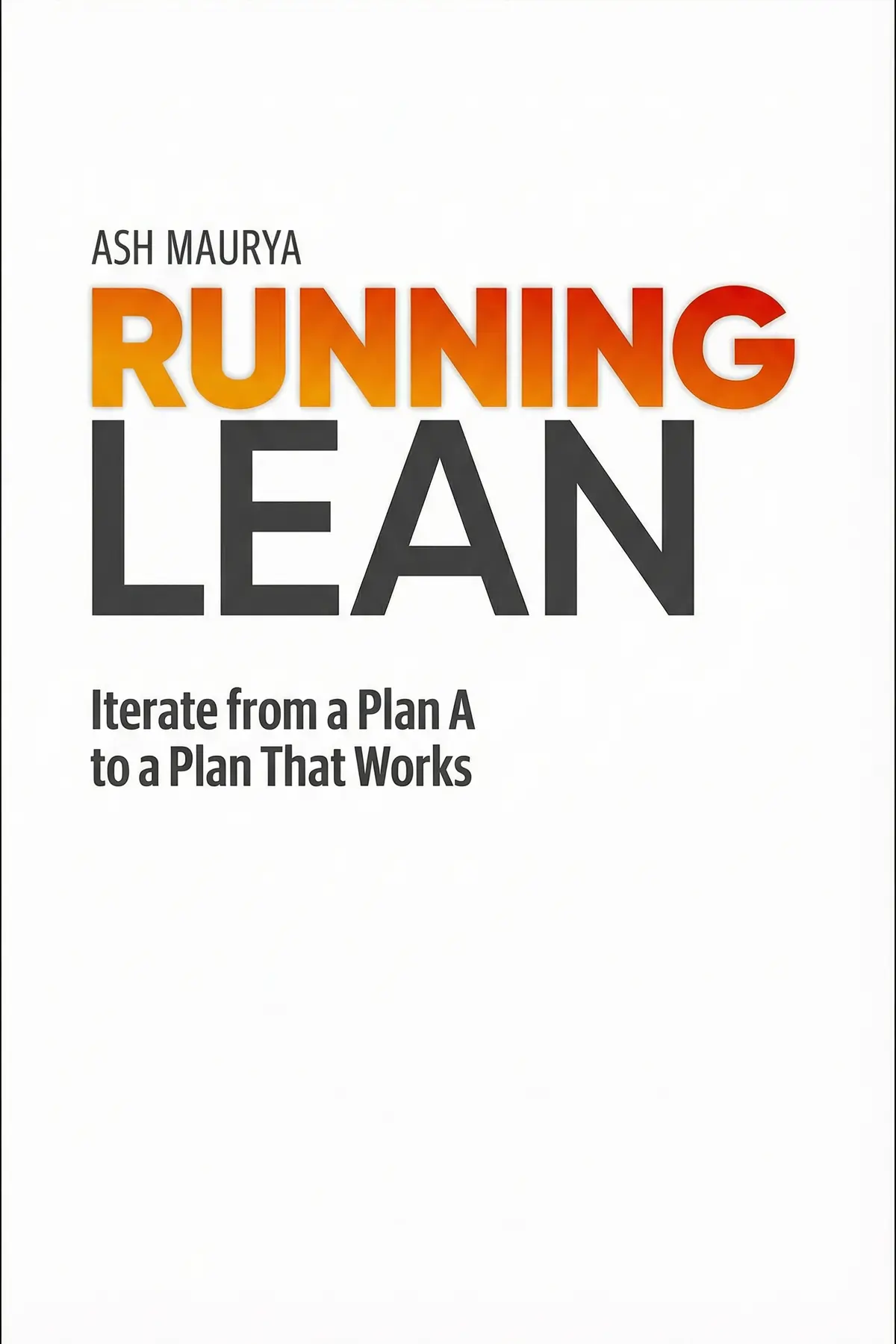
Table of Content
1. Introduction
58 sec
Building and shipping a product before testing it with customers wastes resources, and the book warns that this path leads to failure. In Running Lean, entrepreneur Ash Maurya argues that an idea becomes a business only through repeated testing, and that the testing can begin on one sheet of paper, long before any product exists.
His starting point is humbling: a first plan is a collection of guesses. The real work is to replace those guesses with evidence, one at a time, by watching what people do and by talking with them directly. That applies at every stage, from the first sketch of a business model to the moment paying customers start to arrive, or fail to.
Follow his method and you can check an idea without a large budget, hear the problem customers will actually pay to have solved, put a price in front of people early, and find the precise step where a launch is losing them.
2. Fit your whole business idea on one page
1 min 28 sec
Months spent on a detailed business plan can lock you into a vision just when the facts start to argue with it. A simpler format keeps a new idea flexible enough to survive its first contact with customers.
3. Hear your customer's real problem in conversation
1 min 32 sec
Surveys and focus groups look like serious research, yet early on they often tell founders almost nothing. A handful of honest conversations led one software builder straight to his market and his core promise.
4. Test every assumption with a small, cheap loop
1 min 29 sec
A full product launch is an expensive way to discover a mistake. Even a single line of text on a web page can show you whether your instincts about customers are right.
5. Let a demo test your features and price
1 min 33 sec
Customers can judge a product and its price long before the product exists. The trick is giving them something real enough to react to, and knowing what to leave out of the first release.
6. Find the exact step where customers give up
1 min 25 sec
People who like a product can still abandon it halfway through signing up. Finding the moment they quit takes two kinds of evidence, and only one of them points toward a fix.
7. Turn slow sales into an ordered list of fixes
1 min 31 sec
Slow sales and silent reviews feel like the end of a business. Maurya reads them as a signal with a specific repair order, and the right measure of success depends on what you sell.
8. Conclusion
1 min 10 sec
What Maurya offers is a different idea of what building a company means. The product comes last, and feedback is the material everything before it is made from. A one-page canvas, a conversation with a busy parent, a test tagline, a sketch with a price attached: each is a small, cheap way of asking the market a question before serious money is spent on the answer.
He adds practical help for founders who find that asking uncomfortable, such as software developers who rarely deal with customers face to face. Begin with users you already know, so the process feels familiar. When you can meet in person, choose a neutral place such as a café, which feels more personal than an office, and leave enough time for a relaxed talk in which people say what they really think. Then, when you reach out for feedback, begin with users you already know, meet somewhere neutral like a cafe, and leave time for a relaxed talk.
The customers who line up overnight for a product are the end of the story. It begins with someone willing to ask, listen and change the plan.
About this book
What is this book about?
Plenty of people have a promising business idea. Far fewer turn it into a product with real customers, and many who try spend their money building something nobody asked for. Ash Maurya argues that the gap is not talent or funding. It is the habit of testing the idea again and again, adjusting it until it fits what the market wants. Drawing on lean methods, Maurya lays out a sequence. Write the business model on a single page so it can change quickly. Talk to potential customers one at a time instead of relying on surveys or focus groups. Run small build-measure-learn experiments on mock-ups and landing pages. Show a demo and a price before building the real thing. Then follow early adopters from first visit to first payment to find where they give up. Readers get a practical order of work for the riskiest stage of a new venture, plus a clear way to judge whether a launch has traction and what to fix first when it does not.
Book Information
Who it's for
First-time founders
First-time founders with an idea who want to test it before spending savings on building it.
Developers and product builders
Software developers and product builders who rarely talk to customers and need a simple way to start.
Operators facing slow launches
Operators facing a slow launch who want to know what to fix first.
About the Author
Ash Maurya
Ash Maurya has founded several start-ups, including WiredReach. After encountering the Lean Startup and Customer Development ideas of Eric Ries and Steve Blank, he applied and tested them in his own companies and wrote about the results on a blog that became Running Lean. He created Lean Canvas, a one-page tool for modeling a business, has mentored at accelerators such as TechStars, and has guest lectured at MIT and Harvard.
Ratings & Reviews
Ratings at a glance

What people think
Listeners find the book's insights highly valuable, with one individual noting it reflects 10 years of startup consulting experience. Furthermore, the fundamental guidance for new entrepreneurs and straightforward ideas make it a functional resource. Listeners also consider the content beneficial, including one who mentioned it helped them save time and money.
Top reviews
Chatri
This book is a masterclass in pragmatism for anyone actually trying to build something from scratch. Instead of theorizing about success, Maurya provides a clear roadmap that helped me avoid dumping thousands into a failing idea. The Lean Canvas alone justifies the purchase price because it forces you to confront the riskiest parts of your business model before you write a single line of code. Frankly, I wish I’d found this years ago when I was chasing vanity metrics instead of real customer validation. It’s an essential handbook that translates vague 'startup vibes' into a repeatable, scientific process.
Show moreMilk
As someone who identifies as an engineer by trade, I initially approached this text with a massive amount of skepticism. I was looking for technical agile strategies, but what I found was something much more valuable: a way to apply the scientific method to a business plan. Maurya explains how to treat your product as an experiment, using customer interviews to extract hard data rather than just seeking ego-boosting compliments. It shifted my focus from purely 'how to build' to 'what is actually worth building' for the user. This isn't just for 'entrepreneurs'—it's for anyone who wants to create solutions that actually solve real-world problems.
Show moreEthan
The section on vanity metrics was a total wake-up call for my current project. Instead of obsessing over hits or downloads, Maurya pushes you to find 'early adopters' who are willing to give you a real commitment. I appreciate how he breaks down the 'Unfair Advantage' concept, forcing you to think about what cannot be easily bought or copied by competitors. Truth is, the book is a bit dated in its specific examples, but the core principles remain incredibly relevant in today's saturated market. If you are struggling to get past the initial 'idea' phase, this systematic approach to testing hypotheses is exactly what you need.
Show morePor
Finally got around to finishing this, and it’s easily one of the most actionable startup books on my shelf. It takes the abstract concepts of the lean movement and turns them into a step-by-step workbook that any founder can follow. The emphasis on defining your MVP based on qualitative feedback rather than just your own 'vision' is a hard pill to swallow but absolutely necessary. You might find some of the concepts basic if you’re a veteran, but for a first-timer, this is the gold standard. It’s about building a business model that is actually viable, not just a product that looks cool.
Show moreTern
Ever wonder why most startups fail within the first eighteen months? It is usually because they build something nobody wants, and this book tackles that head-on with a very specific, iterative framework. To be fair, the first chapter contains the meat of the argument, and the subsequent sections can feel like an expansion of those initial points. Some might find the repetition annoying, but for me, it hammered home the importance of the problem/solution fit. While the writing style occasionally drifts into a 'blogger' tone, the underlying logic is sound enough to ignore the fluff.
Show moreFilm
Wow, I am genuinely impressed by how much practical wisdom is packed into these pages. It is obvious that the author has spent over a decade in the trenches of startup consulting because the advice feels lived-in and battle-tested. Look, the process is quite detailed—maybe even a bit overwhelming for a total novice—but that complexity is necessary to navigate the 'Plan A' trap. I particularly liked the distinction between users and customers; knowing who actually pays the bills is a lesson many founders learn too late. It’s a solid resource that will save you both time and capital if you actually follow the steps.
Show moreJoshua
After hearing so much buzz about the Lean Canvas, I finally decided to dive into the full source material. The book serves as a comprehensive manual for iterating your way to success before you run out of resources or patience. While some sections feel a bit repetitive, the focus on 'getting out of the building' to talk to real people is a message that cannot be repeated enough. I found the advice on customer interviews particularly enlightening, specifically the part about listening for pain points rather than pitching your own solution. It’s a grounded, tactical guide that avoids the 'self-important' tone common in business literature.
Show moreCamila
Not what I expected from a business book, but in a surprisingly good way. Instead of high-level fluff, you get a grit-and-grind look at how to validate a business model through small, fast experiments. The focus on 'Speed, Focus, and Learning' as an intersection for success is a framework I now use daily with my own team. Not gonna lie, the author’s writing can be a bit 'over-enthusiastic blogger' at times, which might grate on some readers. However, the practical value of the checklists and interview scripts far outweighs any minor stylistic gripes I might have.
Show moreSomboon
Personally, I found the amount of detail in the latter half of the book to be a bit suffocating. While the 'Plan A' concept is brilliant, the process introduced to move beyond it becomes so complex that it’s hard to follow the thread. It feels like a rewrite of more popular startup books but with a heavier emphasis on a very specific, rigid methodology. Got to say, I preferred the first version of this book for its simplicity, as this one feels like it’s trying too hard to be a definitive textbook. It’s decent for a one-time read, but it didn't quite hit the mark for me.
Show moreMaja
Picked this up with high hopes but ended up feeling like I was reading a collection of old blog posts. The author lacks the deep institutional background of other business theorists, and it shows in the way he over-simplifies complex market dynamics. Most of the content is just a rehash of Eric Ries’s work, rephrased with more 'rules' and 'steps' that feel artificially inflated to fill pages. If you have already read the foundational lean literature, you can probably skip this one without missing much. It’s a weak attempt at universalizing theories that don't always apply to larger, more complex ventures.
Show moreQuestions about this book
What is the main idea of Running Lean by Ash Maurya?
Maurya argues that launching a product without testing it wastes resources and usually fails. A first business plan is a set of assumptions, so each one should be checked with real feedback at every stage: a one-page lean canvas, customer interviews, build-measure-learn experiments, a demo with pricing, a simple landing page and close tracking of where early customers drop away. Both data and direct conversations with customers guide each change.
What is a lean canvas?
A lean canvas is a one-page diagram of a business model, created by Ash Maurya as a faster alternative to a long business plan. It takes little time to write and is easy to change, which matters because early ideas shift as founders learn. Maurya suggests drawing several canvases for one idea, each with a different model, then keeping the ones that seem to meet a real market need.
Why does Running Lean advise against surveys and focus groups early on?
At an early stage, founders do not yet know which questions matter or which answers are possible, so surveys tend to produce many vague responses such as other. Focus groups pull people toward group thinking and hide individual reactions. Maurya prefers one-to-one interviews, which reveal unexpected needs. His own interviews showed that busy parents were the group most eager to share photos and videos with family.
How do you measure traction according to Ash Maurya?
Traction is proof that people truly want what you offer, and how you gauge it depends on what you sell. For something bought and used once, like a book, good sales are a fair sign. For software, the sign is how many customers return each month. Without a clear measure, Maurya suggests checking conversion rates along the customer lifecycle, ranking problems by how many customers they cost and fixing the biggest first.
How can I start getting honest customer feedback if I find it intimidating?
Maurya suggests beginning with users you already know, so the process becomes familiar before you approach strangers. When meeting in person, choose a neutral setting such as a café, which feels more personal than an office. Allow plenty of time so the conversation stays relaxed and people feel free to say what they really think. Interviews, he argues, are where the real fixes come from.
Readers also enjoyed

Alibaba: The House That Jack Ma Built
Duncan Clark



7 Powers: The Foundations of Business Strategy
Hamilton Helmer




Bad Blood: Secrets and Lies in a Silicon Valley Startup
John Carreyrou
AUDIO SUMMARY AVAILABLE
Listen to Running Lean in 15 minutes
Get the key ideas from Running Lean by Ash Maurya, plus 5,000+ more nonfiction titles.
- 5,000+ titles
- Listen as much as you want
- 7-day free trial
- Cancel anytime









