

13 min 40 sec
Available in: English
Ritual: How Seemingly Senseless Acts Make Life Worth Living
Explains why acts that look pointless, from firewalks to pre-game routines, bond groups, increase generosity and calm nerves, and how to use small rituals to steady yourself and strengthen the people around you.
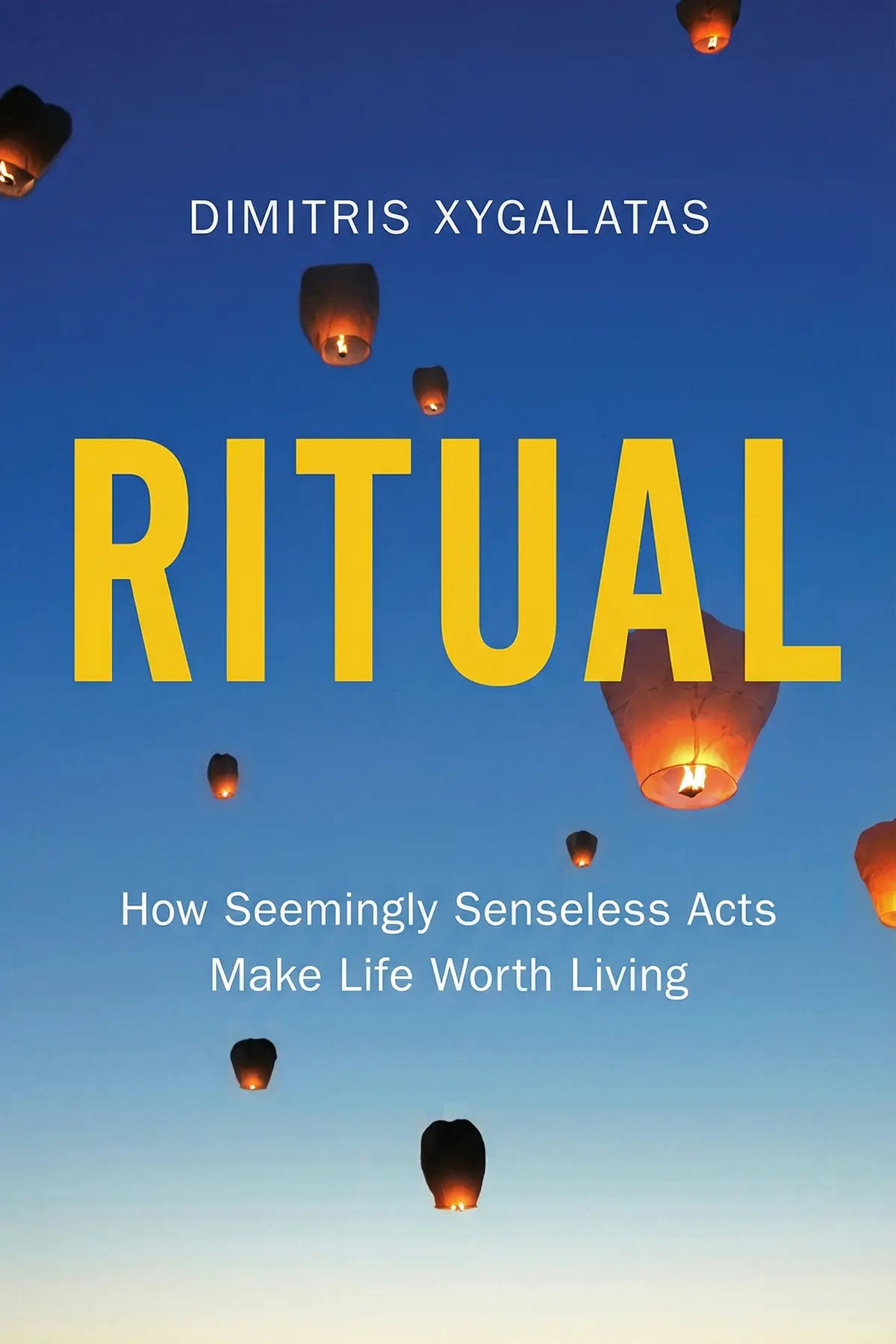
Table of Content
1. Introduction
1 min 03 sec
If your pulse races before a big meeting, a small fixed routine may steady you better than any pep talk. That is one of the findings in Ritual, where anthropologist Dimitris Xygalatas argues that acts which look senseless, from tapping a pen twice to walking barefoot over burning coals, do real work on the mind, the body and the group. His case is that rituals bond people, turn shared hardship into generosity and calm, and give us a feeling of control when events are out of our hands. The same force can push a group toward kindness or toward hostility.
Xygalatas pairs fieldwork with measurement. Heart rates are recorded at a midnight firewalk in Spain, giving is tested after a Hindu festival in Mauritius, and wearable sensors follow people’s stress for weeks. Follow that evidence and the toast at dinner, the chant in a stadium and your own pre-meeting habit stop looking like quirks. They become tools you can choose, design and aim on purpose.
2. Build belonging by doing things in unison
2 min 17 sec
Once a year, a Spanish village gathers at midnight to do something that looks reckless to outsiders. Ask the villagers why, and their short answer says more about human identity than any explanation of the act itself.
3. Shared hardship makes people more generous
2 min 13 sec
Devotees in Mauritius carry heavy offerings all day and pierce their skin with sharp objects. Researchers then checked how much they gave to charity, and the people who merely watched turned out to matter too.
4. Turn a hard ordeal into lasting calm
2 min 18 sec
Walking on knife edges should leave people shattered. Anthropologists who tracked participants for two months found something that runs against common sense about stress, and the most painful ordeals showed it most clearly.
5. Steady your nerves with a small fixed routine
2 min 16 sec
Island fishermen performed elaborate rites before some trips and skipped them before others. That difference, together with a lab study on rushed speeches and a look at baseball, shows when small routines help most.
6. Aim a ritual's power toward kindness
2 min 16 sec
The same surge of excitement that made some volunteers more helpful made others colder. A video game experiment shows why the rituals that unite a team or a nation can also turn it against outsiders.
7. Conclusion
1 min 17 sec
The pen tapped twice before a meeting and the bamboo frame carried up 241 temple steps belong to the same family. In Xygalatas’s account, a ritual’s power sits in the people performing it. Rituals sync the heartbeats of walkers and watchers, make people three times as likely to give, push stress below its usual level and steady a batter before the pitch. An act with no practical purpose is free to carry something else: belonging, meaning and a sense of order when life offers little of either.
That makes rituals worth designing instead of leaving to chance. Before the next moment that tightens your chest, run the same short sequence you used last time, and let repetition do its work. With the people you care about, keep at least one thing you do together, in step, on a regular rhythm, and do not shy away from shared efforts that are hard. If you lead a group, look closely at its traditions and ask whether they turn people toward one another or against someone else.
The villagers in northern Spain never needed a theory for their firewalk. They already knew that crossing the coals together, each with someone on their back, is how they stay who they are.
About this book
What is this book about?
Humans toast, chant, pray, carry lucky charms and, in some places, walk barefoot over burning coals. To an outsider many of these acts look senseless. Dimitris Xygalatas, an anthropologist who pairs fieldwork with scientific measurement, argues that their apparent pointlessness hides real effects on mind, body and community. He takes readers from a midnight firewalk in a Spanish village to the Kavadi ordeal in Mauritius, where devotees carry heavy bamboo frames and pierce their skin, and from Malinowski's fishermen in the Trobriand Islands to baseball players before a game. Along the way he shows rituals syncing the heart rates of walkers and watchers, making participants more generous, lowering stress for days after a painful ordeal and helping athletes perform under pressure. Readers learn why rituals feel so necessary, why shared hardship binds people, and how to build small routines that bring calm and focus. They also get a warning: because rituals amplify whatever message surrounds them, they can unite a group in kindness or turn it against outsiders.
Book Information
Who it's for
Professionals who freeze up
Professionals who freeze before interviews, exams or presentations and want a simple way to steady themselves.
Team leads and organizers
Team leads and community organizers looking for ways to build real belonging, and to avoid us-versus-them traps.
Curious about human rituals
Curious readers who have wondered why humans cling to toasts, chants and lucky charms.
About the Author
Dimitris Xygalatas
Dimitris Xygalatas is an anthropologist at the University of Connecticut, where he leads its Experimental Anthropology Lab. He has spent several years studying rituals in many parts of the world, combining what he observes in the field with scientific experiments to learn how rituals shape behavior and society. He has published more than 100 articles, and journalists from The New York Times and the Guardian, among others, have interviewed him about his work.
Ratings & Reviews
Ratings at a glance

What people think
Listeners describe this investigation into human ceremony as captivating and enlightening, although some point out that a few cultural specifics might have benefited from more rigorous fact-checking. Furthermore, they value the way the text applies interdisciplinary science to demonstrate the quantifiable psychological and social advantages of ritualistic habits. Listeners also commend the accessible prose and varied case studies, with one listener highlighting the fascinating puzzle box experiment that contrasts how children and chimpanzees imitate behavior. They further highlight how the author illustrates our yearning for social connection using vivid stories, including the bureaucratic chaos following a priest’s invalid baptism.
Top reviews
Milk
Wow, the story about the priest who accidentally invalidated thousands of baptisms because of a single word choice will stay with me forever. It’s the perfect example of how rigidity defines ritual. Xygalatas does an incredible job of bridging the gap between ancient traditions and modern science. He shows that whether we are fire-walking in Greece or just blowing on dice in a casino, we are trying to impose order on a chaotic world. The data on physiological synchrony during collective ceremonies was mind-blowing. I loved how he used biometric sensors to prove that these 'meaningless' acts have measurable benefits for our health and community. This is easily the most engaging science book I have read all year.
Show moreCarter
Finally got around to reading Xygalatas, and his work on 'honest signaling' and high-cost rituals like fire-walking is transformative. He explains why we do things that should, by all logic, be avoided. Why do we dance until we collapse or pierce our skin? Because it proves our dedication to the group in a way words never could. The book is packed with these 'aha!' moments that make you rethink your own daily routine. I found the writing to be incredibly immersive and the balance between lab experiments and field observations was perfect. It’s a rare book that can make you feel both smarter and more connected to humanity. Absolutely worth your time if you like social psychology.
Show moreAroha
Picked this up because I’ve always been fascinated by why humans do things that make no sense on paper. Xygalatas explains how these 'causally opaque' behaviors actually serve a massive psychological purpose. The study comparing how human children and chimpanzees solve puzzle boxes was a total standout for me. While the chimps were smart enough to skip the useless steps to get a treat, the kids followed the ritualized movements exactly. It really highlights how we are hardwired to value the process over the literal outcome. The writing is accessible and sharp, though I did find a few sections on the hormonal data a bit dense for a casual reader. Still, it’s a brilliant look at the invisible threads that hold our societies together.
Show moreIsaiah
As someone who grew up in a very traditional household, this book gave me a completely new perspective on the habits I used to resent. I always thought of ceremony as a waste of time, but Xygalatas argues that the 'wastefulness' is actually the point. It’s a signal of commitment. His exploration of 'high-cost' rituals—like the extreme body piercings during Thaipusam—explains how pain and effort create deep social bonds. The prose is lively and never feels like a dry textbook. I did think the chapter on COVID-19 felt a little rushed compared to the deep dives into tribal traditions, but the overall message is powerful. We aren't just thinking animals; we are ritualistic ones.
Show moreSin
The chapter on how rituals function in high-stress environments like sports or the military was eye-opening. We often mock athletes for their 'lucky' socks, but this book proves those small acts of repetition are vital for cognitive control. Xygalatas manages to make complex anthropology feel like a conversation at a bar. I especially liked the section on 'honest signaling' and why groups require such high entry costs to ensure loyalty. My only real gripe is that I wanted more focus on modern, digital rituals. The book leans heavily on traditional and religious examples, which are great, but I think there’s a missed opportunity to look at how we’re ritualizing our lives online today.
Show moreFatima
Ever wonder why we blow on dice or wear 'lucky' socks even when we know it doesn't actually change the physics of the game? This book dives deep into the 'causal opacity' of our lives. It turns out that when we feel out of control, our brains crave the structure of ritual to damp down the 'error signals' in our minds. I loved the mix of high-stakes religious ceremonies and mundane everyday habits. The anecdote about the priest whose 'we' instead of 'I' caused a bureaucratic nightmare for the Vatican was both hilarious and terrifying. It’s a solid 4-star read that offers a lot of great trivia and some genuinely profound psychological insights.
Show moreTanawan
Not gonna lie, I went into this expecting a dry academic text, but Xygalatas has a real knack for storytelling. He takes you from the laboratories of Connecticut to the villages of Mauritius without ever losing the reader. The way he explains the physiological benefits of shared trauma in rituals—how it syncs up the heart rates of entire crowds—is just brilliant. I did notice the mistake about Jewish mourning customs that other reviewers mentioned, which is a shame because it makes you wonder about the other cultural details. However, the overarching scientific theory is so compelling that I can overlook a few factual slips. It’s a fascinating look at the 'why' behind our most bizarre behaviors.
Show morePannipa
While the science behind the social bonding theories is undeniably robust, I found myself snagging on a few of the cultural descriptions. As a Jewish reader, seeing the author state that we watch over the dead for seven days at home was a bit jarring. It’s a basic fact that we bury our dead almost immediately; the 'shiva' is the mourning period that follows. This made me question if other rituals were fact-checked with the same level of care. Truth is, the book has some fascinating insights into why we crave ceremony, but these little inaccuracies pulled me out of the experience. It is a decent read for the psychology, just take some of the ethnographic details with a grain of salt.
Show moreMan
Is it a science book or an anthropology memoir? It sits somewhere in the middle. I enjoyed the description of the St. Andrews puzzle box experiment because it offered a clear, scientific look at human mimesis. However, the author’s personal transition from skeptic to believer felt a bit forced in the narrative. To be fair, the research into how collective action lowers cortisol levels is fascinating and well-presented. I just wish the tone was a bit more consistent. One minute you're reading about rigorous biometric testing and the next you're in a very anecdotal story about Greek fire-walkers. It’s an interesting collection of facts, but it lacks a cohesive thread to tie everything together perfectly.
Show moreIngrid
Frankly, I wanted to love this more than I actually did, but the middle section felt like a slog through data that didn't always justify the length. I appreciated the core argument that rituals reduce anxiety, but the author repeats this point across almost every chapter with slightly different examples. Some of the anecdotes are genuinely shocking, like the Toraja people keeping their deceased relatives in their homes for years, but the analysis surrounding them felt repetitive after a while. I also struggled with some of the generalizations made about modern secularism. It felt like a 300-page book that could have been a very tight, 50-page essay. Not a bad effort, but it just didn't hold my attention.
Show moreQuestions about this book
What is the main idea of Ritual by Dimitris Xygalatas?
Xygalatas argues that rituals, even ones that look senseless, have measurable effects on the people who perform them. They bond groups through shared action, turn shared hardship into generosity, lower stress after intense ordeals and give people a feeling of control when outcomes are uncertain. Because they amplify whatever message surrounds them, they can also divide groups into us and them.
Do painful rituals really make people more generous?
In Mauritius, those who went through the Kavadi ordeal were three times as likely to give to charity as people who took part in a milder ritual such as group prayer. The more pain someone endured, the more they gave. Even family and friends who only watched became more generous, and at a Spanish firewalk the heart rates of walkers and spectators moved in sync.
How can I use rituals to reduce stress and perform better?
The book suggests building a short, fixed routine for high-pressure moments and repeating it the same way each time, like a baseball player adjusting gloves before every pitch. Xygalatas reports that players with pre-game rituals perform better, because the routine lowers stress, raises confidence and sharpens focus. A sequence as simple as straightening your jacket, tapping a pen and breathing deeply can serve.
Can rituals be harmful?
Yes. Xygalatas calls rituals technologies of the mind that can be used for better or worse. In one experiment, physical arousal made people more helpful after prosocial cues but less helpful after antisocial ones. Rituals likewise build loyalty in religions, armies, teams and companies, but they can also harden divisions, as in nationalism or bitter rivalries.
Readers also enjoyed


A Liberated Mind: How to Pivot Toward What Matters
Steven C. Hayes


Acting with Power: Why We Are More Powerful Than We Believe
Deborah Gruenfeld


Age of Propaganda: The Everyday Use and Abuse of Persuasion
Anthony Pratkanis



AUDIO SUMMARY AVAILABLE
Listen to Ritual in 15 minutes
Get the key ideas from Ritual by Dimitris Xygalatas, plus 5,000+ more nonfiction titles.
- 5,000+ titles
- Listen as much as you want
- 7-day free trial
- Cancel anytime









