
12 min 43 sec
Available in: English
Rich AF: The Winning Money Mindset That Will Change Your Life
By Vivian Tu
Shows how inherited money beliefs hold you back. It explains why raising your income beats endless cost cutting, and gives a simple three-color budget that plans for what you value, fun included.
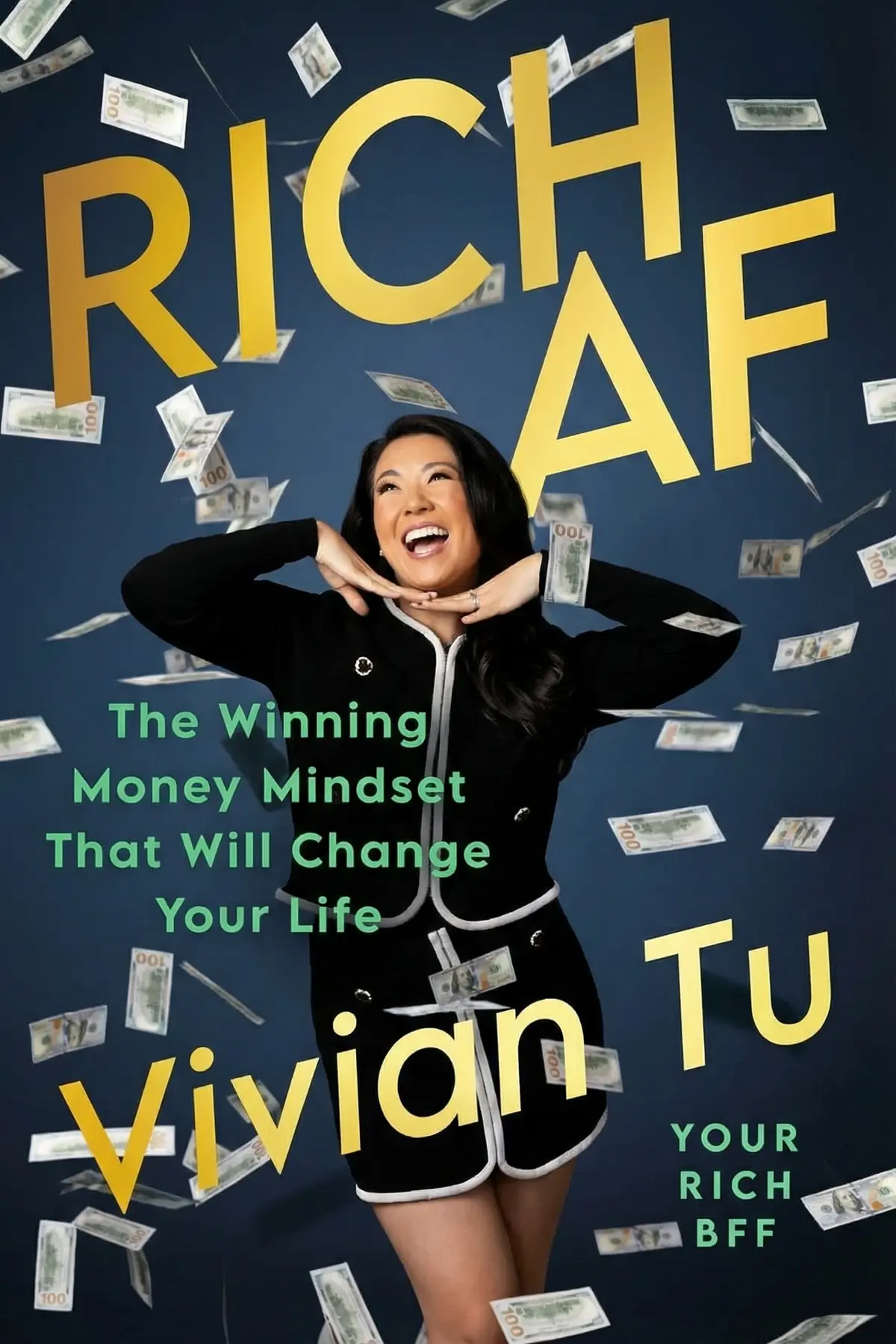
Table of Content
1. Introduction
59 sec
If money seems to slip away however hard you hold on, Vivian Tu suggests the leak may start in your own head, with rules you picked up at home before you ever earned a paycheck. In Rich AF, the former J.P. Morgan trader argues that getting rich has little to do with math skills or family money. What counts is knowing your goals and clearing away the habits that block them. Her first real lesson reverses standard advice: what you can save is limited by what you earn, but what you can earn has no such ceiling.
Her case fits in one line. Unlearn the money beliefs you inherited, push hard on your income in places that reward you, and treat a budget as a plan for the life you want. Along the way you get a test for the money advice you grew up with, three questions for judging whether your job is holding you back, and a simple three-color system that shows where your money really goes.
2. Spot the money rules your family handed you
1 min 42 sec
A loving father gave his daughter advice that cost her real money, and he was sure he was protecting her. The same kind of well-meant rule may be shaping your choices right now.
3. Put idle cash to work and stop performing
1 min 50 sec
Keeping money safe, buying what others admire and venting about bills all feel normal. Tu argues each one slowly drains wealth, and the fix asks for something harder than reflection.
4. Grow the side of your finances with no ceiling
1 min 41 sec
Skipping coffee and sharing a cramped apartment can only take you so far. A summer job paying five dollars a head showed Tu where the bigger opportunity was hiding.
5. Choose a workplace that pays for your effort
1 min 52 sec
Working hard is not enough if your employer only notices it. Tu learned that a respected Wall Street desk still lacked something she needed, and found it somewhere unexpected.
6. Make a budget that leaves room for fun
1 min 45 sec
Most people hear the word budget and picture a diet for their wallet. Tu describes something closer to a recipe, and the step she puts at its heart is not about numbers at all.
7. Sort every expense by color and true cost
1 min 46 sec
A fifteen dollar fast-food lunch costs more than fifteen dollars, once you see what else that money could have done. Tu’s color system turns that hidden price into a choice you make on purpose.
8. Conclusion
1 min 08 sec
In the end, Tu asks for a change of stance. Money stops being a score you keep failing and becomes material you can shape. The father who steered her away from student aid, the $5-a-head nights in Chicago and the move from a respected trading desk to a company that actually promoted her all point the same way. That story shows how a well-meant belief handed down by a parent can quietly cost you, and why such money myths are worth questioning.
That stance supports a few things worth doing soon. Pick one money rule from your childhood and check whether it holds up. Look at your job with honest eyes, ask whether it rewards your effort or only uses it, and keep building connections either way. Then gather your spending in one place, color it red, yellow and green, and weigh each green item against what that money could have done instead.
None of this calls for a finance degree or a lucky start. Tu’s case is that wealth begins the day you stop following money rules nobody chose and start writing your own.
About this book
What is this book about?
Many people work hard, save where they can and still feel that money slips away. Vivian Tu, a former J.P. Morgan trader who made her first million by 27, argues that the biggest barriers are often invisible. They are attitudes and habits picked up at home, usually from parents who meant well. Rich AF takes those barriers apart in three steps. First, Tu challenges inherited money myths: idle cash feels safe but wastes opportunity, spending to impress others drains wealth, and complaining without acting changes nothing. Second, she shifts the focus from saving to earning, since saving is capped by income and income is not. Her own path from club promoter in Chicago to Wall Street, BuzzFeed and TikTok shows why the right workplace matters as much as hard work. Third, she rebuilds budgeting as a plan, not a punishment. Readers get a spending audit, a red, yellow and green system for sorting expenses, and an opportunity cost test that shows whether each purchase is worth what it gives up.
Book Information
Who it's for
Early-career savers feeling stuck
Early-career professionals who save hard but feel their income is stuck.
Questioning inherited money habits
Anyone who suspects their parents' money habits are steering their own choices.
Avoiding punishing budgets
People who avoid budgeting because it feels like punishment and want a plan that includes fun.
About the Author
Vivian Tu
Vivian Tu started her career as an equities trader at J.P. Morgan, covering industrials, materials and energy stocks. She then moved to BuzzFeed as a strategy sales partner, helping brands run marketing campaigns across several channels. She made her first million by age 27. Today she is the founder and CEO of Your Rich BFF Media LLC, a multimedia company that teaches personal finance.
Ratings & Reviews
Ratings at a glance

What people think
Listeners find the book both captivating and easy to follow, as it translates intricate financial theories into basic terms. They also commend the exceptional guidance and assets provided, with one listener remarking on the efficient way it deconstructs individual chapter topics. Furthermore, it garners praise for its encouraging perspectives and life-changing methodology, which helps listeners feel significantly more confident.
Top reviews
Pichaya
Finally got around to reading this because my social media feed was basically just Vivian Tu for three months straight. To be fair, the hype is actually justified because she manages to turn complex financial principles into something that feels like a conversation over cocktails. The 'girly pop' energy might be polarizing for some, but for those of us in marginalized communities, it’s refreshing to see someone speak our language. I’ve always felt intimidated by the stock market, but the way she breaks down chapter concepts into actionable items made me feel totally capable. It’s an engaging, fast-paced read that doesn't sacrifice the quality of the advice just to be trendy. Truly a transformative guide for anyone who felt like traditional finance wasn't built for them.
Show moreOn
This book effectively bridges the gap between 'vague manifestation' and 'boring textbook finance' in a way few others manage to do. Most of us just want to know how to maximize our paychecks without feeling like we have to give up every single joy in life. Not gonna lie, I was skeptical about the 'Your Rich BFF' persona in a long-form book, but it actually works quite well. She takes these massive, scary financial concepts and whittles them down into simple concepts that even a total novice can grasp. It’s way better than older staples like 'Rich Dad Poor Dad' because it actually accounts for the modern economy we live in. I’ve already recommended it to three people at work who are trying to figure out their 401ks.
Show moreLena
Picked this up on a whim and now I’m actually looking at my high-yield savings account every single morning with a smile. The motivational insights sprinkled throughout the chapters kept me turning pages much faster than I ever thought I would for a book about taxes and budgets. Vivian Tu has a way of making you feel empowered rather than guilty about your past spending mistakes, which is a huge shift from the old-school experts. I particularly loved the breakdown of how to negotiate a salary because that’s an area where so many of us leave money on the table. This isn't just a book; it's a toolkit for a better life. I feel like I finally have a roadmap that makes sense for my specific goals.
Show moreOwen
Wow, I didn't expect a book about money to actually make me feel more confident in my everyday life choices and professional career. It’s more than just a guide to investing; it’s a transformative approach to how we view our worth in a world that often tries to diminish it. The resources provided are incredibly helpful, and I’ve already used several of the templates she suggested for tracking my net worth. Every chapter feels like a mini-lesson that builds on the last one, making the whole journey feel very cohesive and manageable. If you’re tired of feeling like financial freedom is a club you aren't invited to, you need to read this immediately. Vivian is the mentor we all wish we had in high school.
Show moreOlivia
The chapter on investing was exactly what I needed to stop being afraid of the market and actually start moving my money. In my experience, most finance books are either incredibly dry or way too focused on manifestation without any real math to back it up. Vivian finds a great middle ground here by offering fantastic advice and resources that feel practical for the sub-30 crowd. My only real gripe is that the writing style is very 'millennial internet,' which might not age perfectly in a few years. However, the core message about financial equity and unlearning bad habits is solid gold. If you’re looking for a starting point to get your money right in 2024, this is a very strong contender.
Show moreGift
As someone who grew up in a household where we just didn't talk about money, this book felt like a massive deep breath of fresh air. Frankly, the cultural lens Vivian applies to wealth building is something I haven't seen in many other bestsellers in this genre. She addresses the specific hurdles faced by POC and LGBTQ+ folks without making the book feel exclusionary to others who just want good advice. The structure flows logically from basic budgeting into the more intimidating world of retirement accounts and long-term wealth building. I appreciated the specific resources listed at the end of the sections because they gave me a clear path forward. It’s a solid intro that makes the path to being 'Rich AF' feel attainable for everyone.
Show moreKasemsan
Ever wonder why traditional finance books always seem to be written by the same demographic of men in suits who don't understand our reality? This book flips that script entirely by focusing on equity and the unique challenges faced by marginalized communities in the financial world. Personally, I found the sections on unlearning generational money trauma to be the most impactful part of the entire experience. The advice is extremely practical, easy to read, and filled with actionable items that you can implement the same day you read them. My only minor complaint is that some of the humor feels a little forced, but the quality of the information is undeniable. It’s a great starting point for anyone feeling left behind by the current economy.
Show moreCarlos
In my experience, most money guides either simplify things too much or bury you in jargon, but Vivian hits a sweet spot here. She manages to transform complex financial principles into relatable stories that actually stick in your brain long after you close the cover. Gotta say, the layout of the book is fantastic, with clear summaries that help you digest the information without feeling overwhelmed by the data. I appreciated how she didn't just tell us what to do, but explained the 'why' behind every strategy she suggests for building wealth. While some of the advice is definitely geared toward a US audience, the general principles of mindset and discipline are universal. It’s a very engaging read that I’ll likely revisit when I’m ready for my next big financial move.
Show moreKatya
Truth is, the advice here is solid for beginners, but the writing style felt a bit too 'internet-speak' for my personal taste at times. There are only so many times I can read the phrase 'girly pop' before I start to lose focus on the actual math being discussed. To be fair, she does a great job of explaining the difference between various investment vehicles, which is where I usually get confused. It’s a very accessible entry point, but if you’ve already read books like 'Financial Feminist' or 'Girls That Invest,' you might find some of this repetitive. It’s a decent motivational tool, but it lacks the deep technical dive that some seasoned investors might be looking for in a finance book.
Show moreTod
Look, I really wanted to love this given how much I enjoy Vivian’s videos, but the branding issue is impossible to ignore if you follow other creators. It’s quite disappointing to see such a similar title and aesthetic to Amanda Frances’ work, and it leaves a bit of a bad taste regarding the author's originality. While the actual financial tips are okay for a total beginner, there isn't much here that you can't find for free on a basic blog or YouTube channel. The lack of integrity in the naming convention makes it hard for me to fully recommend this to my friends. I hope her next project leans more into her own unique voice rather than copying existing established brands. It's just okay, but the controversy overshadows the content for me.
Show moreQuestions about this book
What is the main idea of Rich AF by Vivian Tu?
Tu argues that financial freedom depends more on mindset than on math skills or family wealth. She asks readers to unlearn money myths absorbed in childhood, to focus on raising income because saving is capped by what you earn, and to treat a budget as a plan that reflects their values rather than a list of restrictions.
What are the three financial truths in Rich AF?
First, wealth should not be hoarded: idle cash is a missed opportunity, so money should be put to work through investing. Second, spending to impress other people is a waste, so purchases should reflect your own values. Third, complaining about money without acting changes nothing; you can negotiate, save and invest to change your direction.
What is the red, yellow and green budget method?
After a spending audit, Tu sorts expenses into three colors. Red is essentials you cannot cut, like rent and basic utilities. Yellow is needs with flexible amounts, like groceries. Green is discretionary spending, like entertainment, eating out and fun shopping. You then judge green and yellow items by their opportunity cost, meaning what else that money could have done.
Why does Vivian Tu focus on earning more instead of saving?
Saving is limited by income, while earning potential has no fixed ceiling. Tu learned this as a summer club promoter in Chicago, paid $5 per guest, when organizing groups of college friends earned her a decent sum each weekend. She also stresses picking employers that recognize, reward and advance your work, and knowing when to leave.
Who should read Rich AF?
It suits young professionals and anyone who works hard but feels stuck financially, especially people who suspect inherited beliefs about money are holding them back. It also fits readers who avoid budgets because they feel restrictive, since Tu presents budgeting as a flexible plan that leaves room for joy and spontaneity.
Readers also enjoyed




AUDIO SUMMARY AVAILABLE
Listen to Rich AF in 15 minutes
Get the key ideas from Rich AF by Vivian Tu, plus 5,000+ more nonfiction titles.
- 5,000+ titles
- Listen as much as you want
- 7-day free trial
- Cancel anytime









