

14 min 48 sec
Available in: English
Read Write Code: A Friendly Introduction to the World of Coding
A plain-language tour of how computers really work, from the 1s and 0s under every photo to websites, the cloud and machine learning, so technical talk stops sounding like a foreign language.
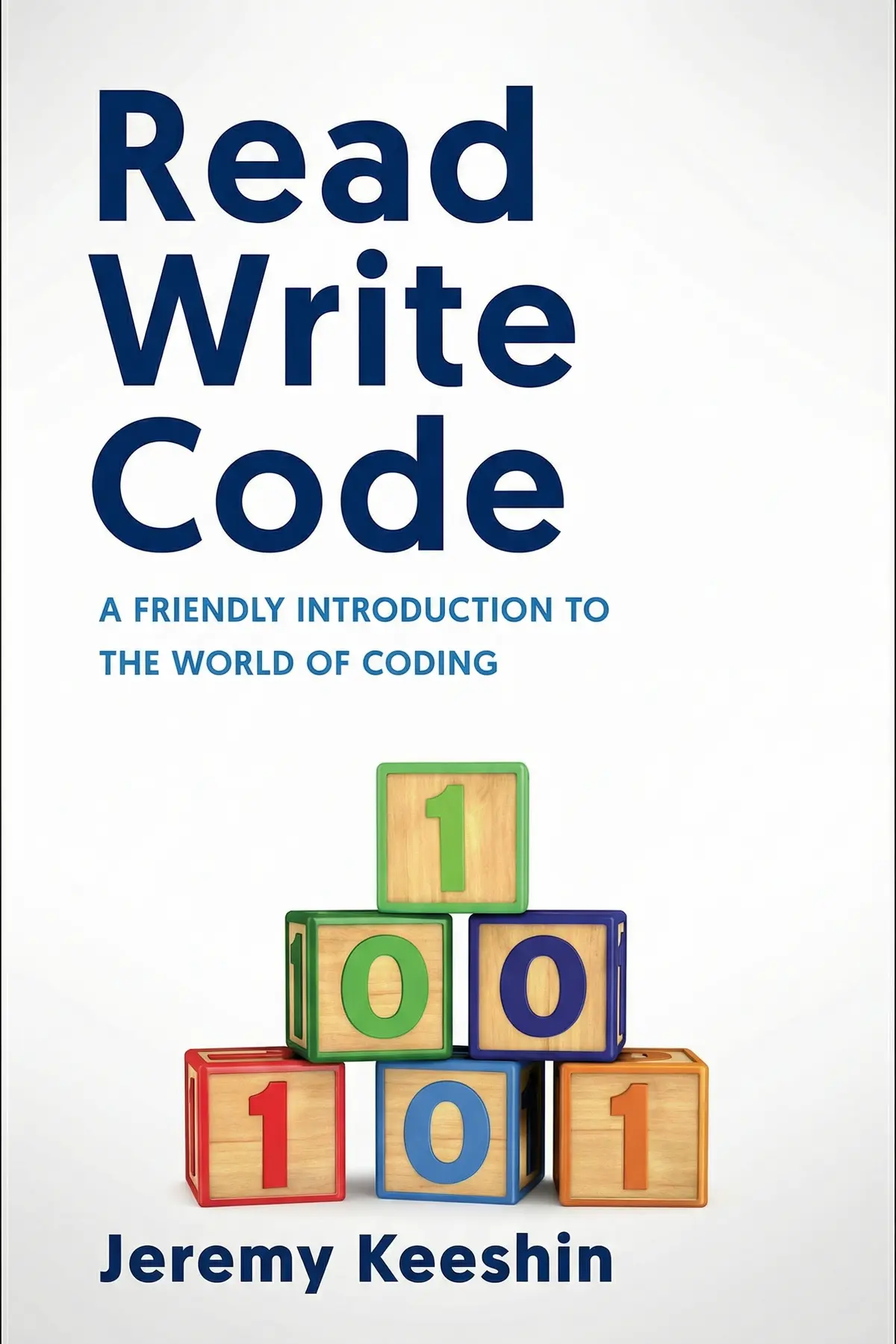
Table of Content
1. Introduction
1 min 07 sec
If talk of coding, algorithms or AI makes you nod along and hope nobody asks your opinion, the jargon may be the real obstacle. In Read Write Code, Jeremy Keeshin, who taught computer science at Stanford and now runs the school coding platform CodeHS, makes a simple opening claim: coding is just giving a computer exact instructions. He treats understanding it as a basic literacy, as ordinary and as necessary as reading and writing.
His throughline runs from the smallest unit to the largest. Bits become programs, programs become websites and cloud services, and data fed to programs becomes artificial intelligence. At every level, someone is either telling a machine precisely what to do or showing it enough examples to make a good guess.
Follow that thread and the tools you use daily stop feeling like magic. You gain the words to join a technical conversation, the habits programmers use to crack hard problems, and a calmer view of what AI can and cannot do.
2. Treat every app as a list of instructions
1 min 31 sec
Software, programs and apps sound like three different things, and the people who build them seem to speak another language. One simple picture of a tireless but very literal helper makes the whole subject far less intimidating.
3. See the 1s and 0s behind every photo
1 min 26 sec
A family video, a favorite song and a one-word text message seem to have nothing in common. At the deepest level of the machine, they are made of exactly the same material, and only two symbols are allowed.
4. Four building blocks sit inside almost every program
1 min 37 sec
Programs that guide traffic or recommend music look endlessly complicated. Strip them down and a handful of small structures keep appearing, and you probably already use most of them in your working day without calling them code.
5. Plan a hard problem like a programmer
1 min 34 sec
Your map app picks the fastest route home in an instant, out of countless possibilities. The method behind it, and the two habits programmers use before writing a single line, can help with problems that have nothing to do with computers.
6. What really happens when you type a web address
1 min 40 sec
Most people use a browser every day without knowing what it is or what it fetches. A one-minute experiment on any web page reveals the hidden layers that turn a short address into the screen in front of you.
7. Know where your photos and files really live
1 min 31 sec
The cloud sounds weightless, a convenient place somewhere above us. Keeshin describes something far more physical, and the convenience it offers comes with a trade-off most people accept without ever thinking about it.
8. Understand where AI stumbles on toddler-easy tasks
1 min 32 sec
Machines can scan oceans of data in seconds, yet a small child beats them at things that feel trivial. That odd gap reveals how artificial intelligence really works, and how to judge the next product that claims to think.
9. Prepare for automation without the panic
1 min 38 sec
Headlines about robots taking jobs and machines that outthink us make the future feel frightening. Keeshin’s view of what automation will really look like, and what today’s AI actually is, points to a more practical response than fear.
10. Conclusion
1 min 12 sec
Keeshin’s book adds up to a firm reassurance. Technology looks mysterious mainly because of its vocabulary. Strip that away and the same pattern repeats at every level: tiny bits, exact instructions, structures that repeat and choose, plans that break hard problems apart, networks that carry pages and data, and, at the newest layer, systems that learn patterns from examples and play the odds.
Seeing that pattern is what he means by reading the digital world. It lets you notice where a tool is likely to fail, where your data has gone and what a claim about AI really rests on. Writing a little code is the natural next step, and the habits behind it pay off long before you open an editor.
Try some of them this week. Right-click a favorite website, choose Inspect and pick out its frame, its style and its behavior. Write your next difficult task as plain-English steps, then split it into pieces you can finish. And when a new AI tool impresses you, ask what it learned from.
The loyal assistant is already in your pocket. It has only ever needed clearer instructions.
About this book
What is this book about?
Many capable people go quiet when a conversation turns to code, algorithms or AI. Jeremy Keeshin argues the trouble is mostly vocabulary. Underneath the jargon, coding is giving a computer exact, step-by-step instructions, and he treats understanding it as a basic literacy, as necessary today as reading and writing. Keeshin builds the picture from the bottom up. He starts with bits and bytes, the binary units everything digital is made of, then moves to programming languages, functions, loops and the algorithms that find your fastest route home. From there he explains what a browser, a domain name and a web page actually are, where the cloud physically sits, and how artificial intelligence learns from examples instead of following scripts. Readers get the core vocabulary of computing in plain words, a few problem-solving habits programmers use every day, and a grounded view of AI, automation and jobs that replaces worry with understanding.
Book Information
Who it's for
Lost in tech talk
Professionals who feel lost when colleagues talk about code, the cloud or AI.
Weighing learning to code
Career switchers and students weighing whether to learn programming and wanting the basics first.
Managers working with developers
Managers and team leads who work with developers and want to follow their decisions.
About the Author
Jeremy Keeshin
Jeremy Keeshin is a co-founder and the CEO of CodeHS, an online platform that helps schools teach coding and computer science. Before starting the company, he taught computer science at Stanford, and his work today sits in computer science education and education technology. He has visited hundreds of schools around the world, and he is the author of Read Write Code. Outside work, he is a comedy fan, a juggler and a traveler.
Ratings & Reviews
Ratings at a glance

What people think
Listeners find the work highly effective for explaining programming and computer science topics in a straightforward, understandable manner. They like the informal narrative style and view it as a solid pick for any reader, while one listener mentions its particular value for students and teachers just beginning. They appreciate how it makes technology feel less daunting, and one review calls out the interactive coding exercises.
Top reviews
Harper
This book is the missing link for anyone who feels like technology is a black box. Keeshin doesn't just teach you how to type lines of Python; he teaches you how to think like a developer. I loved the analogy of the 'literal-minded assistant'—it perfectly captures why my programs used to crash constantly! The writing style is conversational and never condescending, making topics like binary and logic gates feel like common sense rather than rocket science. My only minor gripe is that I wish it dove deeper into specific languages toward the end, but as a primer, it’s unbeatable for gaining digital fluency.
Show moreTanawan
Picked this up on a whim and couldn't put it down. It’s rare to find a book that explains 1s and 0s without making your eyes glaze over. Keeshin makes the binary foundation of our devices feel tangible and interesting. I especially appreciated the transition from raw logic to actual applications like social media and search engines. The interactive feel of the examples kept me engaged throughout. If you've ever felt like the digital world was passing you by, read this. It’s empowering to finally understand the infrastructure behind the apps I use every single day. Truly an essential literacy tool.
Show moreChan
As someone who has always been curious about AI but terrified of the math, I found this book to be a total lifesaver. Keeshin explains machine learning as probability rather than magic, which was a huge 'aha' moment for me. The discussion on Moravec’s paradox—why robots struggle with 'easy' human tasks—was fascinating and grounded the whole AI hype in reality. The book is friendly, smart, and incredibly timely. It doesn't just tell you that coding matters; it shows you why digital literacy is the new standard for participating in society. A breath of fresh air for the tech-curious.
Show moreSau
Wow. This is the first tech book I’ve read that didn't feel like a dry textbook. Keeshin’s tone is like a friend explaining things over coffee. I’ve been trying to learn JavaScript on my own, but I lacked the 'big picture' context that this book provides. Understanding how databases work and how they feed into user experiences has made my own coding practice much more meaningful. It’s more than just a book about syntax; it’s about the philosophy of the digital age. It’s an essential read for anyone wanting to be a builder of the future, not just a consumer.
Show morePensuda
Finally, a book that treats coding like a basic literacy instead of an elite secret! Jeremy Keeshin does a brilliant job of showing that you don't need to be a math genius to understand how the internet functions. The way he discusses the future of work and the rise of automation is balanced—not alarmist, but realistic. This book empowered me to stop being a passive user of my devices and start thinking like a builder. Whether you’re a student, a teacher, or just a curious human, you need this. It makes the intimidating world of computer science feel completely approachable.
Show moreLaor
Ever wonder why a 'bug' is even called a bug? Jeremy Keeshin’s approach to demystifying the digital world is exactly what we need in an era where AI is everywhere. I’m a high school teacher, and I’ve already started using his explanations of IP addresses and domain names in my classroom. The way he breaks down complex systems into manageable chunks is masterful. However, to be fair, some of the sections on the 'cloud' felt a little too brief for my liking. Still, it’s a fantastic starting point for students or professionals who are intimidated by the word 'coding'.
Show moreThawee
The chapter on algorithms is worth the price of the book alone. Most people think algorithms are just scary math, but Keeshin shows they’re just logical steps, like a recipe. I loved the focus on pseudocode and problem decomposition. It helped me realize that I’m already using these skills in my daily life without knowing it! Truth is, the book can get a bit repetitive when talking about the importance of 'clarity' in code. We get it, machines are very literal! But that’s a small nitpick for such a solid, accessible resource for beginners looking to understand the modern world.
Show moreSofia
After hearing so much about the 'cloud,' it was nice to finally have someone explain that it’s just a bunch of physical servers in a giant building somewhere. Keeshin has a knack for stripping away the buzzwords and getting to the core of how data moves across the internet. The section on HTML and CSS was a great touch, as it gives you an immediate look at how the web is structured. I do wish there were more diagrams to illustrate the network paths, but the prose is clear enough to follow. It's a great bridge for non-techies to cross over into understanding.
Show moreTim
Not what I expected in terms of depth, but still quite useful for the right audience. Look, if you already have a computer science degree or work in IT, you’re going to find this way too basic. It’s definitely written for the absolute layperson. I found the sections on loops and conditional statements to be very clear, but I was hoping for more hands-on project ideas. It’s more of a 'theory of how things work' book rather than a practical 'learn to code in 30 days' manual. Good for my parents or a young student, maybe not for a power user.
Show moreKomsan
Frankly, I have mixed feelings about the pacing. On one hand, the explanation of how bits and bytes create images and music is the best I've ever read. It's clear and vivid. On the other hand, the section on memorizing password rules vs. passwords felt a bit dated and out of place compared to the more forward-thinking chapters on AI and AGI. I also found the middle chapters on programming languages a bit repetitive. It’s a decent primer for a total novice, but it might leave you wanting more if you have any existing tech background. Good, but not perfect.
Show moreQuestions about this book
What is the main idea of Read Write Code by Jeremy Keeshin?
Keeshin argues that coding is simply giving a computer precise, step-by-step instructions, and that understanding it is now a basic literacy alongside reading and writing. He builds the picture from binary bits up through programming languages, algorithms, the web, the cloud and artificial intelligence, showing that each layer is either exact instructions or patterns learned from data, and that anyone can grasp the essentials.
Who should read Read Write Code?
It suits beginners who feel intimidated by technical jargon: professionals who want to follow conversations about software and AI, students and career switchers deciding whether to learn programming, and managers who work with developers. It assumes no background and explains terms like bug, byte, loop, algorithm, domain name and machine learning in plain language.
How does Read Write Code explain artificial intelligence?
Keeshin describes AI as machines taking on tasks like planning, reasoning and understanding language, driven mainly by machine learning. Instead of following written steps, a system is given large amounts of data and builds mathematical models that find patterns and make predictions, which he says comes down to probability. He also explains Moravec’s paradox: skills that are easy for people, like recognizing faces, are often hardest for machines.
How can I apply the ideas in Read Write Code without becoming a programmer?
Borrow the programmer’s planning habits: write a hard task as plain-English steps, the way coders use pseudocode, then break it into smaller pieces you can solve one at a time. Right-click a web page and choose Inspect to see its HTML, CSS and JavaScript. And decide deliberately which files you store in the cloud, since that means keeping them on someone else’s computers.
Does Read Write Code say AI will take our jobs?
Keeshin expects automation to come mostly from software working behind the scenes, not physical robots. He notes that new technologies have always removed some jobs and created others, but many new roles now need highly specialized skills, making transitions harder. His answer is to learn how to cooperate with technology, above all by grasping how coding works, while accepting that current AI is built on data, probability and optimization.
Readers also enjoyed









AUDIO SUMMARY AVAILABLE
Listen to Read Write Code in 15 minutes
Get the key ideas from Read Write Code by Jeremy Keeshin, plus 5,000+ more nonfiction titles.
- 5,000+ titles
- Listen as much as you want
- 7-day free trial
- Cancel anytime









